
Share:

AI marketing & automation


Google Discover sends billions of clicks to websites every year, and most business sites never see any of them. The feed shows up when users open the Google app, swipe right on an Android home screen, or open a new tab in Chrome on mobile. No one types a query. Google decides what each person sees based on their interests, and it picks the sources.
This guide explains what Discover is, how it selects content, and the exact steps that make your site a candidate. It also covers the part most guides skip, which is how fast this traffic can disappear and how to pursue it without betting your pipeline on it.
Google Discover is a personalized content feed inside the Google app, the mobile Google homepage, and Chrome’s new tab page. It launched in 2018 and recommends articles, videos, and evergreen content based on each user’s interests and Web and App Activity. Unlike search, there is no query. Google predicts what someone wants to read and delivers it before they ask.
That prediction model changes how you optimize. Discover researcher Metehan Yesilyurt puts it simply: “Google Discover is predictive. It is trying to deliver content before you search.” You are not competing for a keyword position. You are competing to be the source Google trusts on topics your audience already follows.
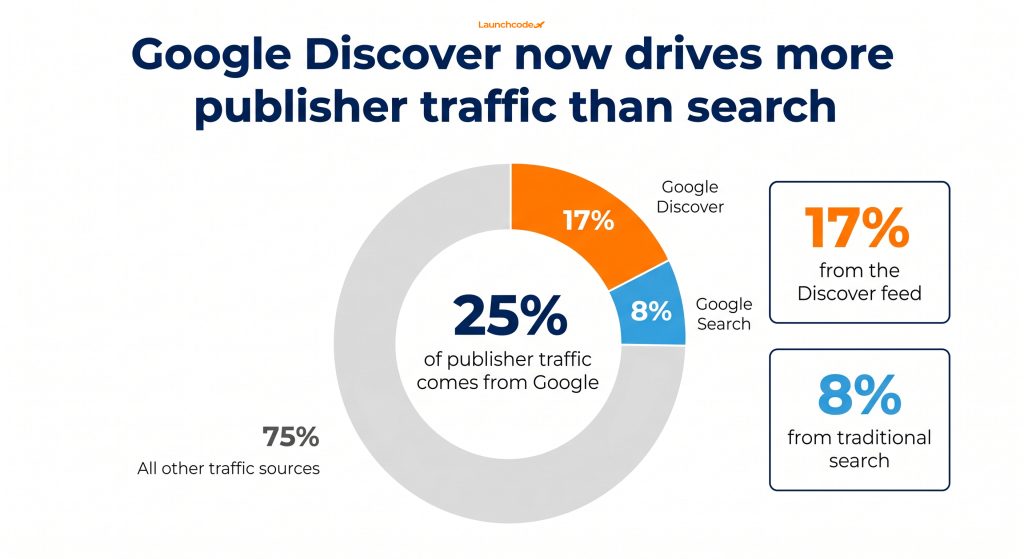
The scale justifies the effort. Chartbeat data reported by Press Gazette shows Google now drives about 25 percent of publisher traffic, split into 17 percent from Discover and just 8 percent from search. Across the Raptive publisher network alone, Discover generates around one billion clicks per year. Raptive serves independent creators and lifestyle sites, so this reach extends well past newsrooms.
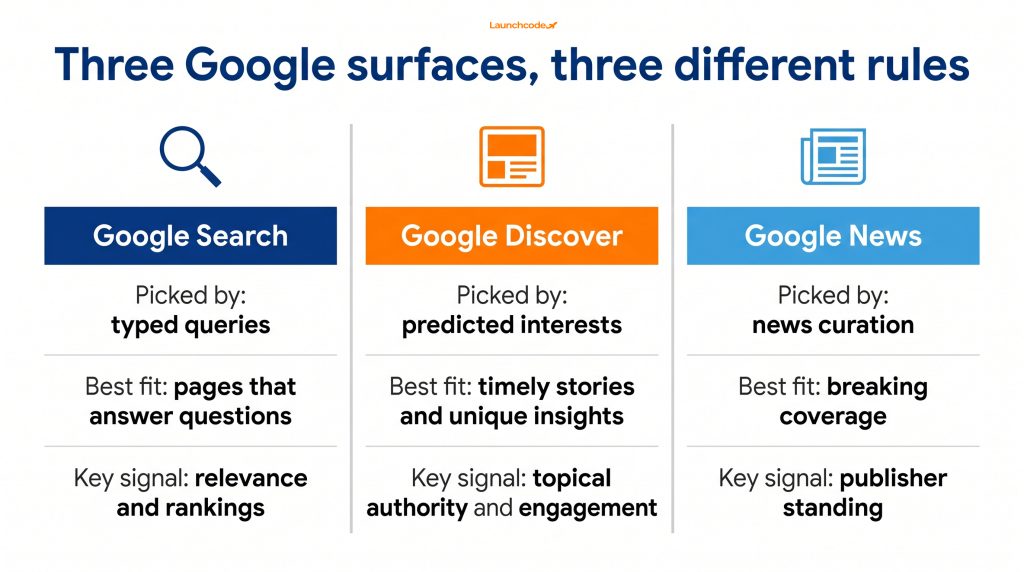
The three surfaces get confused constantly, and tactics that work on one do not transfer to the others.
| Surface | How content gets picked | Best fit | Key signal |
|---|---|---|---|
| Google Search | Matches a typed query | Pages that answer specific questions | Relevance and ranking signals |
| Google Discover | Matches predicted user interests | Timely stories, guides, and unique insights | Topical authority and engagement |
| Google News | Curated news surface | News organizations and breaking coverage | News quality and publisher standing |
Discover is not limited to news. Guides, analyses, expert commentary, and evergreen content all appear in the feed when they match user interests. Google’s documentation confirms that older content surfaces when it stays helpful and relevant.
Discover has been mobile only since launch, but that is changing. Google announced a desktop expansion at Search Central Live in Madrid on April 9, 2025. SEO consultant Brodie Clark first documented the feed appearing on the desktop homepage for accounts in Australia and New Zealand. As of late 2025, no full global rollout has been confirmed, so plan for mobile first and treat desktop as upside, not a forecast.
Discover selects content using many of the same systems Google Search uses to identify helpful, people-first content. There is no submission form and no special tag. Any page indexed by Google that meets Discover’s content policies is automatically eligible. Google is direct about the limits, stating that “being eligible to appear in Discover is not a guarantee of appearing.”
Selection comes down to a match between three things: the entities in your content, the demonstrated authority of your site on those entities, and the interest profiles of real users. When you publish consistently strong content about a topic and users engage with it, Google starts treating your site as a trusted source for that interest cluster. That trust compounds. Sites that appear in Discover regularly tend to keep appearing, while equally good one-off articles from unknown sources rarely surface.
Google revised its Discover guidelines in early February 2026 alongside a Discover core update. Reporting from Practical Ecommerce highlights two changes. Clickbait avoidance moved to the top of the guidance, signaling how heavily the update weighted it, and page experience became a named requirement. The message is clear. Headlines that exaggerate, withhold key information, or cater to outrage now carry real risk, and Discover manual actions can appear in Search Console when content violates policy.
Getting on Discover requires two layers of work. First, clear the technical eligibility bar, which includes indexed content, policy compliance, large images, and the max-image-preview:large setting. Second, earn selection by building topical authority, writing honest high-interest headlines, and publishing content with unique insight. The first layer takes a day. The second takes months of consistent publishing.
Here is the full process in order.
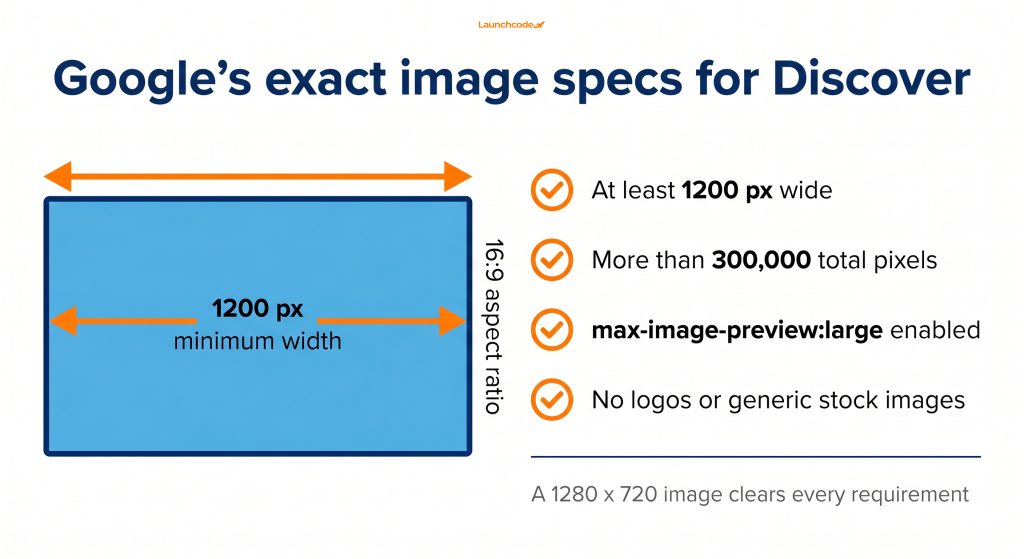
Discover is a visual feed, and weak images make your content nearly invisible in it. Google’s specifications are exact:
Most CMS platforms handle the meta tag through an SEO plugin in minutes. The harder discipline is editorial, which means commissioning or selecting a strong, relevant image for every post instead of reusing stock photos.
“We add max-image-preview:large through the SEO plugin on day one of every site build. It takes about five minutes, and more than half the sites we audit still do not have it.” Derick Do, Co-Founder and Chief Product Officer
The technical layer makes you eligible. Content strategy gets you picked. John Shehata, founder of NewzDash and former VP of audience development at Conde Nast, frames the challenge well: “Discover is the clearest test of editorial judgment in search.” There is no query to react to. You have to know what your audience cares about before they search for it.
In practice, that means three habits:
A B2B SaaS company, for example, will not appear in Discover with a generic feature announcement. A data backed analysis of a shift in its industry, published while interest is climbing, with a strong original image, is exactly the format the feed rewards.
Open Google Search Console and look for the Discover performance report in the left navigation. It shows impressions, clicks, and CTR for any of your content that appeared in Discover over the last 16 months. The report only appears once your site passes a minimum impression threshold, so if you do not see it, your content has not surfaced in the feed at meaningful volume yet.
The report includes Discover traffic from Chrome and tracks all surfaces where users interact with the feed. In GA4, Discover visits typically arrive as direct or google referral traffic, which hides them, so Search Console is the source of truth.
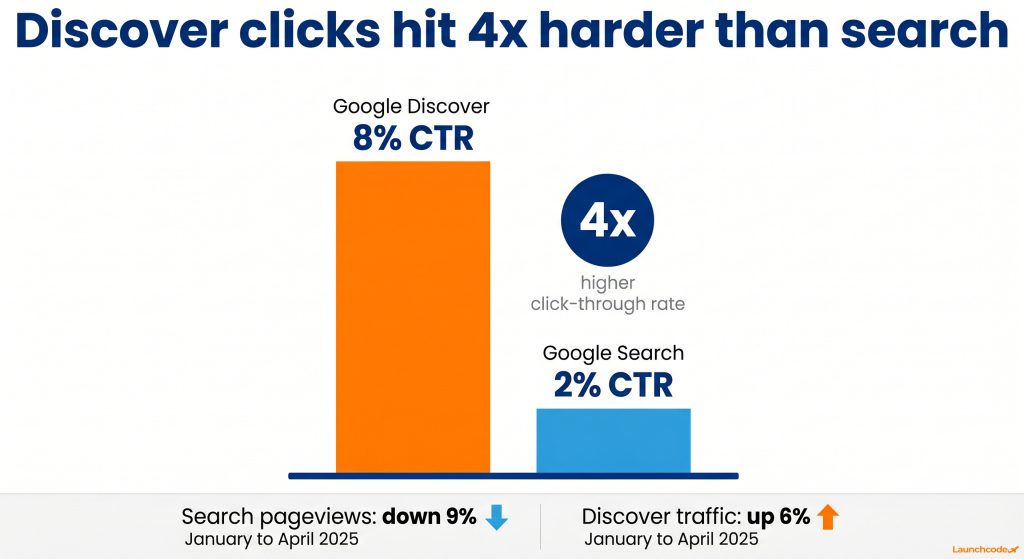
Discover CTR runs far above search. NewzDash analysis cited by Digiday measured an average 8 percent CTR in Discover versus 2 percent or less in Google Search during the first quarter of 2025. The same Chartbeat research tracked a 9 percent decline in Google Search pageviews from January to April 2025 while Discover traffic grew roughly 6 percent across more than 4,000 global sites.
Watch three things in the report:
“We read the Discover report as a topic audit, not a traffic report. If a piece pulls 40,000 impressions there, that cluster gets two more articles on next month’s calendar.” Tanner Medina, Co-Founder and Chief Growth Officer
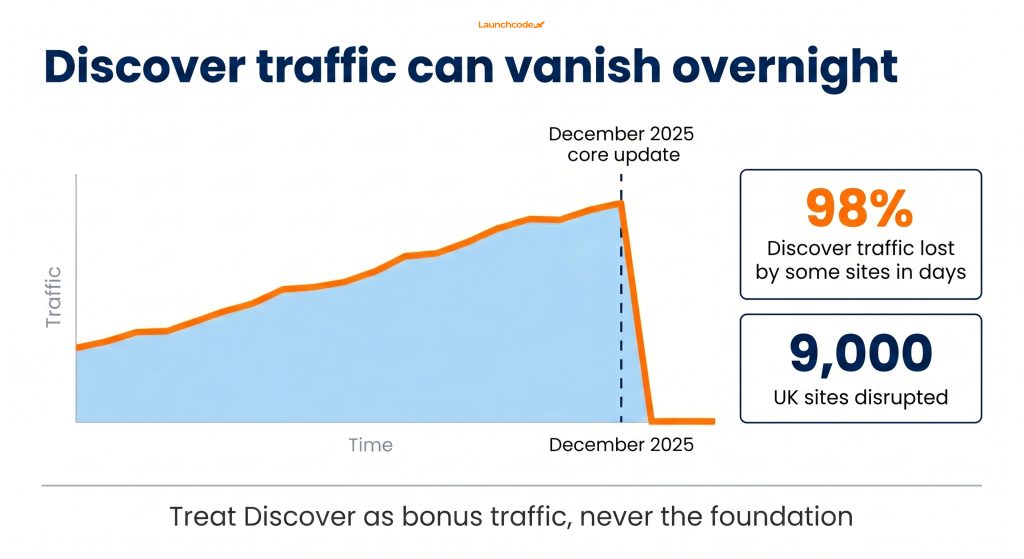
Discover traffic is real but unstable, and Google says so itself, describing it as less predictable than query-driven visits and advising sites to treat it as supplemental. The December 2025 core update proved the point. Publishers documented Discover losses between 50 and 100 percent within the first weekend, and multiple established sites reported 98 percent declines.
Barry Schwartz at Search Engine Roundtable documented the December collapse in detail, and reporting from 365i noted roughly 9,000 UK sites saw measurable disruption. Many were established publications with editorial teams and solid E-E-A-T. Their shared problem was not quality. It was dependency on a single channel Google controls directly.
Shehata, whose team has analyzed more than 200 million articles in Discover, advises teams not to over-rely on the feed because its traffic is volatile, and to treat it as a supplemental layer on top of core topical authority. His position from years of publisher work is blunt: “Google Discover and Google News are supplementary traffic to Google search.”
“Discover spikes look great in a monthly report until they vanish. We forecast pipeline on search, email, and paid, then log Discover as upside. That one rule has saved clients from some painful quarters.” Tanner Medina, Co-Founder and Chief Growth Officer
Treat Discover as a high upside bonus channel built on the same foundation as everything else that works in modern search. The work that earns Discover placement, which is entity-rich content, topical authority, real authorship, and strong page experience, is the same work that earns citations in AI Overviews and other generative engines. At Launchcodex, we fold Discover signals into the same content planning we run for SEO and GEO engagements, because the Search Console Discover report is one of the clearest views of which topics Google already trusts a brand to cover.
Start with the technical checklist this week. Confirm indexing, ship the max-image-preview:large tag, and fix your featured images. Then commit to one authority topic cluster for the next quarter and publish consistently against it. Measure in Search Console, expect volatility, and let Discover compound on top of a search strategy that does not need it to survive.
No. There is no submission process, special tag, or required structured data. Content that is indexed by Google and meets Discover’s content policies is automatically eligible, though eligibility does not guarantee appearance.
No. Google News is a dedicated news surface for publishers and breaking coverage. Discover is an interest-based feed that includes news along with guides, analyses, videos, and evergreen content from any eligible site.
Google recommends images at least 1200 px wide with more than 300,000 total pixels in a 16 by 9 aspect ratio, enabled by the max-image-preview:large robots setting. Generic images like logos hurt your chances.
Business sites can appear. Discover surfaces lifestyle content, guides, and expert analysis along with news. The requirement is genuine topical authority and content tied to interests users actually follow, which is harder for thin corporate blogs.
Core updates regularly shift Discover distribution, and the changes can be severe and fast. The December 2025 update cut some sites’ Discover traffic by 98 percent within days. Review the latest update guidance, audit headline and content quality, and check Search Console for manual actions.


Real stories from the people we’ve partnered with to modernize and grow their marketing.