


Performance marketing pillar: What it is and how it works
A practical guide to performance marketing covering payment models, channels, attribution, AI automation, and first-party da...





Most companies running paid campaigns can tell you how much they spent last month. Few can tell you which channels drove qualified revenue, what each customer cost to acquire across the full journey, or whether their current budget allocation is actually the most efficient one. That gap is where performance marketing either succeeds or fails.
This article explains what performance marketing is, how the core payment models work, which channels belong in a serious performance stack, and what it takes to measure campaigns accurately in 2026. It also covers the parts most guides skip: how attribution breaks in practice, how AI has changed execution, and why the brands with the lowest acquisition costs treat brand and performance as a single system.
Performance marketing is a results-based digital advertising model where advertisers pay only when a specific, pre-defined action occurs. That action could be a click, a completed lead form, a sale, or an app install. Nothing happens on the advertiser's side until the outcome is confirmed. This model shifts financial risk away from the brand and toward the publisher, network, or platform delivering the result.
Ready to grow your organic traffic?
Get a free SEO audit from the Launchcodex team.
Traditional advertising charges upfront. You buy a billboard, a TV slot, or a display impression and accept that some percentage of the audience will convert. Performance marketing inverts that logic. You define what a result looks like, set a price you are willing to pay for it, and only spend when you get it.
The model aligns marketing spend directly with business outcomes, which explains why 62% of marketing professionals worldwide now call performance-driven paid media their most critical investment, even as macroeconomic pressure forces tighter budget decisions. It is also easier to defend in a budget conversation and easier to scale when it is working.
Traditional advertising is an awareness play. Performance marketing is an outcomes play. The two are not mutually exclusive, but they operate on different measurement timelines and success criteria.
With traditional media, success is measured by reach, frequency, and brand lift over weeks or months. With performance marketing, success is measured by cost per action, return on ad spend, and conversion volume in real time. Campaigns can be paused, scaled, or reallocated within hours based on what the data shows.
A common misconception is that performance marketing only belongs at the bottom of the funnel. In reality, it operates across all stages. Data from Keen's 2024 Marketing Insights Report shows enterprise brands allocated up to 79% of spend to top-of-funnel efforts in 2024, with mid-market brands shifting toward a 70/30 split between upper and lower funnel in 2025. Performance channels like YouTube, programmatic display, and connected TV now support awareness goals with measurable impression-to-conversion attribution.
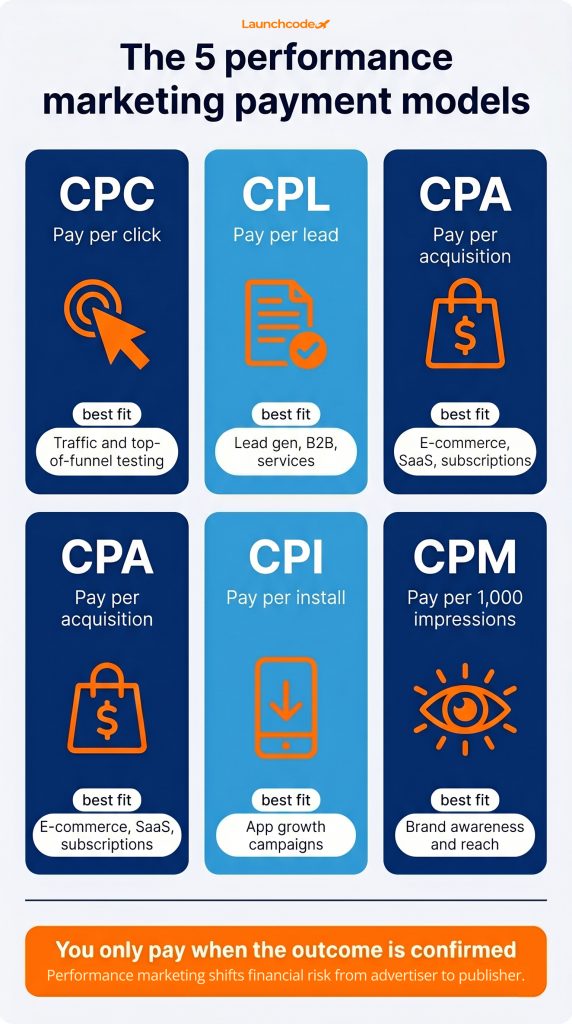
The payment model determines what you pay for and when. The five core models are cost per click (CPC), cost per lead (CPL), cost per acquisition (CPA), cost per install (CPI), and cost per thousand impressions (CPM). Each model distributes risk differently between the advertiser and the publisher. Choosing the right model depends on your campaign goal, your funnel stage, and how clearly you can define and track the target action.
Here is how each model works in practice:
| Payment model | What triggers payment | Best fit | Watch out for |
|---|---|---|---|
| CPC | Each ad click | Traffic, brand awareness, top-of-funnel testing | High click volume with low conversion if the landing page is weak |
| CPL | Each qualified lead generated | Lead generation, B2B, services | Lead quality varies; define what qualifies as a lead before launch |
| CPA | Each completed sale or conversion | E-commerce, SaaS trials, subscriptions | Requires a strong tracking setup to attribute accurately |
| CPI | Each mobile app install | App growth campaigns | Install volume can inflate without user activation |
| CPM | Every 1,000 ad impressions | Brand awareness, reach campaigns | Less suited as a pure performance model; results are indirect |
The model should match your measurable business outcome, not your channel preference.
If your goal is to fill a sales pipeline, CPL is the right model because it ties spend directly to lead volume. If your goal is revenue, CPA is more appropriate because it connects spend to transactions. If you are building an audience for a retargeting campaign, CPC or CPM may make sense as a first-touch tactic.
The mistake most teams make is defaulting to CPM or CPC across all campaigns without linking those metrics back to downstream revenue. Clicks are not customers. Impressions are not intent. The payment model should always trace back to a metric your finance team cares about.
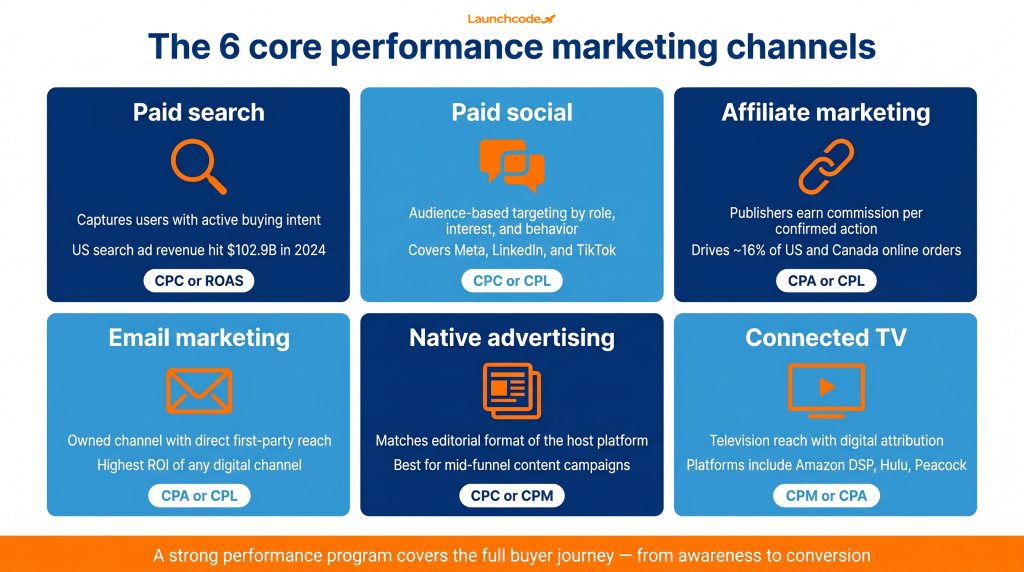
Performance marketing runs across six primary channel categories: paid search, paid social, affiliate marketing, native advertising, email marketing, and connected TV. Each channel has a different cost structure, audience intent profile, and attribution complexity. A strong performance program does not rely on one channel. It builds a multi-channel system where each channel covers a different part of the buyer journey.
The global digital advertising market is projected to exceed $786 billion by 2026, reflecting how central paid digital channels have become to growth strategies across every sector.
Paid search, primarily Google Ads and Microsoft Advertising, captures users at the moment they express intent. Someone searching for "CRM software for small business" is already in the market. Paid search places your offer in front of that demand. US search advertising generated a record $102.9 billion in revenue in 2024, making it the largest segment of digital ad spend globally.
Search campaigns typically run on CPC, though smart bidding strategies allow optimization toward CPA or ROAS targets directly. High-intent keywords in competitive verticals carry significant CPCs, which is why search works best when your landing page and conversion flow are already optimized.
Meta Ads (Facebook and Instagram), LinkedIn Ads, and TikTok for Business give performance marketers audience-based targeting rather than intent-based targeting. You reach people based on who they are and what they are interested in, not what they just searched for.
For B2B companies, LinkedIn Ads offer job title, company size, and seniority targeting that paid search cannot match. The CPL on LinkedIn is typically higher, but the lead quality for enterprise or SaaS audiences often justifies the premium.
TikTok and Meta are better suited to consumer brands, e-commerce, and awareness-stage campaigns that feed retargeting audiences.
Affiliate marketing is a performance channel where third-party publishers, creators, or partner sites drive traffic and conversions in exchange for commission. The advertiser only pays when the defined action occurs.
Affiliate has grown into a serious revenue channel. The global affiliate marketing market reached $17 to $18.5 billion in 2025, with US spending crossing $12 billion for the first time. Affiliate programs account for roughly 16% of all online orders in the US and Canada, a figure that challenges the assumption that affiliate is a secondary channel.
On the compliance side, the FTC finalized stricter disclosure rules in August 2024 requiring affiliates and influencers to clearly label any paid relationship. Violations carry civil penalties of up to $51,744 per offense.
Native advertising, served through platforms like Taboola and Outbrain, matches the look and feel of editorial content. It works well for content-driven campaigns targeting mid-funnel audiences.
Connected TV (CTV) is the fastest-growing entry point in performance media. Platforms like Amazon DSP, Hulu, and Peacock now provide impression-to-conversion attribution that linear TV never could. CTV lets performance marketers treat television-style reach as a measurable channel. Google extended this further in 2025 with the launch of Creator Partnerships inside Google Ads, which lets brands find YouTube creators aligned with their products, link content directly to ad campaigns, and track performance natively within the same platform managing their other paid media.
Attribution is the process of assigning credit for a conversion to the touchpoints that contributed to it. It answers the question: which channel, ad, or interaction influenced this customer to buy? Without accurate attribution, budget allocation is guesswork. You end up rewarding the channel that gets the last click rather than the channel that did the most work.
This problem shows up directly in the numbers. According to Madgicx's AI attribution research, performance marketers relying on last-click attribution models waste an estimated 30 to 40% of their ad spend on channels that receive credit they did not earn. On a $100,000 monthly media budget, that is up to $40,000 misallocated.
"We frequently see platforms claiming credit for sales the CRM does not recognize. The fix is almost always attribution infrastructure, not the campaigns themselves." Brittany Charles, SVP, Client Services
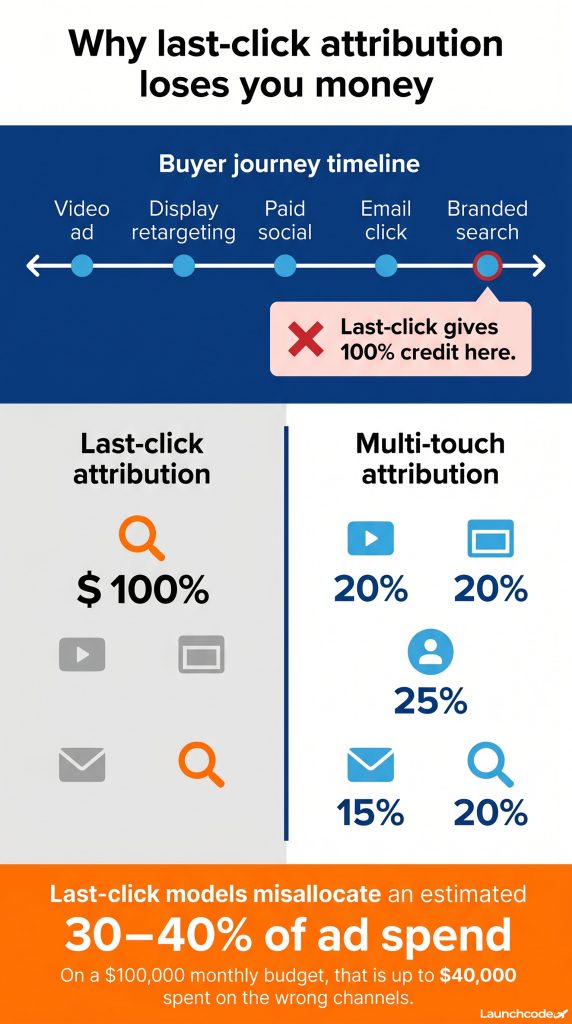
Last-click attribution gives 100% of the conversion credit to the final touchpoint before the sale. In most buyer journeys, that final touchpoint is branded search or direct traffic. But those sessions rarely exist in isolation. The customer saw a video ad, clicked a retargeting banner two days later, and then searched your brand name. Last-click tells you branded search drove the conversion. In reality, the video and retargeting campaigns did the work.
iOS 14.5 accelerated this problem by restricting cross-device tracking. Users who saw a Facebook ad on mobile and converted on desktop became invisible to platform-level attribution. The gap between platform-reported conversions and CRM-reported revenue is now a standard frustration for performance teams.
Multi-touch attribution (MTA) distributes conversion credit across multiple touchpoints based on their contribution to the sale. Common models include linear (equal credit to each touchpoint), time-decay (more credit to recent touches), and data-driven (credit weighted by statistical contribution).
For larger budgets and longer sales cycles, marketing mix modeling (MMM) uses statistical regression across historical spend and revenue data to estimate channel contribution without requiring user-level tracking. It is privacy-compliant by design and works well for channels that are hard to track directly, such as CTV, out-of-home, or podcast advertising.
The most practical improvement most teams can make is implementing server-side tracking through Google Tag Manager's server-side container or a dedicated server-side solution. This sends conversion events directly from the brand's server to ad platforms, bypassing browser-based ad blockers and privacy restrictions. Server-side tracking recovers 15 to 30% of conversion signals that would otherwise be lost. That recovery improves bidding algorithm accuracy and reporting reliability.
AI has moved from a feature inside ad platforms to the primary operating layer of performance marketing. Smart bidding, predictive audience modeling, dynamic creative optimization, and AI-driven attribution now handle tasks that used to require constant manual input. The marketer's role has shifted from operating campaigns to setting strategy, interpreting signals, and making decisions that automation cannot make on its own.
The AI in marketing market grew from $13.84 billion in 2024 to $16.59 billion in 2025, with a projected compound annual growth rate of 18.94% through 2030. That growth reflects real adoption across platforms, budgets, and team sizes.
Google's smart bidding system uses machine learning to adjust bids in real time based on hundreds of signals, including device, location, time of day, audience segment, and query context. Target CPA and Target ROAS bidding strategies optimize toward conversion outcomes rather than clicks. The system improves with more conversion data, which is why feeding it accurate first-party signals matters.
Meta's Advantage+ campaigns use similar AI-driven automation to dynamically allocate budget across audience segments, creative variants, and placements. Early adopters report meaningful cost-per-result improvements compared to manual targeting, though the tradeoff is reduced transparency into exactly who is seeing your ads.
AI-powered tools now build predictive audiences by analyzing behavioral signals and identifying users who match the profile of your highest-value converters, before those users express obvious intent. This shifts targeting from reactive to predictive.
Dynamic creative optimization (DCO) runs thousands of ad variations simultaneously, testing combinations of headlines, images, copy, and calls to action at scale. The system identifies winning combinations faster than manual A/B testing allows. The marketer's job becomes defining the creative inputs and setting the guardrails, not managing the tests.
Sandy Riev, author of the 2026 Performance Marketer Playbook, describes the shift directly: "The successful performance marketer in 2026 is a hybrid strategist operating at the intersection of technology, finance, and law. The era of siloed expertise is over."
That means understanding how bidding algorithms make decisions, where regulatory constraints apply, and how campaign data connects to financial outcomes. Knowing how to run ads is no longer the differentiator.
First-party data is information collected directly from your own audience, including email addresses, purchase history, on-site behavior, CRM records, and loyalty program activity. It is now the required infrastructure layer for all performance marketing. Campaigns that depend on third-party tracking have degraded measurement accuracy across every major browser, and that gap will not close. First-party data is the only targeting and measurement asset you fully control.
Google's April 2025 rollout of user-choice tracking controls in Chrome put the decision to allow or block cross-site data sharing in the hands of individual users. Combined with Safari's Intelligent Tracking Prevention and Firefox's privacy defaults, third-party cookies now appear on a fraction of ad requests compared to five years ago.
Building a first-party data asset takes deliberate collection systems, not just a privacy policy update.
For teams building out this infrastructure, our data infrastructure services cover the full stack from first-party data collection to CRM integration and cross-channel reporting.
Brands that run performance marketing without parallel brand investment pay more per acquisition over time. Brand awareness directly reduces cost per acquisition, and the relationship is quantifiable. According to a McKinsey analysis of US digital campaigns, moving from under 20% brand awareness to 40 to 60% awareness reduces CPA by an average of 35%. According to 2024 WARC data, brands with established awareness achieve 30 to 50% lower customer acquisition costs than unknown competitors.
The mechanism is direct. Recognized brands require fewer ad impressions to drive conversions. Users who already know you trust you faster. Quality scores improve. Conversion rates improve. Every performance metric gets cheaper when brand equity does its job.
Jon Evans, CMO at System1 Group, stated this in a 2024 Marketing Week interview: "The brand versus performance debate is a false dichotomy that holds marketing back. Every brand investment should be measured on commercial outcomes, and every performance campaign should build brand equity. If you are not doing both simultaneously, you are wasting money."
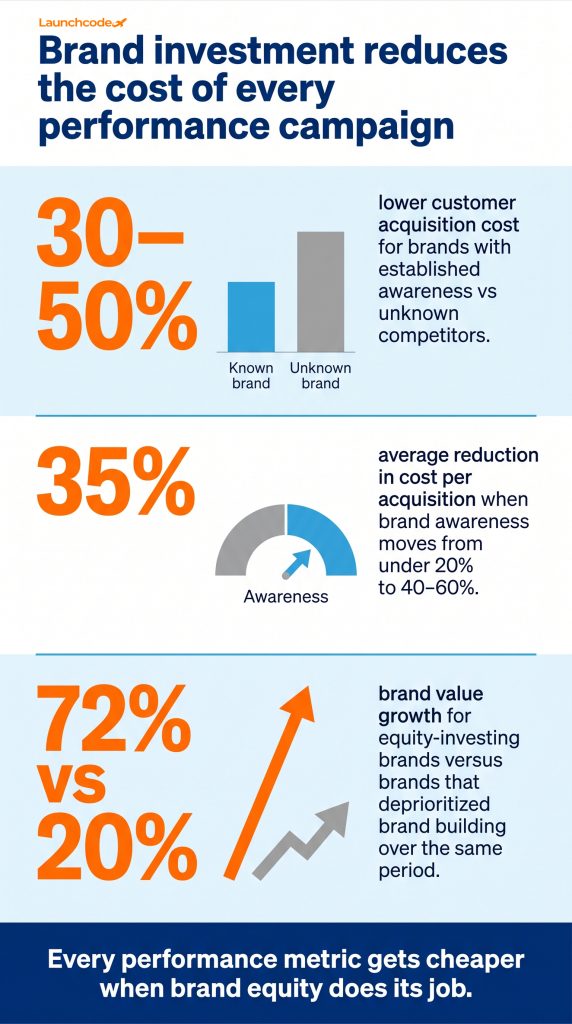
Kantar research published in The Branding Journal in 2024 found that brands with strong equity investment saw a 72% increase in brand value over the study period, while brands that deprioritized brand building grew by only 20%.
Marisa Thalberg, CMO at SeaWorld Parks and Entertainment, framed the budget politics at Adweek's Outlook 2024 event: "We are essentially implying that whatever is on the other side of the equation is what? Not performance. If you are a CFO, which are you inclined toward?" The framing of brand as the non-performance option is a budget argument that brand marketers keep losing, but acquisition cost trends over multi-year periods tell a different story.
Running brand and performance as a unified system does not require two separate teams or two separate budget pools. It requires shared measurement.
"The brands we see grow most efficiently stopped treating brand and performance as separate budget pools. Every campaign has a conversion metric and an awareness metric. Running them together is what keeps acquisition costs from climbing quarter over quarter." Tanner Medina, Co-Founder and Chief Growth Officer
The core metrics in performance marketing are ROAS (return on ad spend), CAC (customer acquisition cost), CPL (cost per lead), conversion rate, and LTV to CAC ratio. A 5:1 ROI is the widely accepted benchmark for good digital marketing performance, meaning $5 returned for every $1 spent. Benchmarks vary significantly by industry, channel, and funnel stage. Use them as directional reference points, not fixed targets.
| Metric | What it measures | Good benchmark | Watch for |
|---|---|---|---|
| ROAS | Revenue generated per dollar of ad spend | 4:1 to 8:1 depending on margin | Platform-reported ROAS often overstates actual revenue |
| CPA (cost per acquisition) | Cost to acquire one paying customer | Varies by LTV; target below 30% of first-order value | Will inflate if attribution is broken |
| CPL (cost per lead) | Cost to generate one lead | Highly variable by channel and market | Lead quality must be tracked, not just volume |
| Conversion rate | Percentage of visitors who complete the target action | 2 to 5% for paid search; 1 to 3% for paid social | Low rates often point to a landing page problem, not a channel problem |
| LTV to CAC ratio | Customer lifetime value relative to acquisition cost | 3:1 is the commonly cited baseline for sustainable unit economics | Requires clean CRM data to calculate accurately |
According to Sender's 2025 marketing ROI data, a 5:1 ROI is the broadly accepted standard for digital marketing performance. Top-performing campaigns often exceed that, but averages are pulled down by campaigns running without proper attribution or without conversion rate optimization on the destination.
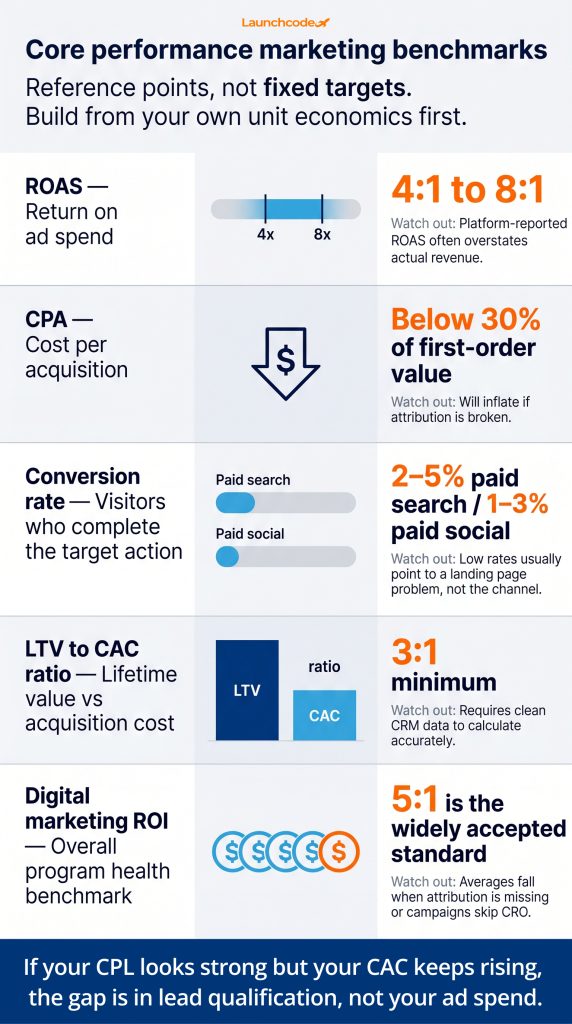
Benchmarks from industry reports are starting points, not goals. Build your targets from your own unit economics.
If your CPL looks strong but your CAC keeps rising, the problem is in the qualification rate or the handoff between marketing and sales. Fixing that closes the gap faster than cutting ad spend.
Performance marketing is a system. The brands and teams that get the most from it treat it that way: a connected set of channels, measurement tools, data assets, and feedback loops designed to improve over time.
The mechanics come first. Choose payment models that match your actual business outcomes, not the defaults your ad platform suggests. Build channel selection around your buyer journey. Invest in measurement infrastructure before scaling spend. Broken attribution makes every optimization decision unreliable.
Attribution is where most programs lose money. Server-side tracking and multi-touch models are not advanced strategies. They are the baseline for running performance marketing accurately in 2026. Without them, the numbers in your dashboards and the numbers in your revenue reports will keep diverging.
Add brand to the system. The McKinsey data on awareness and CPA reduction is an argument for treating brand investment as a performance lever with a longer payback window. Brands that integrate both under shared KPIs acquire customers at lower costs over time.
Treat AI as infrastructure. Smart bidding, predictive audiences, and dynamic creative are table stakes on the major platforms. The advantage now comes from the quality of the signals you feed into those systems: first-party data, clean tracking, and CRM integration.
If you want to see how these components work together as a managed program, explore our performance media services to see how we build and run performance systems for growth-focused brands.
Performance marketing is digital advertising where you only pay when a specific result happens. That result could be a click, a completed form, a sale, or an app download. You define the action, set a price for it, and the platform or partner only gets paid when it delivers.
CPA (cost per acquisition) is the cost to acquire a paying customer or completed sale. CPL (cost per lead) is the cost to generate a qualified lead, such as a form fill or sign-up. CPA measures further down the funnel and requires more robust tracking. CPL is often used in B2B campaigns where the sales cycle prevents immediate purchase.
Affiliate marketing is a type of performance marketing, but performance marketing is the broader category. It includes paid search, paid social, native advertising, email marketing, CTV, and affiliate programs. Affiliate marketing specifically involves paying third-party publishers or partners a commission when they drive a defined action.
A key indicator is a persistent gap between conversions reported by your ad platforms and actual revenue recorded in your CRM. If your Meta Ads dashboard shows 200 conversions this month but your CRM shows 120 new customers, your attribution has a gap. Other signs include ROAS that looks strong in-platform but does not show up in profitability reports, and branded search being credited for most conversions even when you are running large upper-funnel campaigns.
A 5:1 ROAS (five dollars returned for every dollar spent) is a commonly cited benchmark for good digital marketing performance. The right target depends on your product margins. A business with 70% margins can support a lower ROAS than a business with 20% margins and still be profitable. Build your target from your unit economics, then use industry benchmarks to sense-check where you land.
First-party data improves targeting accuracy, lookalike audience quality, and bidding algorithm performance. Uploading CRM lists to Google or Meta lets the platform match them to real users and find others who share similar characteristics. Feeding conversion events from your own server rather than a browser-based tag recovers signal that ad blockers and privacy settings would otherwise strip out, making campaigns more efficient without increasing spend.



A practical guide to performance marketing covering payment models, channels, attribution, AI automation, and first-party da...
Learn which link building tactics move rankings in 2026. Covers digital PR, HARO, linkable assets, anchor text strategy, and...
Google removed Business Profile messaging in 2024. In 2026, it returns as an AI chatbot that answers customers and hands off...