
How tattoo artists get found on Google and AI search
Learn how tattoo artists rank in Google's local map pack and get recommended by AI tools like ChatGPT and Perplexity in 2026...


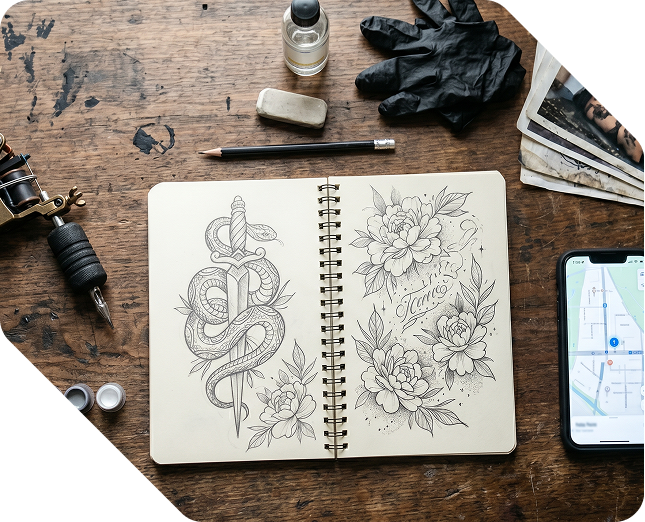


Instagram built your following. Word-of-mouth filled some early slots. But over 85 percent of clients look up a tattoo artist online before they ever send a message or fill out a booking form. That search starts on Google, and increasingly it starts inside AI tools like ChatGPT and Perplexity. If your studio does not show up clearly in both places, you are invisible to a large share of clients who are ready to book right now.
This article explains exactly how discovery works across Google's local map pack and AI search in 2026, and which steps produce results. Just the mechanics, the data, and a clear path to more visibility.
Most tattoo searches happen on Google and AI tools before anyone lands on Instagram. According to BrightLocal research cited by Dingg, 93 percent of consumers used the internet to find a local business in the last year, with 34 percent searching every single day. For tattoo artists, that means the person looking for a fine line specialist in your city is almost certainly starting with a Google search or an AI prompt, not a hashtag scroll.
Ready to grow your organic traffic?
Get a free SEO audit from the Launchcodex team.
The US tattoo industry reached $1.3 billion in market size in 2026 with nearly 24,000 registered businesses, according to IBISWorld. That is significant competition for the same local client pool. The artists who rank in the map pack or appear in an AI-generated recommendation have a structural advantage that is hard to overcome through social media alone.
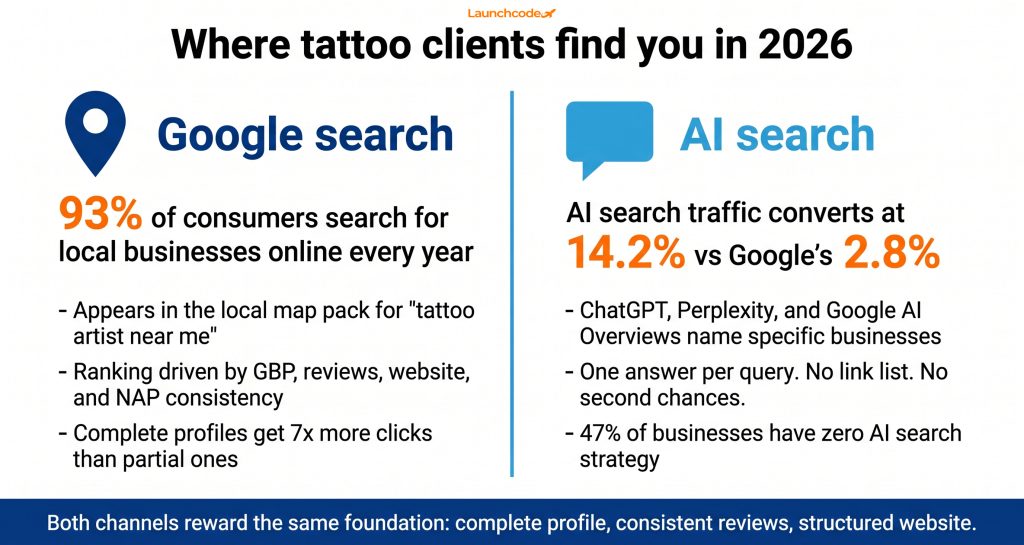
Tattoo discovery in 2026 runs across two parallel channels.
The first is Google search, specifically the local map pack. That is the block of three business listings that appears at the top of results when someone searches "tattoo artist near me" or "blackwork tattoo studio Denver." Ranking here depends on your Google Business Profile, reviews, your website, and your citation consistency across the web.
The second is AI-powered search. Tools like ChatGPT, Perplexity, and Google AI Overviews answer discovery queries directly, naming specific businesses. These platforms do not return a list of links for the user to browse. They give one answer. If your studio is not that answer, the lead disappears entirely.
Both channels reward the same core work: a complete and accurate online presence, a website structured for search, and consistent reviews. AI search adds one layer that most artists are missing.
Your Google Business Profile is the most important digital asset you control for local search. A complete profile gets seven times more clicks than a partial one, and photos alone increase direction requests by 42 percent. Google's algorithm uses your profile to decide relevance, and according to Whitespark's Local Search Ranking Factors survey, primary category scored highest out of 149 measured factors, making it the single most impactful local pack ranking signal.
Getting this right is not complicated, but the details matter. Most studios have a claimed profile with basic information. That is not the same as an optimized one.
"The tattoo artists we see ranking consistently are not always the most followed on Instagram. They are the ones who built a complete entity presence: GBP, reviews, style pages, and schema all working together." Tanner Medina, Co-Founder and Chief Growth Officer, Launchcodex
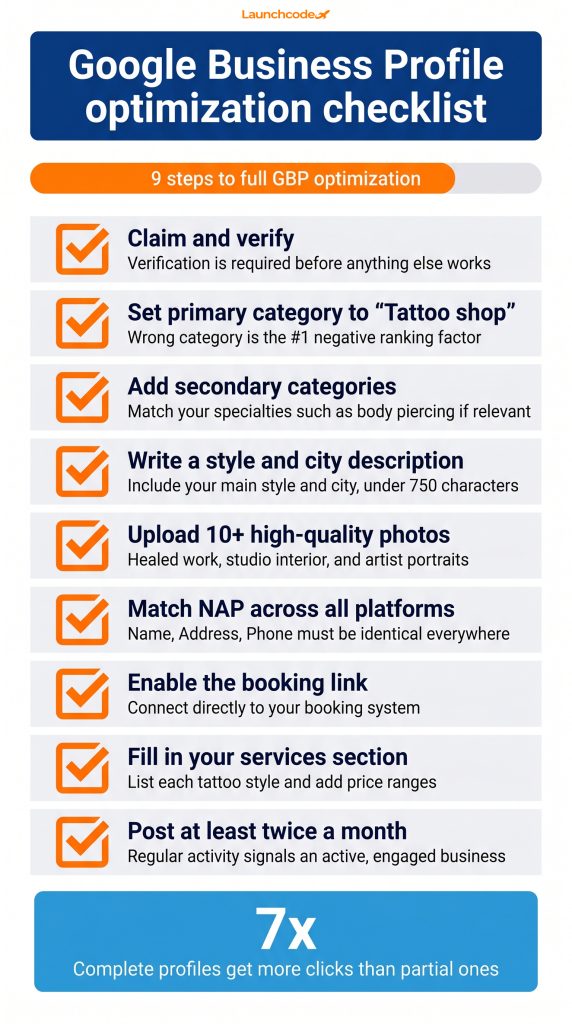
Follow these steps in order:
Three mistakes appear consistently in underperforming profiles:
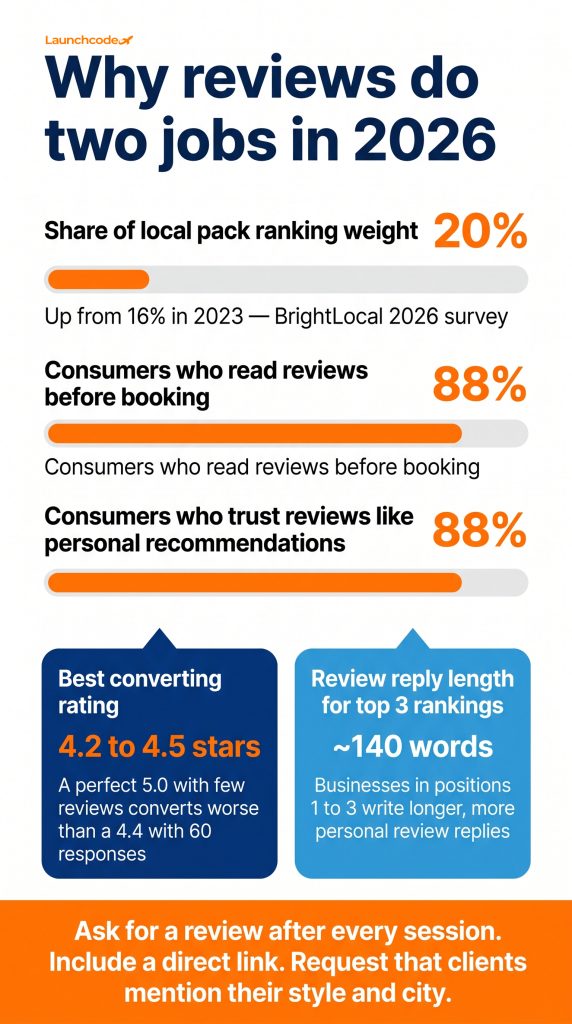
Google reviews now account for roughly 20 percent of local pack ranking weight, up from 16 percent in 2023, according to BrightLocal's 2026 Local Search Ranking Factors survey. They also serve as the primary trust signal AI systems use to evaluate and recommend a business. A studio with 80 recent, detailed reviews and consistent replies is significantly more likely to appear in both a Google map pack result and a ChatGPT recommendation than a studio with 12 reviews from two years ago.
88 percent of consumers read Google reviews before selecting a local business, and the same share say they trust online reviews as much as a personal recommendation from someone they know. Reviews are not optional. They are the most visible form of social proof you have.
Building reviews does not require aggressive tactics. It requires a repeatable process.
"The first question we ask new clients is whether their GBP category is set correctly and whether they are actively collecting reviews. Those two changes have moved studios from page two to the map pack in under 60 days." Brittany Charles, SVP Client Services, Launchcodex
The average rating that converts best sits between 4.2 and 4.5 stars, based on consumer research. A perfect 5.0 with only a handful of reviews converts worse than a 4.4 with 60 detailed responses. Volume and recency together build the profile that both Google and AI systems treat as authoritative.
Instagram is a discovery tool. It is not an SEO asset. It does not rank in Google's local pack. It does not feed structured data to AI systems. A dedicated website with properly structured pages, clear service descriptions, and technical optimization does all three. Digital portfolio use among tattoo artists has climbed 45 percent over the past three years (Bookedin, 2025), and the gap between artists with a strong web presence and those relying on social alone is widening fast.
Your website serves three functions for search and AI visibility: it signals authority to Google, it provides the content AI systems need to cite you, and it converts traffic into booked clients.
At a minimum, your site needs:
Instagram posts do not rank in Google's local search results. Your Instagram grid is invisible to ChatGPT, Perplexity, and Google AI Overviews unless those platforms can crawl a link back to your site. Social platforms also change their algorithms regularly. Your website is the one asset you fully control.
A single homepage targeting "tattoo shop near me" captures broad traffic. A dedicated page targeting "Japanese sleeve tattoo artist in Seattle" captures the client who already knows what they want, has identified a style, and is comparing artists to book. These style-specific landing pages are the most underused SEO tool in the tattoo industry, and they also provide exactly the kind of structured, specific content that AI systems cite when recommending a business.
The logic is direct. A client searching "fine line tattoo artist Brooklyn" is closer to booking than someone searching "tattoo shop." A page targeting that phrase, with portfolio images, a description of your process, pricing guidance, and a booking link, captures that intent in a way your homepage cannot.
Each style page should include:
The FAQ section on each style page does double duty. It satisfies human readers still in the research phase, and it provides the exact question-and-answer structure that AI systems extract and cite when answering queries like "how much does a fine line tattoo cost in Brooklyn."
A realism tattoo artist in Austin with dedicated pages for "realism portrait tattoo Austin," "black and grey realism Austin," and "animal realism tattoo artist Austin" does not just rank for three additional queries. Each page builds topical authority around realism tattooing in Austin, which reinforces the homepage and the GBP listing. Google and AI systems see a consistent, detailed, location-specific business, not a generic studio with a portfolio grid.
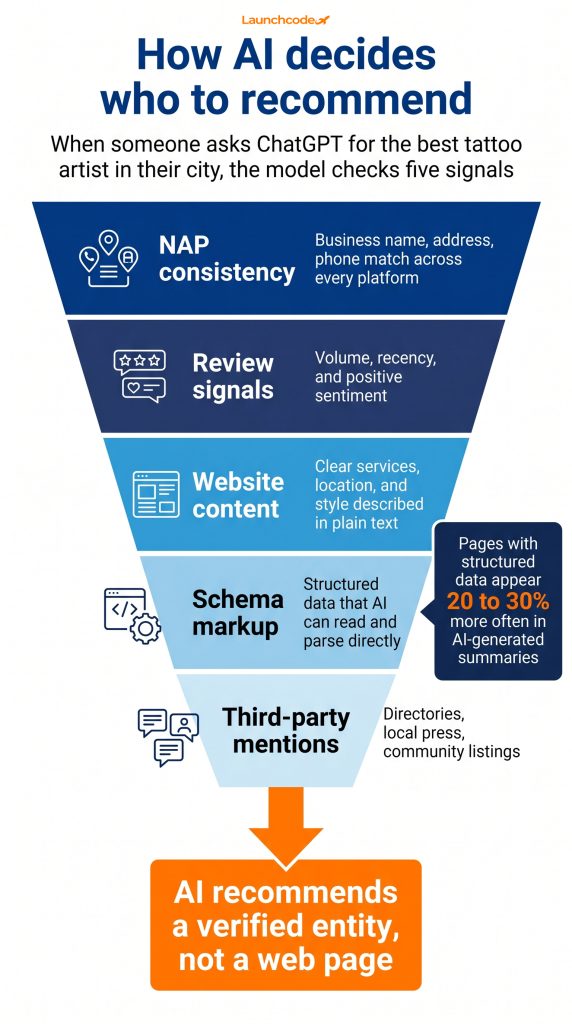
AI tools like ChatGPT, Perplexity, and Google AI Overviews do not recommend websites. They recommend entities. An entity is a recognized business with consistent, verified attributes across multiple sources: your website, your GBP, your reviews, your social profiles, and your directory listings. A studio with a strong entity presence gets recommended. One with a single Instagram profile and no other digital footprint does not appear.
Gartner projects traditional search volume will drop 25 percent by the end of 2026 as users shift to AI-generated answers, according to Slaterock Automation's 2026 GEO industry analysis. That shift is already underway. AI referral traffic to small business websites grew 123 percent in a short window in 2025. And when that traffic arrives, it converts. AI search traffic converts at 14.2 percent compared to Google's 2.8 percent, according to Exposure Ninja's 2026 benchmark data. Fewer clicks, but each one is far more likely to become a booked appointment.
Nearly 47 percent of businesses have no GEO (Generative Engine Optimization) strategy at all. For tattoo artists, that means most of your direct competitors are completely absent from AI-generated recommendations. The window to build early presence is still open.
When someone asks ChatGPT "who is the best realism tattoo artist in Denver," the model evaluates available information from across the web. It looks for:
As LovedByAI explains it, ChatGPT does not recommend a web page when someone asks for a local service provider. It recommends a verified entity. The same logic applies to your studio. If the AI cannot confidently identify and verify your business as a real, credible entity with a clear specialty and location, it will not recommend you.
Schema markup is structured data code added to your website that tells AI systems and search engines exactly what your business is, where it is, and what it offers. Pages with valid structured data appear 20 to 30 percent more often in AI-generated summaries than pages without it, according to 2025 benchmarks from Semrush and Measured.com. Content with FAQ and HowTo schema shows 30 to 40 percent higher visibility in AI-generated answers. For most tattoo artists, this one change makes a measurable difference.
Schema markup is added in a format called JSON-LD, which is now the standard across Google, Bing, Perplexity, and ChatGPT. Google officially recommends JSON-LD for AI-optimized content. Microsoft confirmed that schema helps their AI understand and cite content more accurately. You do not need to code this by hand. WordPress users can add it through Rank Math or Yoast SEO with no coding required.
Start with these four:
The JSON-LD block below shows how a tattoo studio would mark up core business information. Place it in the head section of your homepage:
{
  "@context": "https://schema.org",
  "@type": "TattooParlor",
  "name": "Studio Name",
  "address": {
    "@type": "PostalAddress",
    "streetAddress": "123 Main Street",
    "addressLocality": "City",
    "addressRegion": "State",
    "postalCode": "00000"
  },
  "telephone": "+10000000000",
  "url": "https://yourstudiowebsite.com",
  "openingHours": ["Mo-Sa 10:00-19:00"],
  "priceRange": "$$",
  "description": "Custom realism and fine line tattoos in [City]. Book online.",
  "aggregateRating": {
    "@type": "AggregateRating",
    "ratingValue": "4.9",
    "reviewCount": "87"
  }
}This block, placed in the head of your homepage, gives every AI system a machine-readable identity card for your studio. Plan for four to eight weeks after implementing schema before you see changes reflected in AI-generated responses. That is the typical re-indexing window.
For studios that want this full stack built and maintained, Launchcodex combines GBP optimization, style-specific content, and schema implementation as part of our SEO and GEO services.
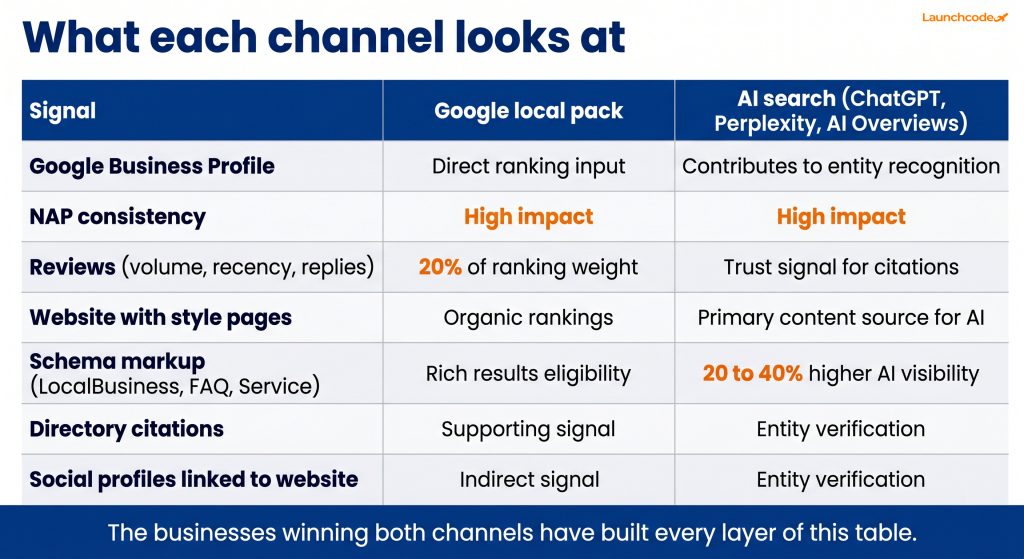
Building visibility across both Google and AI search is not a matter of doing one thing well. It is a matter of doing several connected things consistently. Here is how the signals fit together:
| Signal | Google local pack | AI search (ChatGPT, Perplexity, AI Overviews) |
|---|---|---|
| Google Business Profile | Direct ranking input | Contributes to entity recognition |
| NAP consistency | High impact | High impact |
| Reviews (volume, recency, replies) | 20% of ranking weight | Trust signal for citations |
| Website with style pages | Organic rankings | Primary content source for AI |
| Schema markup (LocalBusiness, FAQ, Service) | Rich results eligibility | 20 to 40% higher AI visibility |
| Directory citations | Supporting signal | Entity verification |
| Social profiles linked to website | Indirect signal | Entity verification |
No single element works in isolation. A complete GBP with no website will not rank consistently. A strong website with no reviews gets skipped by AI systems looking for trust signals. The businesses that lead both channels in 2026 have built all of these layers.
Start with the GBP. Verify it, complete it, and get the primary category right. Add reviews systematically. Build a website with at least three style-specific pages. Add LocalBusiness and FAQPage schema. Maintain NAP consistency across every directory listing you have.
That sequence, done well, puts you in the local map pack and on the shortlist for AI-generated recommendations. For most tattoo artists and studios, it is also a sequence that almost none of your direct competitors have completed.
Most tattoo studios with a complete GBP, active reviews, and consistent NAP start seeing map pack movement within 60 to 90 days. Competitive markets take longer. Style-specific pages on your website can begin ranking within 30 to 60 days for lower-competition style-and-city queries.
Yes. Instagram is not indexed for Google local search and does not feed structured data to AI systems. A website gives you a permanent, crawlable asset you fully control. It also allows you to add schema markup, build style-specific pages, and create a booking experience that social platforms cannot replicate.
Focus on entity consistency first. Your business name, address, and phone number must match across your website, GBP, and all directory listings. Add LocalBusiness schema to your website. Build review volume with detailed, recent responses that mention your style and city. Create FAQ content that answers common client questions. AI systems cite businesses they can confidently identify as verified, location-specific entities.
There is no fixed number, but research shows studios that cross the 10-review threshold see an initial ranking improvement. The more meaningful target is sustained velocity. Studios in the top three local pack positions maintain a consistent flow of new reviews each month. Aim for at least one or two new reviews per week with consistent replies.
GEO stands for Generative Engine Optimization. It refers to structuring your content and technical setup so AI platforms like ChatGPT, Perplexity, and Google AI Overviews cite and recommend your business. Traditional SEO focuses on Google's map pack and blue link results. GEO builds on that foundation with added emphasis on structured data, FAQ content, entity consistency, and answer-ready writing. In 2026, the two disciplines overlap significantly but are not identical.
Yes, indirectly. Your GBP contributes to your entity profile across the web. AI systems cross-reference your GBP data with your website, reviews, and directory listings to verify that your business is real, active, and credible. A fully optimized GBP adds confidence to that entity profile and increases the likelihood of AI citation.



Learn how tattoo artists rank in Google's local map pack and get recommended by AI tools like ChatGPT and Perplexity in 2026...
Build your first email nurture flow the right way. This guide covers trigger selection, sequence structure, segmentation, an...
Learn how to build an email list that actually grows. Covers lead magnets, form placement, segmentation, deliverability, and...