





How to optimize for each LLM: A GEO guide to ChatGPT, Perplexity, and Gemini
Generative engine optimization (GEO), sometimes called AI SEO, works differently on each engine. Here's how retrieval works ...





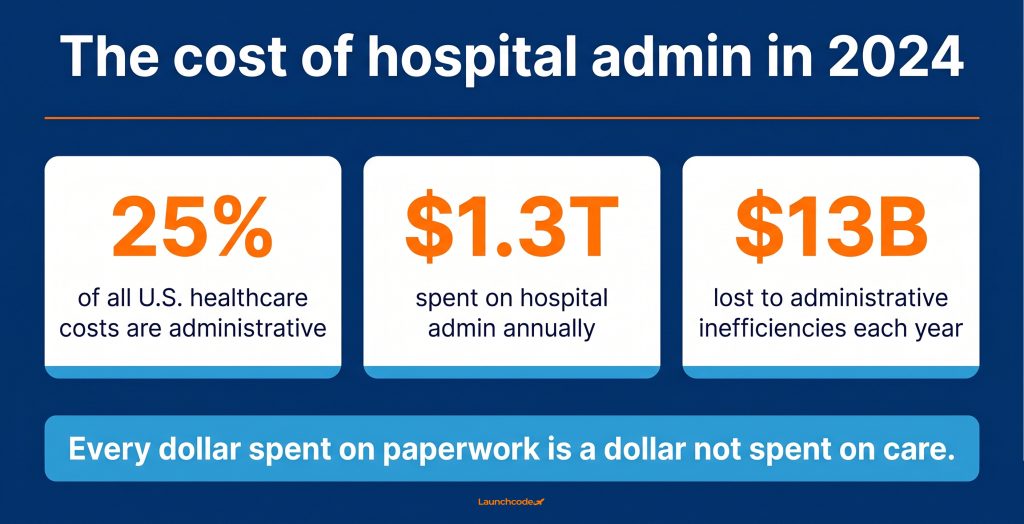
U.S. hospitals spend more than a third of their total budget on administrative work. That is not a rounding error. Administration accounted for roughly 25% of all U.S. healthcare costs in 2024, placing the total above $1.3 trillion. Every dollar spent on paperwork, manual scheduling, and claims rework is a dollar not spent on care.
This article explains where AI automation delivers proven results inside hospital operations, which use cases to prioritize first, and what compliance and change management requirements apply. Each section is grounded in recent data and real health system deployments.
Admin overload does not stay in the back office. When clinicians spend more time on documentation than on patients, care quality drops and burnout rises. A 2025 survey found that 62% of physicians were considering leaving medicine in 2024. By 2025, that figure fell to 28%, a shift that coincided directly with a significant rise in AI adoption for documentation. Fewer administrative hours means more time at the bedside.
Ready to grow your organic traffic?
Get a free SEO audit from the Launchcodex team.
Administrative inefficiencies alone generate approximately $13 billion in annual waste for the U.S. healthcare system. That figure does not include downstream costs like delayed discharges, avoidable readmissions, or the expense of replacing burned-out clinical staff.
Jennifer Holloman, Director of Health IT Policy at the American Hospital Association, stated it directly in a 2026 HealthTech Magazine interview: "If organizations are looking at cost containment, administration is one area of opportunity."
When a physician is in the EHR instead of in the room, patients notice. They get less face time. Follow-up instructions are rushed. Care coordination gaps widen. Removing administrative work that clinicians should never have been doing restores the capacity for the work that only they can do.
The right frame for hospital AI investment is not efficiency. It is care.
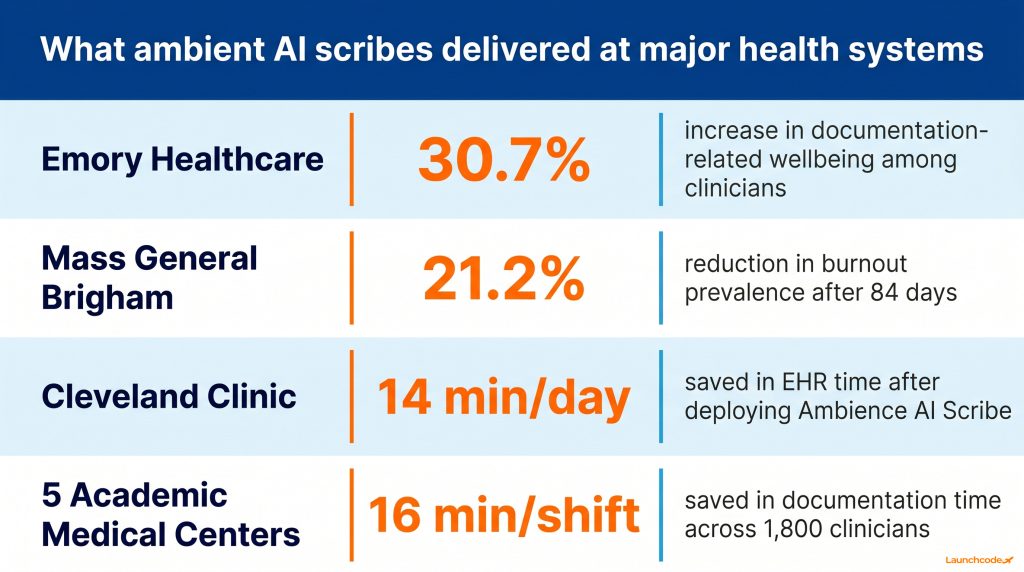
Ambient AI scribes listen to patient-clinician conversations and automatically generate a structured clinical note for physician review. A large study of 1,800 clinicians across five academic medical centers found that AI scribes saved 16 minutes of documentation time and 13 fewer minutes in the EHR per eight-hour shift. Deployed well, they reduce burnout, improve documentation accuracy, and give physicians more time with patients.
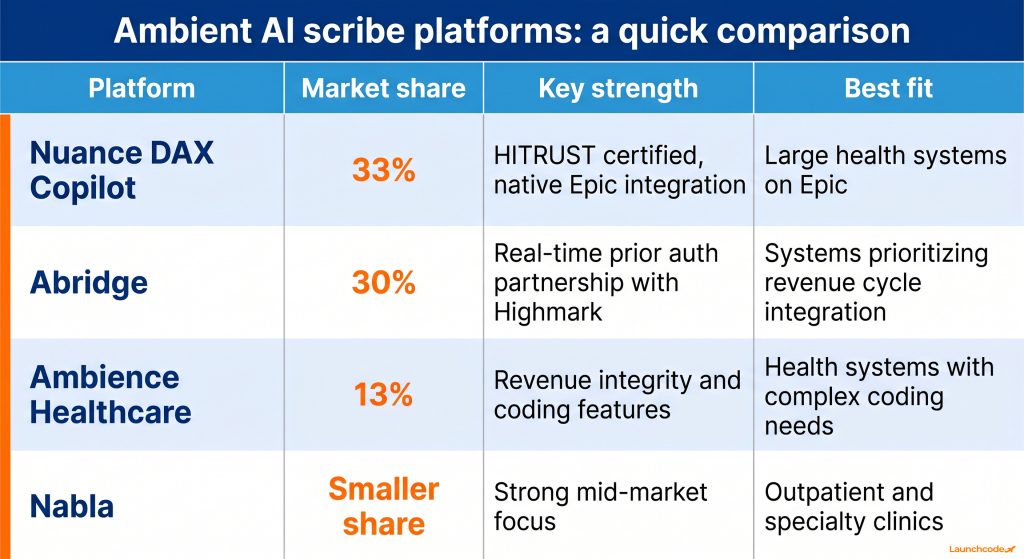
Ambient scribes are the fastest-growing category in healthcare AI. The market generated $600 million in 2025, a 2.4x year-over-year increase, according to Menlo Ventures. Three platforms dominate: Nuance DAX Copilot at 33% market share, Abridge at 30%, and Ambience Healthcare at 13%.
The results across major health systems are measurable. According to studies published in JAMA in 2025 and cited by the American Hospital Association:
Thomas Bentley, Chief Information and Digital Transformation Officer at Ohio State University Wexner Medical Center, described DAX Copilot as the catalyst in reducing EHR documentation burden, allowing clinicians to focus fully on patient care and improving the overall experience for both providers and patients.
Not all ambient scribes perform equally across settings. The first randomized controlled trial of ambient AI scribes, published in NEJM AI in 2025, found that results varied significantly by product: one solution cut documentation time by a meaningful margin while another showed minimal difference. Platform selection matters.
| Platform | Market share | Key strength | Best fit |
|---|---|---|---|
| Nuance DAX Copilot | 33% | HITRUST certified, native Epic integration | Large health systems on Epic |
| Abridge | 30% | Real-time prior auth partnership with Highmark | Systems prioritizing revenue cycle integration |
| Ambience Healthcare | 13% | Revenue integrity and coding features | Health systems with complex coding needs |
| Nabla | Smaller share | Strong mid-market focus | Outpatient and specialty clinics |
A multi-center study spanning five academic medical centers found that 15% of physicians assigned a scribe never used it during the study period. Deployment does not equal adoption.
Common failure points:
Before rollout, define a minimum adoption rate target. Assign an internal champion in each department. Build patient consent language into intake workflows from day one.
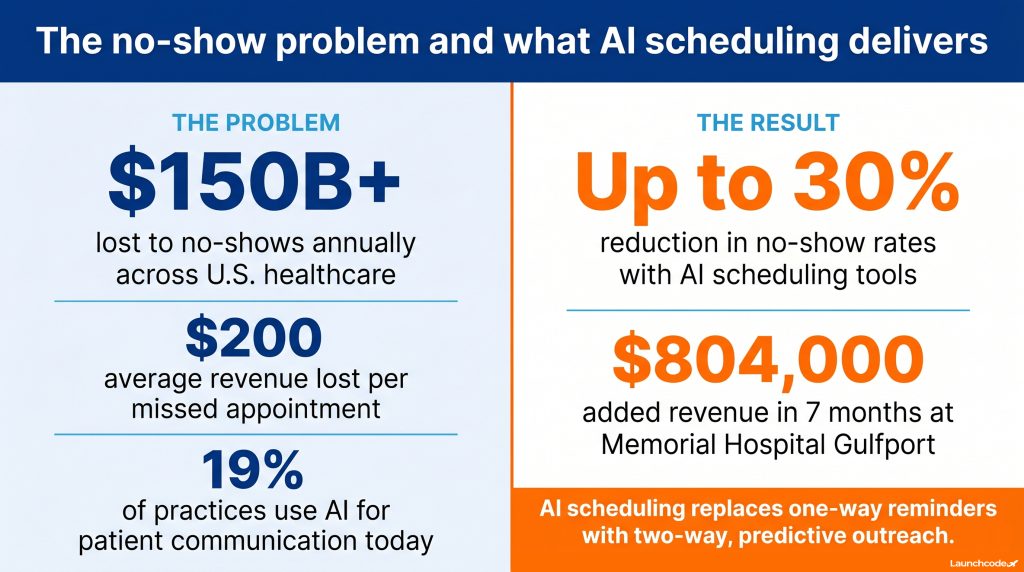
Missed appointments cost U.S. healthcare providers more than $150 billion per year, with each no-show averaging $200 in lost revenue. AI scheduling tools reduce no-show rates by up to 30% by analyzing patient behavior, predicting high-risk appointments, and automating proactive outreach. One documented case shows a 28% no-show reduction translated to $804,000 in added revenue in just seven months.
No-show rates affect every department and every margin line. The problem compounds: empty slots mean unused staff time, underutilized equipment, and patients who receive delayed care. Most hospitals still address this with a one-way SMS reminder. That is not enough.
AI scheduling systems work differently. They analyze historical data to identify patients who are statistically likely to miss. They reach out automatically with personalized rescheduling options. They confirm attendance through two-way communication rather than one-way notification.
According to Health Catalyst data cited in healthcare industry reporting, Memorial Hospital at Gulfport cut no-shows by 28% and added $804,000 in revenue in seven months, projecting more than $1 million annually from the improvement alone.
A complete AI scheduling workflow handles more than reminders. Here is what a mature deployment covers:
A U.S. Department of Health and Human Services ONC data brief found that hospitals using AI for scheduling automation rose from 51% to 67% in a single year, one of the fastest adoption rates seen across any administrative AI category in that period.
Claim denial rates above 10% now affect 41% of U.S. hospital providers, up from 30% in 2022. AI revenue cycle tools review documentation in real time, flag coding errors before submission, and automate prior authorization requests. Advanced platforms now achieve first-pass claim acceptance rates of 95%, reducing rework, appeals, and delayed reimbursement.
The denial problem is accelerating. Payers are deploying their own AI to review and reject claims faster than ever. Providers relying on manual processes are at a structural disadvantage.
According to a 2025 AI in revenue cycle management national survey published via BusinessWire, claims denial management and prior authorization are the two functions healthcare leaders most want AI to address, cited by 54% and 47% of respondents respectively. Nearly 46% of organizations already deploy AI in some RCM capacity, with another 49% planning to do so within 12 months.
A mature AI RCM platform operates across three stages:
McKesson's Glide platform learns from historical remittance data to predict which claims are at risk before they leave the hospital system. BDO's 2025 guidance for healthcare CFOs describes this shift as moving revenue cycle management from reactive correction to proactive prevention.
Dr. McGill at Community Health Network set a clear standard for AI investment: every dollar in the $10 million cost reduction target had to represent actual margin improvement, not soft savings.
Community Health Network used AI to schedule wellness visits, scrub charts, deflect inbound calls, and re-engage lost patients. The system generated $6 million in added revenue and tracked toward a $10 million cost reduction target in 2025, according to Becker's Hospital Review. That is a replicable model. The key was holding AI investment to the same financial accountability standard as any other capital decision.
"The hospitals getting real returns from AI automation are the ones who defined success in hard dollars before they signed a vendor contract. Soft metrics don't survive a budget review." Tanner Medina, Co-Founder & Chief Growth Officer, Launchcodex
Only 19% of medical practices currently use AI or chatbots for patient communication, despite strong patient demand for digital-first interaction. AI chatbots handle appointment booking, insurance questions, pre-visit preparation, and post-visit follow-up around the clock. One academic medical center saw a 47% increase in digital appointments booked after deploying an AI scheduling assistant.
Most patient communication still flows through overworked front desks and generic SMS reminders. Patients wait on hold. Questions go unanswered outside business hours. No-shows happen partly because rescheduling is too difficult.
A well-built patient communication system:
The April 2025 MGMA Stat poll found that only 19% of medical group practices use chatbots or virtual assistants for patient communication. Healthcare is running 5 to 7 years behind other service industries on digital-first communication. That gap is a competitive opening for health systems that move now.
Ambient recording and AI-assisted communication both raise consent questions that most hospital AI guides ignore entirely. Patient consent requirements for ambient AI tools vary by state. Some states require explicit verbal consent before recording begins. Others allow implied consent with proper disclosure at check-in.
Build consent language into intake workflows before deploying ambient scribes. For chatbots and voice agents, make clear in every interaction that the patient is speaking with an automated system and that a human is available on request.
Patients generally accept AI for scheduling and administrative tasks. They resist AI for clinical decisions. Draw that line clearly in your deployment design and communicate it openly. Transparency about where AI is used builds trust rather than eroding it.
Before any AI tool touches patient data, three compliance requirements must be in place: HIPAA authorization, a signed Business Associate Agreement with the vendor, and alignment with the HITRUST Common Security Framework. The top barrier to healthcare AI adoption is data security and privacy concerns, cited by 51% of RCM leaders in a 2025 national survey. Skipping this step creates legal, financial, and reputational exposure that no efficiency gain offsets.
HIPAA governs the privacy and security of all protected health information. Any vendor with access to patient data must sign a Business Associate Agreement before access is granted. That is a legal requirement, not a procurement preference.
HITRUST CSF consolidates requirements from HIPAA, HITECH, ISO 27001, NIST, and other standards into a unified control set. Nuance DAX Copilot, for example, is HITRUST certified and runs on Microsoft Azure with geographic data residency options. When evaluating any AI tool, ask vendors directly: does my data stay in a dedicated instance, or is it used to improve your model?
The top three barriers to AI adoption in healthcare revenue cycle, according to the 2025 Aspirion analysis, are:
Run through these steps before any new AI tool goes live in a clinical or administrative setting:
RAG architecture has become a standard recommendation for healthcare AI deployments. RAG grounds AI outputs in verified source documents rather than general model weights, reducing the risk of inaccurate outputs in documentation, coding, and patient communication contexts.
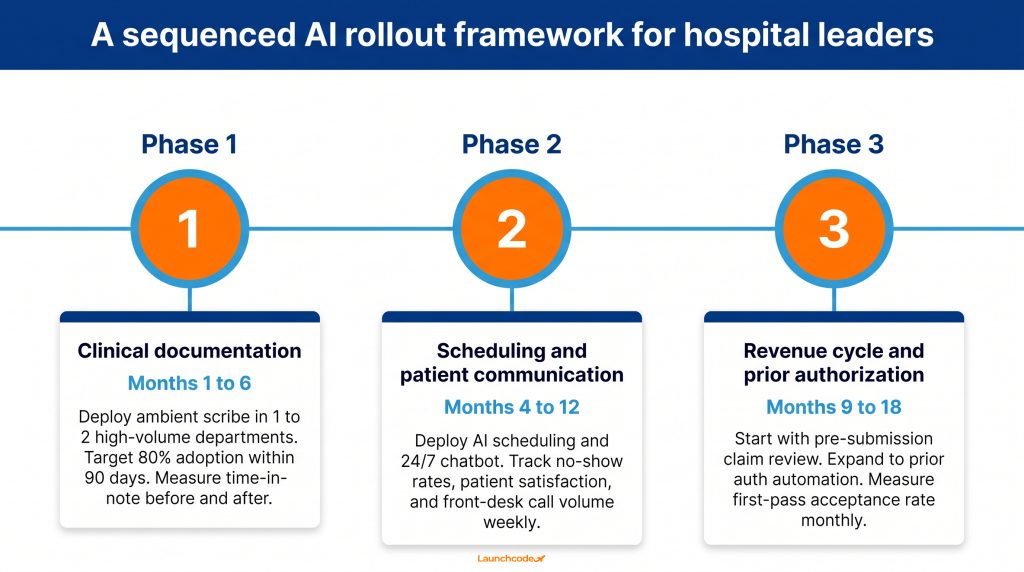
Start with clinical documentation, then expand to scheduling and patient communication, then move to revenue cycle. This sequence delivers the fastest visible ROI, builds clinical trust in AI tools, and generates the institutional knowledge needed to handle more complex use cases safely. Most health systems that succeed with AI begin with a single department, measure rigorously, and scale after proving results.
Every hospital faces different pressures, but the sequencing logic holds across most deployments.
Deploy an ambient scribe in one to two high-volume departments, typically primary care or a specialty with heavy documentation load. Set a clear adoption target, for example 80% of eligible encounters using the tool within 90 days. Measure time-in-note before and after. Use physician satisfaction data to iterate on onboarding. Establish patient consent workflows before go-live.
"Most failed healthcare AI pilots skip the sequencing. They try to automate everything at once, then wonder why adoption stalls. Starting with documentation in one department gives you a proof point that clinicians actually believe in." Derick Do, Co-Founder & Chief Product Officer, Launchcodex
Run AI scheduling alongside the documentation pilot. Use the trust built in phase one to expand patient-facing AI to the same departments. Deploy 24/7 appointment booking, pre-visit reminders, and post-visit outreach. Track no-show rates, patient satisfaction scores, and front-desk call volume every week.
Revenue cycle automation requires deeper integration with EHR and payer systems than documentation or scheduling. Start with pre-submission claim review and denial classification. Expand to prior authorization automation once the tool has been calibrated on your payer mix and procedure patterns. Measure first-pass acceptance rate monthly and tie results directly to finance reporting.
At Launchcodex, we work with organizations deploying AI across operational workflows that mirror this sequence, connecting automation systems, data infrastructure, and patient communication to drive outcomes that show up in the margin.
The Coalition for Health AI is developing assurance lab frameworks that hospitals can use to validate AI tools against clinical and operational standards before full deployment. Build that evaluation into your vendor process, particularly for tools that interact with clinical workflows.
Hospitals succeeding with AI automation share a few consistent behaviors.
They set hard ROI targets from day one. Not "improved efficiency" but specific numbers, tracked to the margin. They treat compliance as a design constraint, not a legal review at the end of procurement. They measure adoption rates alongside deployment rates and adjust onboarding when clinicians are not using the tools. They sequence their rollout rather than trying to automate everything at once. And they extend AI into the patient experience, not just the back office.
Robert McDermott, MD, founder of the Healing Intelligence Network, put the right frame on it in a Becker's Hospital Review interview: AI will never replace the physician-patient relationship because moments of vulnerability require human connectivity. What it does is remove the work that was never supposed to require a physician at all.
That is the goal. Removing administrative friction so your clinical team can spend more time on patients.
An ambient AI scribe listens to a patient-clinician conversation during a visit and automatically generates a structured clinical note for physician review. The physician reviews and edits the note before it goes into the EHR. It removes manual transcription and reduces the time clinicians spend in the electronic health record after patient visits.
Documented case studies show no-show reductions of 28% to 30% with AI scheduling tools. One hospital added $804,000 in revenue in seven months from a 28% no-show reduction. Results depend on how well the tool integrates with existing scheduling systems and how consistently outreach sequences run.
Any AI tool that processes protected health information must comply with HIPAA. The vendor must sign a Business Associate Agreement before accessing patient data. HITRUST CSF certification is the standard framework hospitals use to verify that vendors meet consolidated security and compliance requirements.
A first-pass claim acceptance rate measures the percentage of claims approved by payers on the first submission without denial or rejection. Advanced AI billing platforms have pushed first-pass acceptance rates to 95% in some deployments by flagging documentation gaps and coding errors before claims are submitted.
Start with clinical documentation using an ambient scribe in one or two high-volume departments. This builds clinical trust in AI tools, delivers visible results quickly, and generates the institutional experience needed to expand into scheduling, patient communication, and revenue cycle management.
Measure hard outcomes, not activity metrics. Track time-in-note before and after ambient scribe deployment. Track no-show rate change week over week for scheduling tools. Track first-pass acceptance rate and denial volume monthly for revenue cycle tools. If the number does not show up in the margin or in documented time savings, treat it as a pilot result, not a deployment result.




Generative engine optimization (GEO), sometimes called AI SEO, works differently on each engine. Here's how retrieval works ...
OpenSEO is an open-source SEO platform built for AI agents. See how its MCP server works with Claude Code, what AI visibilit...
See the 10 best WordPress SEO plugins with real AI automation. Compare features and pricing, then build a stack that ranks a...