




Local SEO for multi-location healthcare networks: A step-by-step guide
Local SEO for healthcare networks with multiple locations. Step-by-step framework covering GBP, location pages, NAP, HIPAA r...





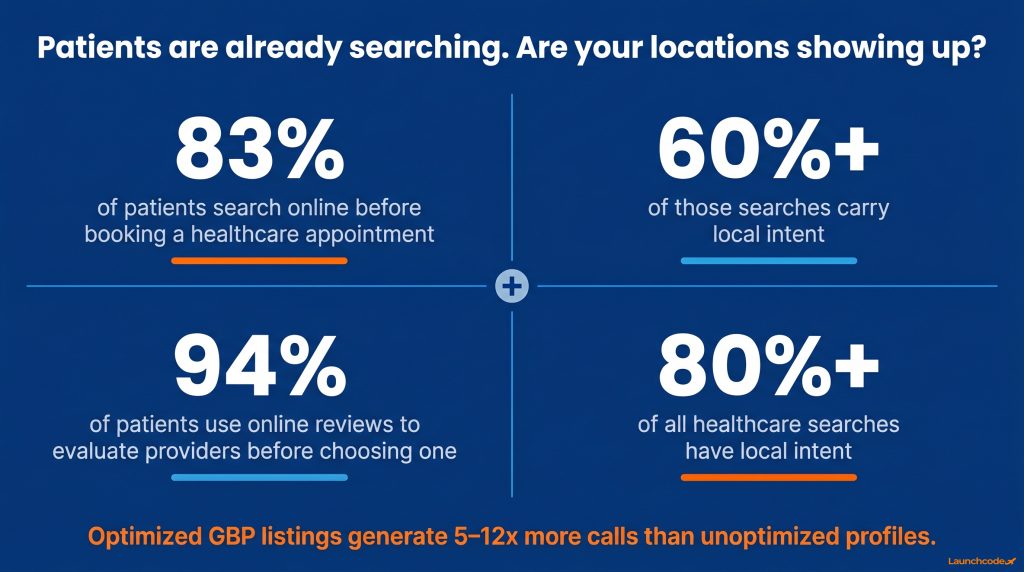
According to a 2024 PatientPop survey, 83% of patients search online before booking a healthcare appointment, and more than 60% of those searches carry local intent. If a location in your network does not appear in those results, patients do not wait. They click on whoever does show up.
The challenge for multi-location healthcare networks is rarely a lack of effort. It is a lack of system. GBP profiles fall out of date. Citation data drifts across directories. Location pages share copied content. Provider profiles go unmanaged for months. Each of these gaps erodes rankings quietly across the entire network until the cumulative loss becomes significant. This guide walks through eight steps to fix that and build a scalable, governed local SEO program that wins both Map Pack rankings and AI-generated answers.
Running local SEO for a multi-location healthcare network is fundamentally different from managing a single clinic. Each location competes in its own local market, needs its own optimized presence, and carries compliance requirements that standard local SEO frameworks do not address. At network scale, governance is the real differentiator, not tactics.
Ready to grow your organic traffic?
Get a free SEO audit from the Launchcodex team.
A single practice needs one Google Business Profile, one location page, and one review stream. A network of 10, 25, or 100 locations needs all of those multiplied, coordinated, and maintained over time. Providers join and leave. Phone numbers change. Office hours shift by season. Any change that does not reach all platforms creates NAP inconsistencies that reduce Google's confidence in each listing and quietly drag rankings down.
Healthcare adds compliance requirements most industries do not face. Responding to patient reviews requires HIPAA discipline. Content must meet Google's elevated standards for Your Money or Your Life topics. The September 2025 update to Google's Quality Rater Guidelines expanded YMYL definitions for health content specifically and raised the bar for what qualifies as authoritative, trustworthy material. Thin location pages and copied service descriptions create real ranking risk.
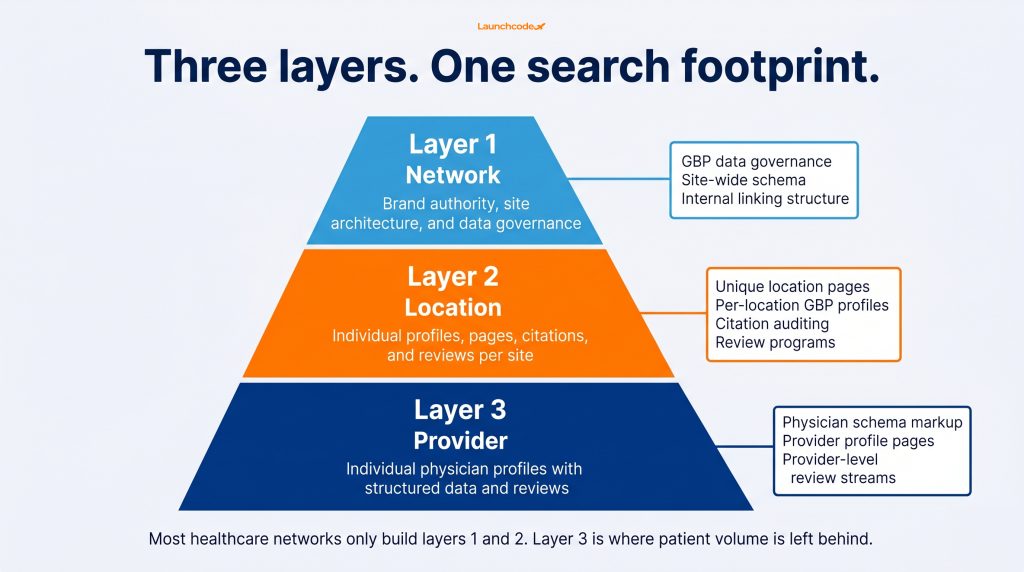
The most practical framework for multi-location healthcare local SEO works across three layers:
Most healthcare organizations invest in the network and location layers but leave the provider layer nearly untouched. That gap represents a significant volume of unearned patient discovery.
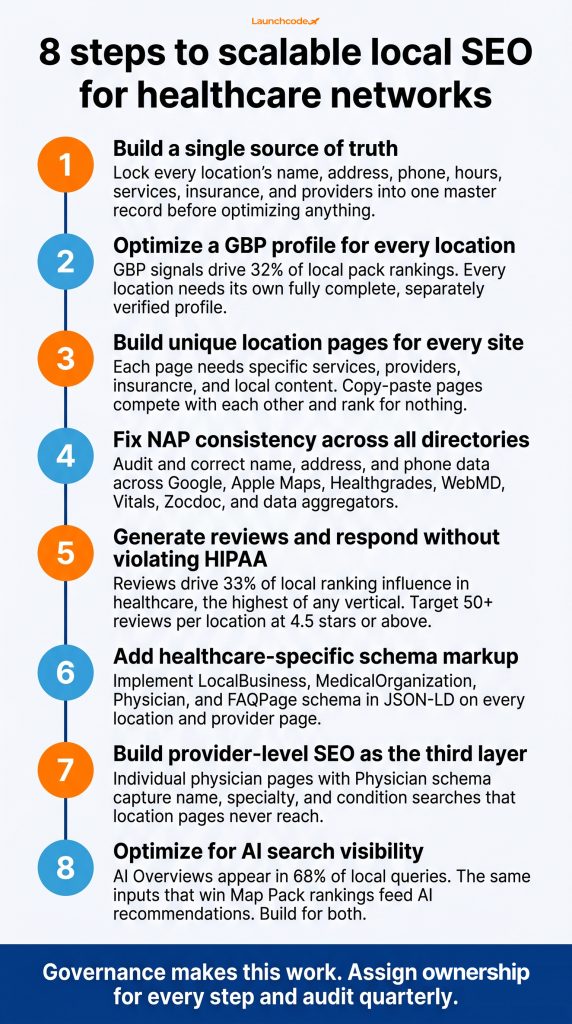
Before touching a GBP profile or publishing a location page, every location's core data must be locked into one central record. Name, address, phone number, hours, services offered, accepted insurance, and provider assignments all need to live in one place and push outward from there. Anything optimized before this step is built on a foundation that will drift.
As Birdeye's healthcare SEO team frames it, networks lose rankings because "location data drifts, provider info becomes outdated, and pages start competing with each other", not because of bad SEO technique. The fix starts with data governance, not more content.
Build a spreadsheet or database with these fields for every location:
Every update to any location's information starts here and pushes out to GBP, the website, and directories.
"The networks that struggle most are not short on effort. They are short on a system. No one owns the master record, so location data drifts across directories for months before it shows up as a rankings problem." — Tanner Medina, Co-Founder and Chief Growth Officer
| Tool | Best fit | Key function |
|---|---|---|
| Yext | Enterprise networks | Pushes NAP data to 200+ directories from one dashboard |
| Semrush Local | Mid-market teams | GBP insights, citation auditing, and rank tracking |
| Birdeye | Healthcare-specific needs | Reviews, listings, and HIPAA-aware workflows in one platform |
| Chatmeter | Large health systems | Used by hospital networks including Children's National and UPMC |
| BrightLocal | Agencies and multi-site teams | Local rank tracking and citation auditing |
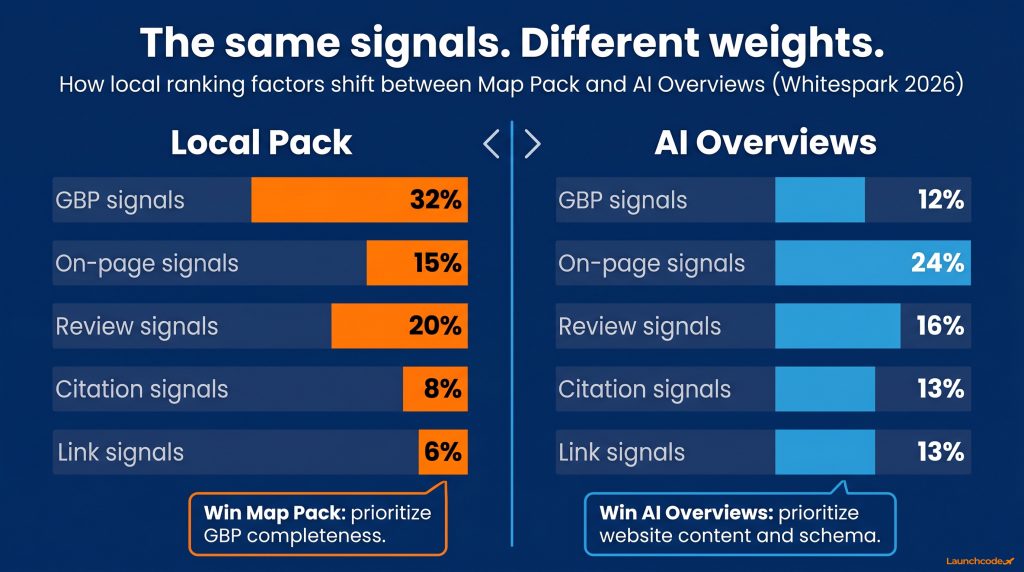
GBP signals account for approximately 32% of local pack ranking weight, making it the highest-leverage controllable factor for each location, according to the Whitespark 2026 Local Search Ranking Factors report. Eight of the top ten Map Pack signals come directly from GBP. Every location needs its own fully complete, separately verified profile. Sharing one profile across multiple sites is not a shortcut. It is a ranking ceiling.
Only 37% of medical professionals had fully set up their Google Business Profiles in a BrightLocal study. In most markets, a complete and actively managed GBP is still a genuine competitive advantage.
Each location needs a dedicated page on the main website with genuinely unique content. Copy-paste location pages hurt rankings because Google treats them as thin content, and they end up competing with each other for the same queries instead of each winning their own local territory. A well-built location page is the anchor that connects GBP performance to website authority.
On-page signals account for 15% of Map Pack ranking weight and carry even more significance for AI search visibility, where they account for 24% of the ranking weight. AI Overviews now appear in 68% of all local queries. Location pages built for real patients are also the primary content source AI systems draw from when generating those answers.
The content that separates one location page from another is local and specific. Reference the community the clinic serves, nearby landmarks, or regional health patterns relevant to that area. A cardiology clinic in a city with an older population has different context to highlight than one near a university. A physical therapy practice near a high school sports complex can speak directly to sports injury rehabilitation and return-to-play timelines.
Avoid filler copy like "Dr. Smith's office in [City] offers the same high-quality care as all our locations." That sentence adds nothing for patients and signals thin content to search engines.
Inconsistent name, address, and phone data across directories confuses search engines and breaks patient trust at the exact moment someone is deciding whether to book. A citation is any online mention of a location's NAP data. When those mentions conflict, Google's confidence in the listing drops and rankings follow.
A suite number present in some directories but missing from others counts as a conflict. "Street" vs. "St." counts. An old phone number still sitting on a health system aggregator counts. At network scale, these discrepancies multiply and accumulate faster than most marketing teams realize.
| Directory | Why it matters for healthcare |
|---|---|
| Healthgrades | Primary patient discovery and review platform |
| Zocdoc | High-intent appointment booking traffic |
| WebMD | Large patient research audience with strong domain authority |
| Vitals | Provider-specific directory for physician name searches |
| US News Health | Institutional credibility for hospital networks |
| Insurance provider directories | Drives in-network appointment decisions directly |
Review signals account for 33% of local ranking influence in healthcare and dental, the highest weight of any vertical, per Whitespark 2026 data. Locations with 50 or more reviews at a 4.5-star rating or above are three times more likely to be selected by patients than lower-rated competitors. The challenge for healthcare networks is executing this consistently at scale while staying compliant.
Joy Hawkins, founder of Sterling Sky and a Google Business Profile Product Expert, makes the stakes clear: "A business might break into Google's local three-pack, but they won't stay visible there unless they're consistently asking customers for reviews, especially when their competitors are doing it."
The patient data backs that up. 94% of patients use online reviews to evaluate providers before choosing one, and 81% of all patient-facing reviews appear on Google, making it the primary channel to prioritize.
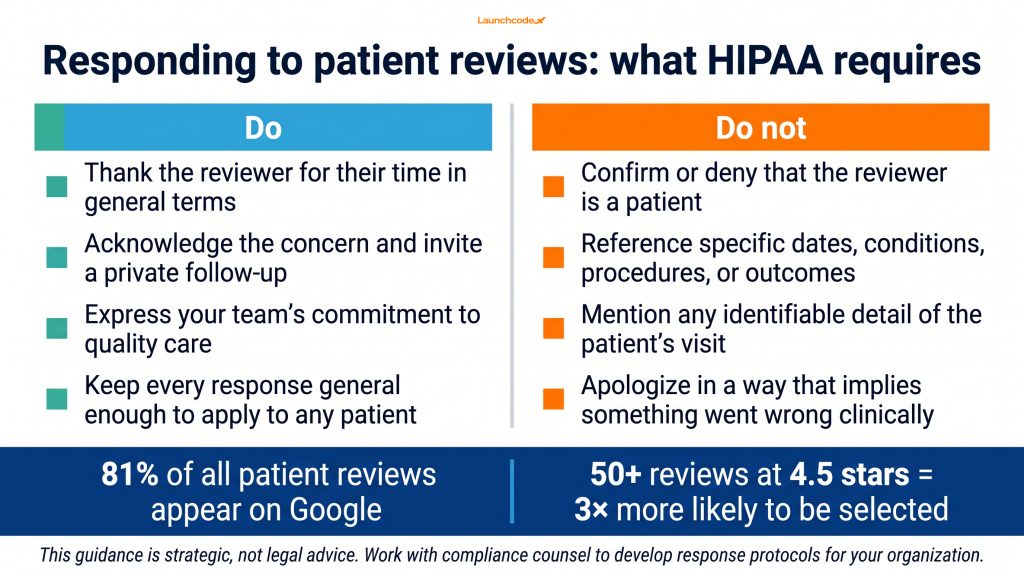
HIPAA compliance applies to every public review response. A reply that acknowledges a specific patient, confirms a diagnosis, or references any detail of care is a potential PHI disclosure and a compliance violation. Every response needs to be drafted with that constraint in mind.
Rules for compliant responses:
A sample compliant response to a positive review: "Thank you for taking the time to share your experience. Our team is committed to providing thoughtful, attentive care, and this kind of feedback means a great deal to us."
Note: This guidance is strategic, not legal advice. Healthcare organizations should work with compliance counsel to develop response protocols suited to their specific situation and applicable state regulations.
Schema markup is structured code that tells search engines and AI systems exactly what your content represents. For healthcare networks, the right schema types help Google and AI tools understand provider credentials, services, and the relationships between individual clinicians, locations, and the parent organization. The returns are measurable. A multi-location clinic that added MedicalOrganization and Physician schema across a 120-page website saw a 22% increase in organic click-through rate within six months, with no changes to visible content.
For AI search visibility, citation signals carry 13% of the ranking weight in AI Overviews, and structured data is how AI systems generate accurate, location-specific answers. When a patient asks "Which urgent care clinics near me accept UnitedHealthcare and are open Sunday," practices with complete, valid schema are the ones that get surfaced.
Use JSON-LD format, which Google recommends. Place it in the head or at the top of the body section on each page. Validate every implementation with Google's Rich Results Test before publishing.
As the Whitespark 2026 analysis concludes, "local search signals and AI search signals have effectively merged." Structured content, consistent listings, and clean schema now determine visibility across Google Maps, AI Overviews, ChatGPT, and Perplexity at the same time. A network that builds schema correctly today builds the infrastructure for AI-driven patient discovery at scale.
A sample LocalBusiness and MedicalOrganization schema block for a healthcare location page:
{
  "@context": "https://schema.org",
  "@type": ["LocalBusiness", "MedicalOrganization"],
  "name": "Northside Family Health Center",
  "url": "https://example.com/locations/northside",
  "telephone": "+1-555-000-0000",
  "address": {
    "@type": "PostalAddress",
    "streetAddress": "1200 Oak Avenue",
    "addressLocality": "Portland",
    "addressRegion": "OR",
    "postalCode": "97201"
  },
  "geo": {
    "@type": "GeoCoordinates",
    "latitude": 45.523064,
    "longitude": -122.676483
  },
  "openingHoursSpecification": [
    {
      "@type": "OpeningHoursSpecification",
      "dayOfWeek": ["Monday","Tuesday","Wednesday","Thursday","Friday"],
      "opens": "08:00",
      "closes": "17:00"
    }
  ],
  "medicalSpecialty": "Family Medicine",
  "image": "https://example.com/images/northside-exterior.jpg"
}Individual physicians and clinicians are searchable entities independent of the practices they work for. Patients search by doctor name, specialty, condition, and insurance acceptance. Building provider-level SEO extends your network's search footprint far beyond what the brand and location layers alone can reach. According to a Healthgrades survey, 76% of patients say a positive online reputation influences their choice of provider, and nearly 75% turn to online reviews as the first step when searching for a new physician.
Most healthcare networks have location pages but no provider-specific pages with structured data. This is the most consistently underbuilt layer in healthcare local SEO and the one with the most room to capture patient-intent queries that competitors are missing entirely.
Provider turnover is the main operational risk at this layer. Every time a provider joins, transfers between locations, or leaves, several digital assets need updating: the provider page itself, GBP service associations, and third-party directory profiles on Healthgrades, Zocdoc, and Vitals.
The governance framework from Step 1 should include a provider change protocol with a defined checklist covering every digital asset that needs updating within a set timeframe after any provider status change.
AI Overviews now appear in 68% of all local queries, well ahead of the 39% appearance rate for traditional Local Packs. For AI search visibility, on-page signals carry 24% of the ranking weight compared to just 12% for GBP signals. A network that has built strong location pages and clean schema markup is already doing most of the work. AI search optimization is not a separate project. It runs on the same foundation.
Whitespark's 2026 research is clear: accuracy drives trust across every discovery surface. AI systems rely on structured, consistent, verifiable information. When the same data appears across your GBP profiles, location pages, schema markup, and directories, AI tools can confidently surface those locations in response to patient queries.
"AI tools pull from structured data, not instinct. If your schema is incomplete or your location pages are thin, the system skips you. The work that wins in AI search is the same work that wins in local search. It just needs to be done more rigorously." — Derick Do, Co-Founder and Chief Product Officer
| Signal category | Local Pack weight | AI Overview weight |
|---|---|---|
| GBP signals | 32% | 12% |
| On-page signals | 15% | 24% |
| Review signals | 20% | 16% |
| Citation signals | 8% | 13% |
| Link signals | 6% | 13% |
Winning Map Pack rankings depends heavily on GBP completeness. Winning AI Overviews depends more on website content quality, schema accuracy, and entity authority. A program built to do both builds more durable, channel-diversified patient acquisition than one optimizing for a single surface.
Local SEO is not a one-time build. It is an ongoing operational discipline. Networks that consistently outperform competitors maintain accurate data, generate reviews at a steady pace, update provider and location information promptly, and track performance at the individual location level. Without a governance model, the gains from Steps 1 through 8 erode within months.
Darren Shaw, founder of Whitespark and author of the annual Local Search Ranking Factors report, frames it clearly: brands that treat accuracy, reviews, and structured content as routine maintenance will hold and grow their visibility. Those that treat it as a one-time project will see rankings degrade quietly over time.
Every area of the program needs a named owner:
| Metric | Where to track | Review cadence |
|---|---|---|
| GBP search views | GBP Insights | Monthly |
| GBP calls and direction requests | GBP Insights | Monthly |
| Location page impressions and clicks | Google Search Console | Monthly |
| Local pack ranking positions | BrightLocal or Semrush Local | Monthly |
| Review count and average rating | Review management platform | Weekly |
| New reviews per month | Review management platform | Weekly |
| Citation accuracy score | Whitespark or BrightLocal | Quarterly |
The return on investment is direct. Optimized GBP listings generate 5 to 12 times more calls than unoptimized profiles, and local SEO reduces paid ad cost per new patient by approximately 30%. Healthcare keywords range from $4 to $35 per click in paid search depending on specialty. A location that ranks organically for its primary terms removes that recurring cost from the acquisition equation entirely.
When your network commits to this eight-step framework, you build a patient acquisition system that performs across traditional search, Google Maps, and AI-generated answers at the same time.
Each step addresses a specific failure mode: drifting data, unverified profiles, thin location pages, inconsistent citations, unmanaged reviews, missing schema, and an untapped provider search footprint. Fix these in order, maintain them consistently, and every location in your network competes on its own terms in its own market.
Over 80% of healthcare searches carry local intent. Patients are searching right now. The networks that show up with accurate, complete, well-structured information earn the appointment. The ones that do not show up let a competitor fill that gap.
The Launchcodex SEO team works with multi-location healthcare organizations to build and manage this full-stack local SEO program, from data governance and GBP management through schema implementation and AI search optimization. If your network has gaps in any of these layers, our local SEO and GEO services are built to close them systematically.
One per physical location. Google requires separately verified profiles for each address. Using one profile to cover multiple sites violates GBP guidelines and limits visibility across every market the network serves.
No. Offering discounts, gifts, or any reward tied to a review violates Google's review policies and FTC guidelines. Review requests should invite patients to share their experience without linking the request to any benefit.
Treating all locations as a single entity. Each location competes in its own local market against its own set of local competitors. It needs its own GBP profile, its own location page with unique content, its own citation set, and its own review stream. Centralizing brand governance is correct. Centralizing local content is not.
At a minimum, quarterly. Any time a location changes its address, phone number, or hours, an immediate update across all directories should follow. Provider changes also trigger a review of healthcare-specific directories like Healthgrades, Vitals, and Zocdoc.
Yes. Patients frequently search by doctor name, specialty, and condition rather than by practice name. Provider pages with Physician schema markup extend the network's total search footprint and capture high-intent queries that location and brand-level pages never reach.
No. Both channels use largely the same inputs. GBP completeness, review velocity, NAP consistency, schema markup, and quality location page content all contribute to both Map Pack and AI Overview visibility. Optimizing for one is most of the way to optimizing for the other.




Local SEO for healthcare networks with multiple locations. Step-by-step framework covering GBP, location pages, NAP, HIPAA r...
Open rate is broken. Apple Mail Privacy Protection distorts more than 55% of all recorded opens. Learn the three-tier email ...
A practical guide to email marketing best practices in 2025. Learn how to improve deliverability, segment your list, build a...