




Is SEO dead in 2026? Google Trends says the opposite
SEO is not dead in 2026, its job changed. See the zero-click data, what still converts, and how to get your brand cited by A...


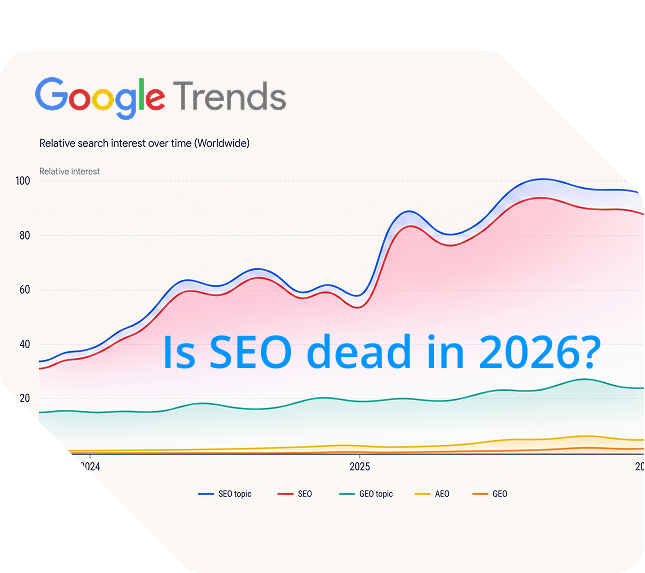


Organic traffic charts are sloping down for a lot of teams, AI Overviews sit above the blue links, and someone in every marketing meeting is asking whether SEO is worth the budget. The fear might be real, but the conclusion is wrong.
This article gives you a data-backed verdict, then a build plan. You will see where the clicks actually went, what still converts, and how to get your brand cited by AI systems. Every number here carries a source and a date so you can act on it, not just read it.
No. SEO is not dead, it is repriced. The channel still works, but the old scorecard does not. Traffic volume fell while search demand and search spend rose. Companies are investing more in organic search, not less, because search still drives the highest intent visitors on the open web.
Ready to grow your organic traffic?
Get a free SEO audit from the Launchcodex team.
The "SEO is dead" headline returns every few years. It ran when Google launched Panda in 2011, again when featured snippets arrived, and again with voice search. Each time, something real changed and the previous playbook lost value. 2026 is a bigger version of the same moment.
Lazy SEO died. Keyword stuffing, thin pages built to hit a word count, and content with no author or expertise behind it lost their remaining value. Google's core updates through 2025 kept targeting exactly that kind of page. What survived is content that shows first-hand experience and answers a specific question better than anything else on the results page.
Start with the spending data. The global SEO services market sizing from Mordor Intelligence puts the market at about 83.98 billion dollars in 2026, up from roughly 74.9 billion dollars a year earlier, with a path toward 148.86 billion dollars by 2031. Budgets rise when a channel returns value. On top of that, WordStream data on the traffic gap shows sites still pull roughly 34 times more traffic from Google and traditional search than from AI chatbots. Search is not shrinking as a behavior. It is changing shape.
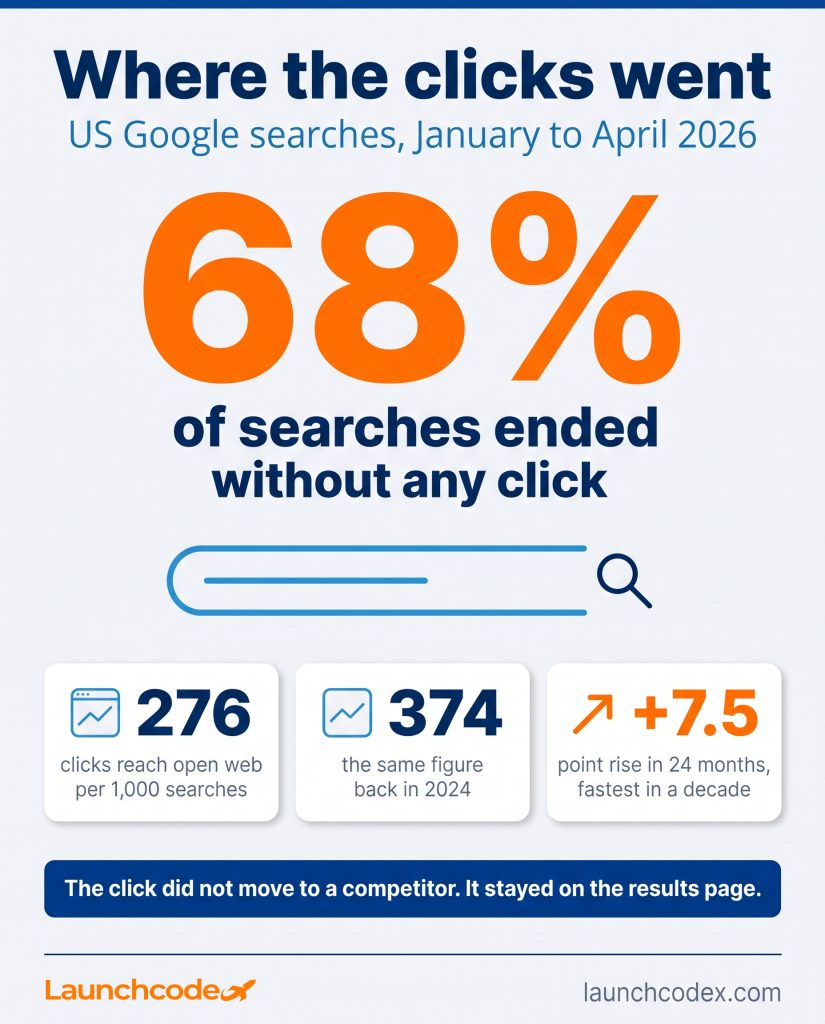
Most searches now end without a click. In the first four months of 2026, 68 percent of US Google searches ended without any click to a website, up from about 60 percent in 2024. The click did not move to your competitor. It ended on the results page itself, answered by an AI Overview or a snippet.
This is the hard data behind the panic, and it deserves a clear look before we talk about what to do.
Rand Fishkin's team measured this with clickstream data. Their finding that 68 percent of US Google searches ended without a click is the sharpest proof that behavior changed. Put it in raw terms and it lands harder. For every 1,000 US Google searches, only 276 clicks now reach the open web, according to the breakdown reported by Search Engine Roundtable, down from 374 two years earlier. The SparkToro analysis of the acceleration notes the rate climbed about 7.5 percentage points in 24 months, the fastest jump in a decade.
AI Overviews cause most of the recent loss. The Search Engine Land report on the study shows AI Overviews now appear on more than 20 percent of searches, and when they show, click-through rates drop by roughly 60 percent. That single feature reshaped the results page.
AI Mode gets blamed, but the data clears it for now. It handled only 0.34 percent of searches during the study window. That said, Google said at I/O 2026 that AI Mode passed 1 billion monthly users and that query volume more than doubles each quarter. It is not the current cause. It may well be the next one, so build for it now.
AI answers are not pulled from thin air. ChatGPT, Gemini, Perplexity, and Google AI Overviews read from web content they can find, trust, and quote. SEO is the discipline that makes your pages findable and trustworthy. So the same work that once earned rankings now earns citations inside AI answers.
The goal shifted from position to presence. You want to be the source the machine quotes, not one link out of ten.
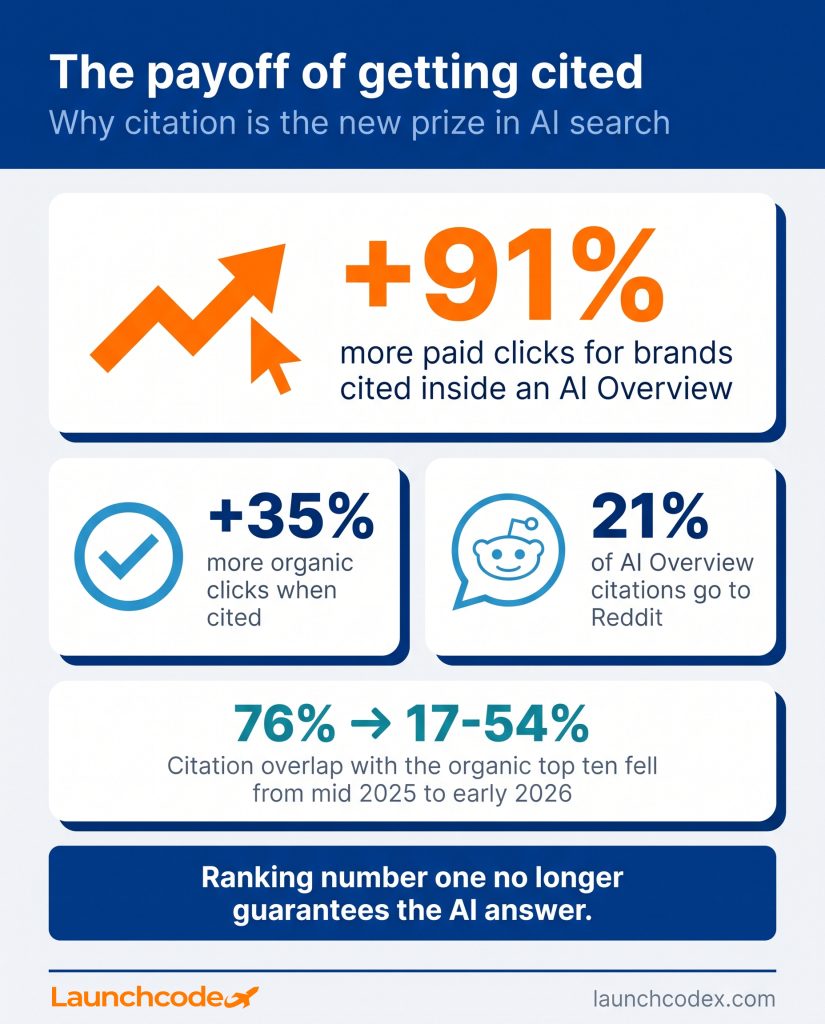
Search practitioner Ashley Liddell drew the line cleanly in a Search Engine Land piece on recognition, noting there is a difference between content that ranks and content that gets cited. The data backs the distinction. Citation overlap between the organic top ten and AI Overview sources fell from about 76 percent in mid 2025 to somewhere between 17 and 54 percent in early 2026, based on aggregated study data. Ranking number one no longer guarantees a spot in the AI answer.
Getting cited pays. Per Seer Interactive data compiled in this roundup of AI Overview statistics, brands cited inside an AI Overview earn 35 percent more organic clicks and 91 percent more paid clicks than brands left out of the same answer. When an AI answer names your brand, the clicks and trust follow the mention.
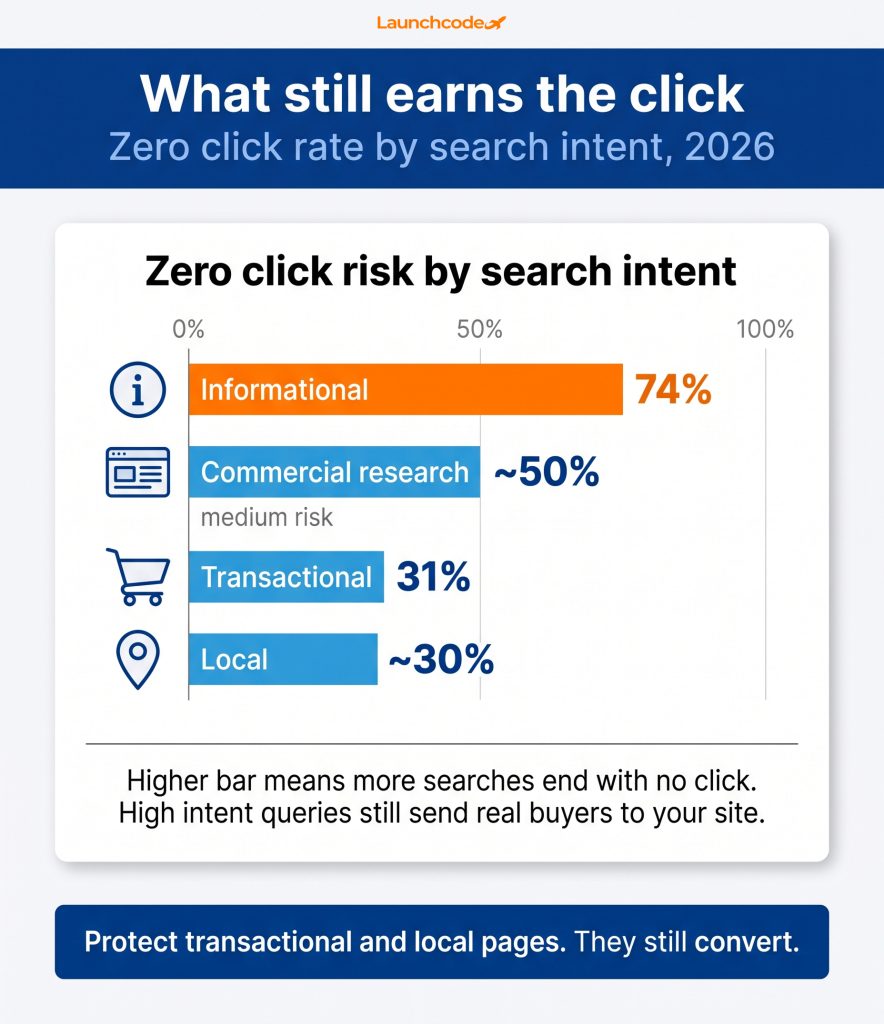
High intent search still sends real buyers to your site. Informational queries lose the most traffic to AI answers, but transactional and local searches barely moved. If someone is ready to buy or hire, they still click, compare, and convert.
The zero-click number is an average, and averages hide the useful detail. Intent is the real segmentation.
The gap by intent is wide. Drawing on Semrush intent data collected by Omnibound, informational queries reach about 74 percent zero click, while transactional queries sit near 31 percent. A person searching "what is email deliverability" often gets a full answer on the page. A person searching "email marketing agency for Shopify brands" is shopping, and they click.
| Query type | Zero click risk | What to do |
|---|---|---|
| Informational | High, around 74 percent | Aim for the citation, not the click. Write the clear, sourced answer AI quotes. |
| Commercial research | Medium | Publish comparisons, real numbers, and proof so you get named in the shortlist. |
| Transactional | Low, around 31 percent | Keep sharp service and product pages. These still convert on the click. |
| Local | Low | Own the map pack, reviews, and location pages. Zero click here still drives calls. |
"When we segment a client's pages by intent, the transactional and local pages hold their traffic while the informational pages bleed clicks to AI answers. We rebuild the informational ones to get cited instead of chasing sessions that no longer arrive." Tanner Medina, Co-Founder and Chief Growth Officer
Teams make the same mistakes when they read the zero-click headline and panic.
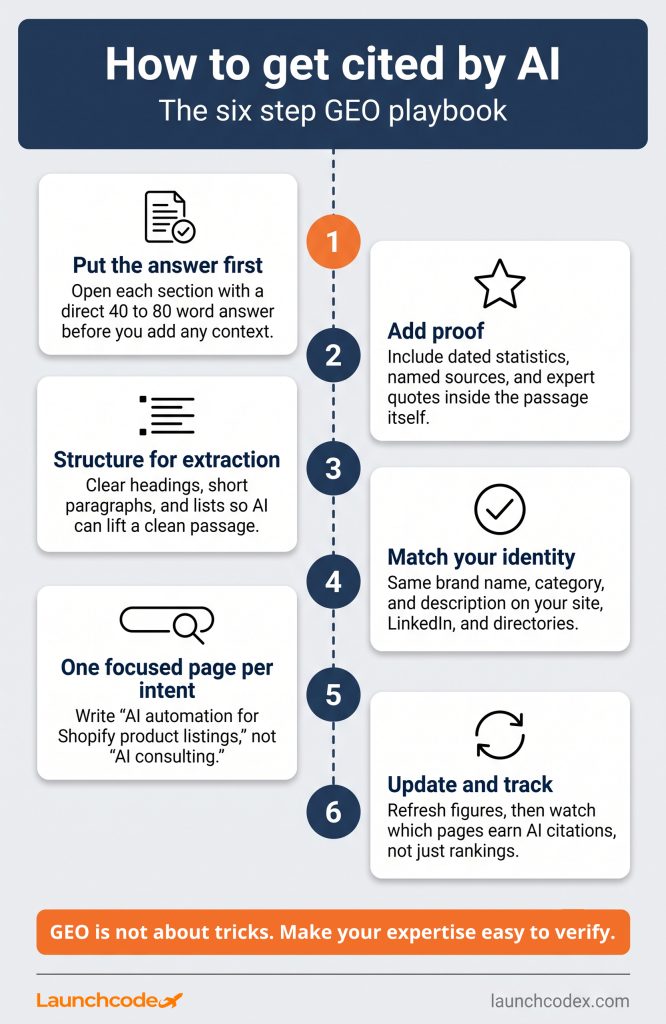
Generative engine optimization, or GEO, is the practice of structuring content and authority so AI systems cite your brand. The research is clear about what works. Add sourced statistics, credible quotes, and citations, then write in clean, extractable prose. These moves raise your visibility in AI answers without tricks.
GEO is not about fooling the model. It is about making your expertise easy to verify.
A study from Princeton, Georgia Tech, and IIT Delhi tested this across about 10,000 queries. The GEO research paper led by Pranjal Aggarwal found that adding cited sources, quotations, and statistics raised visibility in AI-generated answers by 30 to 40 percent. The authors write that adding relevant statistics, credible quotes, and citations from reliable sources significantly improves visibility in generative responses. Even improving fluency and readability alone produced a 15 to 30 percent lift. Clear writing is a measurable tactic, not a soft nicety.
Run this process on any page you want cited.
Know where the machine looks. Using Profound and SE Ranking data from the same statistics roundup, Reddit holds about 21 percent of AI Overview citations, and LinkedIn is the most cited domain for professional and B2B queries across AI platforms. That means your GEO plan reaches past your own site. Presence on the platforms AI already trusts feeds the answer.
Google Search Console shows impressions and clicks, but it will not tell you whether an AI Overview cited you, so pair it with an AI visibility tracker. At Launchcodex, we run SEO and GEO as one workflow for clients, building citation-ready pages by default and tracking both rankings and AI mentions.
"Search Console will not tell you if an AI Overview quoted you, so we log rankings and AI citations on the same dashboard. Once you can see which pages earn mentions, you stop guessing and start updating the ones that miss." Derick Do, Co-Founder and Chief Product Officer
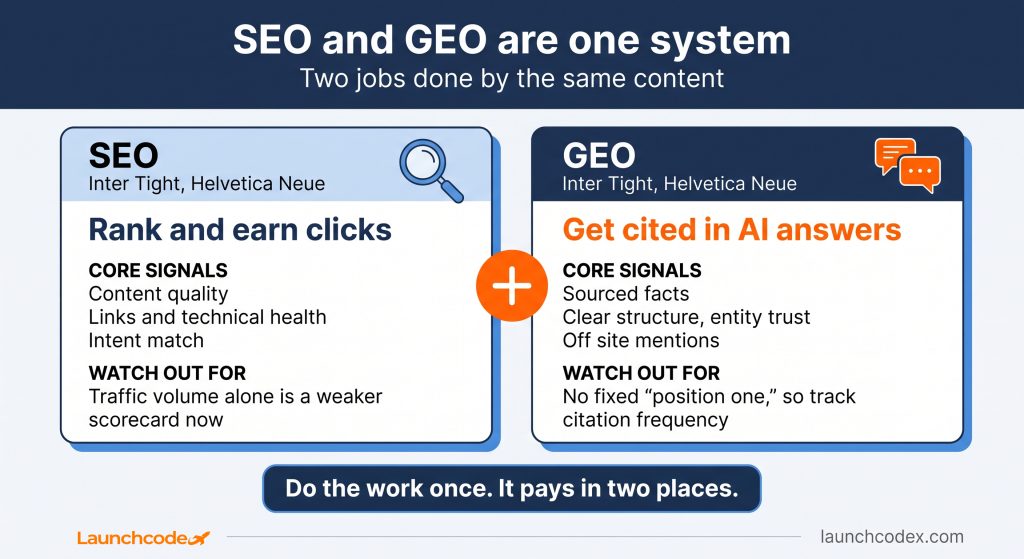
SEO and GEO are not rivals. They are two jobs done by the same content. SEO makes your page findable and ranked. GEO makes it quotable by AI. The signals overlap so much that strong work on one lifts the other. Run both, or you give up half your visibility.
Treating them as a choice is the common error. The smarter frame is one system with two outputs.
| Discipline | Main goal | Core signals | Watch out for |
|---|---|---|---|
| SEO | Rank and earn clicks | Content quality, links, technical health, intent match | Traffic volume alone is a weaker scorecard now |
| GEO | Get cited in AI answers | Sourced facts, clear structure, entity trust, off site mentions | No fixed "position one," so track citation frequency |
The reinforcing loop is simple. A page with a clear answer, real data, and clean structure ranks well in Google. That same page is easy for an AI system to parse and quote. As Rand Fishkin puts it, publish the clear, correct page so the machine gets your facts right and quotes you. You do the work once. It pays in two places. Our SEO and GEO services are built around that single system rather than two disconnected efforts.
SEO in 2026 is harder to fake and more rewarding to do right. The verdict is settled by the data. Search demand holds, the SEO market grows past 83 billion dollars, and AI answers read from the content SEO produces. What changed is the scorecard. Ranking alone is no longer the only goal. Citation and qualified conversion matter just as much.
Your next step is practical. Segment your pages by intent, protect the transactional and local pages that still convert, and rebuild your informational pages to be the source AI quotes. Add dated facts, name your sources, tighten your structure, and track citations alongside rankings. Do that, and the AI shift becomes an opening rather than a threat.
Data note. Figures cited here are dated and sourced from SparkToro, Similarweb, Mordor Intelligence, Seer Interactive, Semrush, WordStream, and the Aggarwal GEO research paper. AI citation share varies by query, platform, and date, so treat those figures as directional. Last updated 2026.
Yes, for most businesses. Search still drives the most qualified traffic on the open web, and the SEO services market grew past 83 billion dollars. The return now comes from citations and high-intent conversions, not raw traffic volume.
GEO, or generative engine optimization, structures your content and authority so AI systems like ChatGPT and Gemini cite your brand. SEO aims for rankings and clicks. GEO aims for being the quoted source. The same content usually serves both.
Because clicks moved into the results page. In early 2026, 68 percent of US Google searches ended without a click, mostly due to AI Overviews. Informational pages lost the most, while transactional and local pages held steady.
Lead with a direct answer, add dated statistics and credible quotes, and structure the page with clear headings and short paragraphs. Research shows these moves lift AI visibility by 30 to 40 percent. Keep your brand identity consistent across the web too.




SEO is not dead in 2026, its job changed. See the zero-click data, what still converts, and how to get your brand cited by A...
AI Overviews trigger on 67% of healthcare queries. Learn how plastic surgery practices earn citations in ChatGPT, Perplexity...
Evaluate, shortlist, and choose the right digital marketing agency in 2026. This guide covers AI and GEO readiness, attribut...