

Share:

AI marketing & automation


Choosing a digital marketing agency has never been harder to get right. Every agency uses the same language: data-driven, results-focused, full-service. The pitches sound identical, and the promises are easy to make. According to Gartner’s 2025 CMO Spend Survey, 39% of marketing leaders planned to cut agency spend in 2025, and 59% said their budget was already insufficient to execute their full strategy. That is not a market with room for a bad hire.
This guide gives you a decision framework that covers agency type, AI readiness, measurement depth, red flags, and contract terms. Work through each section before you shortlist a single agency. By the end, you will know what a strong partner looks like and how to filter out agencies that only look good on a slide deck.
You are not buying services. You are buying a system. The right agency builds the tracking, strategy, and execution layer that connects your marketing activity to measurable revenue. Agencies that deliver only outputs, such as blog posts, ad creatives, or monthly reports, without tying those outputs to business results, are a cost center with no ceiling.
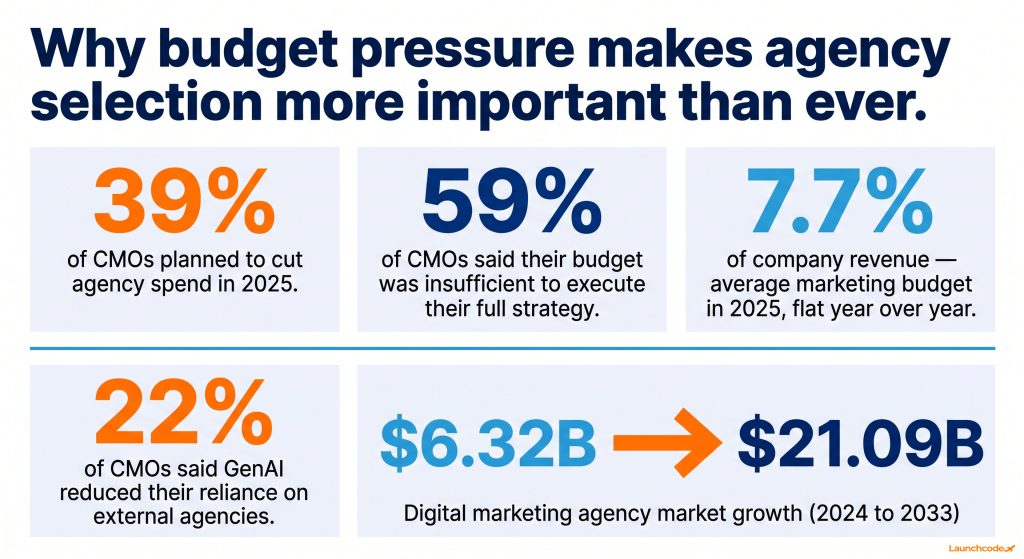
This distinction matters more now than it did five years ago. The global digital marketing agency market was valued at $6.32 billion in 2024 and is projected to reach $21.09 billion by 2033 at a CAGR of 14.32%. More agencies entering the market means more noise, more similar-sounding proposals, and more risk of choosing one that runs activity without accountability.
A service-delivery agency executes tasks. A revenue infrastructure agency builds systems. The difference shows up in how they onboard you, what they ask before recommending tactics, and how their reports are structured.
Service-delivery agencies bring a menu. Revenue infrastructure agencies run a discovery process first. They ask about your sales cycle, your margin structure, your highest-value customers, and your attribution gaps before recommending a single channel or tool.
Choosing the right agency is a decision about the systems, tracking, and execution that turn attention into pipeline and pipeline into closed revenue. Buyers who treat it as a vendor selection end up evaluating the wrong things.
Ewan McIntyre, VP Analyst and Chief of Research at Gartner’s Marketing Practice, stated directly that marketing spending has stalled at a level that falls short for many CMOs. Flat budgets and rising pressure to prove ROI mean buyers cannot afford an agency that measures success by volume of output.
22% of CMOs also told Gartner that generative AI had already reduced their reliance on external agencies for creativity and execution. Agencies that only offer task delivery are more replaceable every year. The agencies worth hiring bring judgment, strategy, and systems that your brand cannot easily replicate internally.
Full-service agencies handle strategy and execution across multiple channels. Specialists focus on one area with greater depth in that lane. The right choice depends on your current stage, internal team capabilities, and how integrated your marketing needs to be. Most growth-stage businesses benefit from a full-service partner. Early-stage businesses with one clear, isolated bottleneck may do better starting with a specialist.
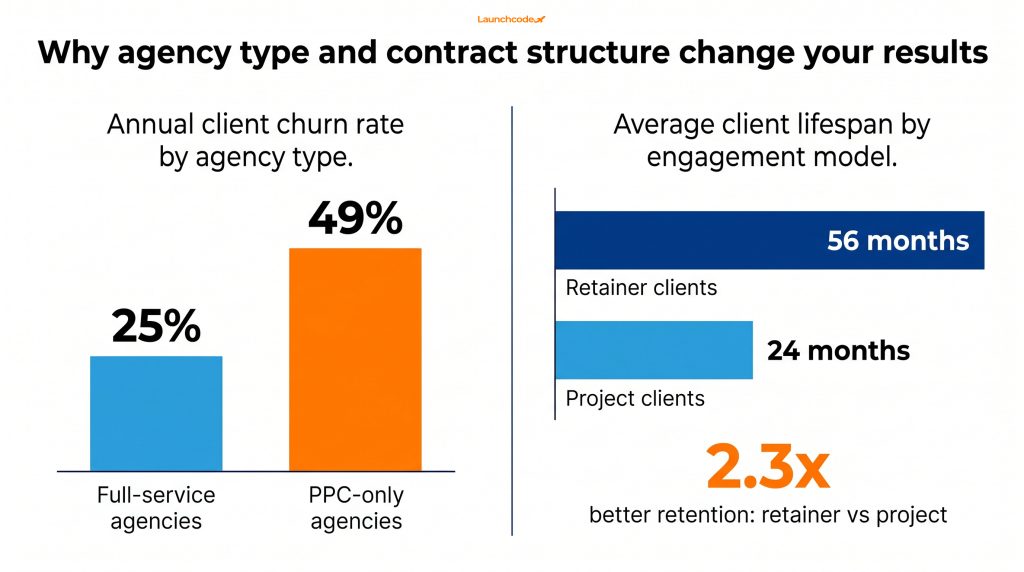
According to the Focus Digital 2026 Marketing Agency Churn Report, which analyzed retention patterns across agencies surveyed from September to November 2025, full-service agencies have the lowest annual client churn rate at 25%. PPC-only agencies have the highest at 49%. That gap reflects a real dynamic: when an agency runs a single channel in isolation, the results are easier to commoditize and easier to replace.
| Agency type | Who it fits | Key strength | Watch out for |
|---|---|---|---|
| Full-service | Enterprise brands and growth-stage businesses needing integrated strategy | Lower churn, coordinated campaigns, single point of accountability | Generalists who lack depth in any one service area |
| Specialist | Businesses with one defined, isolated channel gap | Deep expertise in a single discipline | Siloed thinking that ignores the rest of the funnel |
| Boutique | SMBs wanting senior attention without enterprise overhead | Direct access to experienced talent | Limited bandwidth and tool investment |
| Hybrid retainer | Brands needing flexibility across services over time | Balances recurring work with project needs | Scope drift without clear ongoing deliverables |
The Focus Digital report found that retainer clients stay with agencies for an average of 56 months, nearly five years. Project-based clients average 24 months. That gap has nothing to do with loyalty. It reflects the compounding value of ongoing strategy, which project engagements cannot build.
Retainer agencies achieve 2.3 times better retention than project-based counterparts. If you want results that improve over time, you need a partner working on your brand continuously, not one delivering a one-time output and moving on.
Any agency pitching a purely keyword-rank strategy without addressing AI visibility is offering a partial solution to a fundamentally changed problem. Traditional search behavior has already shifted. Agencies that cannot speak to generative engine optimization (GEO) are not equipped for the current environment, regardless of how strong their legacy SEO track record is.
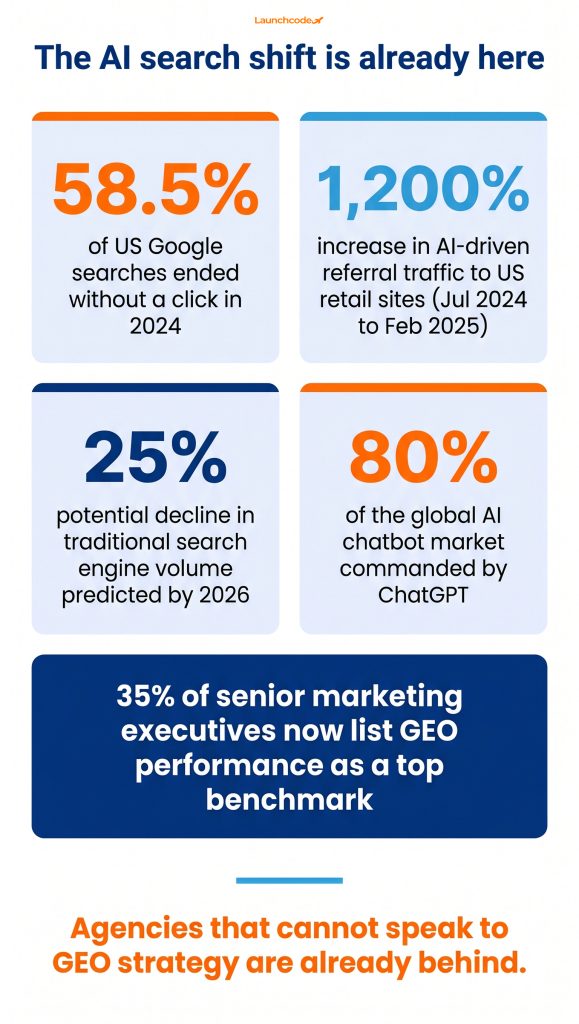
Research tracking AI search behavior found, citing SparkToro’s zero-click search study, that 58.5% of US Google searches ended without a click in 2024, with zero-click rates reaching 65 to 69% on mobile. Rank-based reporting already misses more than half the visibility picture. Gartner has predicted that traditional search engine volume could fall by up to 25% by 2026 as users shift to AI-powered discovery tools.
Adobe Digital Insights tracked a 1,200% increase in AI-driven referral traffic to US retail sites between July 2024 and February 2025. ChatGPT now commands roughly 80% of the global AI chatbot market. Perplexity processes over 30 million daily queries. These are not niche discovery channels.
McKinsey’s 2025 Global Survey on AI found that 78% of organizations were already using AI in at least one business function in 2024, up from 55% the year prior. 35% of senior marketing executives now list GEO performance as a top benchmark. This is a mainstream capability expectation.
“We ask every prospective partner: show us how you track brand citations in ChatGPT and Perplexity. Agencies that have a real answer, with a named process and actual tools, tell you everything about how current their thinking is.” Tanner Medina, Co-Founder and Chief Growth Officer
If a prospective agency cannot explain what GEO is, how they build brand citation across AI platforms, and how they measure AI-driven visibility, move on.
Ask these questions directly during any pitch conversation:
Strong answers include specific tools, named processes, and real examples. Vague answers about “optimizing for AI” without process detail behind them are not enough.
Many agencies now claim to be AI-first without substantive capability behind the label. Signs of AI-washing:
Using AI tools to move faster is fine. An agency that cannot connect AI to your brand’s visibility in AI-generated answers is using it for the wrong reasons.
The pitch process reveals more than most buyers realize. Strong agencies ask you as many questions as you ask them. They want to understand your margins, sales cycle, constraints, and current gaps before recommending anything. A generic proposal built before a real discovery conversation is a clear signal that the agency is selling a package, not solving your problem.
If their answers feel recycled from a template, they are not thinking about your growth. They are thinking about their pipeline.
Ask these to evaluate strategic depth:
Pay attention to specificity. Weak answers are abstract. Strong answers include named tools like Semrush, Ahrefs, or GA4, real decisions made from data, and clear reasoning about trade-offs.
Ask these to evaluate measurement maturity:
A strong agency will welcome the sample report request. An agency that hedges on it is telling you something important about transparency.
Ask:
Many buyers sign with a senior strategist and get handed to a junior account manager two weeks later. Ask the question before you sign, not after.
Good reporting connects marketing activity to business outcomes. Clicks, impressions, and reach are not results. Qualified pipeline, cost per acquisition, and revenue influenced by channel are results. Any agency that cannot tie their work to those metrics is measuring effort, not impact.
The attribution problem in digital marketing has grown more complex. Privacy changes, cookieless tracking, and the growth of AI-driven discovery have all made platform-reported numbers less reliable. Asking an agency directly whether they use business driver modeling or only platform-reported ROAS will quickly tell you whether they have kept pace.
Platform-reported metrics exist in isolation. Meta’s attributed conversions and Google Ads ROAS typically overcount because each platform claims credit for the same conversion. Multi-touch attribution and media mix modeling give a more accurate view of what actually drove a sale.
GA4 has become the standard for web analytics and conversion tracking. Any agency you evaluate should be comfortable configuring it, connecting it to CRM data, and building reports that reflect revenue outcomes, not just behavior. If they still reference Universal Analytics or cannot explain GA4 event tracking, that is a real gap. Reporting tools like Looker Studio should be part of how they visualize and share data with you.
Strong agency reports include:
Weak reports stack impressions, reach, and click-through rates without connecting any of them to outcomes. If a report could apply to any client without changing the context, it is not a real report.
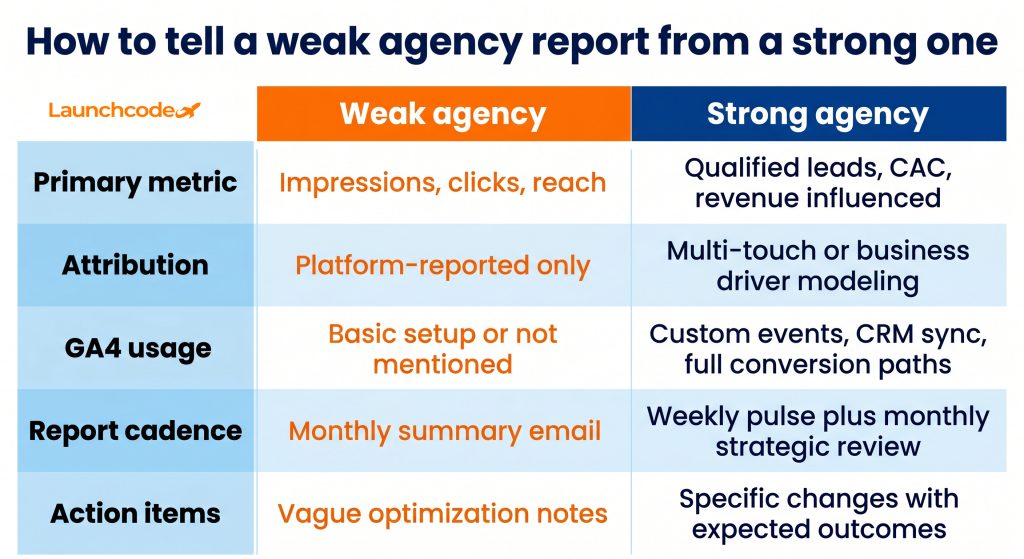
| Signal | Weak agency | Strong agency |
|---|---|---|
| Primary metric | Impressions, clicks, reach | Qualified leads, CAC, revenue influenced |
| Attribution approach | Platform-reported only | Multi-touch or business driver modeling |
| GA4 usage | Basic setup or not mentioned | Custom events, CRM sync, full conversion paths |
| Report cadence | Monthly summary email | Weekly pulse plus monthly strategic review |
| Action items | Vague optimization notes | Specific changes with expected outcomes |
Most agency red flags are visible before you sign anything. They appear in how the pitch is structured, what questions the agency skips, and how contract terms are framed. Identifying them early saves weeks of proposals, calls, and ultimately months of wasted budget.
One useful test: check whether the agency can maintain its own marketing presence. An agency that markets social media services but cannot keep its own social accounts active is signaling a lack of bandwidth or genuine capability. Apply that same test across every service they pitch.
“The agencies that keep clients longest report proactively. When performance dips, your agency should flag it before you ask. If you’re always the one chasing updates, the relationship is already broken.” Brittany Charles, SVP Client Services
A good contract protects both sides without creating unreasonable lock-ins or vague performance standards. The most important elements are asset ownership, a defined scope of work, clear billing terms, a reasonable engagement length with structured review points, and a clean exit clause if the relationship stops working.
Retainer-based engagements consistently outperform project-based ones. Retainer clients stay with agencies for an average of 56 months compared to 24 months for project-based clients. That result comes from compounding strategy over time, not from clients who feel trapped by contract terms.
A strong agency will not resist reasonable transparency on any of these terms. If a contract negotiation feels adversarial, that dynamic rarely improves once work begins.
Once you have applied the filters above, you should have two or three credible candidates. At this stage, the decision comes down to fit: strategic alignment, communication clarity, and a clear sense of who will actually deliver the work. The goal is not the cheapest option or the most impressive-sounding pitch. The goal is the agency most likely to produce results for your specific business at your current stage.
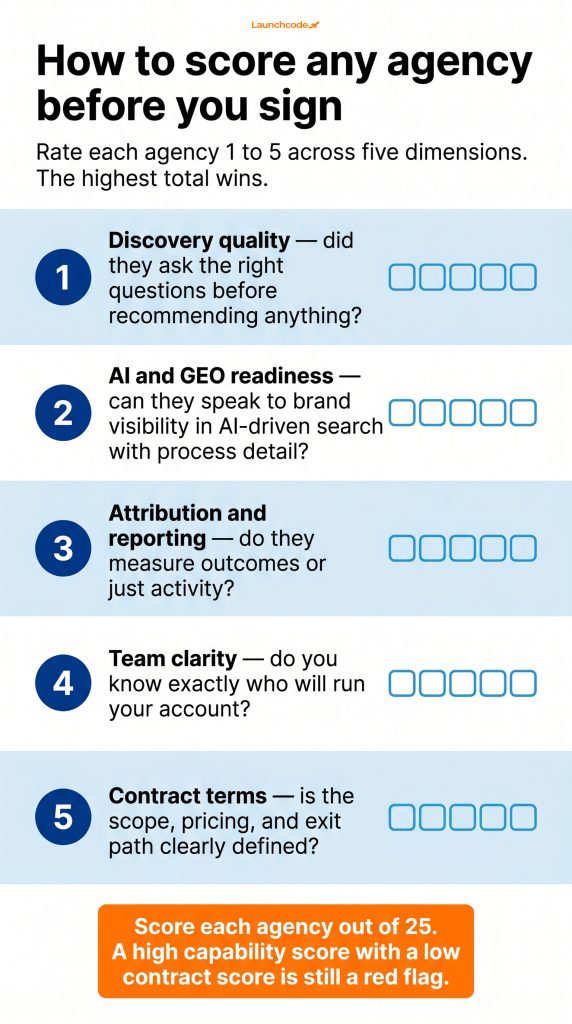
Score each agency on a 1 to 5 scale across five dimensions:
Add the scores. The agency with the highest total is usually the strongest choice. If one scores very high on capability but poorly on contract terms, treat that as a serious concern to resolve before signing.
Before you sign, ask one question: does this agency think about your business in terms of revenue and growth, or in terms of tasks and deliverables?
At Launchcodex, every new engagement starts by building the measurement foundation before any campaign goes live. That means connecting GA4, configuring conversion tracking, and establishing a baseline against agreed KPIs first. Agencies that lead with tactics and add measurement later are optimizing for their own efficiency. That order of operations is one of the clearest signals of whether a partner will be accountable or just active.
A full-service agency handles strategy and execution across multiple channels such as SEO, paid media, email, and creative. A specialist focuses on one service area with greater depth in that lane. Full-service agencies tend to have lower churn rates and work better for businesses that need integrated, cross-channel campaigns. Specialists suit businesses with one clearly defined, isolated gap.
Pricing varies widely by scope, agency size, and market. Monthly retainers for SMBs typically range from $2,000 to $10,000 per month. Mid-market and enterprise engagements run higher. Be cautious of unusually low pricing. High-quality digital marketing requires real investment in tools, talent, and process. Always clarify exactly what is included in any quoted fee before comparing options.
Generative engine optimization (GEO) is the practice of optimizing your brand to be cited and recommended by AI systems like ChatGPT, Google Gemini, and Perplexity. Adobe Digital Insights found that AI-driven referral traffic to US retail sites grew 1,200% in just seven months. Agencies that cannot build GEO strategy are missing a fast-growing and dominant discovery channel.
Ask about their discovery process, who will run your account day to day, how they connect marketing to revenue, what attribution model they use, and whether you can see a sample report from an active client. Strong agencies will answer with specifics and will ask you equally direct questions about your business in return.
The clearest red flags are: guaranteed results, no discovery process before recommending strategy, vague scope in the contract, agency ownership of your accounts and assets, and the pitch team being different from the delivery team. Any one of these should prompt serious caution before you proceed.
Retainer-based engagements consistently outperform project-based ones on both retention and compounding results. Retainer clients stay with agencies for an average of 56 months compared to 24 months for project clients. For most growth-stage businesses, a retainer is the better structure, provided the scope, deliverables, and exit terms are clearly defined in the contract.


Real stories from the people we’ve partnered with to modernize and grow their marketing.