
Share:

AI marketing & automation


A peer-reviewed study on AI-generated information in plastic surgery found that 95% of patients use the internet to research procedures before speaking to a surgeon. That behavior has shifted to AI-native search. Patients skip the listing pages. They ask ChatGPT, Perplexity, or Google AI Overviews, receive a synthesized answer, and move toward a consultation only when that answer points to a specific practice. If your content is not cited in that answer, your practice does not appear in that patient’s search.
This article walks through a practical GEO framework for plastic surgery practices that want to earn AI citations on high-intent procedure queries. You will learn what separates high-intent from informational queries, how AI systems decide which sources to reference, how to structure content and schema for citation eligibility, and how to measure AI visibility as a primary practice KPI.
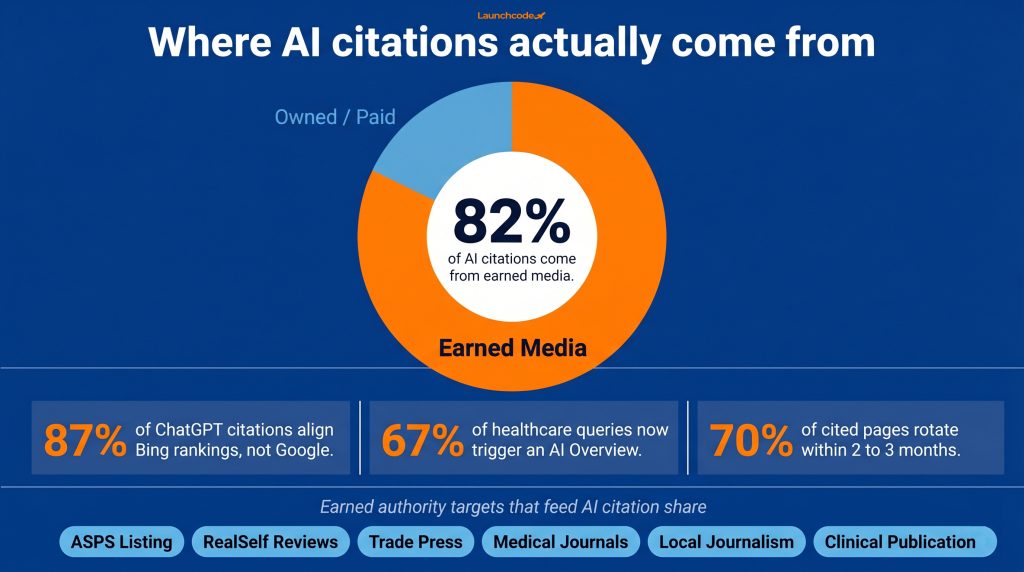
AI Overviews for plastic surgeons now trigger on 67% of healthcare-related queries, the highest rate of any major search vertical. Patients researching rhinoplasty, breast augmentation, facelifts, and body contouring receive AI-generated answers before they ever see a traditional listing. Practices that do not appear in those answers lose discovery opportunities to competitors, regardless of where their pages rank.
The 2024 ASPS Procedural Statistics Report recorded 1.585 million cosmetic surgical procedures in the US, with liposuction, breast augmentation, tummy tuck, breast lift, and eyelid surgery as the top five categories. ASPS President Scott Hollenbeck, MD noted that “patients continued to prioritize their aesthetic health in 2024 despite the unpredictable economic uncertainty they faced throughout the year.” Demand is durable. The competition for that demand has moved to AI-mediated search.
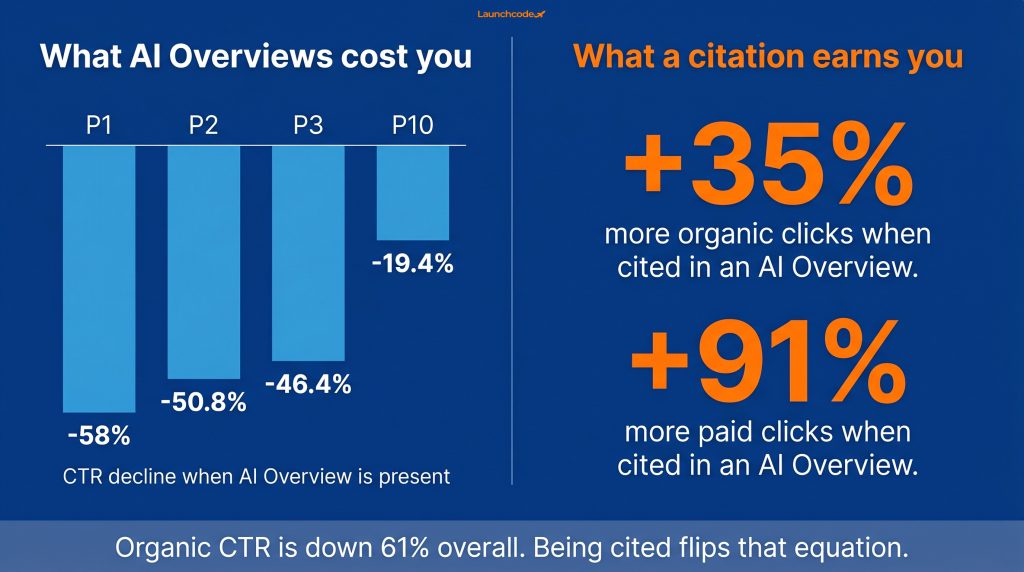
A Seer Interactive analysis of 25.1 million organic impressions across 42 organizations found that organic CTR dropped 61% and paid CTR dropped 68% when AI Overviews were present. Ahrefs confirmed the same trend, finding that position-one pages lose up to 58% of expected clicks when an AI Overview appears above them. Position two loses 50.8%. Position three loses 46.4%.
For practices investing in SEO, this is the clearest data available: page-one rankings no longer guarantee traffic. The click goes to the AI answer, and the AI answer goes to whatever source it cites.
The same research surfaces the other side of the picture. Being cited within an AI Overview produced 35% more organic clicks and 91% more paid clicks compared to appearing in traditional results without a citation. AI citations drive qualified consultation traffic directly.
As one analysis of answer engine optimization for plastic surgeons put it: “Ranking #1 in 2026 no longer means the top link. It means you are the trusted answer that AI chooses to show first.” GEO investment is not optional for practices that depend on procedure-based patient acquisition.
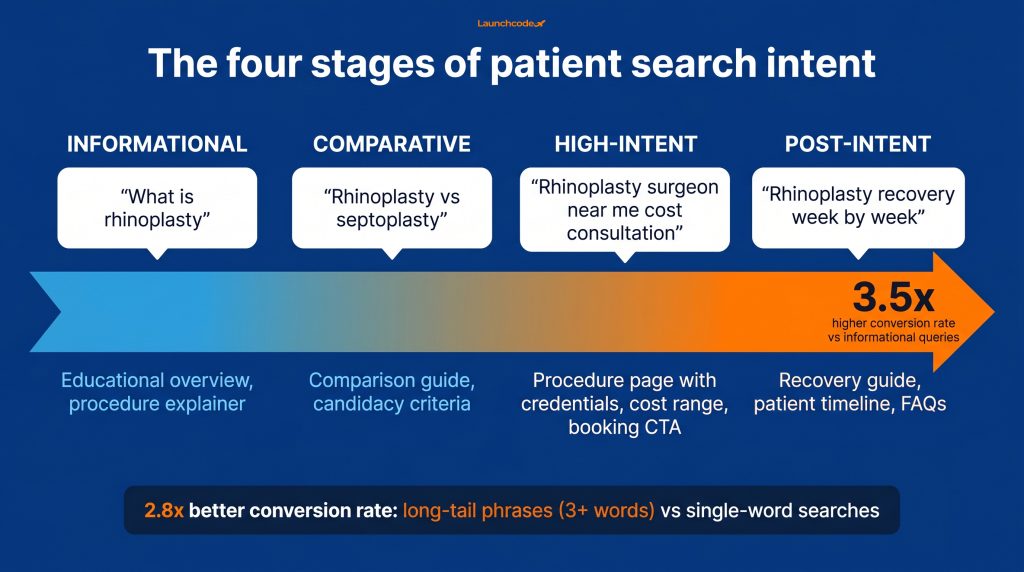
High-intent procedure queries signal that a patient is close to a booking decision. Phrases like “rhinoplasty surgeon near me cost consultation” or “board-certified breast augmentation Newport Beach” include location, credential, and action modifiers that separate them from general educational searches. These queries convert differently, and they require different content to earn AI citations.
According to conversion data for plastic surgery search terms, high-intent keywords generate 3.5x higher conversion rates than general informational queries. Long-tail phrases with three or more words deliver 2.8x better conversion rates than single-word searches. That gap justifies building a separate content and GEO strategy around each procedure query type.
| Query type | Example | Search intent | Content needed |
|---|---|---|---|
| Informational | “What is rhinoplasty” | Research, early stage | Educational overview, procedure explainer |
| Comparative | “Rhinoplasty vs septoplasty” | Evaluation, mid-stage | Comparison guide, candidacy criteria |
| High-intent | “Rhinoplasty surgeon near me cost consultation” | Decision, ready to book | Procedure page with credentials, cost range, booking CTA |
| Post-intent | “Rhinoplasty recovery week by week” | Post-decision research | Recovery guide, patient timeline, FAQs |
AI systems serve different content types depending on where a query falls in this table. “What is rhinoplasty” draws from general educational sources. “Best board-certified rhinoplasty surgeon in Los Angeles” draws from locally-attributed, credential-rich sources. Practices need content for each stage, but high-intent and post-intent queries produce the strongest return from GEO investment.
High-intent queries carry implicit safety requirements. Google classifies all medical and surgical content under YMYL, which stands for Your Money or Your Life, meaning AI systems apply heightened scrutiny before citing any source for these queries. A page with thin content, no authorship, and no credential signals will not be cited for a high-intent procedure query even if it ranks in traditional search. The threshold is higher, and that is an advantage for practices that build content correctly. Most competitors never clear it.
AI platforms like Google AI Overviews, ChatGPT, and Perplexity each use different citation logic, but they share one requirement: the source must be recognizable as authoritative before it gets cited. For plastic surgery practices, authority comes from a combination of site structure, content depth, credential signals, and third-party references. No single factor controls citation eligibility.
InfluxMD’s GEO guide for medical practices provides useful context: 87% of healthcare searches now trigger AI-generated responses, and 68% of patients already use AI to research health information. Practices that ignore AI citation logic are spending budget on a shrinking channel while the channel that captures patient decisions goes unclaimed.
Google AI Overviews pull from pages that already perform in traditional search, then apply a secondary filter for content comprehensiveness, structured markup, and EEAT signals. A page ranking at position four or five with strong entity signals and structured FAQ content can appear in an AI Overview ahead of a position-one page with thin supporting content. Content structured for extraction gets cited more reliably than content optimized only for ranking.
According to GEO research for plastic surgeons referencing a Search Engine Land case study, 87% of ChatGPT citations align with Bing’s top results. A practice that ranks well on Google but remains invisible on Bing may never appear in ChatGPT responses, regardless of content quality.
ChatGPT’s search-enabled mode uses Bing’s index as a primary data source. Practices focused entirely on Google optimize for one AI citation channel while ignoring another. Verifying Bing Webmaster Tools, submitting a sitemap, and confirming that procedure pages index correctly on Bing costs almost nothing and opens a meaningful share of ChatGPT citation volume.
A single procedure landing page rarely earns sustained AI citation. AI systems favor sources with topical depth, meaning a page that links to supporting content on cost, recovery, candidacy, risks, and outcomes signals more authority than an isolated page. For each high-priority procedure, build a cluster: one pillar page supported by satellite pages that answer every question a patient would ask.
This structure does two things. It signals topical authority to AI systems trained to prefer comprehensive source coverage. It also captures patients at every stage of the research journey, including post-intent queries that convert directly to consultation bookings.
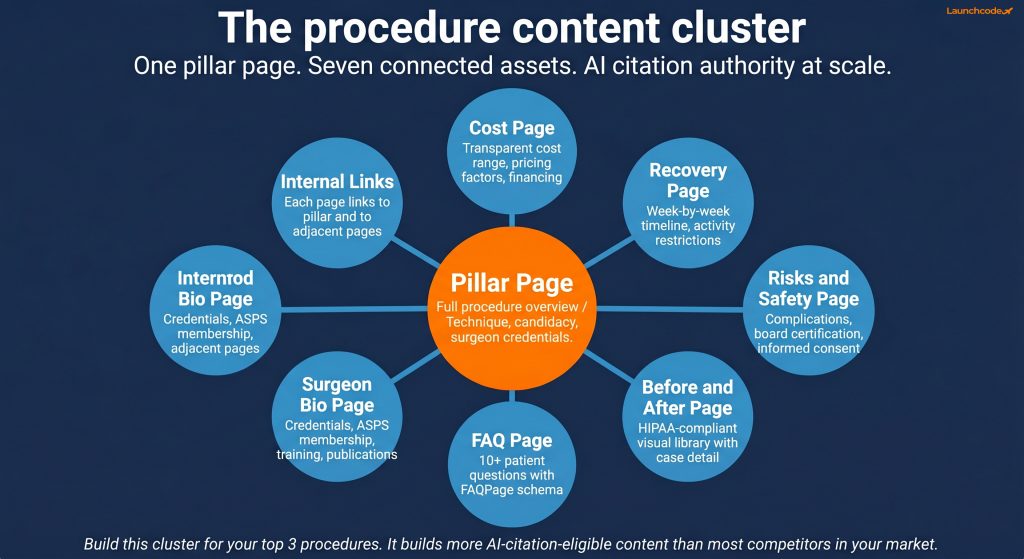
A complete procedure cluster for a high-volume category like rhinoplasty or breast augmentation should include:
Each page in the cluster should link to the pillar page and to adjacent satellite pages. Internal linking builds the topical entity map that AI systems use to assess depth. A practice that publishes this full cluster for its top three procedures builds more AI-citation-eligible content than most competitors in its market.
“The practices that commit to full procedure clusters see a measurable lift in AI citation share within 60 to 90 days. The depth signals matter more than most marketing teams expect.” Tanner Medina, Co-Founder and Chief Growth Officer, Launchcodex
The 2024 ASPS report identified over 837,000 patients on GLP-1 medications who pursued aesthetic procedures after significant weight loss. Queries around post-weight-loss body contouring, skin removal surgery, and Ozempic body procedures are high-intent, growing fast, and currently underserved by authoritative medical content. AI systems have fewer credible sources to draw from in this category. According to the 2026 digital marketing analysis from the World Academy of Cosmetic Surgery, GEO-optimized content for procedure queries where AI systems have fewer authoritative sources gives practices a realistic path to competing against larger, established competitors. A practice that builds a GLP-1 body contouring cluster today faces less competition for AI citations than it would targeting breast augmentation or rhinoplasty.
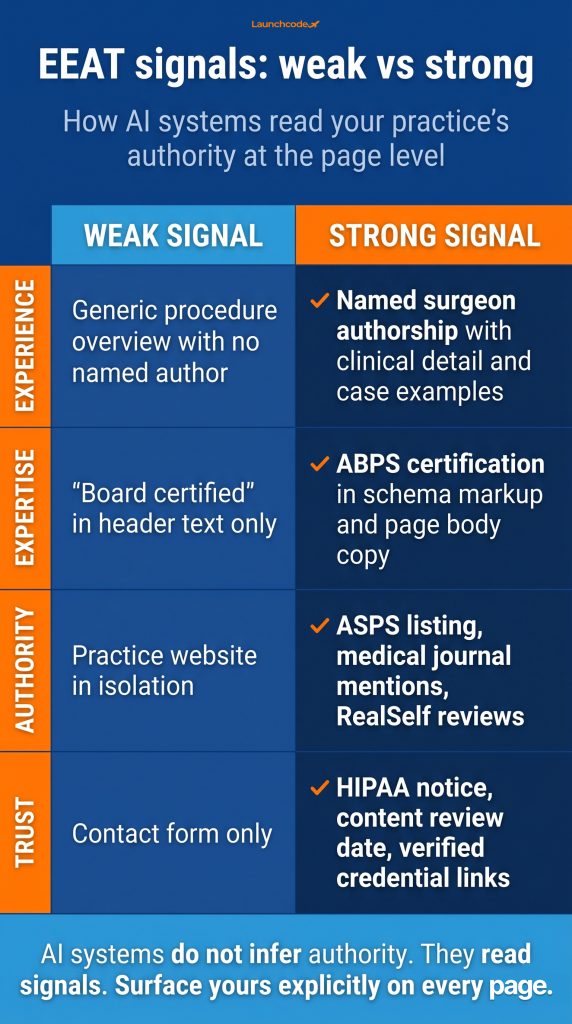
EEAT, which stands for Experience, Expertise, Authoritativeness, and Trustworthiness, is the explicit gate through which AI systems decide whether to cite a source for a YMYL query. Practices that treat EEAT as a general guideline rather than a page-level checklist leave their most credible content uncited.
Most practices assume their board certification speaks for itself. It does not, unless it is surfaced in machine-readable and reader-visible formats on every relevant page. AI systems do not infer authority. They read signals.
These signals demonstrate that content comes from a surgeon who has performed the procedure.
These signals connect the practice to recognized external entities.
| EEAT dimension | Weak signal | Strong signal |
|---|---|---|
| Experience | Generic procedure overview | Named surgeon authorship with clinical detail and case examples |
| Expertise | “Board certified” in header text only | ABPS certification in schema markup and page body copy |
| Authority | Practice website in isolation | ASPS listing, medical journal mentions, RealSelf reviews |
| Trust | Contact form only | HIPAA notice, content review date, verified credential links |
Schema markup does not guarantee AI citations, but it creates the machine-readable foundation that helps AI systems correctly attribute your content. Sites with rich, connected schema markup show 78-94% higher citation rates in Google AI Mode, and authoritative well-structured content is three times more likely to be cited than narrowly focused pages, according to healthcare schema markup research from HCIC 2025. For plastic surgery practices, schema is the technical layer that converts clinical authority into machine-readable form.
Fabrice Canel, Principal Program Manager at Microsoft Bing, confirmed in March 2025 that “schema markup helps Microsoft’s LLMs understand content,” as documented in a schema markup implementation guide for AI citations. The same principle applies across Google and Perplexity. Without schema, AI systems make probabilistic inferences. With schema, they read verified facts.
“Most practice sites we audit have zero structured data beyond a basic local business schema. Getting Physician and FAQPage schema deployed correctly is often the fastest single change a practice can make to improve AI citation eligibility.” Derick Do, Co-Founder and Chief Product Officer, Launchcodex
Implement these schema types in priority order:
82% of AI citations come from earned media rather than owned content or paid placements, according to a Muck Rack analysis cited in recent GEO market analysis. For plastic surgery practices, this means the publications, press mentions, journal citations, and third-party directory listings pointing to your practice do as much citation work as your own website content. A strong on-site GEO strategy without earned authority will consistently underperform.
AI systems synthesize information from multiple credible sources. A practice cited by ASPS, reviewed on RealSelf, mentioned in a medical publication, and featured in a regional health journal builds a richer entity profile than a practice with a polished website and no external footprint. Each external reference adds a data point that AI systems use to confirm authority before citing.
Practical earned authority targets for plastic surgery practices:
The 87% Bing-ChatGPT citation alignment means Bing ranking is a direct ChatGPT ranking input. Most plastic surgery practices have never verified their Bing Webmaster Tools account. These steps take less than two hours and directly affect ChatGPT citation eligibility.
Tracking rank positions and organic sessions alone will not show whether your practice is gaining or losing ground in AI search. AI citation share, meaning the percentage of relevant queries for which your practice appears in an AI-generated response, is the metric that reflects actual discovery performance in 2026. Practices that do not measure this are operating with a significant blind spot.
Most practices find out they are losing AI visibility only when consultation volume drops. By then, a competitor has already captured the citation share. A measurement cadence built early creates the feedback loop needed to adjust content, schema, and authority strategy before that loss compounds.
| Tool | What it tracks | Best for |
|---|---|---|
| Semrush AI Toolkit | AI Overview visibility across queries | Google AI citation monitoring |
| Otterly.AI | Brand and citation mentions across ChatGPT, Gemini, and Perplexity | Multi-platform citation tracking |
| Ahrefs | Content gap analysis and backlink authority | Identifying competitor citation advantages |
| Google Search Console | AI Overview impression data under Web search type | Baseline impression tracking post-schema |
| Bing Webmaster Tools | Crawl coverage and index status | ChatGPT citation pipeline health |
Run a citation share audit monthly across the procedure categories that drive the most consultation volume. For each procedure, track three things:
Roughly 70% of pages cited in AI Overviews rotate within a two-to-three month window. Citation share is not a static outcome. Content freshness, new competitor entries, and schema updates all shift the citation picture regularly. A practice that audits monthly and makes incremental adjustments holds more stable citation share than one that launches a GEO project and does not monitor it afterward.
Patient acquisition through AI-mediated search is already the default for the majority of healthcare query categories. The practices that act now, before every competitor has a GEO strategy in place, will build citation share that late movers find expensive to displace.
The framework is repeatable. Classify your queries by intent and prioritize high-intent procedure categories. Build full content clusters around each priority procedure, including the cost, recovery, risks, and FAQ pages that thin competitors skip. Surface EEAT signals at the page level in both copy and schema markup. Verify Bing coverage to open the ChatGPT citation channel. Build earned authority through ASPS listings, RealSelf, and trade press contributions. Measure citation share monthly and adjust based on what cited competitors have that you do not.
The relationship between SEO and GEO is worth stating directly. Strong traditional SEO, which means solid technical foundations, authoritative backlinks, and well-structured content, is the same base that AI systems draw from when selecting citations. You do not abandon one to pursue the other. You build the foundation once and optimize it for both audiences.
Launchcodex builds and executes GEO-ready content architecture for healthcare and high-trust service clients as part of our SEO and GEO service engagements. If you want to audit your current procedure pages for AI citation readiness and identify where competitors are capturing the citations you should be earning, that is where the work starts.
GEO, or generative engine optimization, is the practice of structuring content so AI platforms like ChatGPT, Perplexity, and Google AI Overviews cite and recommend it in generated responses. Traditional SEO focuses on earning rankings in search result listings. GEO focuses on becoming the source an AI system trusts enough to reference when a patient asks a procedure question.
Google AI Overviews matter most for volume, since Google accounts for the majority of health searches. ChatGPT is growing rapidly and its citations align heavily with Bing rankings. Perplexity attracts a research-oriented audience that often includes high-intent patients. A complete AI visibility strategy accounts for all three platforms separately.
No. Schema markup is a necessary foundation, not a guarantee. It helps AI systems correctly parse and attribute content, which increases citation probability. Sites with strong schema implementation have shown 78-94% higher citation rates in Google AI Mode, but content quality, topical depth, and external authority still determine whether a page qualifies for citation.
High-intent queries include decision-stage modifiers like location, board certification, cost, and consultation. Phrases like “rhinoplasty surgeon near me consultation” signal that the patient is ready to act. These queries convert at 3.5x the rate of general informational searches and require procedure pages built with credential signals, pricing transparency, and clear booking paths.
Monthly audits are the recommended cadence. About 70% of pages cited in AI Overviews rotate within two to three months, so citation share is not stable. A monthly check across your top procedure categories, covering Google AI Overviews and Perplexity alongside a Bing coverage check for ChatGPT health, gives enough data to make timely adjustments before competitors pull ahead.
Yes. 87% of ChatGPT citations align with Bing rankings, which means Bing indexing is a prerequisite for ChatGPT citation eligibility. Bing Webmaster Tools setup takes less than two hours, costs nothing, and directly affects how often your practice appears in ChatGPT responses. Skipping it means skipping a major AI citation channel entirely.


Real stories from the people we’ve partnered with to modernize and grow their marketing.