

Share:

AI marketing & automation


Healthcare organizations invested over $4 billion in digital marketing in 2024. Yet 28% of healthcare marketers still rank measuring ROI as one of their top challenges. That gap is not a data problem. It is a measurement strategy problem.
Most teams track the wrong things with the wrong models, run tools that create legal risk, and report numbers that finance leaders do not trust. This article covers the specific failures behind that gap and gives a practical fix for each one.
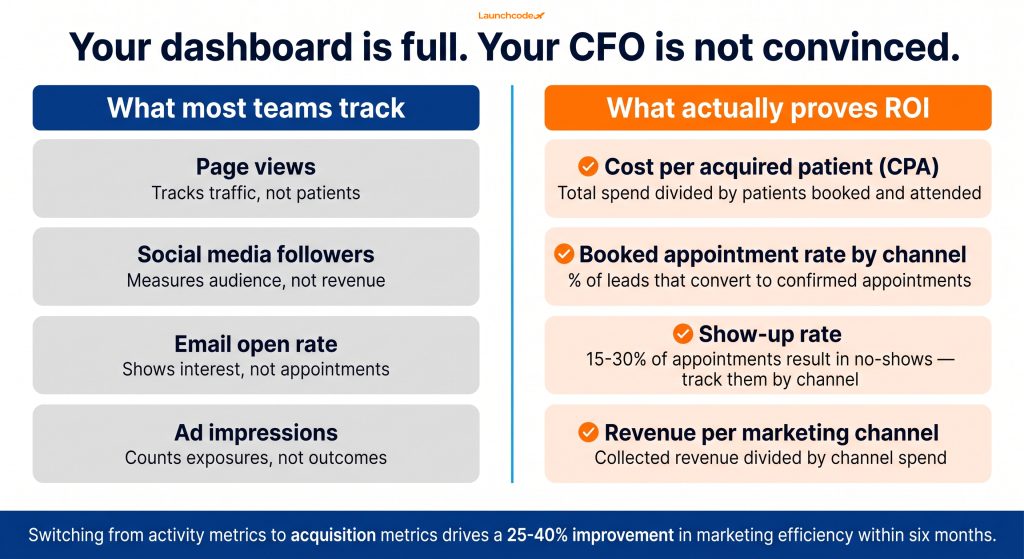
Most healthcare marketing dashboards are full of numbers that feel productive but cannot justify budget. Page views, social followers, email open rates, and ad impressions are easy to collect and easy to present. They are also nearly useless when a CFO asks whether marketing drove real patient volume. Replace activity metrics with acquisition metrics: cost per acquired patient, booked appointment rate by channel, show-up rate, and revenue per marketing dollar.
Healthcare is not an impulse purchase. A patient considering a specialist visit may research for weeks, read reviews, check insurance, and call before booking. Tracking that journey with soft engagement metrics is fine as a directional signal. Using those same metrics to report ROI is a category error.
Teams that shift to revenue-focused measurement typically see a 25-40% improvement in marketing efficiency within six months. The gains come not from spending less, but from knowing which channels are actually producing patients.
“The moment a healthcare team stops reporting on impressions and starts reporting on cost per booked appointment, the whole conversation with leadership changes. Finance finally has a number they can work with.” Tanner Medina, Co-Founder & Chief Growth Officer
A frequent mistake is running a brand awareness campaign and measuring it with conversion KPIs. A campaign designed to introduce a practice to a new geographic area should be measured on reach, brand search volume growth, and assisted conversions over time. Judging it on immediate appointment bookings will always produce a false failure signal.
Align the metric to the campaign objective first, then connect that objective to a downstream revenue outcome.
A patient might see a paid search ad on Monday, read a blog post on Wednesday, check Google reviews on Friday, and call after a retargeting ad two weeks later. Last-touch attribution credits only that final ad with the entire acquisition. First-touch credits only the original search click. Both are wrong. Both cause you to misallocate budget toward channels that look good in reports but are not actually driving decisions.
McKinsey noted that attribution analysis is a critical component of measuring digital marketing ROI in healthcare, and most providers are still early in building those capabilities. Single-touch models dominate because they are simple to configure, not because they reflect how patients actually behave.
Multi-touch attribution (MTA) distributes conversion credit across all the touchpoints a patient encountered before booking. The right model depends on your service line and conversion cycle.
| Model | How credit is distributed | Best fit for |
|---|---|---|
| Linear | Equal credit to every touchpoint | Long consideration cycles, primary care |
| Time decay | More credit to recent touchpoints | Short-cycle services, cosmetic procedures |
| Position-based (U-shaped) | 40% first touch, 40% last touch, 20% spread across middle | Services with strong awareness and strong close channels |
| Data-driven | Algorithmic weight based on actual path analysis | High-volume practices with 12+ months of clean data |
For most mid-sized practices, a position-based model is a practical starting point. It respects both the channel that introduced the patient and the channel that closed the appointment, without requiring the data volume that algorithmic models need to perform reliably.
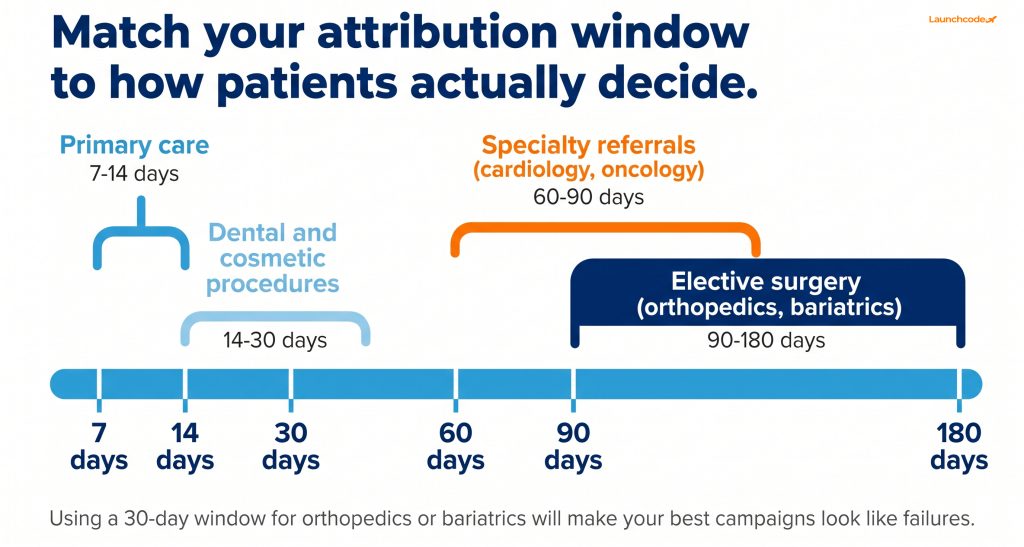
A 30-day attribution window works for cosmetic dermatology. It will make an orthopedic campaign look like it is failing. Patients researching joint replacement surgery can take months to book a consultation. A 30-day window for that service line means the campaign earns no credit for the majority of conversions it actually produced.
Match your attribution window to the realistic decision timeline for each service:
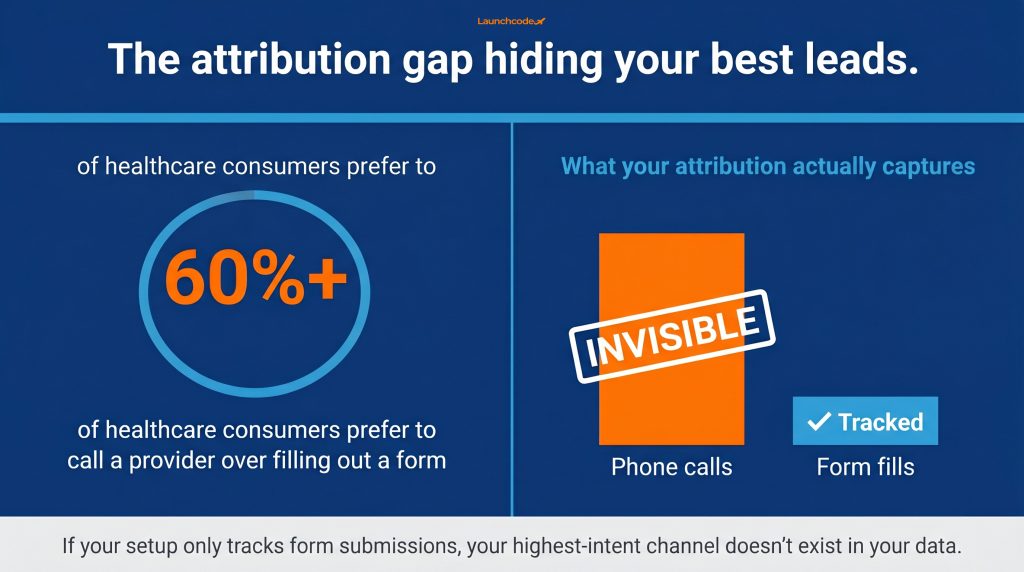
More than 60% of healthcare consumers prefer to call a provider rather than fill out a form when researching care, according to Invoca research cited by Sweet Media. For behavioral health, that number is even higher. If your attribution setup only tracks form submissions, you are missing the majority of your inbound leads and attributing those patients to nothing. Your best-performing channels will look like they are not working.
This is one of the most consistent attribution failures across healthcare marketing accounts. The digital journey looks complete in the CRM. The phone channel is invisible.
Call tracking uses dynamic number insertion (DNI) to solve this problem. A unique phone number is displayed to each website visitor based on how they arrived. A visitor from a Google Ads campaign sees one number. A visitor from organic search sees a different one. When that visitor calls, the platform records which source drove the call, how long the call lasted, and in some cases the outcome of the conversation.
Platforms like CallRail and Invoca integrate directly with Google Ads, Meta Ads, and most healthcare CRMs. Once connected, you can import phone call conversions back into your ad platforms. This lets ad algorithms optimize toward booked appointments, not just clicks or form fills.
Call recording creates a compliance risk if conversations contain protected health information (PHI). Any vendor that stores or processes call recordings for a HIPAA-covered entity must sign a Business Associate Agreement (BAA). Both CallRail and Invoca offer BAAs and HIPAA-compliant recording configurations. Confirm this before activating call recording. The BAA requirement applies regardless of the 2024 court ruling discussed in the next section.
Most healthcare marketing teams do not have a compliant tracking stack. Over 70% of medical practices unknowingly run non-compliant tracking on their websites, according to 2026 analysis from Anzolo Medical. The risk is real. As of 2024, HHS OCR has imposed civil monetary penalties totaling over $144 million in HIPAA enforcement actions. This is not a reason to remove all tracking. It is a reason to audit every script on patient-facing pages and confirm that any vendor receiving patient data has signed a BAA.
The tracking compliance situation in healthcare has shifted several times in recent years. Here is the timeline that matters for marketing teams:
The court ruling vacated the specific guidance document, not HIPAA itself. The core HIPAA Privacy Rule still prohibits sharing PHI with third-party vendors without a BAA. If a tracking tool can connect a user’s behavior to their health condition or identity, that data likely qualifies as PHI. Many states have also enacted consumer health data privacy laws that go beyond federal HIPAA requirements. Consult legal counsel before making changes to your tracking configuration.
Most healthcare ROI calculations are too conservative because they measure the revenue from a single visit against the full cost of acquisition. That math makes almost every channel look expensive. The correct denominator is patient lifetime value (PLV), not visit revenue. When you calculate ROI against a patient’s full relationship with your practice, the economics of healthcare marketing change completely.
Most healthcare patient relationships generate between $10,000 and $20,000 in lifetime value, with some health systems projecting values up to $1.2 million when accounting for all care episodes. A primary care patient visiting twice a year for 10 years at $150 per visit generates $3,000 in direct visit revenue. When you include specialist referrals, diagnostics, and family member acquisitions, the real value often exceeds $15,000.
The LTV:CAC ratio measures how much lifetime revenue you generate for every dollar spent acquiring a patient. A ratio of 3:1 or higher is a healthy benchmark. A ratio below 1:1 means you are spending more to acquire patients than they will ever return in revenue.
With patient acquisition costs ranging from $155 to $610 by specialty and lifetime values exceeding $10,000, most healthcare marketing programs have strong underlying economics. The problem is not that the math fails. The problem is that teams calculate ROI against one appointment, decide the channel is too expensive, and cut budget from programs that were actually working.
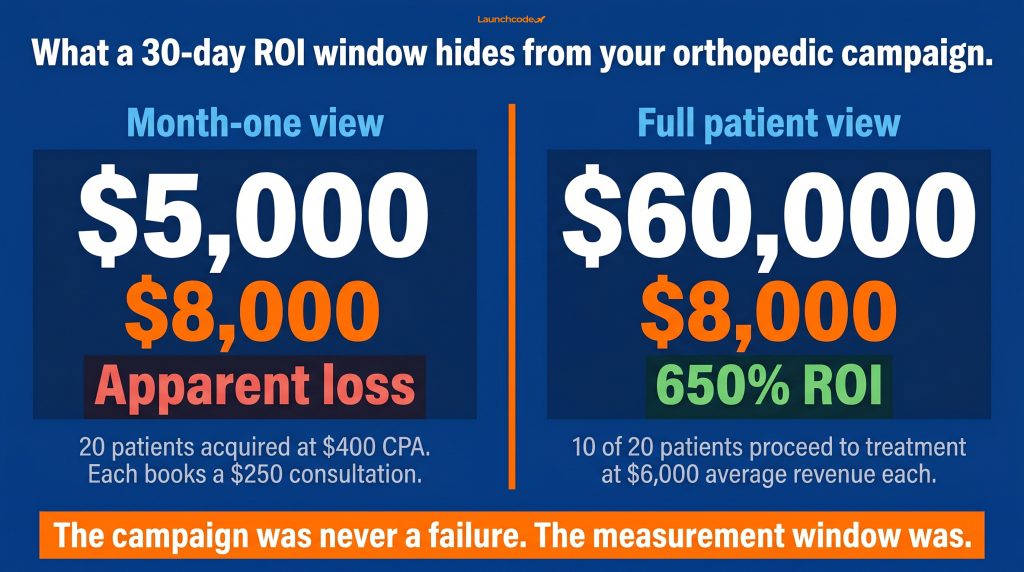
An orthopedic practice runs a Google Ads campaign that acquires 20 new patients at $400 cost per acquisition. Total campaign spend is $8,000. Each patient books an initial consultation at $250, producing $5,000 in month-one revenue. On paper, the campaign looks like a loss.
Extend the view. Each orthopedic patient who proceeds to treatment generates an average of $6,000 in surgical and follow-up revenue. If 10 of the 20 patients proceed, revenue from that cohort reaches $60,000 against the original $8,000 investment. The ROI is 650%. The campaign was never a failure. The measurement window was.
Accurate healthcare marketing ROI requires data from at least three systems to connect cleanly: your ad platforms, your CRM, and your practice management or EHR system. When those systems do not share data, attribution will always be incomplete. A typical enterprise healthcare brand runs campaigns across 15-25 platforms simultaneously, each generating metrics in its own schema with no unified view. Closing that loop is the core technical challenge of healthcare attribution.
“Most practices we audit are running three or four disconnected systems. The data exists. The problem is that nobody has connected the dots between ad clicks, phone calls, and patient records. Once those systems talk to each other, the ROI picture changes fast.” Derick Do, Co-Founder & Chief Product Officer
For a practice that wants to move from broken attribution to reliable measurement without a full enterprise data warehouse build, these are the core components:
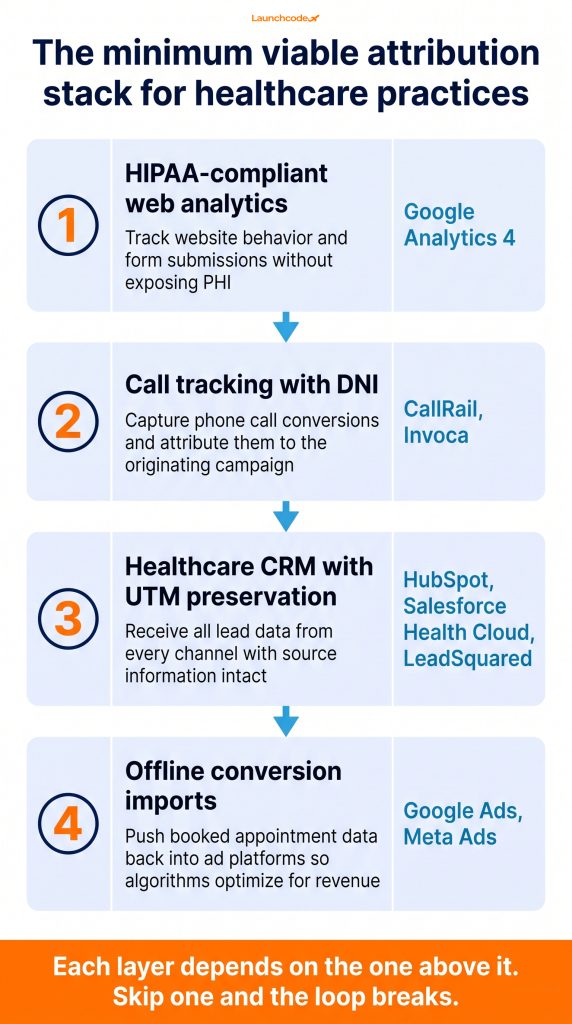
The final step, and the hardest, is connecting CRM lead data to EHR appointment and revenue data. This is where closed-loop reporting becomes possible: a campaign drives a click, the click creates a call, the call books an appointment, the appointment generates revenue, and every step traces back to the originating campaign.
Platforms like Epic and Cerner offer API access that most enterprise marketing teams can connect to via a middleware layer or a marketing data warehouse tool like Improvado. For smaller practices, a simpler approach is a weekly export from the practice management system matched against CRM lead records by phone number. It is not a perfect system, but it closes the loop well enough to support attribution decisions with confidence.
As Cured Health notes: ROI falls apart when marketing, access center, and clinical data are not connected. Integrate those systems and you finally see the full picture.
The data you collect only protects your budget if you present it in a format that non-marketing leaders understand. Most marketing reports are built for marketing teams. They contain channel-level CTRs, impression share, and quality scores that mean nothing to a CFO. Leadership needs three numbers: how much was spent, how many patients were acquired, and what revenue did those patients generate.
Ewan McIntyre, VP Analyst and Chief of Research at Gartner, noted in the 2025 CMO Spend Survey that marketing spending has stalled at a level that falls short for many CMOs. Fifty-nine percent of CMOs reported budgets insufficient to execute their strategy. Teams that can demonstrate clear, consistent ROI measurement are in a materially stronger position than those that cannot.
Build a one-page executive summary alongside your detailed channel reports. Structure it like a finance document, not a marketing dashboard.
Include these components:
Lead with those numbers. Move CTR, impressions, and engagement metrics to an appendix for teams who want to dig deeper.
Present this data on a consistent schedule, every month or every quarter. The first month of accurate ROI reporting is interesting. The sixth month of consistent reporting with clear trends is credible. That credibility is what secures budget during difficult planning cycles and stops marketing from being treated as a cost center instead of a revenue driver.
Healthcare marketing ROI is solvable. The barriers are not technical complexity or data scarcity. They are measurement habits that prioritize activity over outcomes, attribution models that do not match how patients actually behave, and reporting that speaks marketing language to finance audiences.
Fix it in sequence. Audit your tracking stack for compliance and completeness. Set up call tracking with DNI and import offline conversions to your ad platforms. Rebuild ROI calculations around patient lifetime value, not single-visit revenue. Calibrate attribution windows to match your service line conversion cycles. Then present the resulting data in terms a CFO can act on.
Each step produces measurable improvement. Practices that invest in connected measurement report better, make smarter budget decisions, identify their highest-value acquisition channels faster, and scale the programs that actually produce patients.
If you want help building the data infrastructure behind closed-loop healthcare marketing measurement, our marketing data infrastructure services are built for this kind of engagement.
Divide the total revenue attributed to a campaign, calculated using patient lifetime value rather than single-visit revenue, by the total cost of that campaign. Subtract one and multiply by 100. Include all campaign costs: ad spend, agency fees, software subscriptions, and staff time. Use multi-touch attribution to distribute revenue credit across all touchpoints, not just the last click.
Google Analytics 4 does not offer a BAA. GA4 should not receive any data that could qualify as protected health information, including appointment types, page URLs that reveal health conditions, or user identifiers linked to patient status. Meta Ads similarly does not offer a BAA. Configure both platforms to exclude PHI, and for any tracking that must touch patient data, use a HIPAA-compliant analytics alternative with a signed BAA in place.
Dynamic number insertion (DNI) swaps the phone number displayed on a website based on how a visitor arrived. Each traffic source sees a unique number, so when a patient calls, the call tracking system identifies exactly which campaign, keyword, or channel drove that call. Without DNI, phone calls generate no attribution data. Since the majority of patients contact a practice by phone, that blind spot makes accurate ROI calculation nearly impossible.
It depends on the service line. Primary care works with 7-14 days. Cosmetic and elective dental procedures need 14-30 days. Specialty referrals and surgical consultations require 60-90 days minimum, and for elective surgeries like orthopedics or bariatrics, extend to 90-180 days. Using a standard 30-day window across all service lines will systematically undercount conversions for longer-cycle services and cause campaigns to be cut before they show results.
A ratio of 3:1 or higher is the standard benchmark. Every dollar spent acquiring a patient should return at least three dollars in lifetime revenue. Most healthcare service lines have the economics to achieve this, but the ratio only produces useful guidance when lifetime value rather than single-visit revenue is used in the calculation.


Real stories from the people we’ve partnered with to modernize and grow their marketing.