Share:

AI marketing & automation


You heard the update is live, or you opened Search Console and saw a dip. Now you need two answers fast. Did this update touch your site, and what should you do about it.
This guide gives you the confirmed facts, a clear way to separate the spam update from the May core update, a tactic by tactic audit, and a realistic recovery timeline. Everything reflects what Google has published as of June 24, 2026.
Google released the June 2026 spam update on June 24. The Search Status Dashboard logged the rollout at 9:00 a.m. PT, with the release note posted at 9:03 a.m. PDT. The update applies globally and to all languages and may take a few days to complete. It is the second confirmed spam update of 2026 and arrives with no new spam policies attached.
A spam update sharpens Google’s automated spam detection. As Search Engine Journal reported on the rollout, this looks like a standard update rather than a broader policy shift. The dashboard note is the only confirmation so far, with no companion blog post. In the official note carried by Search Engine Land, Google wrote that the update applies everywhere and may take a few days to roll out.
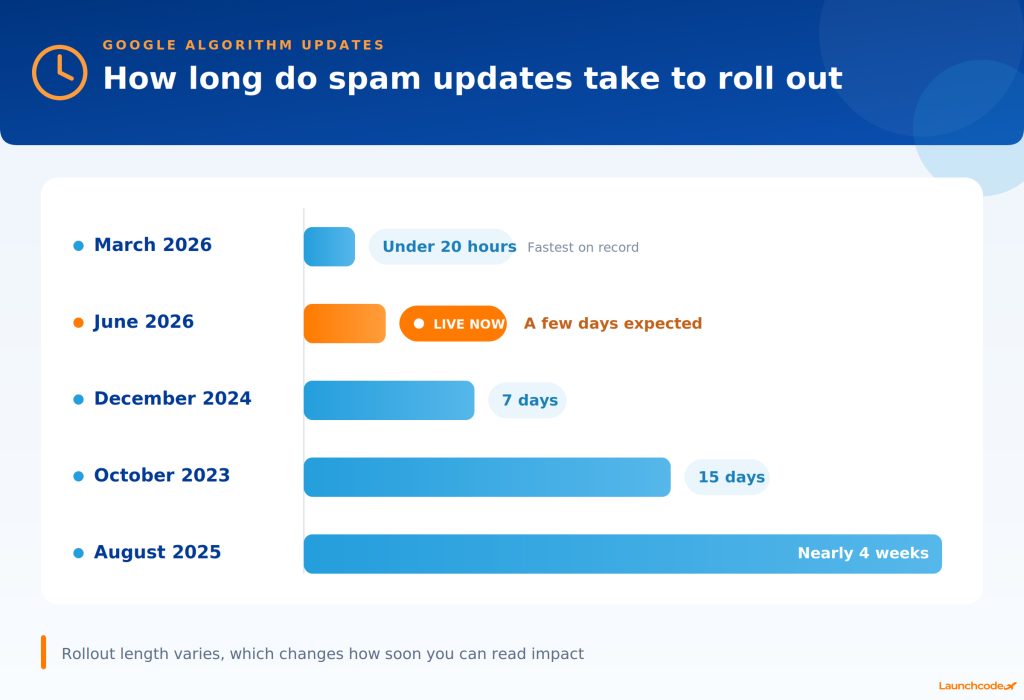
Rollout length varies a lot, which affects how soon you can read the impact.
| Spam update | Rollout length |
|---|---|
| June 2026 | In progress, a few days expected |
| March 2026 | Under 20 hours, fastest on record |
| August 2025 | Nearly four weeks |
| December 2024 | 7 days |
| October 2023 | 15 days |
Those past timings come from Google dashboard data summarized by Justia. Note June 24 in your own reporting so you can separate this update from anything that follows it.
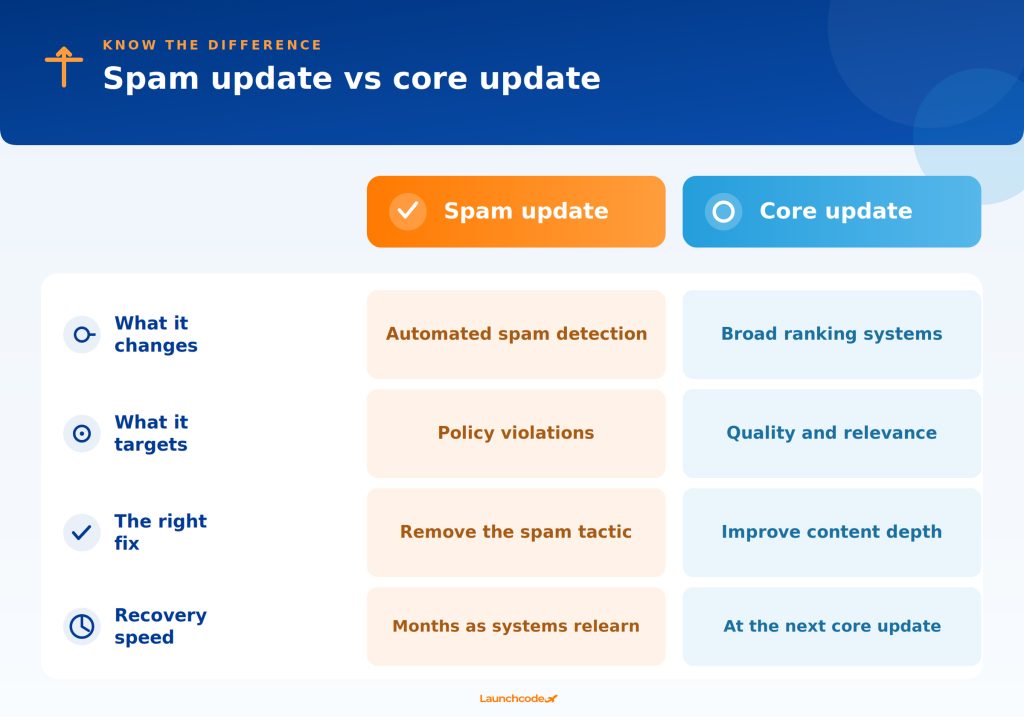
A spam update targets policy violations through systems like SpamBrain, Google’s AI based spam prevention system. A core update is a broad change to ranking systems that weighs overall quality and relevance. The two need different responses. You fix spam by removing the violating tactic. You improve core update performance by raising content quality, not by chasing a quick patch.
This matters in June 2026 because three events overlap. The May 2026 core update ran from May 21 to June 2, almost twelve days. Search analyst Glenn Gabe of GSQI called it stronger than the March update. There was also unconfirmed volatility reported by Barry Schwartz of Search Engine Roundtable around June 19, which appeared to hit spam tactics harder than clean sites. Mixing these together leads teams to fix the wrong problem.
| Factor | Spam update | Core update |
|---|---|---|
| What it changes | Automated spam detection | Broad ranking systems |
| What it targets | Policy violations | Quality and relevance |
| The right fix | Remove the spam tactic | Improve content depth |
| Recovery speed | Months as systems relearn | Often at the next core update |
Google’s own spam updates documentation confirms this split and explains that detection improvements can take months to reassess a site.
Confirm impact with data, not anecdote. Mark June 24, wait for a clean window, then compare Search Console performance before and after the date by page and query. Check the manual actions report. Rule out demand shifts and the May core update before you blame the spam update. Most sites that follow Google policy will see little or no change.
“When a client panics over a dip, we pull the 28-day Search Console comparison by query before touching anything. Most of the time the drop traces to the May core update or seasonal demand, not the spam pass.” Tanner Medina, Co-Founder and Chief Growth Officer
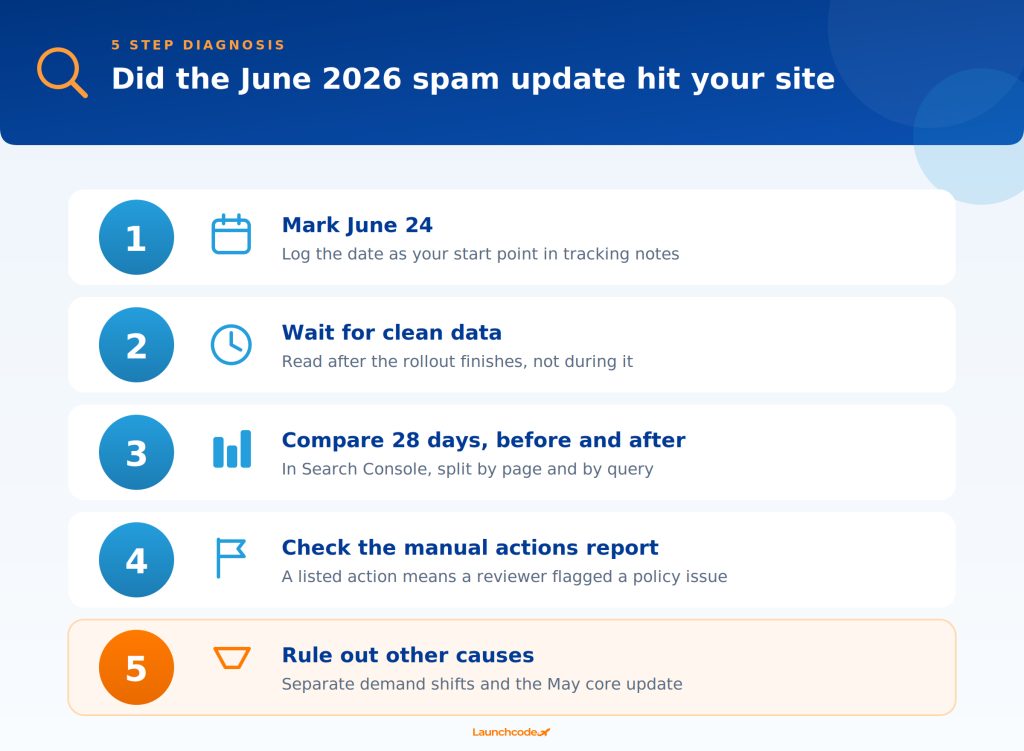
Many teams react to volatility tracker readings alone. Tools like Semrush Sensor and Mozcast sample high volume keywords, so a spam-focused movement that demotes risky sites can stay quiet in the tools while forums light up. Trust your own Search Console data over a generic turbulence score.
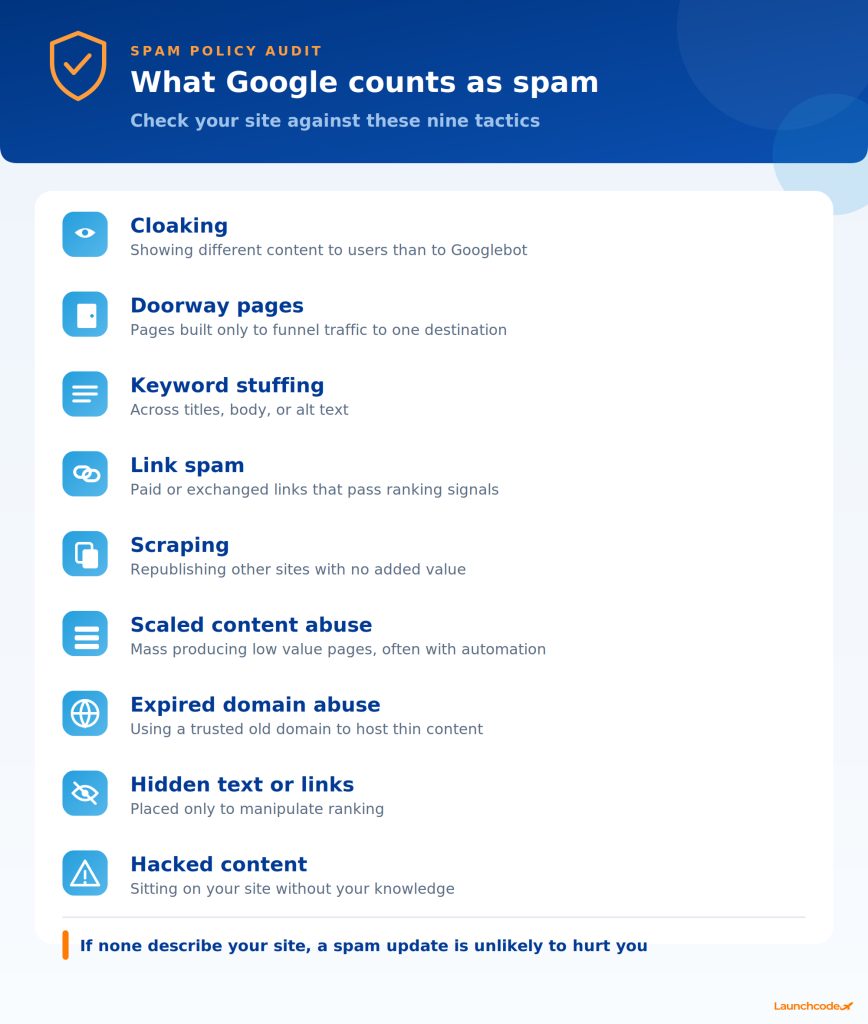
Google’s spam policies name specific behaviors, not vague quality issues. The list includes cloaking, doorway pages, keyword stuffing, link spam, scraping, scaled content abuse, expired domain abuse, hidden text or links, and hacked content. If none of these describe your site, a spam update is unlikely to hurt you. If one does, that is where recovery starts.
Use this as an audit checklist against your own site:
Google warns that repeated or serious violations can trigger automated and manual actions, up to full removal from results. Fixing the issue removes the violation, but ranking benefit gained from spammy links is lost for good once Google discounts those links.
On May 15, 2026, Google expanded its spam policy to state that spam includes attempting to manipulate generative AI responses in Google Search. This was the first time AI manipulation was named directly. Tactics built to force visibility in AI Overviews or AI Mode, such as recommendation poisoning and biased listicles, now carry the same demotion risk as classic ranking spam.
This change predates the June 24 rollout, but it sets the framework you will be judged against. As Search Engine Land documented when the policy changed, the new clause folds aggressive generative engine optimization into the existing spam definition.
Clean ranking still protects AI visibility. A May 2026 analysis by Cyrus Shepard, reported by Winbuzzer, scored 23 factors across 54 studies and found that classic search rank predicted AI citation at 9.4 out of 10, second only to URL accessibility. So the same work that keeps you compliant on blue links also keeps you visible in AI answers. This is why we pair traditional SEO with generative engine optimization built on clean signals rather than manipulation.
“We tell clients to drop any tactic that only exists because AI Overviews exist. If a page would not make sense without the AI surface, it now reads as spam to Google, and the 9.4 citation link to rank means clean ranking work covers AI visibility anyway.” Tanner Medina, Co-Founder and Chief Growth Officer
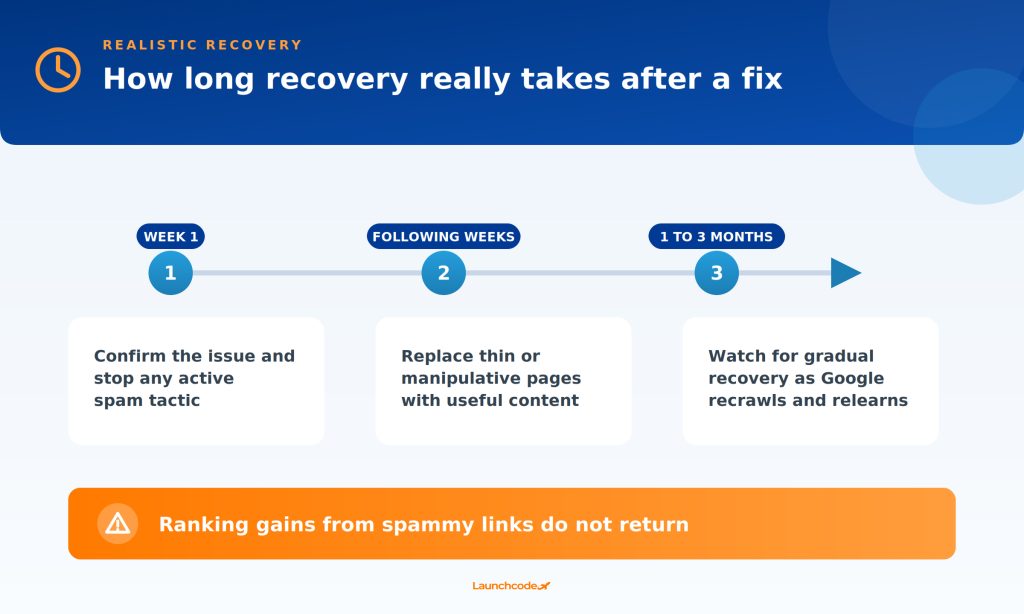
Recovery is slow by design. Google says its systems may take months to reassess a site after you fix a spam problem, so a fast bounce back is not the expectation. Make genuine changes, document them, and measure across the next rollout cycle rather than day to day. Sites built on durable, policy-clean content rarely need this process at all.
A realistic timeline looks like this. In week one, confirm the issue and stop any active spam tactic. In the following weeks, replace thin or manipulative pages with content that serves a real user need. Over the next one to three months, watch for gradual recovery as Google recrawls and relearns. Remember that link-based gains tied to spammy links do not return.
“We build content and link systems that pass the spam policy checklist on day one. The accounts we run on those systems watched the March 2026 update finish in under a day with zero movement, so update weeks become a dashboard check instead of a rebuild.” Derick Do, Co-Founder and Chief Product Officer
The durable answer is structural. Teams that maintain content systems designed to survive algorithm updates spend update weeks watching dashboards, not rebuilding sites. That stability is the real protection against every future spam and core update.
The June 2026 spam update is routine enforcement, not a new rulebook. Your job this week is calm and specific. Mark June 24, open a clean comparison window in Search Console, and audit your site against Google’s named spam tactics. If you find a violation, fix the cause and expect a recovery measured in months. If you find nothing, keep publishing useful content and let the rollout finish.
The strongest position is the one you build before an update lands. Clean links, real expertise on the page, and content that answers genuine questions protect both your rankings and your place in AI answers. That foundation turns each Google update into a non-event.
This article reflects information confirmed as of June 24, 2026 and will be updated when Google marks the rollout complete. Ranking guidance here supports good decisions but does not guarantee recovery, since outcomes depend on your site and Google’s systems.
No. It improves automated spam detection like SpamBrain. A core update changes broad ranking systems. The two need different fixes.
Google said a few days. Past spam updates have ranged from under 20 hours in March 2026 to nearly four weeks in August 2025.
No. Google announced no new policies with it. The live framework, including the May 15 AI manipulation clause, still applies.
Mark June 24, wait for clean Search Console data, compare performance by page and query, and check the manual actions report before you change anything.
Usually not. Google says reassessment can take months, and ranking gains from spammy links cannot be regained.


Real stories from the people we’ve partnered with to modernize and grow their marketing.