

Share:

AI marketing & automation


Most ad budgets leak. The source is not targeting or bidding. It is launching creatives with no system for knowing what works or why. Teams guess. They refresh when results drop. They repeat the cycle without ever building real knowledge about their audience.
A creative testing framework solves this. It replaces gut decisions with structured experiments. Every ad becomes a data point. Every test teaches your team something about the message, format, or hook your audience responds to. This article covers the full process: writing a hypothesis, structuring test campaigns, reading results accurately, scaling winners, and building a creative library that compounds with every campaign.
A creative testing framework goes beyond A/B testing. It is a structured system that covers ideation, hypothesis writing, test design, result analysis, and documented learning. A/B testing is one method inside that system. Without the surrounding structure, individual tests produce noise instead of knowledge.
Most teams run A/B tests reactively. An ad underperforms, so they swap in a new image or change the headline and call it a test. That is not a framework. A framework starts before a single asset goes into production. It defines what you are testing, why, what success looks like, and how the result informs the next decision.
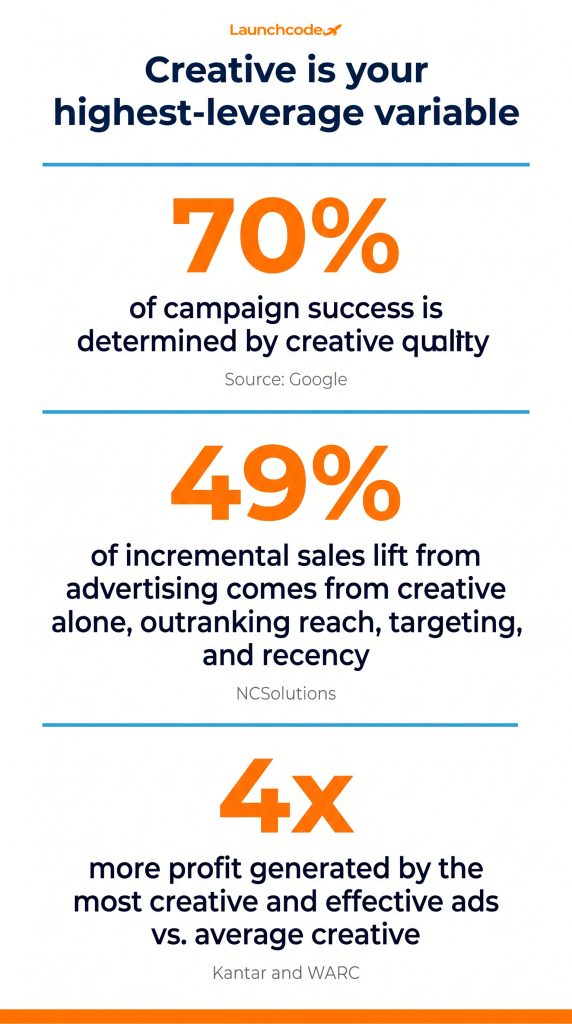
NCSolutions research based on nearly 450 CPG campaigns found that creative accounts for 49% of incremental sales lift from advertising, more than reach, targeting, and recency combined. Google attributes 70% of campaign success to creative quality. Creative decisions are your highest-leverage optimization activity. Treating them as guesswork is expensive.
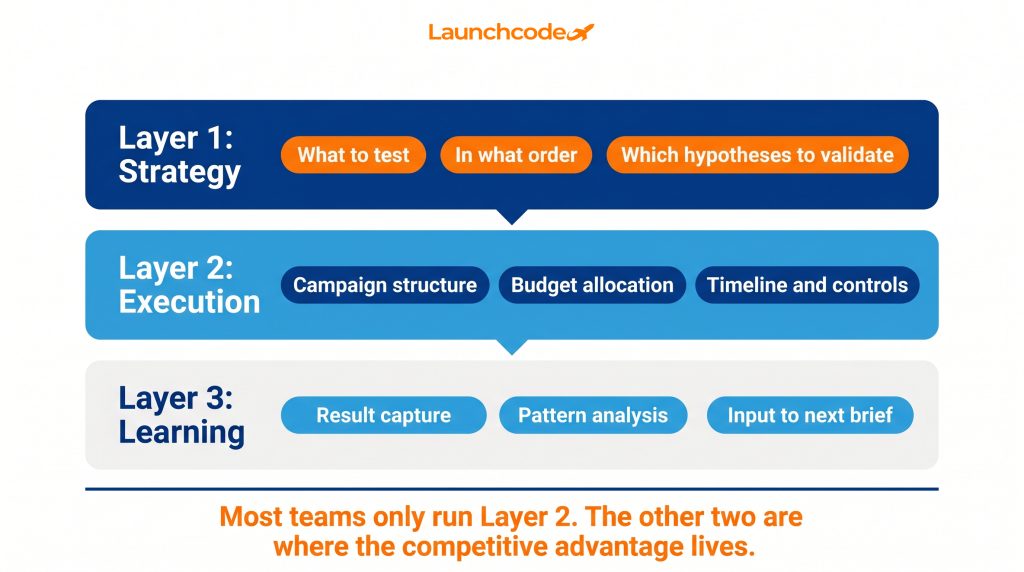
A complete creative testing framework operates across three layers.
Most teams only run layer two. They set up tests but skip the hypothesis and the learning log. The result is a lot of data and very little compounding knowledge.
The most common creative testing mistake is running multiple variations with no documented rationale and no isolated variables. When an ad wins, the team cannot explain what drove the result. When it loses, they have no idea what to change.
A team that runs 20 creative variants with no hypothesis and no isolation gets one useful output: a winner. A team that runs five variants with documented hypotheses gets a winner and a body of learning about why it won. The second team is building an asset. The first is just running ads.
Every test must begin with a written hypothesis before any asset goes into production. The format is: “We believe [specific change] will produce [measurable outcome] because [reason based on data or audience insight].” Without this, there is nothing to validate or falsify, and each test produces a result with no transferable learning.
Writing the hypothesis forces clarity before production starts. It requires your team to state what they believe, why they believe it, and what metric will confirm or disprove it. This changes how you read results. Instead of asking which ad won, you ask whether the outcome matched the prediction and what that tells you about the audience.
Here are two examples that show the difference clearly.
Weak: “Let’s test a video against a static image and see what happens.”
Strong: “We believe a 15-second UGC testimonial video will outperform a polished product static by at least 20% on purchase conversion rate, because post-purchase survey data shows that social proof is the primary driver of first purchase decisions for this audience.”
The second example names the format, the metric, the threshold, and the rationale. It is testable. It is falsifiable. It produces a clear learning regardless of outcome.
CreativeOS formalizes this template as: “We believe that [specific creative change] will [expected outcome] because [reasoning based on data or insight].” Use it as a standard before every test brief.
“Most teams over-engineer the production and under-engineer the brief. A concept test with three distinct angles tells you more about your audience in two weeks than six months of refining a single direction.” Georgia Callahan, Executive Creative Director
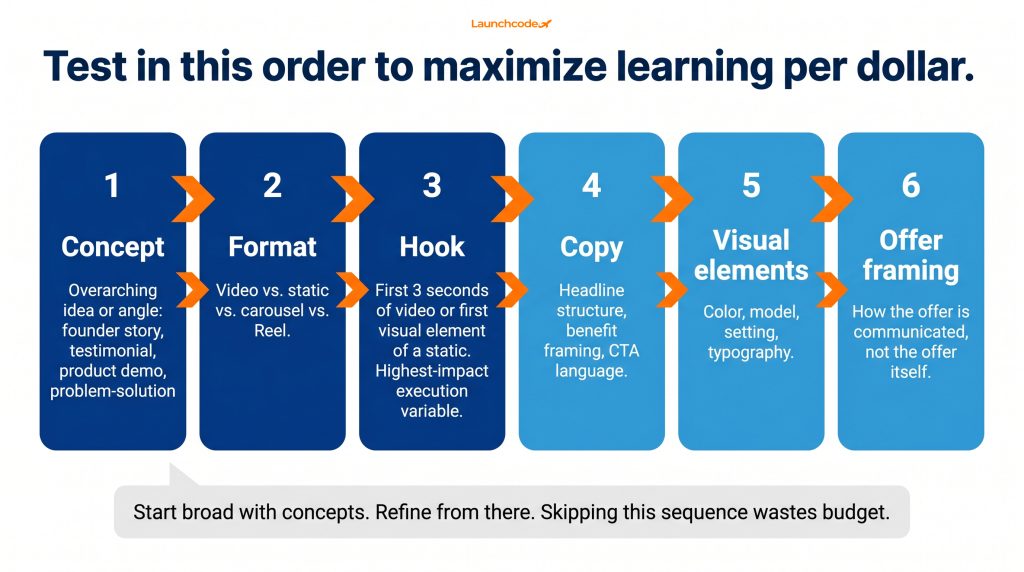
Not all hypotheses carry equal weight. Test in this order to maximize learning per dollar spent.
This sequence ensures the highest-impact decisions come first. Each stage builds on what the previous one proved.
Test fundamentally different creative ideas before you optimize any single idea. Running five versions of the same hook is variation testing. Running a founder story, a testimonial, and a product demo against each other is concept testing. Concept tests produce the largest learning per dollar. Run them first.
This is the step most teams skip. They already have a creative direction and want to refine it. If the concept itself is wrong, no hook variation or copy tweak will fix the underlying problem. Concept testing identifies the strongest angle first. Variation testing then extracts more performance from it.
Use Ad Set Budget Optimization (ABO) for concept testing. ABO assigns each concept a fixed, equal daily budget so the algorithm cannot starve one variant before the test reaches reliable data. Running concept tests under Campaign Budget Optimization (CBO) risks having Meta’s algorithm pick a winner within hours based on early signals rather than statistical evidence.
| Test type | Campaign structure | Budget method | Best for |
|---|---|---|---|
| Concept test | Separate ad sets per concept | ABO with equal daily budget | Finding the strongest angle |
| Variation test | Multiple ads in one winning ad set | ABO or DCO | Refining execution within a proven concept |
| Scaling | Advantage+ Shopping Campaign | Algorithmic | Amplifying validated winners |
Keep concepts genuinely distinct. As Pilothouse Digital documented in their analysis of Meta’s Andromeda system, the platform groups similar-looking ads through its Lattice entity clustering system. Ads that look or sound alike compete for a single auction slot. Distinct concepts get distinct distribution. Variety is not a creative preference here. It is an algorithmic requirement.
Never test new creative against established winners. Proven BAU (Business as Usual) ads carry accumulated optimization signals, social proof, and pixel data that new ads simply do not have. Always run new creatives against each other in the pre-flight phase. Confirm the best new concept before you bring it into a challenger test against your current control.
Clean test results require campaign isolation, equal budget distribution, and controlled variables. Mix a creative test into a live campaign and the data becomes unreliable. The platform’s optimization engine will skew spend toward the early leader, and you will declare a winner based on algorithm preference, not creative quality.
Use ABO during the testing phase. Set a fixed daily budget per ad set, typically $50 to $150 depending on account size and target CPA. Each ad set should contain one creative variant with identical audience, placement, and objective settings. This structure gives each concept equal exposure before the algorithm influences delivery.
Use CBO once a winner is validated. At that point, you want algorithmic optimization working in your favor, not working around a controlled test environment.
AdManage.ai recommends allocating 10 to 20% of total ad budget to ongoing creative testing. Treat this as R&D spend. It keeps a pipeline of validated creative flowing without disrupting proven campaigns.
For most accounts, testing three to five creative variants at a time is the right range. Testing fewer limits learning and slows the cycle. Testing more fragments the budget and prevents any single variant from reaching statistical significance. Meta’s own behavior confirms the risk: when too many ads load into one ad set, the algorithm typically distributes nearly all spend to one or two early favorites and starves the rest.
Name test campaigns with a consistent convention. For example: “Creative Test | Testimonial vs. Demo | Reel | May 2025.” This makes filtering and retrospective analysis faster when you review the learning log months later.
Before launch, document the hypothesis, creative asset IDs, audience, budget, and start date. This record is the first entry in your creative knowledge base and the reference point you use when analyzing results.
Do not declare a winner until you have statistically significant data. A 100% lift from two conversions to four conversions is not a result. It is noise. Define the success metric and the minimum performance threshold in the hypothesis before the test runs, then hold to that standard when results arrive.
Not every metric predicts the same outcome. Use this hierarchy based on campaign objective.
For B2B and lead generation campaigns, qualified lead rate and downstream pipeline value matter more than CTR or raw CPL. A creative driving 40% lower CPL from unqualified contacts is not a winner.
“The biggest mistake I see is teams declaring winners on CTR before they have conversion data. The hook got the click. That tells you nothing about whether the message actually converted.” Olivia Tran, AVP of Media Services
Watch for these errors when analyzing test data.
As Supermetrics notes in their ad creative testing guide, data tells you what happened. Your job is to understand why. The why is what becomes reusable learning for the next round.
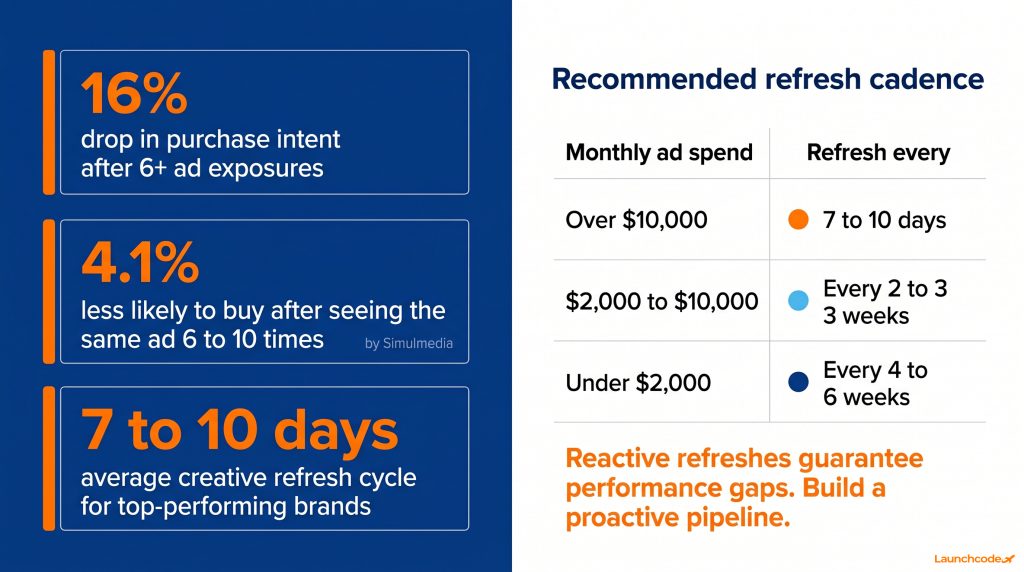
All winning ads stop winning. Purchase intent drops roughly 16% once a user sees the same ad six or more times, according to Meta research cited by AdManage.ai. Top brands rotate in new creative every 7 to 10 days to stay ahead of that decline. Waiting for results to crash before refreshing guarantees performance gaps that cost more to recover from than to prevent.
Creative fatigue hurts performance and damages brand perception. Simulmedia research found that people who see an ad 6 to 10 times are 4.1% less likely to purchase than those who saw it 2 to 5 times. Push past 11 exposures and the negative effect compounds further.
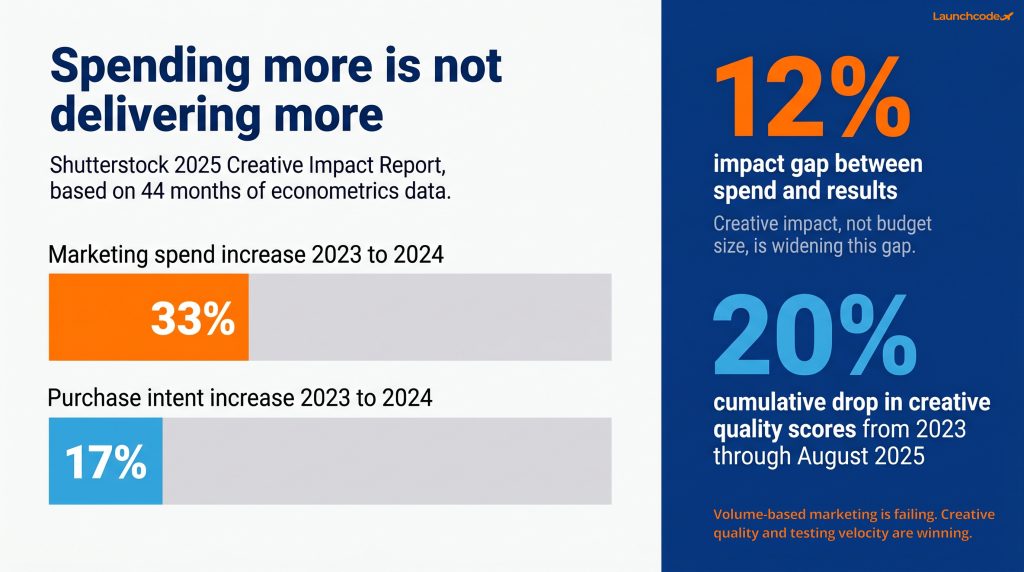
The Shutterstock 2025 Creative Impact Report adds another data point: between 2023 and 2024, marketing spend grew 33% but purchase intent only increased 17%. Spending more without rotating smarter is a losing strategy.
Watch for these early signals before CTR collapses.
Meta now surfaces fatigue alerts in Ads Manager for some campaign types, a feature that appeared in late 2024. These warnings can flag burnout risk before a campaign launches. Use them as an early signal, but do not rely on them exclusively. Active monitoring of the metrics above catches fatigue faster.
| Account monthly spend | Recommended creative refresh |
|---|---|
| Over $10,000 | Every 7 to 10 days |
| $2,000 to $10,000 | Every 2 to 3 weeks |
| Under $2,000 | Every 4 to 6 weeks |
The goal is to always have tested, validated creative queued before current runners fade. A reactive refresh cycle, where production starts after performance drops, guarantees a gap. A proactive pipeline eliminates it.
Meta’s Andromeda system reads your creative assets as targeting signals. It uses visual recognition and messaging analysis to find the right audience for each ad. Creative differentiation is now an algorithmic requirement. Ads that look too similar are grouped by the Lattice entity clustering system and compete for one auction slot instead of reaching different audience segments.
Andromeda can process and trial up to 5,000 ads per week across an account. That scale rewards brands that produce diverse, distinct creative and penalizes those running minor variations of the same concept. Testing similar iterations wastes budget and disrupts the learning phase because the platform cannot differentiate the concepts.
Creative concepts need to differ meaningfully across at least one major dimension.
Minor surface changes, such as a different button color or a slightly reworded CTA on an identical visual, are not distinct concepts to Andromeda. They will be clustered and treated as one. One brand testing 12 distinct hook variations on Reels, as documented by AdAmigo.ai, found that a before-and-after testimonial format produced a 41% improvement in CTR over their control and allowed them to scale without losing ROAS. That result was only visible because the concepts were genuinely different.
TikTok’s algorithm is almost entirely creative-driven and rewards native-feeling content. Polished brand ads consistently underperform raw creator-style videos on the platform. Google’s responsive search and display tools test asset combinations at scale automatically, but concept-level direction still requires human judgment. The principles of hypothesis-driven testing apply across all platforms, even when the execution mechanics differ.
AI does not replace creative strategy. It compresses the time between hypothesis and test-ready asset. Teams using AI tools to generate and analyze creative variants produce 20 to 50% more experiments per month than teams working manually. More experiments mean faster learning cycles and more actionable data per quarter.
The Shutterstock 2025 Creative Impact Report identified that volume-based marketing is failing as content saturation grows. The teams pulling ahead are those combining creative quality with testing velocity, not simply spending more.
AI tools support three phases of the creative testing workflow.
Patrick Gatterbauer, cited in Motion’s research on ad fatigue, describes the principle directly: “Think in modules. The structure guides you. When you have the raw data, you can cut it however you want. This allows you to easily iterate and avoid guesswork.”
Modular creative means producing ads as interchangeable components. Multiple hooks, multiple body sections, multiple CTAs, and multiple visual treatments built separately so they can be mixed, tested, and swapped without restarting production for each new variant. This approach supports high-volume testing without proportional increases in production cost. It also feeds Andromeda the creative diversity it rewards with efficient distribution.
The real output of a creative testing framework is not a single winning ad. It is an accumulating body of knowledge about what your audience responds to and why. Each test adds a data point. Over time, those points reveal patterns. Those patterns inform better briefs, reduce wasted tests, and improve the hit rate on new concepts before they launch.
Connor MacDonald, Head of Growth Marketing at Ridge, puts the operational mindset clearly: “If performance is far from where we need it to be, we need to be taking larger, net-new swings.” A knowledge base makes those swings smarter because it eliminates directions already proven to underperform.
Maintain a shared testing log with these fields for every experiment.
Review the log quarterly. Over time you will see which concept types consistently outperform, which hooks hold the longest before fatigue, and which formats drive results for each audience segment. This log is a competitive asset most teams never build.
For agencies managing multiple accounts, the knowledge base becomes more valuable with each client added. Learnings from one account inform creative briefs for others in the same vertical. Hook types that prove effective for a B2B SaaS brand may transfer to a professional services client. Not every insight generalizes, but every insight is worth reviewing against the next brief.
At Launchcodex, creative sprint documentation sits alongside campaign reporting so creative learnings and media data are reviewed in the same workflow, not in separate silos. That structure is what turns individual test results into a compounding creative system.
Kantar and WARC research, matching 450 ads from the Kantar Link database against WARC profit ROI figures, found that the most creative and effective ads generate more than four times the profit of average creative. The brands achieving that multiple are not spending more. They are learning faster and applying those learnings consistently across every campaign.
A creative testing framework pays off through repetition. Teams that test randomly, refresh reactively, and document nothing are always starting over. Teams with a working framework build on every campaign they run.
The core habit is straightforward. Write the hypothesis before production starts. Structure the campaign for clean data. Read results against the original prediction. Log the learning. Feed it into the next creative brief. Repeat on a fixed cadence.
Platforms will keep evolving. Meta’s Andromeda is already making creative differentiation a technical requirement. CPMs rose more than 18% in early 2025, according to AdAmigo.ai benchmark data, particularly in competitive verticals like fashion and beauty. When media costs rise, creative efficiency becomes the primary lever for protecting margin. The brands scaling in that environment are the ones treating every ad flight as a structured experiment that informs the next one.
Build the system. The winning ads will follow.
A creative testing framework is a repeatable system for evaluating ad creative through structured experiments. It covers hypothesis writing, test design, campaign structure, result analysis, and documented learning. It differs from general A/B testing because it includes the strategy and learning infrastructure around each test, not just the test itself.
For most accounts, three to five creatives per test is the right range. Testing fewer limits learning and slows the cycle. Testing more fragments the budget and prevents statistically reliable results. High-spend accounts above $50,000 per month can test more variants if budget is properly structured across isolated ad sets using ABO.
Concept testing compares fundamentally different creative approaches, such as a testimonial vs. a product demo vs. a founder story. Variation testing refines execution within a proven concept, such as three different hooks inside a winning testimonial format. Always run concept tests first. Variation testing only compounds value once the right concept is confirmed.
Watch for CTR declining while frequency rises, CPMs increasing with no targeting changes, and video completion rate dropping on previously strong ads. Purchase intent drops roughly 16% after six or more exposures. Top brands refresh creatives every 7 to 10 days at high spend levels. Build a tested pipeline so replacements are ready before results fall.
Andromeda reads creative assets as targeting signals and clusters ads that look too similar through its Lattice system. Similar ads compete for one auction slot instead of reaching different audience segments. Each creative variant must differ meaningfully in angle, format, or emotional frame, not just surface details like button color or slightly reworded copy.
Use ABO (Ad Set Budget Optimization) during testing phases. It gives each variant a fixed, equal budget so the algorithm cannot skew delivery before the test has enough data. Switch to CBO (Campaign Budget Optimization) after a winner is validated and you want algorithmic delivery optimization at scale.
Allocate 10 to 20% of total ad budget to ongoing creative testing. This funds a continuous pipeline of new creative without pulling budget from proven campaigns. Treat it as R&D spend that protects future performance, not a cost against current results.


Real stories from the people we’ve partnered with to modernize and grow their marketing.