

Share:

AI marketing & automation


B2B buying has shifted faster than most sales pipelines. Buyers self-educate across content, tools, and AI assistants, while reps still work a linear sequence that assumes scheduled demos and long email threads in a traditional CRM.
This gap creates slow response times, lost intent, and crowded queues of unprioritized deals. In this article, you will learn how to rebuild your B2B sales pipeline for an AI-first world, so your team moves faster, focuses on real opportunities, and gives buyers the control they expect without losing human judgment or forecast visibility.
AI is reshaping B2B sales because buyers want self-service and low friction, while leadership expects higher productivity from lean teams. The result is an AI-first pipeline where models qualify, enrich, and route work, and humans focus on discovery, deal strategy, and complex decisions instead of manual tasks and reporting.
LinkedIn and vendor studies show that more than half of sales professionals already use AI in their workflows, and that AI adopters are more likely to hit or exceed quota. At the same time, research from firms such as McKinsey and Bain links AI in sales to higher revenue growth and better forecast accuracy when teams pair it with clean data and strong processes.
For most revenue leaders, the question is no longer if AI belongs in the sales process. The questions are where to start, which pipeline stages to redesign first, and how to protect trust while you automate. The goal is not to replace reps. The goal is to build a pipeline that reflects how buyers decide today, and that uses AI to remove friction at every stage.
Main shifts that pressure traditional pipelines:
“Most teams come to us with the same problem. Their buyers move faster than their pipeline does. AI is the only way to close that gap without burning out the sales team.”
Marcus Nguyen, AVP, Sales

Before you introduce new AI tools, you need a clear view of how your pipeline works today. The fastest wins come from fixing broken handoffs, incomplete data, and unclear ownership, then adding AI to support what works instead of masking underlying problems with automation.
Start with one clear exercise. Map your current pipeline from first signal to closed deal. Include channel, owner, data fields, and tools for each stage. Look for:
Then quantify the impact. For example, measure time to first response for inbound requests, no-show rates for demos, and time from proposal to signature. These metrics show where friction lives today, and where AI can help.
A simple readiness checklist:
Launchcodex often starts AI work with this kind of diagnosis, then uses our AI automation and workflow systems program to design flows that fit the reality of your pipeline instead of an idealized diagram.
“Healthy AI work starts with honest pipeline math. If your data is messy, no model will save your forecast.”
Brittany Charles, SVP, Client Services
An AI-first pipeline keeps the same high-level stages, but each stage has machine-readable criteria, clear triggers, and defined AI jobs. AI handles enrichment, scoring, and orchestration, while humans handle judgment, negotiation, and deal strategy. The result is a pipeline that is observable, testable, and easier to improve.
You do not have to invent a new funnel. Most B2B teams can keep familiar stages such as Lead, MQL, SQL, Opportunity, and Closed. The change is at the level of fields, triggers, and workflows.
For each stage, define three things:
Example AI-first stage design:
For most teams, this redesign pairs well with internal assistants that support reps. For example, Launchcodex often builds internal GPT-style tools that draft follow-ups, summarize calls, and propose next steps, then connects them to the CRM with AI marketing automation workflows.
“AI only works in the pipeline when reps can see that it protects their selling time. We design around their day first, then layer models on top.”
Marcus Nguyen, AVP, Sales
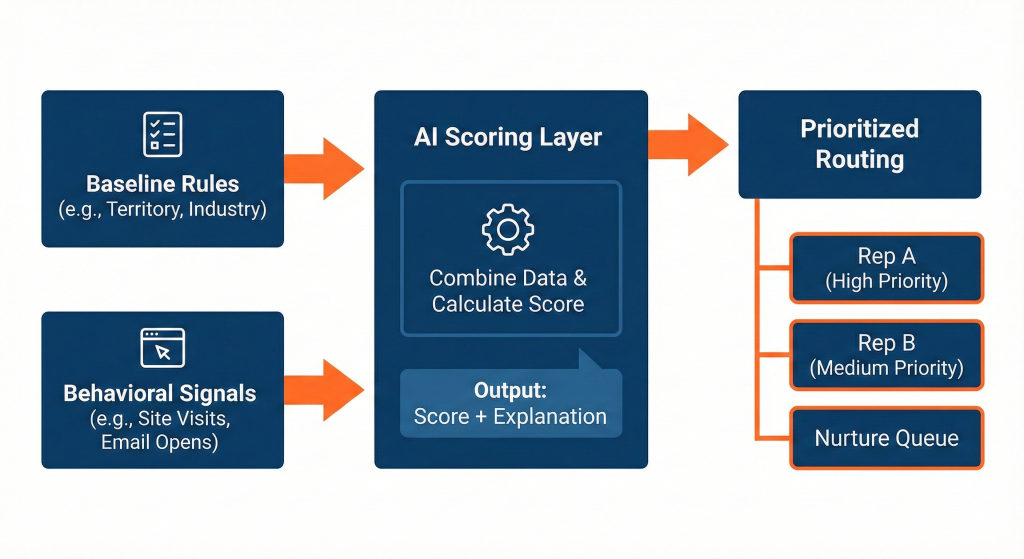
AI becomes valuable in B2B sales when it improves who gets attention first. A modern scoring and routing layer combines rules, behavior, and model judgments to focus reps on the likeliest deals, while keeping the logic transparent enough that sales leaders trust the system.
Traditional lead scoring often uses static rules. Title equals director, plus company size above a threshold, equals high score. In an AI-first pipeline, the scoring model can consider more context, such as website behavior, content consumed, previous interactions, and historical paths from similar accounts.
A practical pattern:
When Launchcodex designs these systems, we pair the scoring logic with clean tracking and dashboards from our data infrastructure work. This makes it easy to compare AI-scored deals to control groups, adjust thresholds, and align on what “good” looks like in your context.
If you want concrete workflow examples, the patterns in our article on AI workflows for scaling marketing translate directly into sales operations, especially around lead enrichment, routing, and reporting.
The highest value AI in sales works as a copilot across the stack, not as a single chatbot. It summarizes calls, suggests next steps, prepares briefs for internal champions, and keeps CRM data clean. This reduces manual work and gives leaders a more accurate view of the funnel.
Useful copilot jobs across your stack:
These copilots sit on top of clean data and event-driven architectures. If you are moving toward more real-time responses, the patterns in our article on event-driven architectures for real-time AI processing explain how to stream events from tools like Salesforce, HubSpot, and product analytics into AI services without adding more manual work.

AI-first does not mean AI only. Your pipeline must protect buyer trust, respect privacy, and give humans the final say on critical decisions. This means clear policies, visible guardrails, and simple ways for reps to override or correct AI outputs when needed.
Buyers care about how you use their data. Sales teams care about how AI decisions affect their quota. Both groups need clear boundaries.
Practical guardrails:
Launchcodex designs AI automation with a strong focus on governance, using patterns from our AI SEO and GEO work where we already manage complex relationships between models, data sources, and brand representation. The same discipline applies in sales. Every AI decision should be auditable and reversible.
Launchcodex works with sales and RevOps leaders to turn AI from scattered experiments into a connected system. We map your pipeline, design AI-assisted workflows, build automations across your tools, and instrument everything so you can measure time saved, win rate lift, and revenue impact.
For B2B SaaS and enterprise teams, we often pair:
If you want a partner to design this end-to-end, our B2B SaaS marketing and AI automation and workflow systems services connect strategy, build, and ongoing optimization in one program. The goal is not to add another tool. The goal is a sales pipeline that fits how your buyers buy today.
AI-first sales pipelines start with clarity, not tooling. When you define stages, clean up data, and align teams on the buyer journey, it becomes much easier to assign meaningful jobs to AI and to measure real impact in win rates, cycle time, and forecast accuracy.
From there, you can introduce scoring, routing, copilots, and automation in a controlled way, one workflow at a time. The teams that will win are the ones that treat AI as a core part of their revenue system and keep humans focused on the work only they can do, such as complex discovery and deal strategy.
Start with a mapping exercise and a small audit. Document your stages, fields, and tools. Measure response times and conversion rates between two stages. Then pick one clear use case such as AI-supported lead enrichment and routing before you attempt full AI coverage.
Treat AI like any other change. Run controlled tests where one group uses AI assisted workflows and another does not. Track metrics such as time to first response, meetings booked, opportunity win rate, and time spent on manual tasks. Only scale what shows a clear, repeatable lift.
Most teams can adapt their existing CRM. Focus first on standardizing fields, logging events, and cleaning your data model. Many AI capabilities can sit on top of what you have now, or connect through automation platforms, as long as the underlying data is consistent and accessible.
Involve reps early. Ask them where manual work hurts the most and start by automating those tasks. Give them control over approvals and provide clear visibility into how AI decisions are made. When they see fewer admin tasks and better queues, adoption improves on its own.



Real stories from the people we’ve partnered with to modernize and grow their marketing.