
Share:

AI marketing & automation


When you search for an agency partner, the terminology can feel interchangeable. Marketing agency. Digital marketing agency. Full-service agency. Performance agency. The labels blur together, but the differences are real, and they affect what you get, what you pay, and what results you can realistically expect.
This article breaks down what each agency type does, how they differ in structure, measurement, and fit, and which makes sense for your situation. You will also see how a newer category, the AI-first agency, changes the comparison entirely.
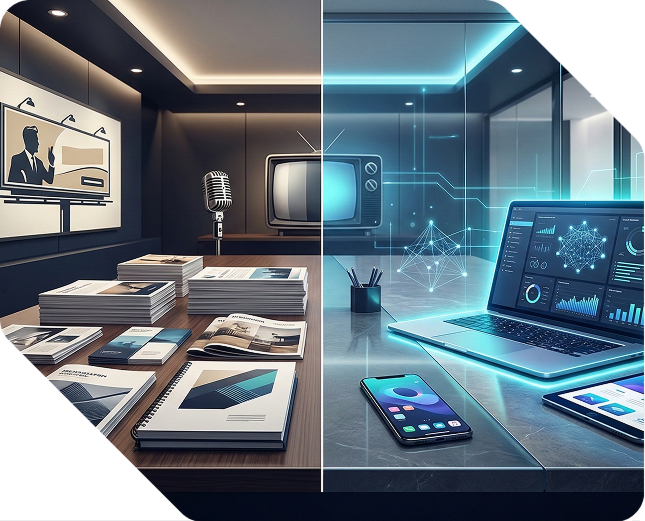
A marketing agency plans and executes campaigns across both online and offline channels. The scope is broad by design. These agencies manage brand positioning, messaging, creative strategy, and media placement across TV, radio, print, outdoor, PR, events, and direct mail, often alongside some digital work. They typically start with brand identity and audience strategy before deciding which channels to activate.
According to BluMango, marketing agencies tend to start with positioning and messaging before moving to channels and tools. That sequencing defines how these agencies operate and what they prioritize.
Marketing agencies excel when brand building is the primary goal, when your audience spans both online and offline touchpoints, or when your category demands high-production creative. Large consumer brands, retail chains, and franchise systems with significant awareness budgets often benefit from this model.
The trade-off is visibility into results. Traditional channels are harder to measure in real time. A TV spot or print campaign may drive awareness without a direct, traceable path to conversion.
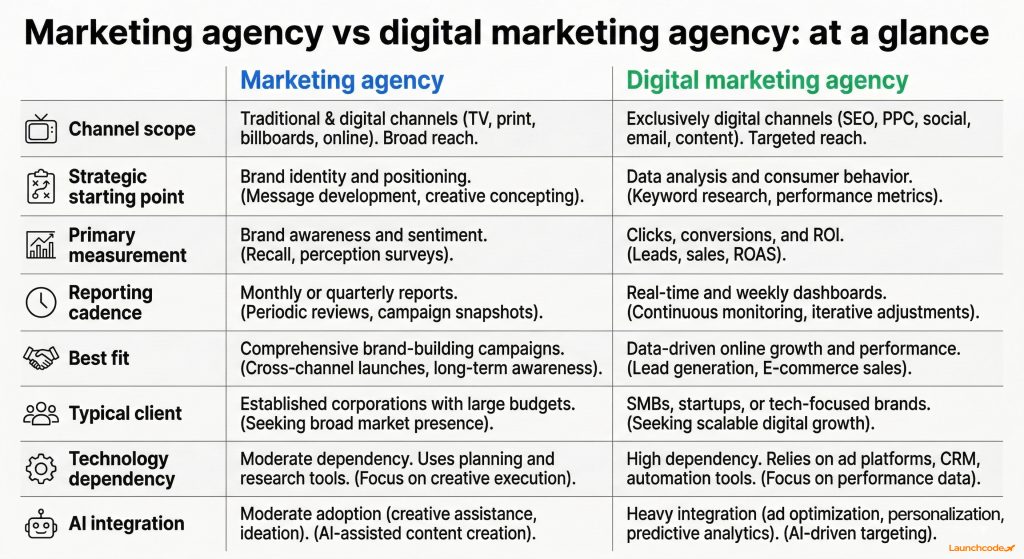
A digital marketing agency operates exclusively online. Every service, from SEO and paid search to email automation and web development, runs through digital channels with measurable outcomes at every stage. Where a marketing agency starts with brand, a digital agency starts with data. The core question is not what the brand should say, but which channels reach the right audience, at what cost, and with what measurable return.
Digital ad investment exceeded $790 billion in 2024, representing 72.7% of all global advertising spend. That concentration of budget is the market signal driving most businesses toward digitally focused partners.
This is where the structural gap between the two agency types becomes most visible. A digital agency can track every touchpoint from first click to closed deal. Tools like Google Analytics 4 and HubSpot connect channel activity directly to revenue. A traditional marketing agency measures awareness, sentiment, and reach, metrics that are real but harder to connect to pipeline.
“Clients who switch from traditional to digital agencies almost always say the same thing: they had no idea what was working before. Real-time data changes how you make every decision.” Brittany Charles, SVP, Client Services, Launchcodex
For businesses that need to justify marketing spend against revenue outcomes, the digital agency model offers a direct line between activity and result. Businesses investing in digital marketing see an average return of $5 for every $1 spent, with PPC alone delivering roughly $2 per $1.
| Factor | Marketing agency | Digital marketing agency |
|---|---|---|
| Channel scope | Online and offline | Online only |
| Strategic starting point | Brand and positioning | Data and performance |
| Primary measurement | Reach, awareness, sentiment | Clicks, leads, revenue, ROAS |
| Reporting cadence | Monthly or quarterly | Weekly or real time |
| Best fit | Brand building, broad awareness, traditional media | Lead generation, traffic growth, conversion, measurable ROI |
| Typical client | Large consumer brands, retail, franchise | SaaS, B2B, e-commerce, SMBs, growth-stage brands |
| Technology dependency | Moderate | High |
| AI integration | Rare to emerging | Common to standard |
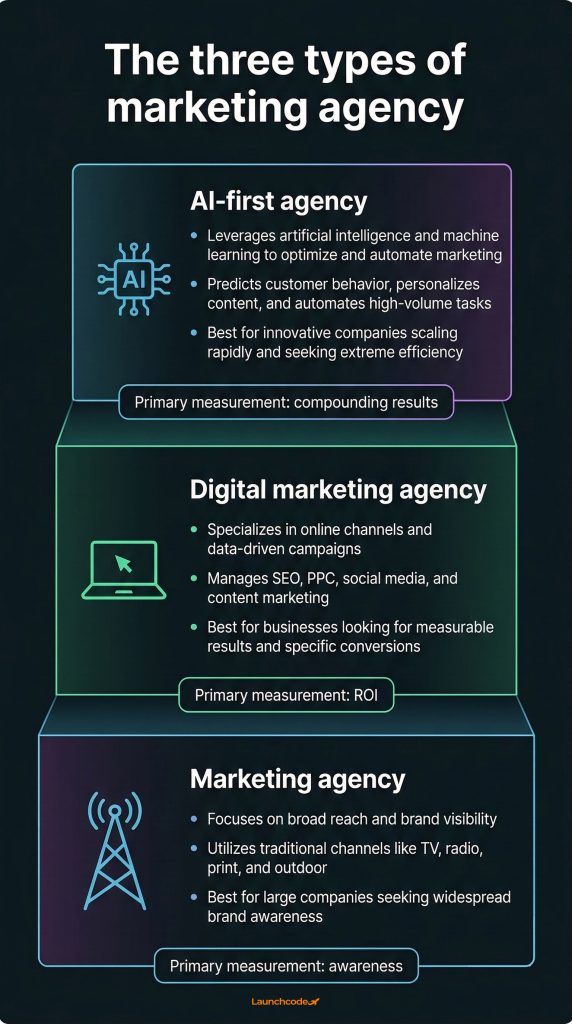
An AI-first marketing agency uses machine learning, automation, and predictive analytics as default operational tools, not as add-ons or experiments. This model operates above both traditional and digital agency types in terms of execution speed, personalization depth, and efficiency. Most digital agencies now use AI in some capacity, but using AI for content is different from building an agency around AI-powered systems.
By 2024, an estimated 91% of marketing agencies were using AI for content creation, up from 78% in 2023. An AI-first agency goes further, applying automation to campaign management, audience segmentation, reporting, content workflows, creative testing, and lead scoring at the same time. Social media managers using AI tools save roughly six hours per week. Applied across an entire agency operation, those efficiency gains compound into faster delivery and sharper decision-making for every client.
The practical outcome is that an AI automation and systems design partner can deliver more testing cycles, faster insights, and tighter feedback loops than agencies running manual processes at comparable budget levels.
71% of consumers expect personalization from brands, and 76% feel frustrated when they do not receive it, according to McKinsey data. Personalization at scale requires data systems and automation. Agencies without those capabilities will struggle to meet modern buyer expectations regardless of how strong their strategy team is.
The right agency type depends on where your revenue comes from, how your buyers behave, and how you measure success. There is no universal answer. The right starting point is to ask where your best customers come from and how they find you. That answer usually points directly to which agency model fits your growth path.
Most businesses evaluate agencies the wrong way. They compare service lists, review creative portfolios, and pick based on presentation quality. None of those signals tell you how an agency actually operates or whether it will deliver results for your specific situation.
“The biggest red flag in an agency pitch is a beautiful deck with no clear answer on how they measure results. Process and reporting tell you more than creative samples.” Jasmine Morales, VP, Agency Operations, Launchcodex
Before signing with any agency, ask six questions. The answers tell you whether an agency starts with brand, channels, or data. That starting point shapes every deliverable, every report, and every result.
Agencies running genuine AI-powered operations will answer question three with specific tools and workflows, not general statements. Agencies relying on manual processes will hesitate or pivot to creative examples.

The line between marketing agency and digital marketing agency is narrowing, but the performance gap between manual and AI-powered operations is widening. Businesses need to know which side of that gap their agency sits on.
Large traditional holding companies like Omnicom and Publicis Groupe are acquiring digital and AI capabilities at pace. Smaller independent digital agencies are building creative strategy and branding practices that once belonged only to full-service shops. But execution speed remains the dividing line.
Among small businesses that tried new tactics in 2024, 40% committed fully to digital, 32% stayed with traditional approaches, and 28% split their spending across both. That split reflects a market still in transition. The direction is clear. Digital investment is compounding, and agencies built around real-time data, channel expertise, and AI-native workflows are pulling ahead.
At Launchcodex, every engagement is built on this model. AI sits inside strategy, execution, and reporting by default, not as an upgrade. The goal is always measurable business outcomes, whether that means more qualified leads, higher organic traffic, or lower cost-per-acquisition.
The difference between a marketing agency and a digital marketing agency comes down to three things: channel scope, measurement depth, and operational speed.
If your growth depends on digital channels, and for most businesses it does, you need a partner built for that environment. If you also need real-time data, automation, and AI-powered optimization, a standard digital agency may not be enough.
Map your current customer acquisition path. Identify where your highest-value leads come from. Then match that to an agency model built to scale it. If that path runs through search, social, content, or email, the match is a digital or AI-first agency with proven performance data to back it up.
A marketing agency covers both online and offline channels including TV, print, and events. A digital marketing agency works exclusively online, across channels like SEO, paid search, social media, and email, with real-time measurement tied to business outcomes.
A digital marketing agency or an AI-first agency is almost always the better fit. B2B SaaS buyers research and convert online. A digital agency can track the full journey from first search to signed contract and optimize every step.
GEO stands for generative engine optimization. It refers to strategies that improve a brand’s visibility inside AI-generated answers from tools like Google AI Overviews, ChatGPT, and Perplexity. Not all digital agencies offer GEO yet, but it is becoming a standard part of a complete search strategy.
Some can, especially larger full-service agencies with dedicated digital practices. But an agency built around traditional media will default to traditional thinking. If digital performance is your primary goal, a dedicated digital or AI-first agency will typically deliver better results and better reporting.
Ask for specific examples. How do they use AI in campaign management, content production, and reporting? Agencies with genuine AI capabilities will describe concrete systems and workflows. Agencies that treat AI as a buzzword will give vague answers.
Pricing models vary widely. Traditional agencies often charge retainers tied to creative production and media buying. Digital agencies commonly use performance-based or retainer models tied to specific channel outputs. AI-first agencies may charge more upfront for system builds but deliver better efficiency over time.


Real stories from the people we’ve partnered with to modernize and grow their marketing.