
Share:

AI marketing & automation


Branded search has always been hard to control. Someone types your name and Google decides what shows up, from an old interview to a fan page to a competitor ad. You could influence that picture from the outside, but you could not own it.
Search profiles change that for brands and creators who qualify. This guide explains what the feature is, the exact follower thresholds, how to claim and set up a profile step by step, and what it means for your visibility now that AI answers send fewer clicks to websites. You will leave with a clear decision, whether you qualify today or not.
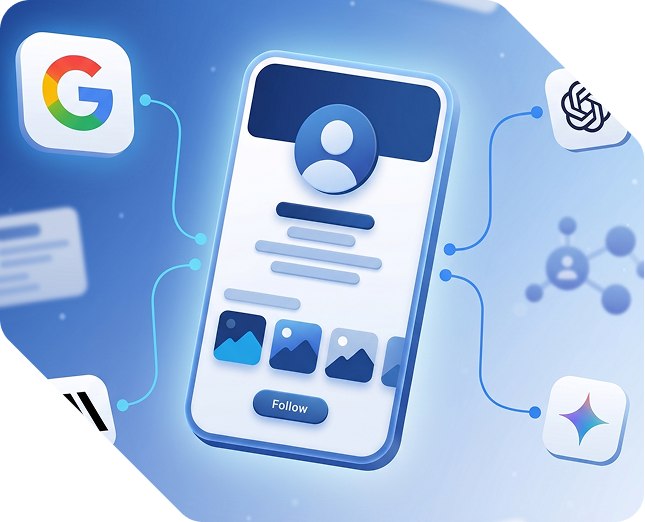
A Search profile is a claimable page that gathers your articles, videos, and social posts into one branded space inside Google Search and Discover. Google introduced the feature in the US on June 4, 2026, calling it a new way for publishers and creators to shape their presence on Search. It controls how you appear, not where you rank.
Google product manager Ibrahim Badr framed the profile as a dedicated, shareable space to highlight content across platforms. You add an avatar, a bio, a website, and links to your social and video accounts. You can pin specific posts or let your latest content fill the page.
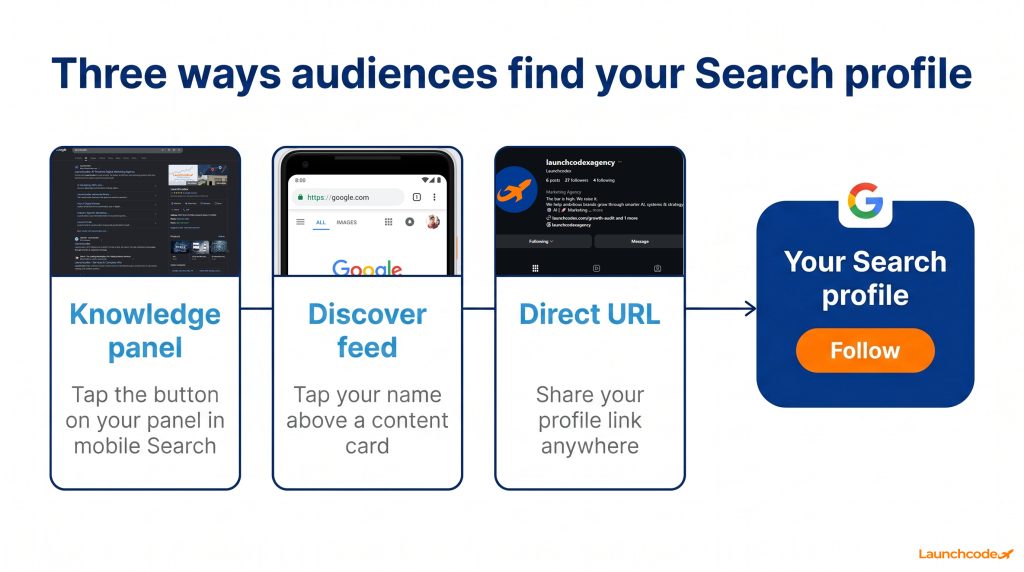
A profile is only useful if audiences reach it. There are three entry points on mobile, as Variety reported at launch:
Each entry point includes a follow button. When someone follows you, your content becomes more likely to surface in their Discover feed, the personalized feed on the Google app home screen.
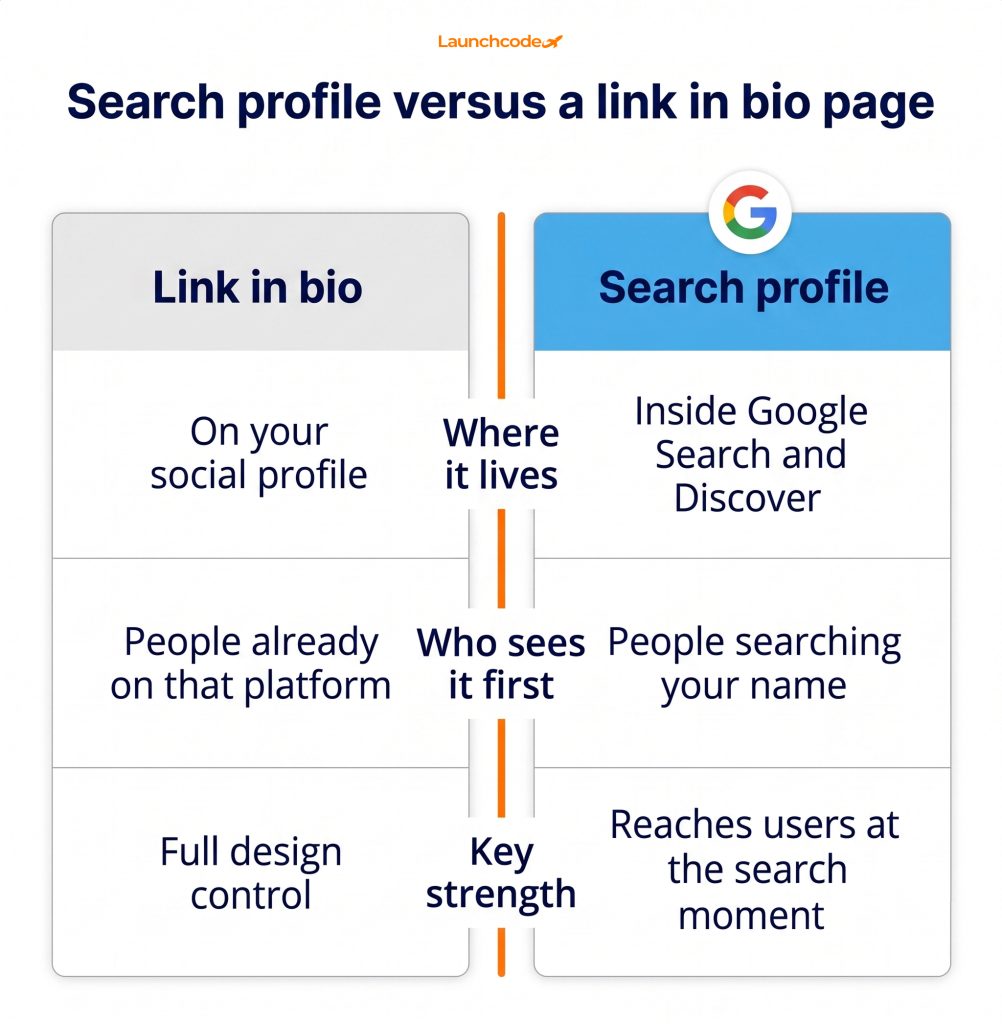
The Verge described profiles as an alternative to link in bio services like Linktree. The comparison helps, but the difference matters for visibility.
| Surface | Where it lives | Who sees it first | Key strength |
|---|---|---|---|
| Link in bio page | On your social profile | People already on that platform | Full design control |
| Search profile | Inside Google Search and Discover | People searching your name on Google | Reaches users at the search moment |
A link in bio page works after someone lands on your social account. A Search profile works at the search itself, before the visitor picks a platform.
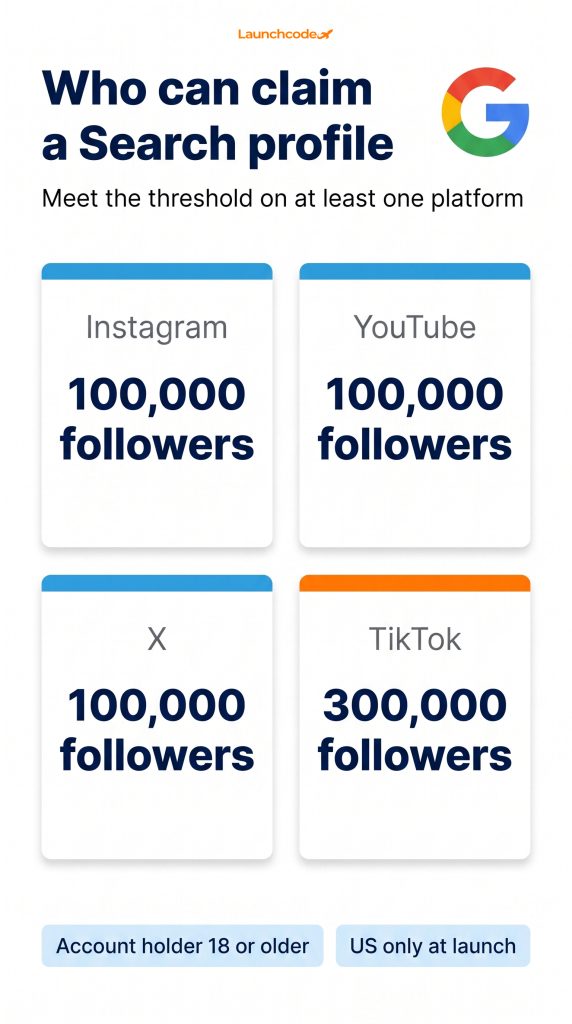
To claim a profile, you need a public account with at least 100,000 followers on Instagram, YouTube, or X. If your only public account is on TikTok, you need at least 300,000 followers. The managing account holder must be 18 or older. The feature is US only at launch.
Google lists these thresholds on its Search profile information page. The bar is high on purpose. This is built for established creators, publishers, and brands with a real audience on one major platform, not for accounts that are just starting out.
The Google Search Help documentation covers a few cases that the headlines skip. An adult can claim and manage a profile on behalf of someone under 18. You can also run separate profiles for separate brands or identities, though each one needs its own Google Account.
The thresholds are clear, but access has not been consistent. PPC Land reported that Damien Andell, co-founder of the Google Discover research group 1492.vision, documented accounts holding active profiles from the private beta before the stated follower limits applied. The lesson for brands near the line is simple. Check your eligibility directly rather than assuming the public rules are the whole story.
You claim a profile at profile.google.com, sign in with your Google Account, and verify the social or video accounts that meet the threshold. Your profile handle is set to match your most followed linked account. Linked content usually syncs within about 24 hours.
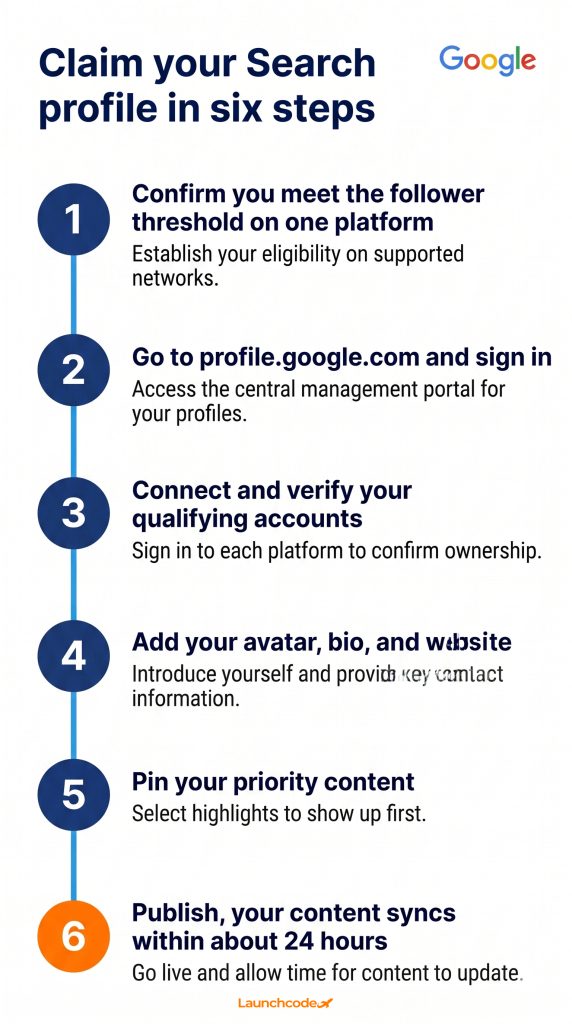
Search Engine Journal walked through the starting point and the handle rule. Here is the full process from check to live page.
Claiming a profile can trigger a knowledge panel for eligible brands that do not have one yet. If you already have a knowledge panel, it gets enhanced with your updated avatar, latest content, and a direct link to the profile. At Launchcodex, we treat the knowledge panel and the profile as one connected asset, since a clean panel and a controlled profile reinforce the same branded result.
“We wire the profile, the knowledge panel, and your structured data into one system, so the same brand facts feed Search, Discover, and AI answers.” Derick Do, Co-Founder and Chief Product Officer
A profile gives you owned space inside Google at a moment when AI answers are cutting clicks to websites. It will not lift your rankings. Its value is control of branded presence and a direct line into Discover, which matters more as users get answers without leaving the results page.
The traffic math explains the timing. Pew Research Center found that when an AI summary appeared, users clicked a search result just 8 percent of the time, versus 15 percent without one. The same data showed users were more likely to end a session after seeing a summary, 26 percent of the time against 16 percent. Even being cited inside an AI answer rarely helps, since only 1 percent of users clicked a cited source.
“When AI result pages drop clicks to 8 percent, your profile and knowledge panel are some of the only branded results you still control.” Tanner Medina, Co-Founder and Chief Growth Officer
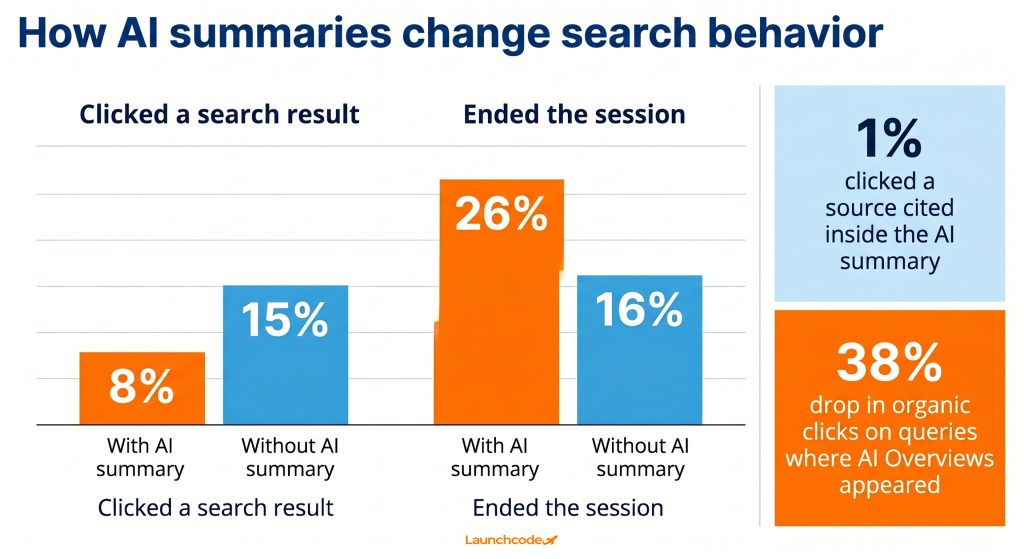
Skeptics note that traffic studies often show correlation. One study answers that. Search Engine Journal covered a randomized field experiment that found AI Overviews cut organic clicks by 38 percent on queries where they appeared, work from Indian School of Business and Carnegie Mellon University researchers. The same coverage cited Ahrefs data showing a 58 percent drop in click-through rate for top ranking pages when an Overview was present.
Google sees this differently. VP of Search Liz Reid has argued that AI Overviews improve quality and reduce low value clicks. Both things can be true. Fewer clicks reach your site, and the clicks you do earn may carry more intent. A Search profile responds to that shift by giving you a result you control and a follow button that builds a direct audience in Discover.
Most businesses sit below 100,000 followers, so the profile is closed to them today. You still have useful work to do. Prepare your branded search result now, grow the follower signals that qualify you later, and strengthen how AI systems describe your brand.
Treat the wait as setup time. Work the surfaces you already control.
“Pick the platform closest to 100,000 and put everything into it. We have seen one focused account cross the line in months, while four part-time accounts stall.” Tanner Medina, Co-Founder and Chief Growth Officer
A profile is one owned surface. Your rankings, your AI citations, and your Discover presence are separate jobs that need separate work.
Search profiles are a real opportunity for brands that qualify. You get a controlled, shareable result inside Google and a direct line into Discover, both valuable as AI answers shrink the open web click. The honest caveat is that a profile shapes presence, not rankings, and the feature is US only for now.
Your next step depends on where you stand. If you clear the threshold, claim your profile at profile.google.com this week and connect it to a clean knowledge panel. If you do not, use the time to fix your branded results, grow followers on your strongest platform, and make sure AI systems describe you correctly. Either path moves your visibility forward.
Yes, on Instagram, YouTube, or X. If your only public account is on TikTok, you need at least 300,000 followers. The account holder must also be 18 or older.
No. A profile controls how your brand appears and helps people follow you in Discover. It does not change where your pages rank in organic results.
You can claim and customize a profile in one session at profile.google.com. Content linked from your accounts usually syncs to the page within about 24 hours.
Not at launch. Google rolled out Search profiles in the US first and has said it plans to expand to more countries later.
A Linktree page works once someone is already on your social profile. A Search profile appears inside Google Search and Discover, so it reaches people at the moment they search your name.


Real stories from the people we’ve partnered with to modernize and grow their marketing.