
Share:

AI marketing & automation


You have a fixed marketing budget and one hard question. How much goes to paid ads that work this week, and how much goes to organic systems that pay off next quarter? Most guides dodge this and tell you to do everything. That answer wastes money.
This article resolves the tradeoff with real cost and conversion data. You will see what each channel costs to book a consult, how to phase your budget as your practice grows, and how to use organic as the steady base while paid moves with seasonal demand. By the end, you will have a split you can defend and apply this quarter.
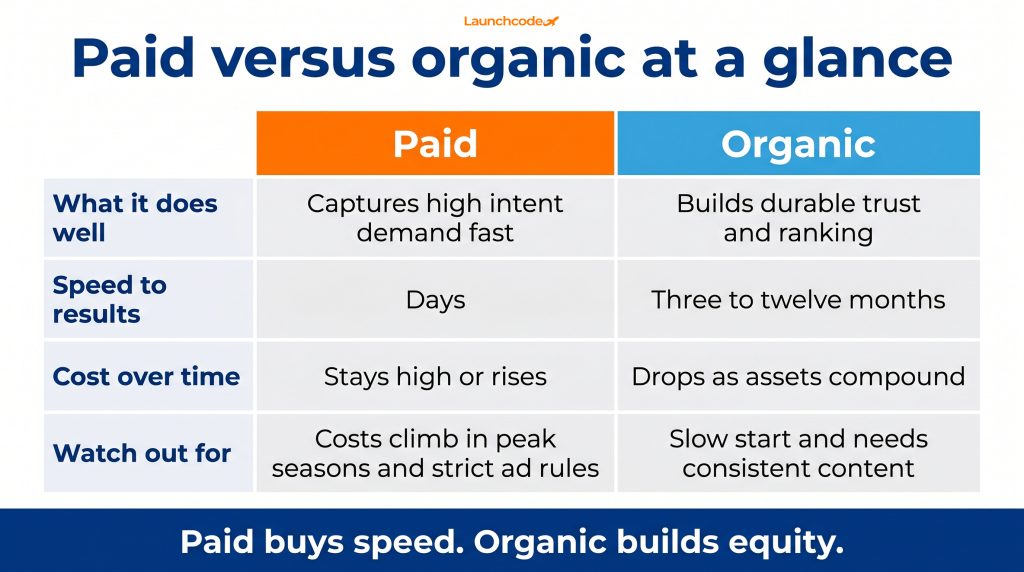
Paid channels like Google Ads and Meta Ads buy attention fast. You pay per click, leads arrive within days, and the moment you stop spending, the leads stop. Organic channels like SEO, reviews, and content build assets you own. They take months to mature, but once they rank and convert, each new patient costs far less. The two solve different problems on different timelines.
The difference matters because plastic surgery is a high consideration purchase. Patients research for weeks before booking a $15,000 procedure. Paid puts you in front of them at the high intent moment. Organic earns trust across the full research window.
Paid and organic are not rivals. They cover different jobs across the patient journey.
| Approach | What it does well | Speed to results | Cost over time | Watch out for |
|---|---|---|---|---|
| Paid (Google Ads, Meta) | Captures high intent demand fast | Days | Stays high or rises | Costs climb in peak seasons, strict ad rules |
| Organic (SEO, reviews, GEO) | Builds durable trust and ranking | Three to twelve months | Drops as assets compound | Slow start, needs consistent content |
Demand is steady, so the real fight is for visibility. The American Society of Plastic Surgeons 2024 Procedural Statistics Report found cosmetic surgical procedures rose 1% and minimally invasive treatments rose 3% in 2024, even through economic uncertainty. ASPS President Scott Hollenbeck, MD, said patients continued to prioritize their aesthetic health throughout the year. The global cosmetic surgery market is projected to grow from $61.32 billion in 2026 to $83.33 billion by 2034, per Fortune Business Insights. Demand is stable and growing, so your competitors are all chasing the same patients. Channel efficiency decides who wins.
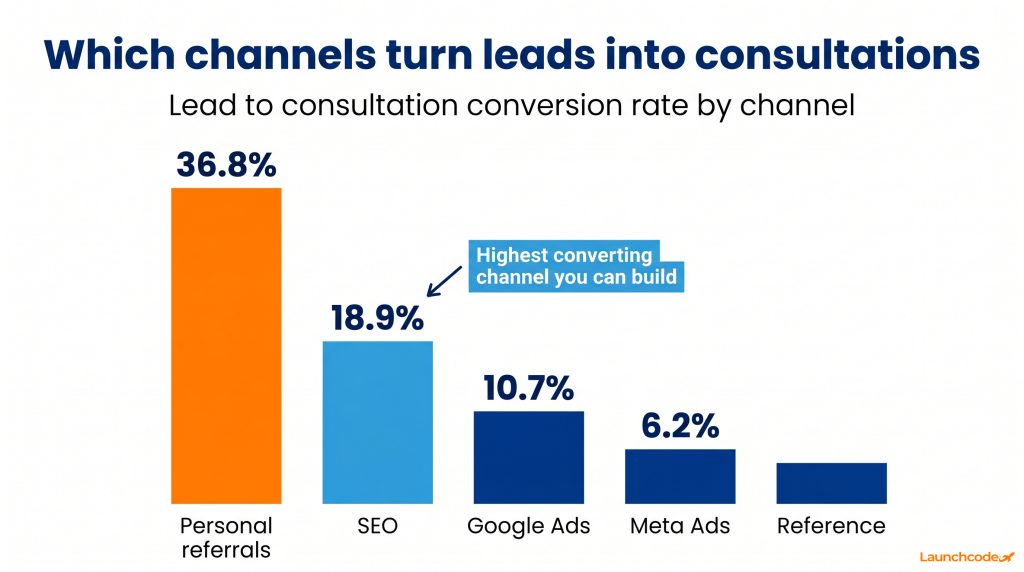
Organic delivers the lowest cost per patient across every procedure. Patient acquisition cost through SEO runs roughly half the cost of Google Ads. For rhinoplasty, SEO acquisition cost was $302 versus $644 through Google Ads and $397 through Meta Ads. SEO also converts leads to consultations at 18.9%, well above 10.7% for Google Ads and 6.2% for Meta Ads.
These numbers should anchor your budget thinking. Paid is not wasteful, it is expensive per result, which is why an organic foundation lowers your blended cost over time.
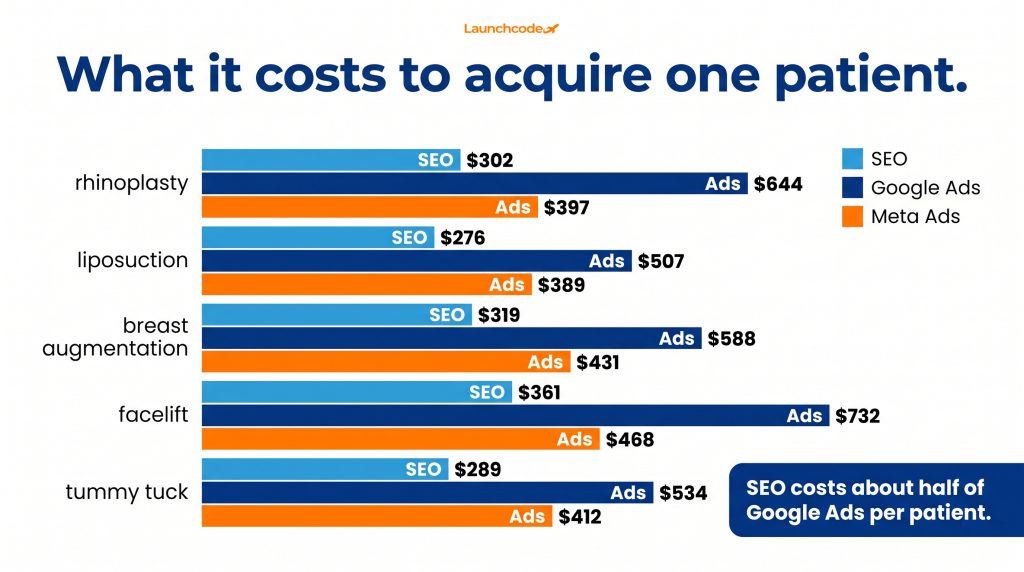
The pattern holds across surgical categories. Data below comes from the First Page Sage Plastic Surgery Lead Generation Statistics 2026 Report, based on 58 US clinics.
| Procedure | SEO acquisition cost | Google Ads acquisition cost | Meta Ads acquisition cost |
|---|---|---|---|
| Rhinoplasty | $302 | $644 | $397 |
| Liposuction | $276 | $507 | $389 |
| Breast augmentation | $319 | $588 | $431 |
| Facelift | $361 | $732 | $468 |
| Tummy tuck | $289 | $534 | $412 |
“We track patient acquisition cost by procedure, not just by channel. A facelift lead at $361 through SEO versus $732 through Google Ads changes how we phase a client’s budget within the first month.” Tanner Medina, Co-Founder and Chief Growth Officer
Cost is only useful next to conversion. The same research ranks lead to consultation conversion by channel: personal referrals lead at 36.8%, SEO follows at 18.9%, then Google Ads at 10.7%, and Meta Ads at 6.2%. Referrals win, but you cannot buy them directly. SEO is the highest converting channel you can actively build.
Paid still earns its place. Cost per lead for plastic and cosmetic surgery averaged $102.51, yet that figure fell 29% year over year and cost per click dropped about 10%, according to LocaliQ healthcare advertising benchmarks. Paid is getting more efficient, which supports keeping performance media in the mix rather than dropping it.
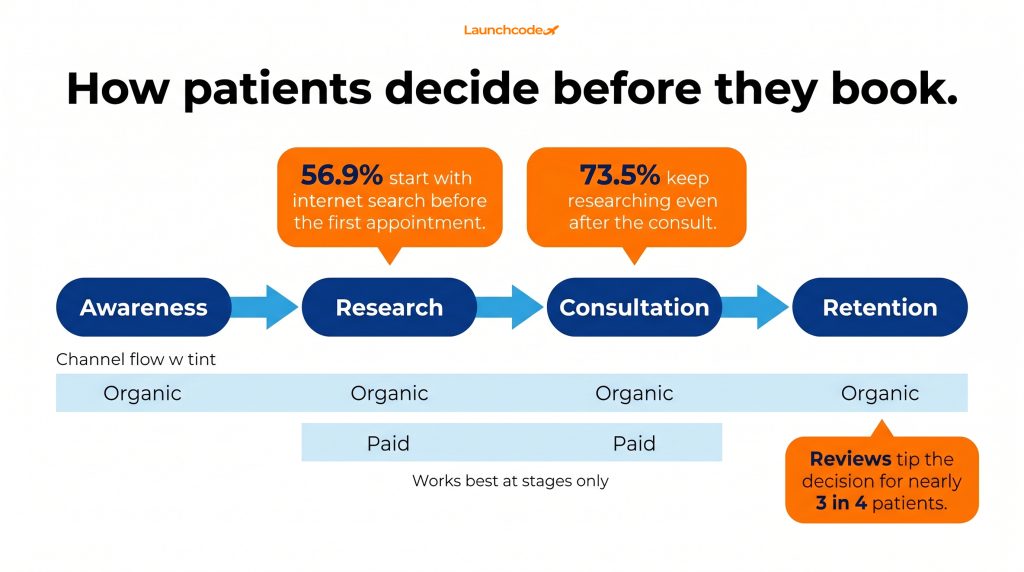
Patients move through awareness, research, consultation, and retention. Paid works best at the high-intent research and consultation stages, when someone searches a specific procedure and city. Organic works across the whole journey, especially the long research phase where patients compare surgeons, read reviews, and build trust before they fill out a form.
Matching channels to stages stops you from overpaying. You do not need a $40 click to reach someone who is still six weeks from deciding.
The research window is long and digital. A peer-reviewed study, Evaluation of Information Sources in Plastic Surgery Decision-making, found internet searches were the most common information source before a first surgical appointment at 56.9%, ahead of family and friends at 39.7%. Most patients, 73.5%, kept seeking outside information even after the consult. Your digital presence is the first impression, and it keeps working after the appointment.
Not all organic traffic is equal. Geo-targeted procedure queries like tummy tuck Miami convert at 21.4% lead to consultation, nearly double the 11.2% of general procedure terms, per the First Page Sage report. Build SEO and paid around procedure plus location terms, not broad informational keywords that pull in researchers who never book.
Reviews sit upstream of every channel. They decide whether your paid clicks and organic visits convert. Looking at online reviews is the first step in choosing a physician for nearly three out of four patients, and one in five patients with a referral still validates that referral through online reviews. Strong reviews lift the return on every dollar you spend, paid or organic.
Treat reputation as infrastructure, not an afterthought. A practice with thin or polarized reviews leaks conversions no matter how good its ads are.
A Northwestern Medicine study reported by the American Society of Plastic Surgeons found that in the fast-changing plastic surgery market, online reviews are becoming the new word of mouth with real power to influence referrals. There is a catch worth managing. Study author Rob Dorfman of Northwestern noted that unhappy patients post longer reviews and take up more screen space than happy ones, which creates a bias of dissatisfaction in online ratings. A system that invites satisfied patients to review at the right moment balances that skew.
Generative engine optimization, or GEO, is the cheapest fastest-moving organic channel most practices have not claimed. As ChatGPT, Perplexity, and Google AI answers grew as lead sources, GEO patient acquisition cost for plastic surgery fell 19% in six months. Practices that structure clear, citable content now can earn answer engine visibility before their local competitors do.
GEO is not separate from SEO, it builds on it. The same structured, entity-rich pages that rank in search also get cited in AI answers.
Acquisition cost through generative engines is dropping while adoption stays low, which is the rare window where being early is cheap. The First Page Sage report also found YouTube Shorts now outperforms TikTok for clinics using high quality before and after video, so one video pipeline can feed both social reach and answer engine signals.
“Most practices have an FAQ page written for nobody. We restructure procedure and FAQ content so it answers the exact questions patients ask ChatGPT and Google AI, and those same pages still rank in classic search.” Derick Do, Co-Founder and Chief Product Officer
This GEO foundation is the kind of structured content system Launchcodex builds for healthcare clients, where the same assets serve search rankings and AI citations at once.
Compliance limits paid more than organic, which shifts trust building toward organic channels. Medical advertising on Google requires LegitScript certification for many procedures. Meta restricts cosmetic surgery imagery and idealized claims in paid placements, while organic posts carry more flexibility. HIPAA governs how you handle and track patient data across every channel.
These rules shape strategy. When paid creative is constrained, your organic content and reviews carry more of the trust.
A short disclaimer note belongs on your content too. State your data sources, show a last updated date, and make clear that articles offer marketing guidance, not medical or legal advice.
Match the split to your stage. A newer practice that needs patients now should be weighted heavily, around 60 to 70%, while building organic in the background. As SEO, reviews, and GEO mature over two to three quarters, shift toward a 40 to 50% organic base and use paid for peak seasons. The goal is a falling blended acquisition cost over time.
There is no single correct ratio. The right one depends on your local competition, your procedure mix, and how mature your organic assets already are.
| Stage | Suggested paid share | Suggested organic share | Primary goal |
|---|---|---|---|
| Launch, months 1 to 3 | 65% | 35% | Generate leads now, plant organic seeds |
| Build, months 4 to 9 | 50% | 50% | Grow SEO and reviews, refine paid targeting |
| Scale, months 10+ | 40% | 60% | Lower blended cost, use paid for seasonal peaks |
Cosmetic surgery advertising costs rise 50 to 100% before summer and wedding seasons, according to Patient10x, where plastic surgery keywords commonly reach $15 to $50 or more per click. Run organic as your steady year-round base, then raise paid spend ahead of peak demand and pull back when costs climb past your acquisition targets.
One practice we worked with started at 70% paid because it needed bookings fast. Over two quarters, it built procedure pages, added review schema, and ran a steady before-and-after video pipeline. As organic leads grew, it moved to a near-even split. Blended acquisition cost dropped because the cheaper organic leads carried more of the volume, and paid budget rose only before summer.
Track cost per lead and lead to booked surgery by channel and by procedure. A rhinoplasty lead at $45 through paid search versus $180 through social tells you exactly where to move next month’s budget. Without channel-level tracking, your split is a guess. With it, you rebalance on evidence every month.
Measurement turns the phased model from theory into a system. The practices that win measure carefully and adjust often.
Traffic without conversion wastes both paid and organic spend. Average session duration on plastic surgery websites is about 2 minutes 15 seconds, per CUFinder benchmarks. That short window is when a visitor decides whether to submit a consult form. Fast, clear procedure pages with strong calls to action lift conversion for every channel feeding them.
The question was never paid or organic. It is in what ratio and in what order. Build the organic base of SEO, reviews, and GEO because it converts higher and costs less per patient. Use paid to generate leads now and to cover seasonal demand. Then rebalance toward organic as your owned assets mature, and your blended cost falls.
Your next step is to pull your own channel-level cost per lead and lead to booked surgery numbers for the last six months. Compare them against the benchmarks here, find the channel with the worst efficiency, and shift that budget toward the phased model above. Figures vary by market and procedure, so let your own data, not averages, set the final split.
SEO converts higher and costs less per patient over time, but it takes months to mature. Paid delivers leads in days at a higher cost. Most practices need both, weighing paid early and shifting toward organic as it grows.
Expect meaningful organic traffic and consultation growth around months five to seven, with stronger top three rankings after that. This is why practices run paid in parallel rather than waiting on SEO alone.
LocaliQ reported an average cost per lead of $102.51 for plastic and cosmetic surgery, down 29% year over year. Your real number depends on procedure, location, and competition, so track your own cost per lead by channel.
Yes, Google requires LegitScript certification to advertise many medical and cosmetic procedures. Secure it before launching paid campaigns for restricted services to avoid disapprovals.
Yes. Acquisition cost through generative engines fell 19% in six months while most practices have not started. Structuring clear, citable procedure and FAQ content now positions you to earn AI answer visibility early.


Real stories from the people we’ve partnered with to modernize and grow their marketing.