
Share:

AI marketing & automation


OpenAI opened Businesses in ChatGPT in beta on November 10, 2026, as a way to reach the 1.2 billion people who use ChatGPT each week. You can now claim your profile, correct your details, and see how often ChatGPT cites your site.
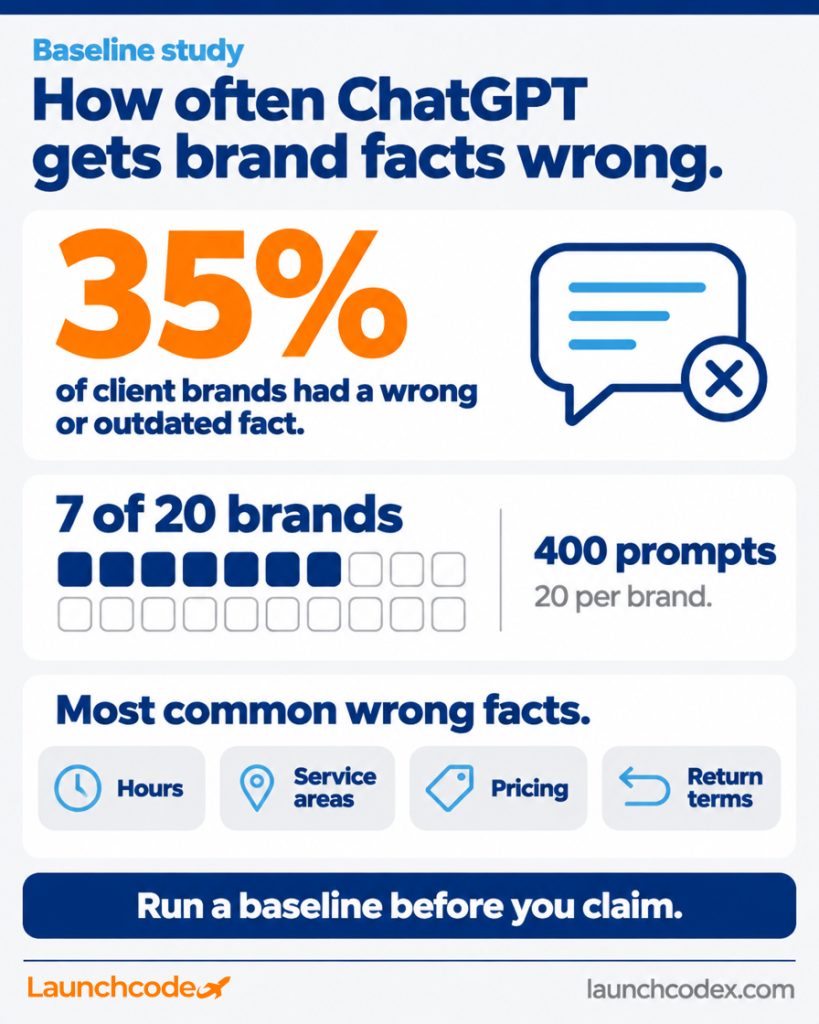
Claiming is the easy part. ChatGPT still weighs your profile against the rest of the web. Before launch, Launchcodex ran 400 buyer style prompts across 20 client brands and found that 7 of the 20 brands, or 35 percent, had at least one incorrect or outdated fact in ChatGPT’s answers, most often hours, service areas, pricing, or return terms. This guide covers the claim steps, options by business type, a six step readiness sequence, and how to measure results.
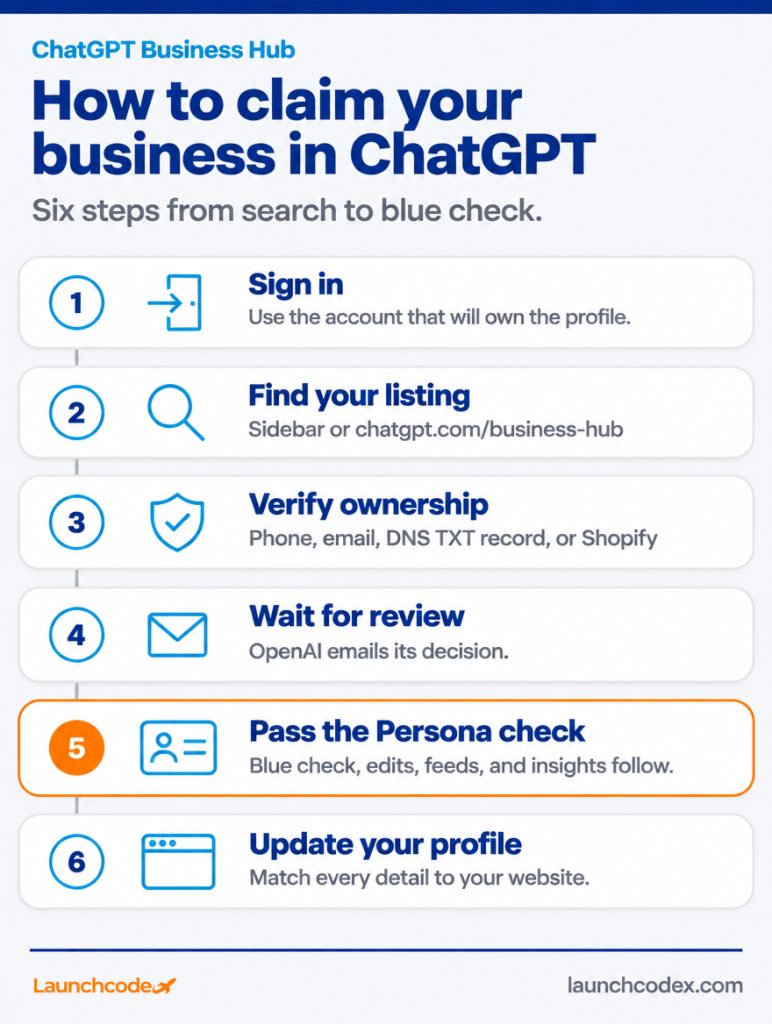
Sign in to ChatGPT, open Business Hub from the sidebar or at chatgpt.com/business-hub, and search for your business name. Verify by business phone, business email, DNS TXT record, or Shopify, then wait for OpenAI’s decision. Next comes Persona identity verification. The blue check, profile edits, product feeds, and insights all wait on Persona approval.
You do not need an Enterprise agreement or an ads account to claim, as VentureBeat reported. Product feeds follow OpenAI’s spec, with 48 fields and 9 required, and a standard upload targets the US.
A new profile publishes automatically on approval, and OpenAI Support cannot delete, unpublish, or hide it, according to Flavio Copes’ launch day deep dive. Three checks come first:
Most eligible businesses can claim a profile, but options vary by type. Local stores and restaurants can claim only an existing US listing. Business Agents are limited to eligible US ecommerce and online service businesses with a website. B2B and SaaS companies can still claim, fix their details, and use insights without a feed or agent.
| Business type | Product feed | Business Agent | First priority |
|---|---|---|---|
| US ecommerce | Yes | Eligible | Feed accuracy |
| US online service or SaaS | Usually not | Eligible | Description and category |
| B2B with long sales cycles | Rarely | Usually skip | Third party facts |
| Local store or restaurant | Optional | Not at launch | Hours and location |
| Multi location brand | Per location | Not confirmed | Rollout tracker |
Claiming the main brand does not claim its locations, and there is no central management yet. Say a home services franchise has 20 US locations. Build a tracker with listing status, verification method, and admin for each one before you start.
The readiness sequence is six steps that make a claimed profile change what ChatGPT says: baseline, ownership, profile facts, corroboration, fit, and measurement. In OpenAI’s words, “Claiming does not guarantee higher placement or sales.” ChatGPT may still use other sources.
“We log each baseline prompt with four columns: prompt, answer, wrong fact, and likely source page. The source column matters most because it tells you which listing to fix first.” Derick Do, Co-Founder & Chief Product Officer
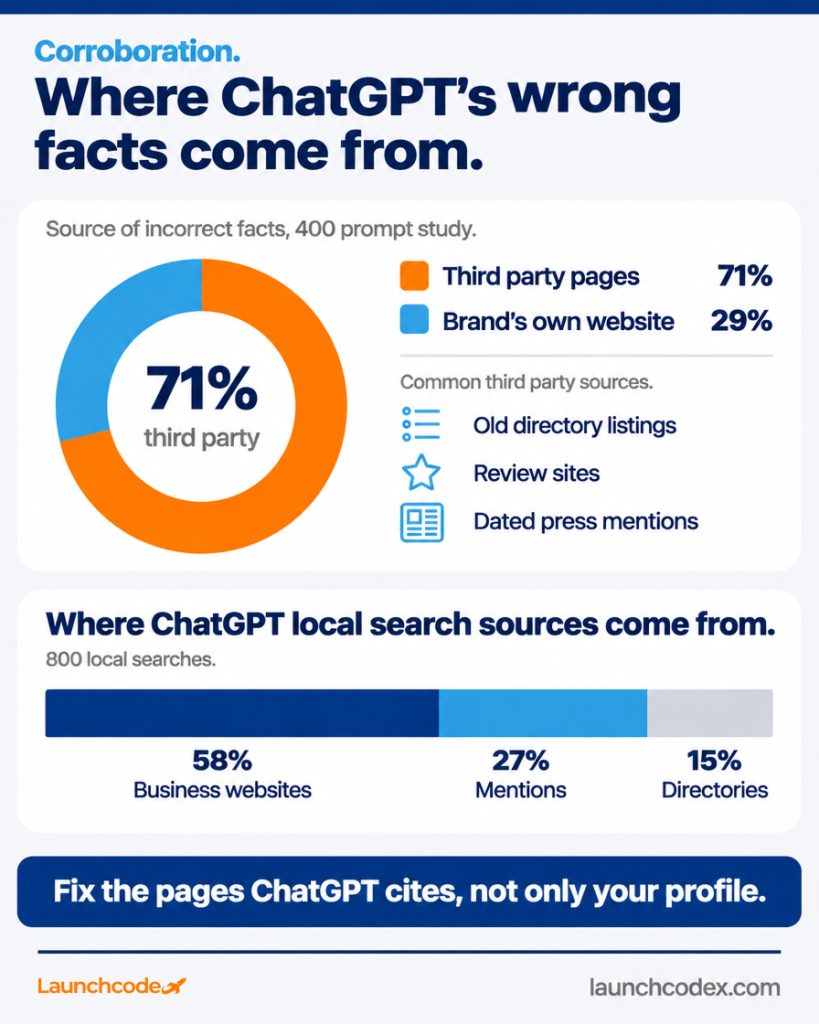
In the same 400 prompt study, 71 percent of the incorrect facts traced back to a third party page, such as an old directory listing, a review site, or a dated press mention, rather than the brand’s own website.
BrightLocal’s 2024 study of 800 local searches found business websites made up 58 percent of ChatGPT search sources, with business mentions at 27 percent and directories at 15 percent. An Empirank audit of 182 recommended businesses found 11.0 percent carried at least one claim the evidence contradicted. Claims backed only by first party material were confirmed correct 75.2 percent of the time, versus 57.5 percent for third party only claims, a gap the study calls descriptive, not causal. Founder James Tandy put it plainly: “Visibility without factual control is an incomplete AEO result.”
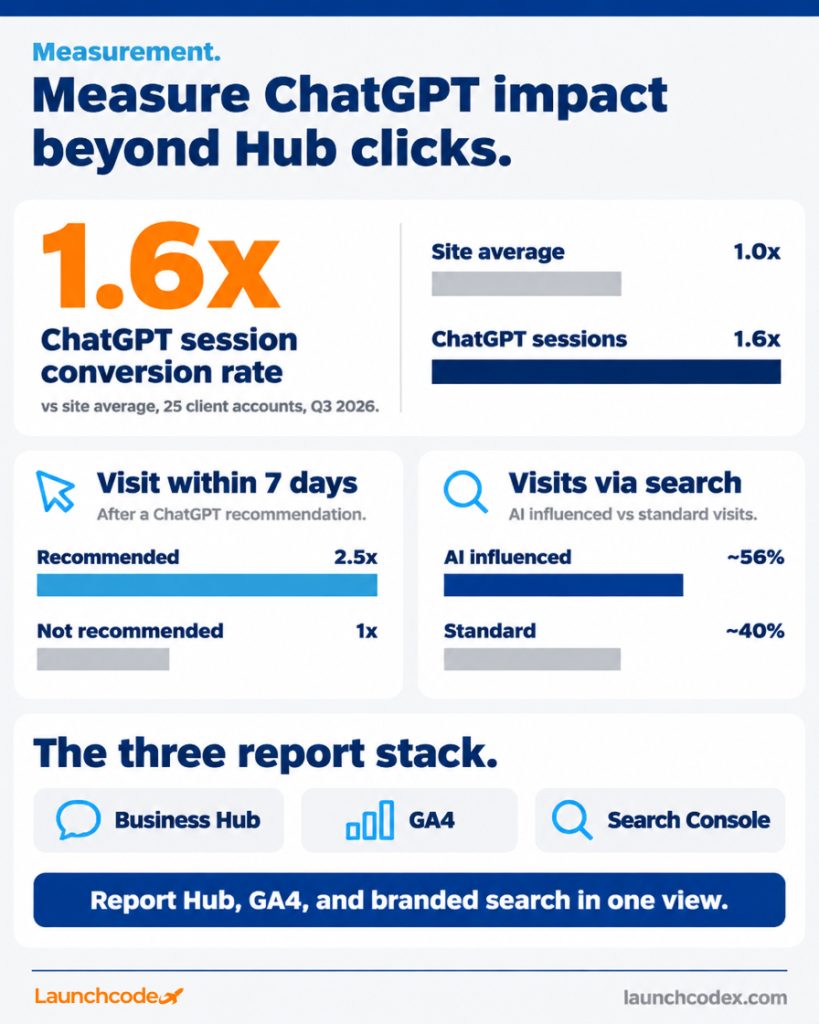
Use three reports together. Business Hub shows mentions and website clicks over the past 28 days. GA4 shows sessions and conversions from utm_source=chatgpt.com. Google Search Console shows branded search trends, which capture people who saw your brand in ChatGPT and searched for it later. Hub clicks alone miss that second path.
For online businesses, a mention counts only when ChatGPT references your website. For local businesses, a location appearing in a result counts even if nobody opens it. That hurts brands sold through retailers. In Flavio Copes’ launch day test, ChatGPT named two sock brands but linked only to retailers, so those brands would earn no mention. The dashboard’s own tooltip also warns that recorded clicks do not confirm visits or conversions.
“We report ChatGPT referral conversions next to branded search in Search Console every month. A 1.6 times conversion rate only gets budget when leadership sees both numbers in one view.” Tanner Medina, Co-Founder & Chief Growth Officer
Publish an agent only if you are an eligible US ecommerce or online service business with real pre sale questions about sizing, compatibility, or returns. It is free at launch and answers from the information you supply. Skip it if most sales run through retailers or long B2B cycles, where the profile and insights do more work.
Benji Shomair, OpenAI’s VP of monetization, told Digiday, “Think of the business agent as the organic experience.” The paid sponsored agent runs on the same build, and businesses cannot bring their own agents. A weak agent today becomes a weak ad destination later.
Claim now to protect your listing, then run the full sequence: baseline, ownership, profile facts, corroboration, fit, and measurement. The businesses that gain most will correct their third party facts and measure beyond Hub clicks.
If you want help, the Launchcodex SEO and GEO team can audit what ChatGPT says about you, fix the sources behind it, and build reporting that ties AI visibility to revenue.
Yes, at launch. Digiday reported that Business Hub and Business Agents are free, and OpenAI did not rule out charging later.
Insights, edits, and feeds become available only after Persona verification is approved. A blank metric can also mean activity has not reached the reporting threshold.
Yes. The admin who claimed the business can grant agency access, with each person on their own ChatGPT account.


Real stories from the people we’ve partnered with to modernize and grow their marketing.