
Share:

AI marketing & automation


Picking an AI tool for your business feels harder than it should. The model names change every few weeks, the prices shift, and most comparison articles still point to last year’s models. You end up comparing tools that no longer exist at prices that are already wrong.
This guide fixes that. You will get the current flagship models, what each one does best for real business work, what they cost once you add seats and usage, how they handle your data, and a plain framework to match a model to your company. The figures reflect the lineup as of June 2026. Prices and versions move monthly, so confirm the current numbers on each vendor’s own page before you commit.
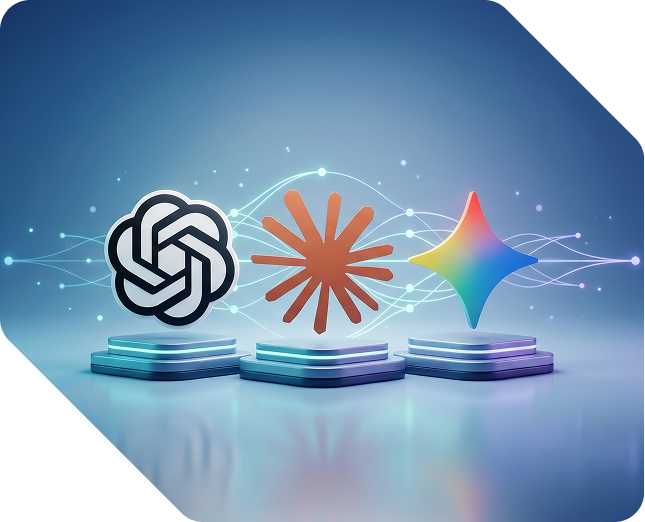
ChatGPT, Claude, and Gemini each run a new flagship in 2026. ChatGPT runs GPT-5.5, Claude runs Opus 4.8, and Gemini runs 3.1 Pro. If you searched using names like GPT-4o, Claude Sonnet, or Gemini 1.5, those are older versions. Start from the current models, because the gaps between them have moved.
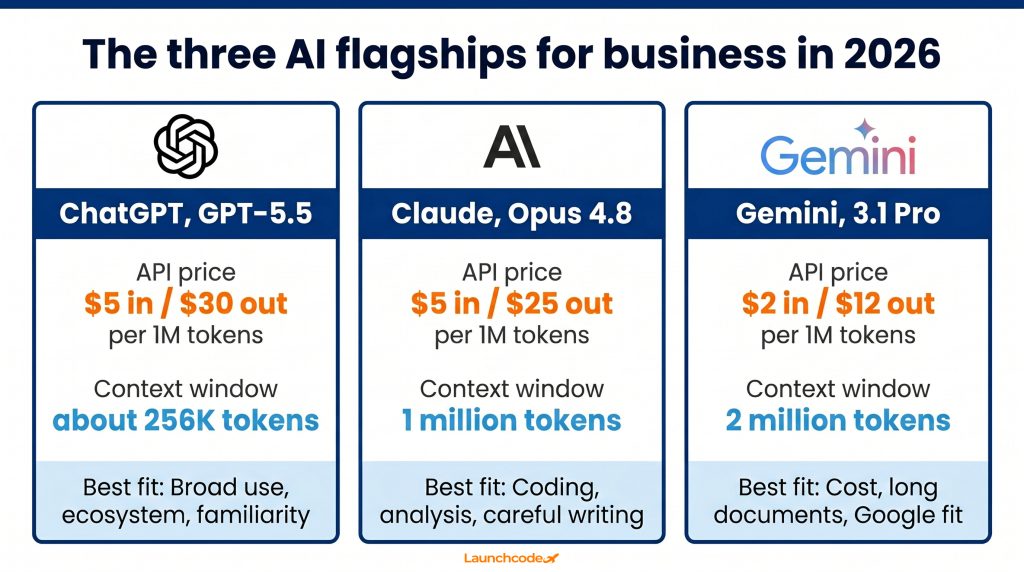
The three platforms now share a similar shape. Each one offers a free tier, a flagship reasoning model, cheaper fast models for high-volume work, and an enterprise tier with security controls. The differences live in the details below.
OpenAI’s flagship is GPT-5.5, with a GPT-5.5 Pro tier for the hardest tasks. According to OpenAI’s pricing page, GPT-5.5 costs 5 dollars per million input tokens and 30 dollars per million output tokens, and Pro runs 30 and 180 dollars. ChatGPT also has the largest user base, which lowers the training cost when you bring on new staff.
Anthropic’s flagship is Claude Opus 4.8, released in late May 2026. Anthropic’s launch notes list it at 5 dollars per million input tokens and 25 dollars per million output tokens, the same rate as the prior version, with a faster mode at 10 and 50 dollars. It leads the field on coding and agentic tasks.
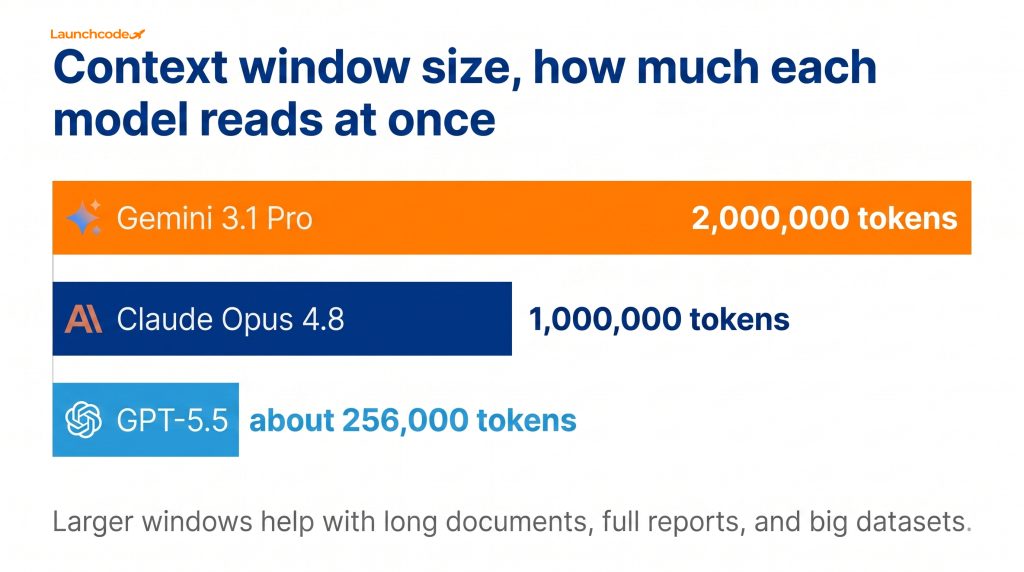
Google’s flagship is Gemini 3.1 Pro. Google’s developer pricing sets it at 2 dollars per million input tokens and 12 dollars per million output tokens under 200K tokens, rising to 4 and 18 dollars above that. It carries a 2 million token context window, the largest of the three, and it runs inside Google Workspace.
| Platform | Current flagship | API price per 1M tokens (in / out) | Context window | Strongest fit |
|---|---|---|---|---|
| ChatGPT | GPT-5.5 | 5 / 30 | About 256K | Broad use, ecosystem, familiarity |
| Claude | Opus 4.8 | 5 / 25 | 1 million | Coding, analysis, careful writing |
| Gemini | 3.1 Pro | 2 / 12 | 2 million | Cost, long documents, Google fit |
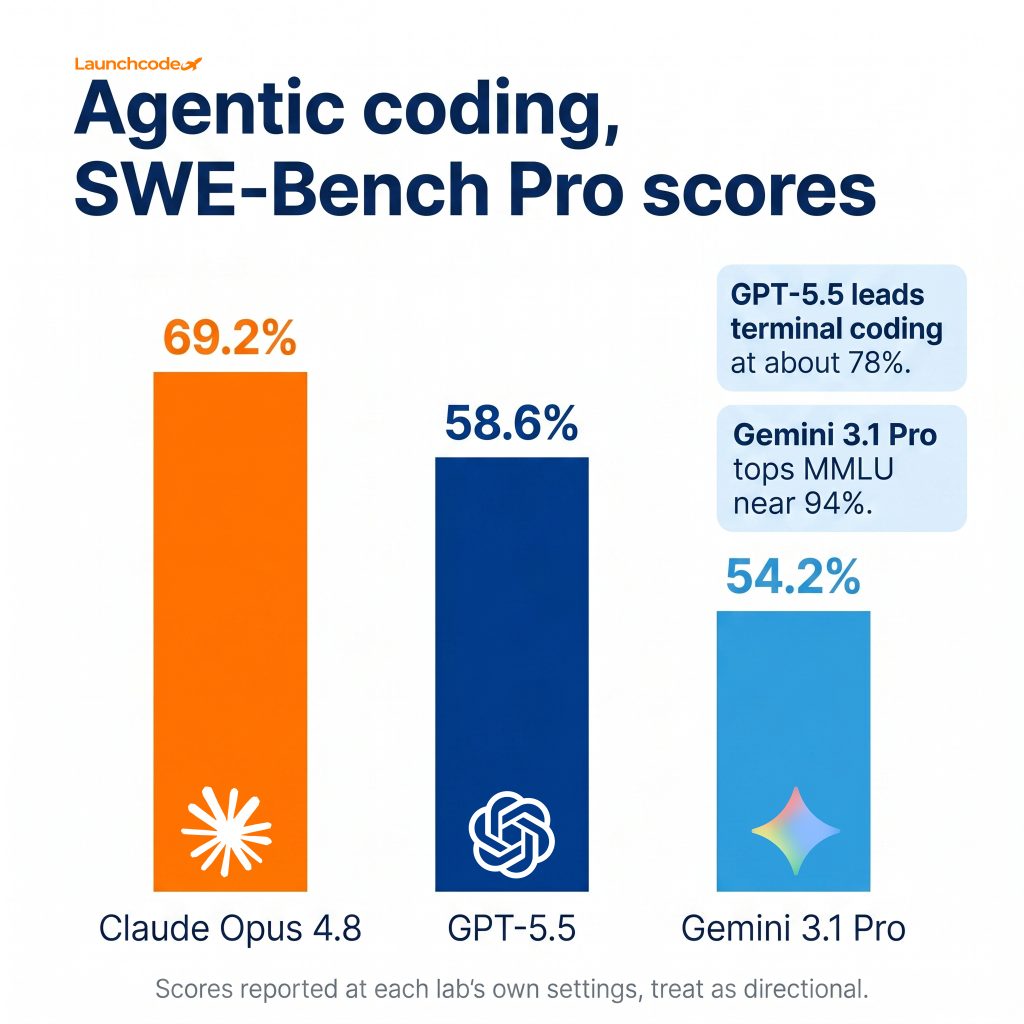
Each model leads a different category. Claude Opus 4.8 leads coding and complex analysis, Gemini 3.1 Pro leads general knowledge tests and long document work, and GPT-5.5 leads breadth and terminal style automation. The top scores now sit close together, so your specific task matters more than any single ranking.
Benchmarks are a starting point, not a verdict. Each lab reports scores at its own settings, so treat the numbers as directional and test on your own work before you standardize.
On SWE-Bench Pro, a hard agentic coding test, Anthropic reported Claude Opus 4.8 at 69.2 percent, ahead of GPT-5.5 at 58.6 percent and Gemini 3.1 Pro at 54.2 percent. GPT-5.5 led terminal style coding at about 78 percent. On MMLU, a general knowledge test, benchmark roundups from early 2026 put Gemini 3.1 Pro near 94 percent at the top, with the leaders clustered within a few points.
“On client builds, Claude Opus 4.8 catches edge cases in code review that we used to fix by hand. Fewer failed runs is the real saving, not the token price.” Derick Do, Co-Founder and Chief Product Officer.
Do not pick a model from a benchmark chart alone. A two-point lead on a public test rarely changes a marketing or operations workflow. Run a one-week trial on your actual tasks, your real documents, and your real prompts. The model that fits your work is the one that wins, not the one with the highest single score.
At the seat level, the three are nearly identical. ChatGPT Plus and Claude Pro cost 20 dollars a month, and Google AI Pro costs 19.99 dollars, with team plans around 25 to 30 dollars per user. Real cost differences appear in API usage at scale and in setup and governance, not in the monthly subscription.
Current subscription pricing shows team tiers near 25 to 30 dollars per user and top consumer tiers at 200 to 250 dollars a month. Because the seat prices match, cost alone should not decide a small team’s choice. The math changes when you build on the API.
When your business calls the models through software instead of a chat window, the per-token price drives the bill. Gemini 3.1 Pro is the cheapest flagship per token. Claude Opus 4.8 sits in the middle with a lower output price than GPT-5.5. GPT-5.5 carries the highest output rate of the three. For high-volume jobs, routing simple work to a cheaper model is where the savings come from.
“For content, the model that nails brand rules on the first draft wins. We see fewer edit rounds with Claude, which saves more than a two-cent token gap ever will.” Tanner Medina, Co-Founder and Chief Growth Officer.
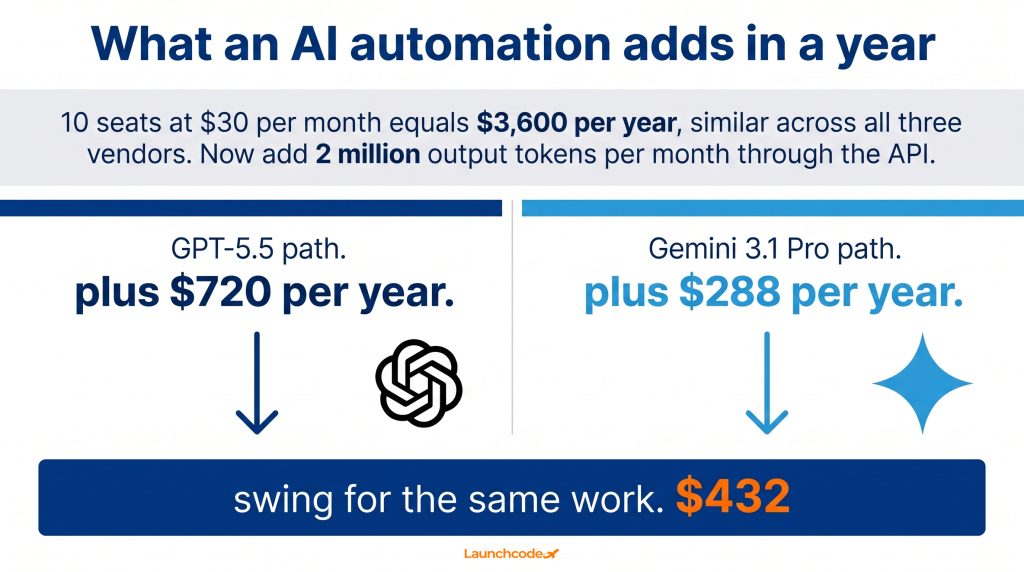
Take a ten-person marketing team. Ten seats at 30 dollars a month is 3,600 dollars a year, similar across all three vendors. Now add an automation that drafts and summarizes content through the API. Send two million output tokens a month through GPT-5.5 at 30 dollars per million, and you add about 720 dollars a year. Run the same volume through Gemini 3.1 Pro at 12 dollars, and you add about 288 dollars. Same work, a 432 dollar swing, before you count setup time.
This is why analysts frame AI as an ongoing cost, not a one-time purchase. Ecosystm analyst Tim Sheedy describes how embedded AI charges add up, calling it “a tax on ISVs” and pushing teams toward cheaper models for routine tasks. Dan Herbatschek of Ramsey Theory Group makes the same point about budgeting, warning that AI costs do not end at deployment and compound over time.
On paid business tiers, all three keep your conversations out of model training by default and offer enterprise security controls. The real differences sit in certifications, data residency, and how carefully your team sets the controls. For regulated work, verify the current data terms with each vendor before you deploy.
Privacy is a configuration problem as much as a vendor problem. The defaults on free consumer tiers differ from the defaults on team and enterprise plans, so the plan you buy changes how your data is treated.
Avoid these by standardizing on a paid business tier, setting data controls on day one, and writing a short internal rule for what staff may and may not paste into any AI tool.
Most companies past the experiment stage use more than one model. They route each task to the best fit and treat models as a menu, not a single default. If you are choosing today, plan for a primary model plus a cheaper second model for high-volume work, rather than forcing everything through one tool.
The market itself has split by use case, which tells you the single winner question is the wrong one.
Enterprise spending is no longer concentrated in one vendor. Menlo Ventures research estimates Anthropic at about 40 percent of enterprise model spend, OpenAI near 27 percent, and Google around 21 percent, with Anthropic holding a large lead in coding. That firm discloses an Anthropic stake, so read the exact figures as directional. The direction holds across sources. A CIO survey reported by eMarketer found OpenAI still leading large deployments while Anthropic reached 44 percent penetration, often used alongside it.
Usage data backs this up. Perplexity’s enterprise analysis found 43.6 percent of organizations used more than one model during 2025, and the largest accounts used dozens. Menlo partner Tim Tully summed up the shift in the report announcement, noting that teams are “prioritizing real performance in production.”
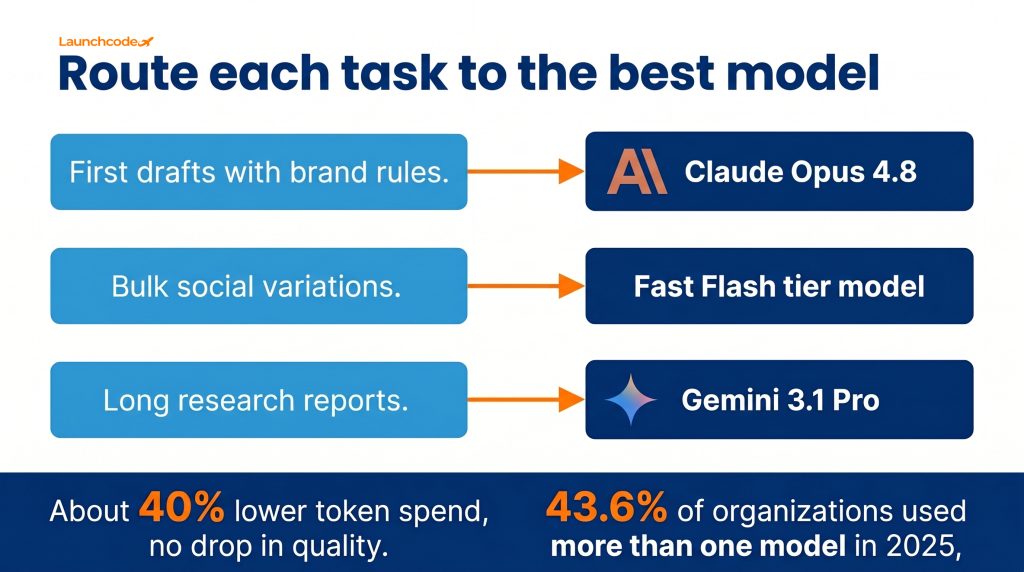
A content team can run Claude Opus 4.8 for first drafts that follow brand rules, send high-volume social variations through a cheaper fast model, and use Gemini 3.1 Pro to read a long research report and pull out the key points. Three jobs, three model choices, one workflow. This split often cuts cost while raising quality on the parts that matter.
“We draft client content on Claude Opus 4.8 and push bulk variations to a Flash tier model. That split cut our token spend about 40 percent with no drop in quality.” Derick Do, Co-Founder and Chief Product Officer.
Choose by your primary work and your existing stack, not by hype. If you write and analyze a lot, start with Claude. If you run on Google Workspace or process large documents, start with Gemini. If you want the broadest tool set and the easiest onboarding, start with ChatGPT. Then add a cheaper second model for volume.
Use this as a starting point, then confirm with a short trial on your real tasks.
| Business profile | Start with | Why | Add for volume |
|---|---|---|---|
| Content and marketing team | Claude | Strong writing and instruction following | A fast cheap model for bulk drafts |
| Software or product team | Claude or ChatGPT | Coding and agentic strength | Gemini for large codebase reads |
| Google Workspace business | Gemini | Native fit in Gmail, Docs, Sheets | ChatGPT for image and broad tasks |
| General small business | ChatGPT | Widest features, easy onboarding | Gemini for cheap, high-volume work |
| Regulated industry | The vendor whose current terms fit | Compliance and residency decide it | Verify before using any second tool |
At Launchcodex, we route tasks across models instead of forcing one tool to do everything, matching the model to the job across content, research, and AI automation work. The pattern that holds up is simple. Use the strongest model where errors are expensive, and a cheaper model where speed and volume matter more than polish. For teams building this into search and content, our work on generative engine optimization shows how model choice connects to visibility in AI answers.
The right AI for your business is the one that fits your highest value work, your budget, and the tools you already run. Claude Opus 4.8 leads coding and careful analysis, Gemini 3.1 Pro wins on cost and long context, and GPT-5.5 brings the widest reach and the easiest start. None of them wins every category, and the strongest setup usually pairs a primary model with a cheaper second one.
Your next step is a short, honest trial. Pick the model that leads your main task, run it on your real work for a week, set your data controls before staff use it, and re-check prices and versions on each vendor’s own page, since this field changes monthly. If you want help designing a model routing setup that fits your workflows, our team can map it to your goals through our marketing and automation services.
It depends on your main task. ChatGPT is the easiest start for general use and onboarding, Claude is the strongest for writing and analysis, and Gemini is the best value and the natural fit if you run on Google Workspace.
At the seat level, yes. All three cost around 20 dollars a month for individuals and 25 to 30 dollars per user for teams. Costs diverge when you use the API at scale, where Gemini is cheapest per token and GPT-5.5 has the highest output price.
On paid team and enterprise tiers, all three exclude your conversations from training by default. Free consumer tiers may not, so move staff to a paid business plan and set the data controls before anyone uses it for work.
Yes, and most companies past the trial stage do. Research shows a large share of organizations route tasks across several models. A common setup uses a strong model for high-value work and a cheaper model for high-volume tasks.
Gemini 3.1 Pro, at 2 million tokens. Claude Opus 4.8 offers 1 million, and GPT-5.5 is smaller. A larger context window helps when you feed the model long documents, full reports, or large datasets in one session.


Real stories from the people we’ve partnered with to modernize and grow their marketing.