
Share:

AI marketing & automation


Anthropic just released its most capable AI model to the public, and most of the coverage is written for developers and investors. If you run a marketing team or a business, you still need a straight answer: what changed, what does it cost, and what should you do about it.
This article gives you that answer. You will learn what Claude Fable 5 is, where it fits in your workflows, why the June 22 deadline matters, and how the launch connects to your visibility inside AI assistants.
Claude Fable 5 is the first publicly available model in Anthropic’s new Mythos class, a tier above the Opus line. Anthropic states that its capabilities exceed any model the company has ever made generally available. The headline change is endurance. Fable 5 can plan, execute, and revise complex work across hours or days instead of answering one prompt at a time.
The naming confuses people, so here is the lineup in plain terms. Anthropic announced Claude Fable 5 and Claude Mythos 5 together. They are the same underlying model. Mythos 5 has its cybersecurity safeguards lifted and stays restricted to vetted partners through Project Glasswing, a collaboration with the US government. Fable 5 is the public version with safety classifiers attached.
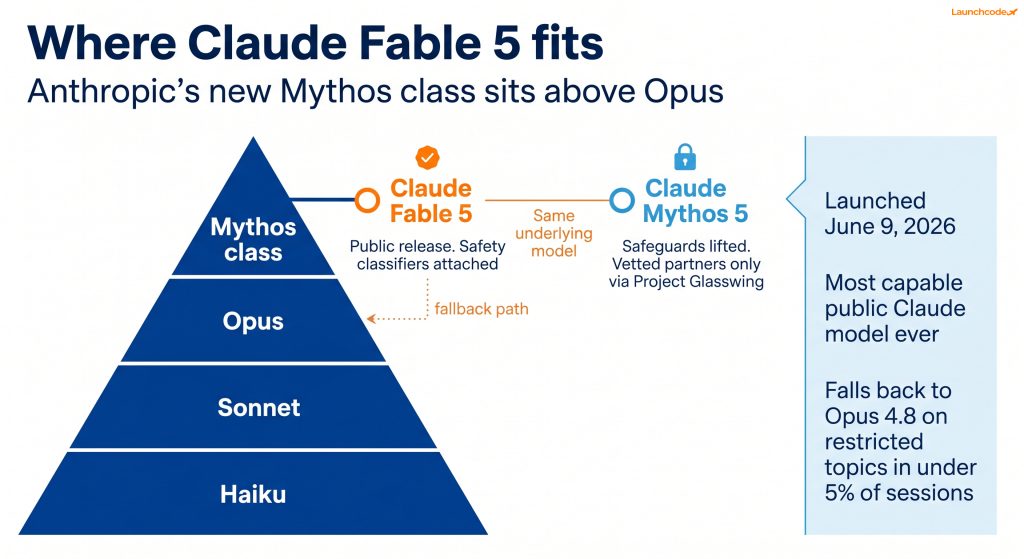
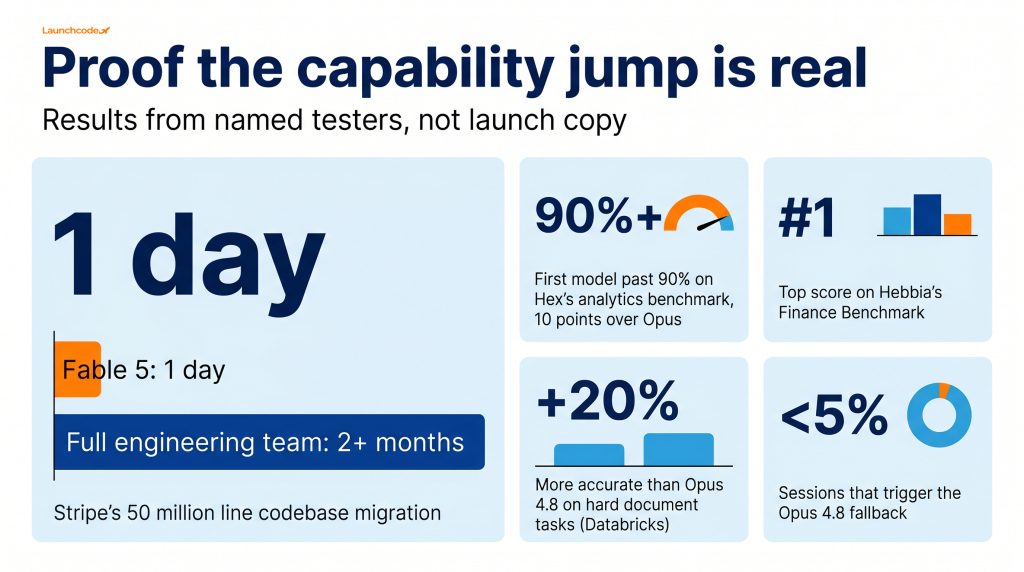
The classifiers reroute requests about cybersecurity, biology, chemistry, and model distillation to Claude Opus 4.8, the previous flagship. Anthropic reports this happens in under 5 percent of sessions, so normal marketing and business work will almost never trigger it. Before release, an external bug bounty found no universal jailbreaks across more than 1,000 hours of testing, a real trust signal for business adoption.
The strongest evidence comes from named testers, not launch copy. Stripe reported that Fable 5 completed a migration across a 50 million line codebase in one day, work estimated at over two months for a full engineering team. On the analysis side, Fable 5 posted the top score on Hebbia’s Finance Benchmark and became the first model to pass 90 percent on Hex’s analytics benchmark, a 10-point jump over Opus.
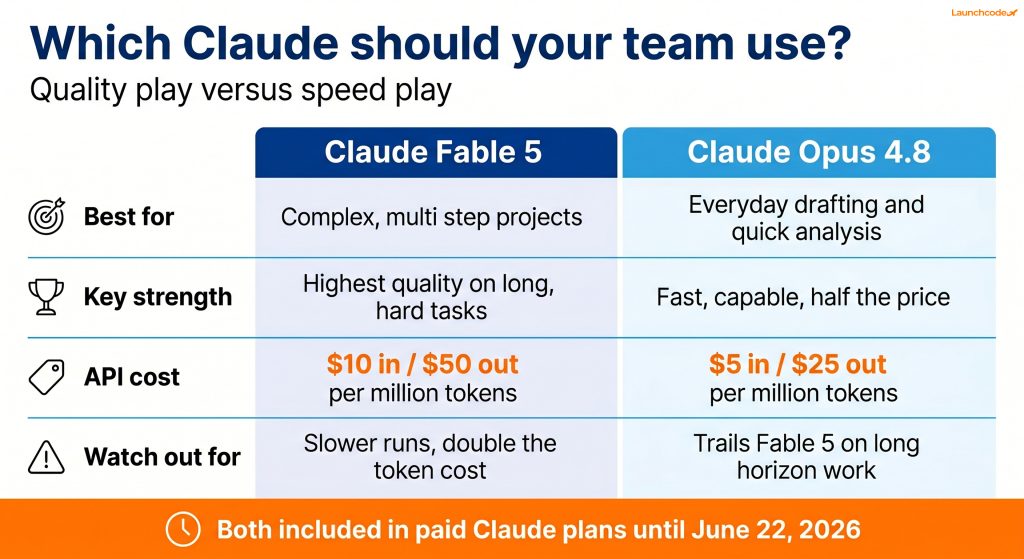
On the API, Fable 5 costs $10 per million input tokens and $50 per million output tokens, roughly double Claude Opus 4.8. The bigger news for most teams is the access window. Fable 5 is included in Pro, Max, Team, and seat-based Enterprise plans until June 22, 2026. After that, it moves to usage credits.
That deadline turns a product launch into a decision point. MacRumors confirmed the June 22 cutoff, and Anthropic plans to restore subscription access once capacity allows. Until then, paid subscribers get roughly two weeks to test the most capable public model at no extra cost. The $10 and $50 per million token pricing puts API usage at twice the Opus 4.8 rate, so the free window is the cheapest evaluation you will get.
| Option | Who it fits | Key strength | Watch out for |
|---|---|---|---|
| Claude Fable 5 | Teams with complex, multi-step projects | Highest quality on long, hard tasks | Slower runs, double the token cost |
| Claude Opus 4.8 | Every day drafting, summaries, quick analysis | Fast, capable, half the price | Trails Fable 5 on long horizon work |
Independent testing supports this split. Databricks ran Fable 5 through its hardest document benchmarks and called it “the quality leader for complex, autonomous knowledge work.” The same Databricks evaluation found Fable 5 about 20 percent more accurate than Opus 4.8 on hard document tasks, while running roughly 30 percent slower and producing 2.5 times more output tokens. Use it where quality matters most, not for every prompt.
“The per token price looks scary until you measure per task. On long jobs, Fable 5 finishes in fewer passes, so the gap versus Opus narrows. Run both on the same task and compare total cost, not token rates.” Derick Do, Co-Founder and Chief Product Officer
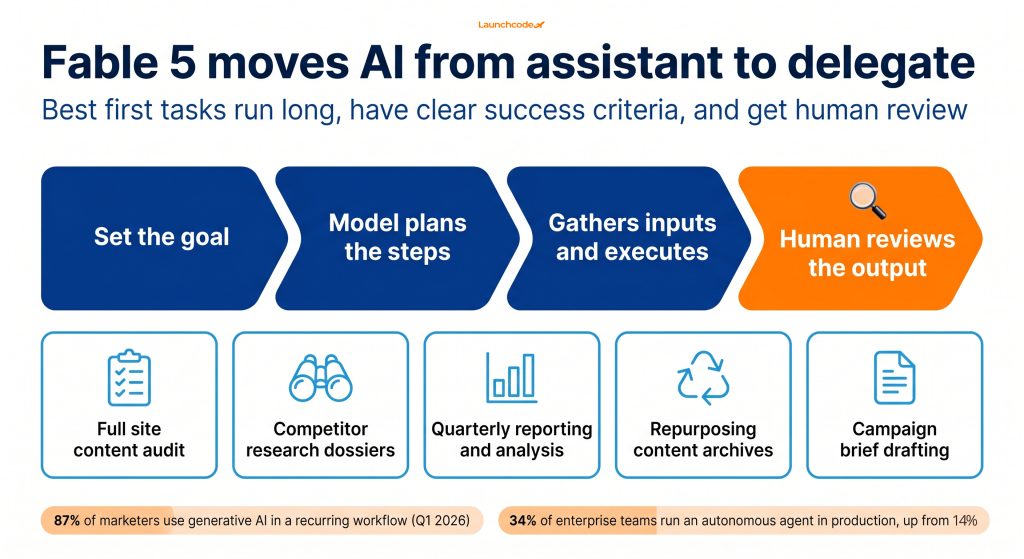
Fable 5 moves AI from assistant to delegate. Instead of generating a paragraph or a quick summary, it can take a goal like a full content audit, a competitor analysis, or a quarterly reporting build, then break it into steps, gather inputs, and deliver finished work for review. That maps directly to the highest cost hours in most marketing operations.
This shift lands in a market that has already adopted AI as the default. Per Salesforce’s State of Marketing research, 87 percent of marketers used generative AI in at least one recurring workflow in Q1 2026, up from 51 percent two years earlier. HubSpot’s 2026 data in the same roundup shows 34 percent of enterprise marketing teams now run at least one autonomous agent in production, double the figure from late 2025. Fable 5 is built for exactly that kind of work.
The best first tasks share three traits: they run long, they have clear success criteria, and a human reviews the output. Strong candidates include:
In our own agentic content and reporting systems at Launchcodex, the pattern holds. Long-horizon models earn their cost on structured, multi-step work with defined checkpoints, and waste it on quick one-off prompts. If you want help designing that kind of system, our AI automation services cover exactly this build.
“Every agent-run we ship has a defined deliverable and a review checkpoint. The runs without checkpoints are the ones we end up redoing. Scope the output before you start the model.” Derick Do, Co-Founder and Chief Product Officer
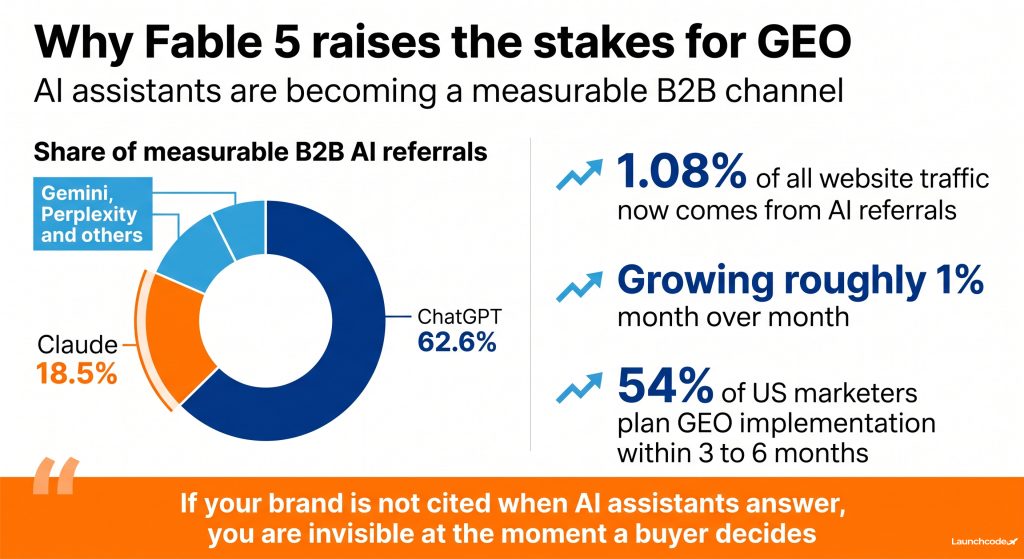
Every capability jump in models like Fable 5 pulls more research, comparison, and buying questions into AI assistants. If your brand is not cited when Claude or ChatGPT answers those questions, you are invisible at the exact moment a buyer decides. That makes generative engine optimization a near-term priority, not a future one.
The channel is small but compounding. AI referral traffic now accounts for about 1.08 percent of all website traffic and grows roughly 1 percent month over month, per Conductor benchmarks. Claude specifically reached 18.5 percent of measurable B2B AI referrals in March and April 2026, second only to ChatGPT. The market is responding fast. eMarketer found that 54 percent of US marketers plan GEO implementation within three to six months.
“In client GA4 reports, AI referrals are still a small share of sessions, but they convert ahead of organic almost every month. We treat citations in AI answers the way we treated rankings in 2015. Early and underpriced.” Tanner Medina, Co-Founder and Chief Growth Officer
The practical move is to treat AI assistants as a distribution channel with its own rules: structured content, clear answers, cited data, and entity-rich pages. Our SEO and GEO services break down how that work differs from traditional rankings.
The free access window rewards teams that test with intent. Run this process now.
The Media Stack’s analysis of the launch framed the real question well: “the harder question is no longer what the model can do, but what it does to the business model.” That is the right lens. Fable 5 is less a chatbot upgrade and more a signal that serious knowledge work is becoming delegable. Teams that build reviewed, repeatable systems around that capability will outpace teams that keep treating AI as a faster typist. Start with one workflow this week, measure it honestly, and let the results set your budget.
They are the same underlying model. Mythos 5 has cyber safeguards lifted and is limited to vetted partners. Fable 5 is the public version with safety classifiers that reroute restricted topics to Opus 4.8.
It is not on the free tier. It is included in Pro, Max, Team, and seat-based Enterprise plans until June 22, 2026, then it requires usage credits. API pricing is $10 per million input tokens and $50 per million output tokens.
No. Use Fable 5 for long, complex, high-stakes work like audits, research, and reporting. Keep Opus 4.8 for everyday drafting and quick analysis, where it is faster and half the cost.
Almost never. Anthropic reports the Opus 4.8 fallback triggers in under 5 percent of sessions, and the restricted topics are cybersecurity, biology, chemistry, and model distillation.


Real stories from the people we’ve partnered with to modernize and grow their marketing.