
Share:

AI marketing & automation


Most content teams know AI tools make mistakes. What they underestimate is how often those mistakes happen and what they cost when they go live. A single fabricated statistic or invented citation can undo months of credibility built through consistent publishing. The problem is structural: hallucination is baked into how language models work, and no model update will remove it entirely.
This article explains what multi-source content verification is, why it has become a required step in content production, and how to build a process your team will actually follow. You will come away with a source-tiering framework, a step-by-step verification workflow, a practical tool list, and the common mistakes teams make so you can avoid them from the start.
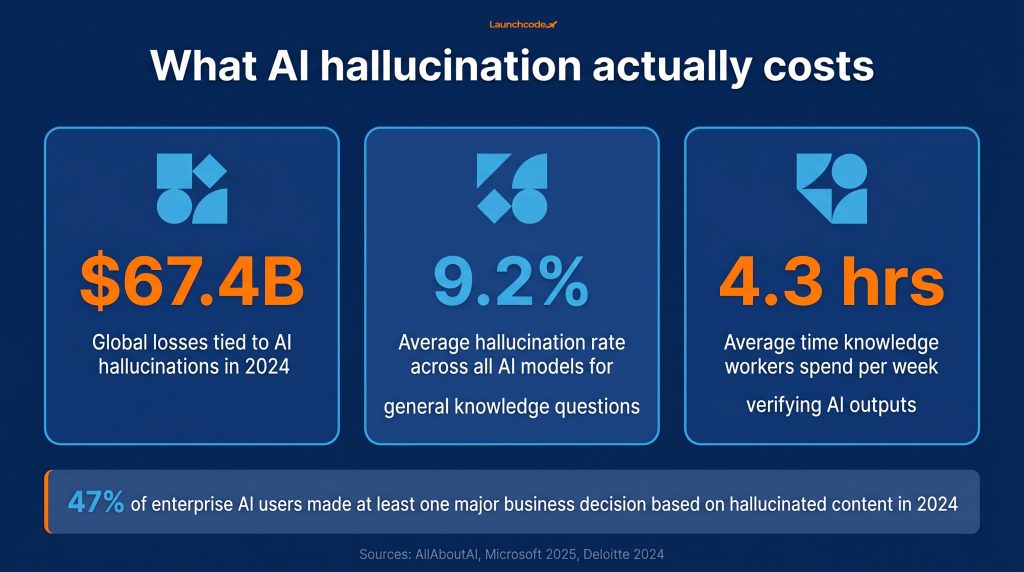
AI tools produce inaccurate information at rates most teams have not planned for. Across all major language models, the average hallucination rate for general knowledge questions sits at around 9.2%. MIT researchers found in January 2025 that AI is 34% more likely to use confident language like “definitely” and “certainly” when generating incorrect information. The more wrong the output, the more certain it sounds. Standard quality checks fail against that pattern.
A writer or editor who judges an AI draft by tone and confidence will miss errors precisely where they are most dangerous. Fluent, assertive prose is not a signal of accuracy. Facts have to be checked against real sources before anyone treats the content as ready to publish.
The business cost is direct. Global losses tied to AI hallucinations reached $67.4 billion in 2024, based on a comprehensive study by AllAboutAI. At the team level, knowledge workers already spend an average of 4.3 hours per week verifying AI outputs, according to 2025 data from Microsoft. That time cost exists whether a formal process is in place or not. A structured workflow makes that time more effective and stops the same errors from reaching publication repeatedly.
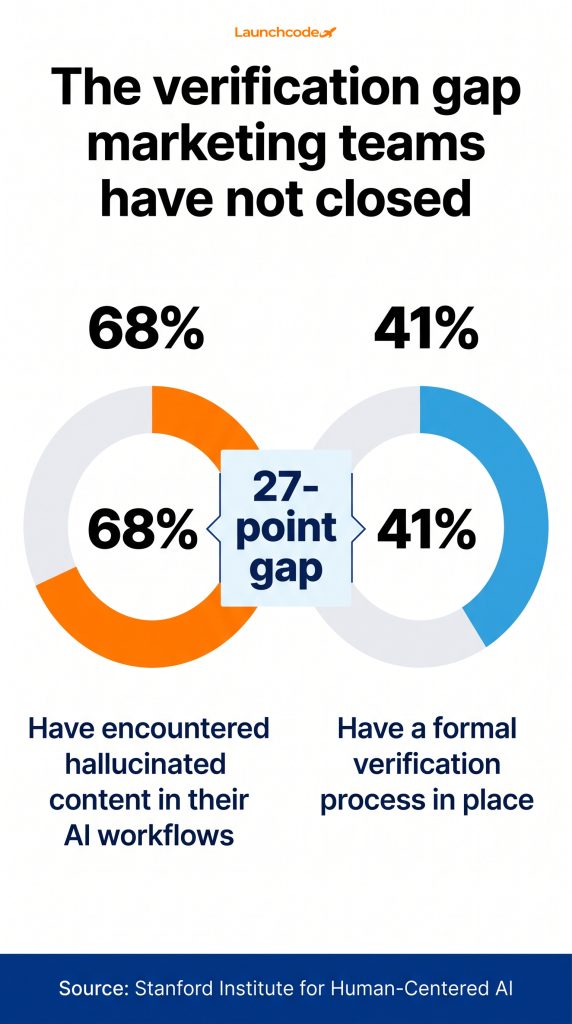
Research from the Stanford Institute for Human-Centered AI found that 68% of marketing professionals using generative AI have encountered hallucinated content in their workflows, yet only 41% have formal verification processes in place. That 27-point gap is where brand credibility gets damaged.
The consequences are concrete. In early 2024, a major technology company’s AI-generated blog post cited three entirely fictional research studies. Journalists identified the fabrications. The company issued a public retraction, which drew broader media coverage and triggered regulatory scrutiny of their marketing practices. The retraction caused more harm than if the post had never gone live.
A mathematical proof published in 2025 confirmed that hallucination is a permanent condition under current language model architectures, not a software bug awaiting a patch. The workflow must account for it every time.
The numbers tell a clear story. Just 28% of Americans trust television, radio, and newspapers to report news fully, fairly, and accurately, according to Gallup’s 2025 data. That is a record low. The World Economic Forum’s Global Risks Report 2025 classified misinformation as a top systemic risk, noting that AI-generated content is accelerating its spread. PwC’s 24th Annual Global CEO Survey listed misinformation as a top 10 threat to growth.
Readers arrive at brand content with more skepticism than at any point in the past decade. Getting caught with a fabricated claim in that environment does not look like an honest mistake. It looks like a pattern.
Multi-source content verification is the practice of confirming a claim by checking it against at least two independent, credible sources before publishing. Both sources must reach the same conclusion through their own research, not by citing each other. The goal is to confirm that the claim is accurate, that the data has not been stripped of context, and that the causal relationship described in the content is the one the original source actually supports.
This is different from plagiarism detection, which checks whether text matches existing content. It is also different from AI content detection, which tries to identify whether text was generated by a machine. Verification is about whether the facts in the content are true.
Not every sentence needs a source. Verification effort should focus on:
General explanations of concepts, original opinions, and widely accepted definitions do not require sourced verification. The threshold rises in proportion to how specific or consequential the claim is.
AI errors fall into two distinct categories that require different verification responses.
Intrinsic hallucinations occur when AI output contradicts the source material it was given. If you feed a model a research paper and the summary contradicts the paper’s actual findings, that is intrinsic. Catching these requires comparing the AI output directly against the input document.
Extrinsic hallucinations are more dangerous in a publishing context. These occur when AI invents facts, citations, or events not found in any real source. A model might cite a 2023 study from Stanford with a plausible-looking author name and DOI, and neither will exist. Catching these requires going to the supposed original source and confirming it is real. A reference that sounds authoritative is not the same as one that is.
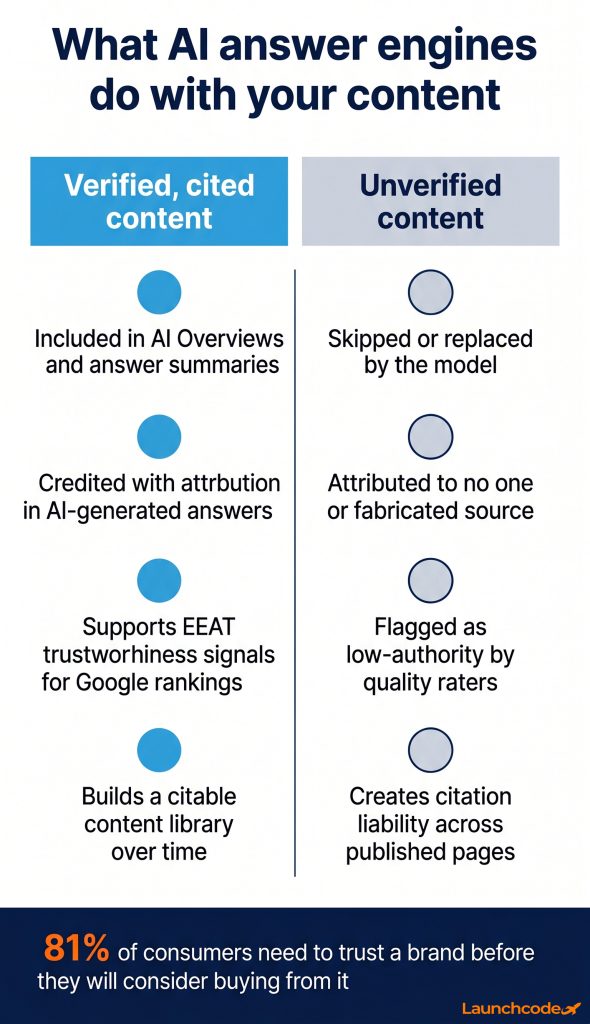
Verified, cited content performs better in both traditional search and AI-generated answers. Google’s EEAT framework, which stands for Experience, Expertise, Authoritativeness, and Trustworthiness, treats clear citations, consistent sourcing, and demonstrable accuracy as core signals of content quality. AI answer engines including Google AI Overviews, Perplexity, and ChatGPT pull from content they can verify. They surface claims backed by traceable, credible sources more reliably than claims that cannot be independently confirmed.
Accuracy is what makes content citable. Content that cannot be verified by a retrieval system gets skipped or replaced, often with a hallucinated alternative from the model itself.
“We track which content gets cited in AI Overviews across our client sites. The pattern is consistent: pages with inline source citations and verified claims get pulled into AI answers far more often than pages that make the same points without attribution.”
Tanner Medina, Co-Founder and Chief Growth Officer, Launchcodex
Generative Engine Optimization (GEO) is the practice of structuring content so AI systems can extract and attribute it. When a claim is backed by multiple credible sources, an AI building a summary is more likely to include it and credit the page it came from. When a claim is unverifiable, the system either omits it or generates a replacement.
Teams building a GEO strategy need verified content as the foundation. Unverified content creates a citation liability: claims that AI systems encounter but cannot confirm, which either disappear from AI-generated answers or get replaced with fabricated alternatives attributed to no one.
Google’s Search Quality Rater Guidelines treat trustworthiness as the most foundational of the four EEAT components. The actions that build it are specific:
A post that cites a real study correctly, with a link to the paper and a note on the sample size, ranks differently than a post that makes the same claim without attribution. These signals are not decorative. Quality raters and algorithmic systems use them to classify content as authoritative.
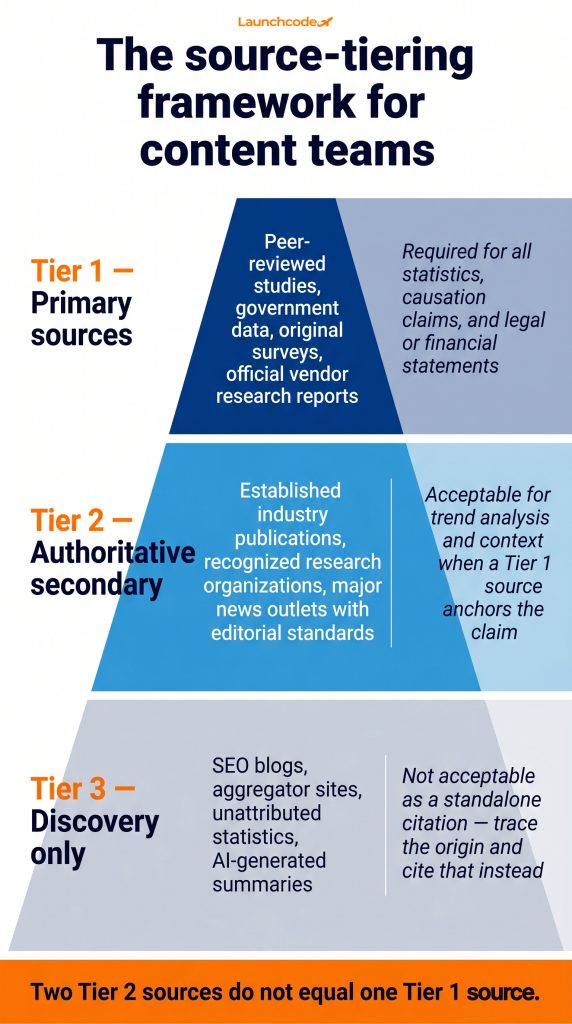
One reason verification slows content teams down is that writers evaluate source credibility from scratch for each new claim. A source-tiering framework removes that decision from the production process. It defines in advance which source types are acceptable for which claims, so writers and editors follow a consistent standard rather than making judgment calls under deadline pressure.
Here is a three-tier model built for marketing content teams.
| Tier | Source type | Examples | When to use |
|---|---|---|---|
| Tier 1 | Primary sources | Peer-reviewed studies, government data, original surveys, official vendor research reports | Required for all statistics, causation claims, and legal or financial statements |
| Tier 2 | Authoritative secondary | Established industry publications, recognized research organizations, major news outlets with editorial standards | Acceptable for trend analysis and context when a Tier 1 source anchors the claim |
| Tier 3 | Discovery only | SEO blogs, aggregator sites, unattributed statistics, AI-generated summaries | Not acceptable as a standalone citation; trace the origin and cite that instead |
A few practical rules keep this manageable in a fast-moving content operation.
Two Tier 2 sources do not equal one Tier 1 source. If a claim requires primary data and none exists, remove the claim or reframe it as an informed opinion rather than a stated fact.
When a statistic appears on a Tier 3 page, find the original. Most aggregator posts link back to a study, survey, or official report. Go to that document, confirm the figure is accurate and in context, and cite the original. If the original cannot be found, the statistic does not belong in the article.
Tier 1 sources can still be misrepresented. Confirm that the claim in your draft reflects what the source actually says, not just that the source exists. A study may find a correlation, not a cause. A report may apply to a specific geography or industry segment. Those qualifications belong in the article alongside the number.
A verification workflow does not have to add hours to production. Teams that fall behind on verification are usually those that treat it as a final step, reviewing everything after the draft is complete. Building verification into the research and drafting phases reduces total time spent and speeds up editorial review by presenting editors with pre-verified claims.
“Verification has to live in the research phase, not the review phase. By the time a writer is drafting, every statistic they plan to use should already have a confirmed source attached to it. That is the only way to make verification fast enough to scale.”
Derick Do, Co-Founder and Chief Product Officer, Launchcodex
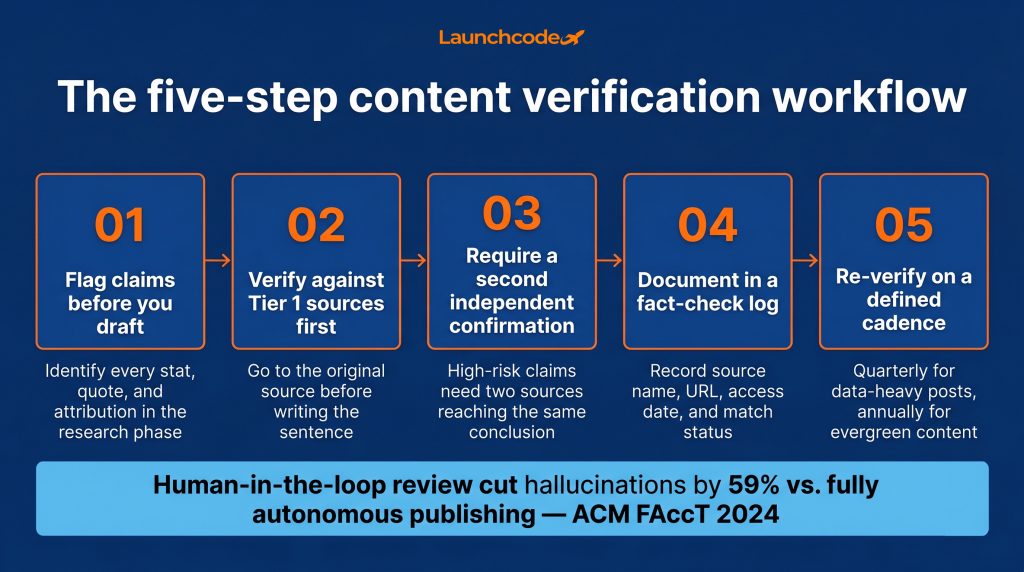
A shared spreadsheet with these columns covers what most teams need:
At Launchcodex, every research-heavy piece goes through a structured verification pass before editorial review, with sources logged against each claim so future updates are traceable and corrections are specific rather than guesswork.
Research from ACM FAccT 2024 found that a human-in-the-loop approach to AI content production cut hallucinations by 59% across a 1,200-article benchmark compared with fully autonomous publishing. IBM’s AI Adoption Index from 2025 found that 76% of enterprises now run human review processes specifically to catch hallucinations before content reaches users.
Automated tools reduce the surface area of errors. They do not replace reading the original source, comparing it to the claim, and making a judgment on whether the two match. That step requires a person.
Verification tools reduce the time cost of checking claims at volume. No single tool replaces reading the source document. The right combination removes friction from finding sources, assessing credibility, and catching common error types before a human reviewer encounters them.
Retrieval-Augmented Generation (RAG) frameworks, including LlamaIndex and LangChain, connect language models to external knowledge bases at the point of generation. The model retrieves real documents before generating an answer rather than predicting based purely on training patterns. Properly implemented RAG reduces hallucinations by up to 71%, according to current research benchmarks.
RAG and human editorial review work at different layers and are not interchangeable. RAG reduces the volume of errors that reach a human reviewer. Human review catches the errors RAG misses. Both are required.
| Tool | Best for | Limitation |
|---|---|---|
| Google Fact Check Explorer | Claims with existing public fact-checks | Does not cover proprietary data or niche industry claims |
| NewsGuard | Fast site-level credibility assessment | API access requires a subscription |
| Perplexity AI | Finding alternative sources for a claim | AI-generated output still requires source confirmation |
| TinEye | Confirming original source of an image | Limited to images that have been indexed |
| RAG frameworks (LlamaIndex, LangChain) | Reducing hallucination during AI drafting | Requires technical setup and a maintained knowledge base |
Most verification failures follow predictable patterns. Understanding them lets teams design their process to avoid them rather than discover them post-publication.
The most frequent error is citing a blog post or roundup that references a statistic without going to the study or survey where that number originated. Aggregators misread findings, strip context, or pass along earlier errors without knowing. Every statistic in published content should trace back to the original source, not to a third party’s interpretation of it.
MIT researchers found in January 2025 that AI models are 34% more likely to use phrases like “definitely” and “certainly” when generating incorrect information. Editing for fluency and confidence before verifying for accuracy reverses the right order. Lock the facts first, then improve the prose.
A statistic accurate in 2023 may be outdated, superseded, or contradicted by newer research by the time someone reads the article in 2025. Content without a defined review cadence accumulates errors over time. Build review dates into the content calendar alongside the publishing schedule.
Two articles that both reference the same underlying study do not constitute independent confirmation. Independent means two sources reached similar conclusions through separate research processes. If both citations trace back to the same original data, you have one source, not two.
Facts that feel universally known are often wrong in the specifics. Percentages, rankings, and timelines that circulate widely tend to do so in distorted form. Apply the same verification standard to familiar-sounding claims as to unfamiliar ones.
Most brands are scaling content production faster than they are building the systems to keep that content accurate. The result is a growing body of published material that erodes trust rather than builds it.
81% of consumers need to trust a brand before they will consider buying from it. Content that cites real sources, traces claims to primary data, and shows its work builds that trust in ways that polished writing alone cannot achieve. Pew Research Center data shows 74% of U.S. adults are already concerned that AI makes it easier to spread false information online. Those readers are the same people arriving at brand blog posts, product pages, and thought leadership content every day.
Multi-source verification is also a GEO strategy with a measurable return. AI answer engines do not cite content they cannot verify. They surface claims backed by multiple credible sources, structured for retrieval, and consistent across the web. Teams that build verification into their production process are protecting accuracy today and building the content infrastructure that earns citations from AI systems over time.
Start with one concrete change: require a source log for every new piece that contains a statistic or causal claim. Trace every number back to its origin before it enters the draft. That single discipline, applied consistently, produces content that holds up to scrutiny, supports EEAT signals, and gives AI systems something worth citing. The brands that do this now will be harder to displace as search and AI search continue to reward trust.
To see how verification fits into a broader SEO and GEO content strategy, our SEO and GEO services page covers how we build it into client programs from the research phase forward.
Multi-source content verification is the practice of confirming a fact, statistic, or claim by checking it against at least two independent, credible sources before publishing. Both sources must reach the same conclusion through separate research, not by citing each other.
AI language models hallucinate at meaningful rates. The average across all major models for general knowledge questions is approximately 9.2%. AI also sounds more confident when it is wrong, which makes errors harder to catch without checking original sources directly.
Google’s EEAT framework treats accurate, cited, well-sourced content as a core trust signal. Content that demonstrates expertise through clear citations and verifiable claims ranks more consistently than unverified alternatives, particularly in competitive and YMYL categories.
A source-tiering framework is a structured policy that defines in advance which source types are acceptable for different types of claims. Tier 1 covers primary research and official data. Tier 2 covers established industry publications. Tier 3 covers discovery-only sources that point toward the original but cannot be cited standalone.
Yes. AI answer engines including Google AI Overviews, ChatGPT, and Perplexity prefer content with verifiable, multi-source claims when building summaries. Content that is well-cited, structured for retrieval, and consistent across credible sources is more likely to appear in AI-generated answers than unverified content.
That depends on the volume of claims and the maturity of the workflow. Teams that build verification into the research phase, before drafting, spend less time overall than teams that treat it as a final edit. A structured fact-check log and a source-tiering framework reduce per-claim verification time significantly over time.
Retrieval-Augmented Generation (RAG) is an AI architecture that connects a language model to an external knowledge base at the time of generating output. Rather than relying entirely on training-based prediction, the model retrieves real documents first. Properly implemented RAG reduces hallucinations by up to 71%, but it does not replace human editorial verification of published content.
A Tier 2 source is an established industry publication or recognized research organization with editorial standards. It is acceptable for context and trend analysis when anchored by a Tier 1 source. A Tier 3 source is an aggregator, SEO blog, or AI-generated summary. It is acceptable only as a discovery tool to find the original source, not as a citation in published content.


Real stories from the people we’ve partnered with to modernize and grow their marketing.