
Share:

AI marketing & automation


Google released its March 2026 core update on March 27. If your traffic or rankings shifted in the past few days, this is likely why. If nothing has changed yet, it still might. The rollout can take up to two weeks, and early stability is not a guarantee.
This article covers what actually changed, which sites are getting hit and why, and what your team can do right now. You will also find specific guidance on AI Overviews, an angle most update coverage skips entirely. In 2026, holding a ranking and losing clicks are both possible at the same time.
The March 2026 core update is a broad ranking recalibration, not a targeted penalty. Google describes it as a “regular update designed to better surface relevant, satisfying content for searchers from all types of sites.” That language sounds mild. The practical effect is not. Core updates re-weight how Google evaluates quality signals across every page on every site, which means significant ranking shifts are normal, even for sites that have not changed anything recently.
Google updated its Search Status Dashboard at 2:14 AM PDT on March 27 to mark the rollout live. The full impact will not stabilize until the rollout completes, which could run into early April.
This is Google’s first broad core update of 2026. The February 2026 update was Discover-only, affecting how content surfaces in Google’s feed for U.S. English users. The March update affects standard Google Search across all regions and content types.
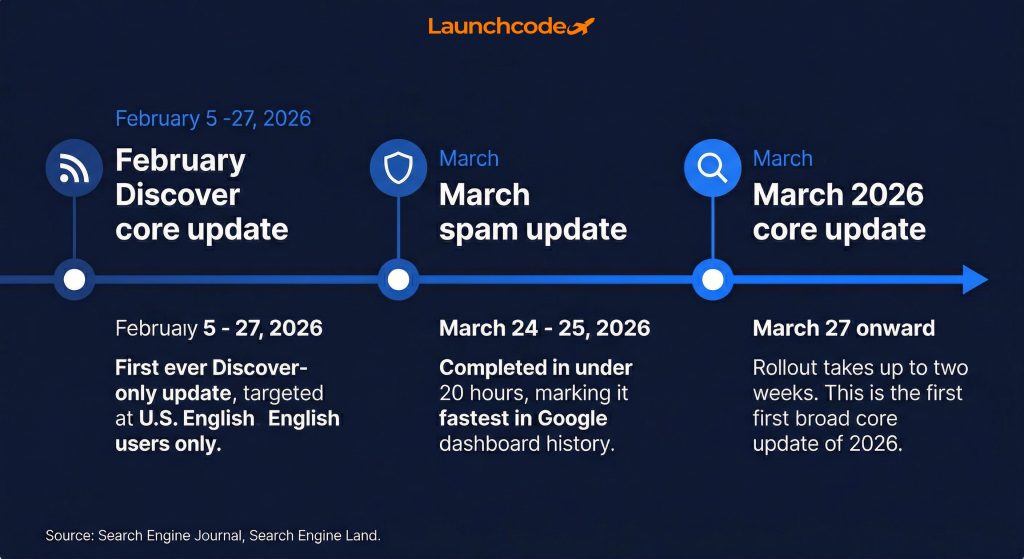
Google ran the March 2026 spam update on March 24, completing it in under 20 hours, making it the shortest confirmed spam update in Google’s history. The core update followed two days later.
Dileep Thekkethil, Director of Marketing at Stan Ventures, described the pattern: the March 2026 update “follows the pattern we saw in March 2024, where Google combined multiple system refreshes into one giant rollout. By running a spam update first, Google effectively cleared the noise of low-quality automation before recalibrating the core ranking signals for the rest of the web.”
The spam sweep removed obvious violators. The core update then recalibrated quality signals across everything that remained. Because the core update worked against a cleaner baseline, the quality signals it rewards are now more decisive than in previous cycles.
| Stage | What to expect |
|---|---|
| Days 1 to 5 | High volatility. Rankings may shift dramatically in both directions. |
| Days 6 to 10 | Partial stabilization. Patterns start to emerge. |
| Days 11 to 14 | Final signals settle. Reliable impact picture appears. |
| Post-rollout | Smaller unannounced updates continue running in the background. |
Do not make major site decisions based on single-day data. Google’s Search Status Dashboard is the only official source for rollout status.
Sites getting hit are those that produce content primarily to generate search traffic rather than to genuinely help users. The specific patterns include scaled AI content without original expertise, thin affiliate content, syndicated articles without added value, and pages where the author’s real-world credentials are absent or unclear. Sites gaining ground have verified expertise, original analysis, transparent authorship, and content that answers reader questions better than competing pages.
The data from the update cycle leading into March 2026 is specific. AI content farms lost 60 to 80% of their traffic. Affiliate sites saw the highest negative impact rate of any category, with 71% experiencing ranking drops. Syndicated content, particularly on Google Discover, saw major losses. Yahoo dropped 47% in Discover traffic, according to Lily Ray, VP of SEO Strategy at Amsive, who noted that “syndicated content has been a BIG problem in Discover for years.”
Google uses a specific phrase for what it penalizes: scaled content abuse. This is content published at high volume through AI or automated systems without meaningful original value. The intent test is what matters. Google Search Liaison Danny Sullivan has stated the official position: “We focus on the quality of content, not how content is produced.” A page can be AI-assisted and still rank well if it demonstrates real expertise and serves users. The violation is content that exists primarily to manipulate rankings.
Sites that held or gained rankings in this cycle share clear traits:
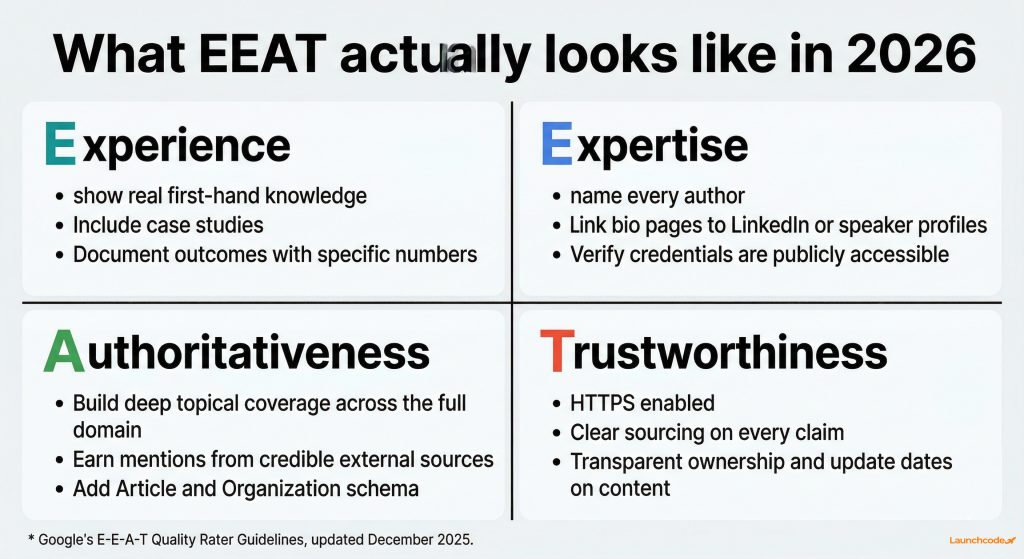
EEAT stands for Experience, Expertise, Authoritativeness, and Trustworthiness. Google has applied it as a quality framework since 2022, but the March 2026 update extends its weight across all content types, not just health, finance, and legal. In practice, EEAT means Google’s systems now check whether your authors are real, whether their credentials are verifiable, whether your domain covers its topic consistently, and whether users trust your content enough to stay and engage.
Most articles on EEAT stop at definitions. Here is what applying it actually looks like.
Experience means content shows real first-hand knowledge. A page about a software tool written by someone who has used it looks different to Google’s systems than a page summarizing what others said about it. Specific details, personal observations, and documented outcomes are the signals. Case study angles and process walkthroughs with real examples are two of the most effective formats.
Expertise requires the author to have verifiable credentials in the topic. Google’s systems now cross-reference author identity with external sources including LinkedIn profiles, speaker pages, and publication history. Anonymous authorship carries ranking risk across all content types in 2026, including entertainment and lifestyle, not just YMYL topics.
Every article on your site needs a named author with a bio page that links to verifiable professional credentials.
Authoritativeness is site-wide. Weak coverage in one area damages authority across the entire domain. Topical authority, meaning deep and consistent coverage of a subject area, carries significantly more weight in 2026 than it did two years ago.
The top 10 domains capture 46% of all ChatGPT citations on a given topic. The top 30 take 67%. Authority concentration in AI systems mirrors what you see in traditional search rankings. Building authority now also builds AI visibility.
Trustworthiness covers the technical and editorial basics: HTTPS, accurate information, clear sourcing, transparent ownership, and update dates on content. If your site lacks any of these, fix them before anything else.
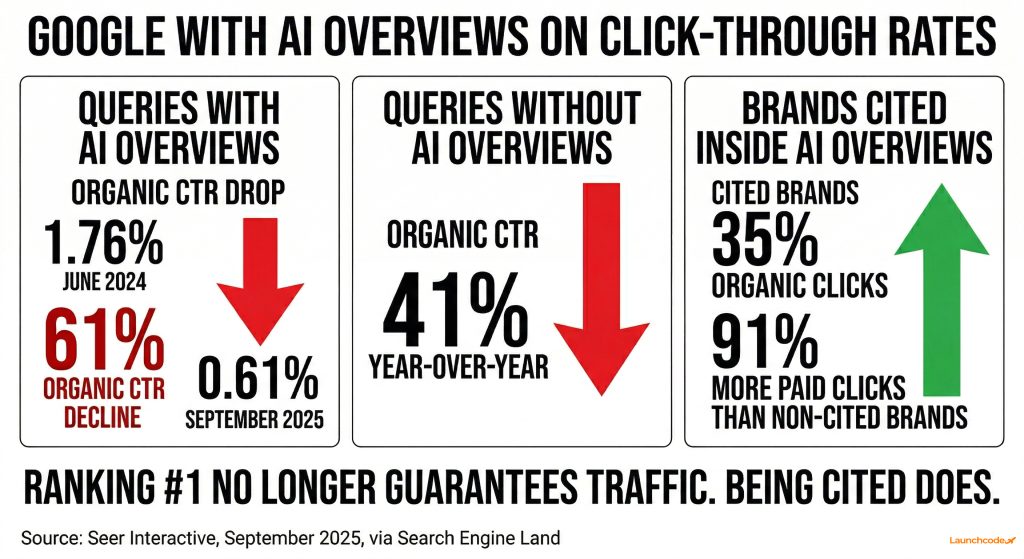
AI Overviews appear directly on the Google Search results page and summarize answers without requiring users to click. Seer Interactive’s analysis of 3,119 informational queries across 42 organizations found that organic CTR dropped 61% for queries where an AI Overview appeared, falling from 1.76% to 0.61% between June 2024 and September 2025. A site can hold its ranking position and still lose more than half its clicks. The March 2026 update does not fix this. It makes it more urgent.
Pew Research Center data shows only 1% of searches lead to a user clicking a link inside an AI Overview. Bain research puts the broader zero-click figure at 60% of all traditional searches ending without any click. Ranking is no longer the same thing as getting traffic.
Seer Interactive found that brands cited within AI Overviews earn 35% more organic clicks and 91% more paid clicks than brands not cited on the same queries. One citation inside an AI Overview can generate more qualified traffic than ranking in position 3 on the same query through traditional results. That is a material shift in how SEO performance translates to revenue.
Even outside of AI Overviews, the traditional CTR curve has shifted. Position 1 organic CTR has dropped 32% year-over-year, while positions 6 to 10 are now getting 30% more clicks than before. The SERP is more crowded, more AI-dense, and less click-friendly at the top. Brands optimizing only for position 1 are working toward a target that delivers fewer returns than it did 12 months ago.
Generative Engine Optimization, or GEO, is the practice of structuring content so AI systems including Google AI Overviews, ChatGPT, Perplexity, and Gemini extract and cite it in their responses. It is not a replacement for traditional SEO. It is the layer that connects traditional rankings with the AI citation opportunity. Duane Martinez, a strategic SEO analyst, frames the shift clearly: “SEO was optimizing for ranking. GEO is optimizing for citation visibility in AI systems, entity authority across platforms, and demonstrable expertise.”
Getting cited in AI systems requires content structured differently from content optimized purely for rankings. The mechanics are specific and learnable.
Research from position.digital shows that 44.2% of all LLM citations come from the first 30% of a page’s text. The introduction and first few sections carry disproportionate weight. If your key answer is buried in paragraph 8, AI systems are unlikely to surface it.
Structured content formats also outperform dense prose. Headings, short answer paragraphs, bullet lists, and FAQ sections all make it easier for AI systems to parse and extract specific answers.
“The brands we see winning in AI citations all share one thing: they put the clearest, most specific answer at the very top of the page and back it with a named expert. GEO is not a separate strategy. It is what good content looks like in 2026.”
Tanner Medina, Co-Founder & Chief Growth Officer, Launchcodex
Standard Google Search Console data does not separate AI Overview impressions from traditional organic impressions cleanly. Use Semrush or Ahrefs to identify which of your target keywords trigger AI Overviews. Then manually test those queries in Google to check whether your brand appears in the AI Overview summary. Track this as a separate metric from traditional rankings. Traffic-only reporting misses how AI search is distributing visibility across your competitive set.
Core Web Vitals are Google’s page experience benchmarks. Google’s 2026 targets are LCP (Largest Contentful Paint) under 2.5 seconds, INP (Interaction to Next Paint) under 200 milliseconds, and CLS (Cumulative Layout Shift) under 0.1. These are not aspirational targets. Sites with LCP above 3 seconds lost 23% more traffic than faster competitors after the March 2026 update. Technical performance is now a floor, not a bonus signal.
Core Web Vitals have been part of Google’s ranking systems since 2021. The March 2026 update increased the weight on these signals, particularly LCP and INP, which measure how fast a page loads its main content and how quickly it responds to user interactions.
“Most teams underestimate how much technical debt costs them in core update cycles. A slow LCP does not just hurt rankings. It tells Google the page does not deliver a satisfying experience, which is exactly what this update penalizes.”
Derick Do, Co-Founder & Chief Product Officer, Launchcodex
Compare organic traffic from February 15 through March 9 against March 27 onward in Google Analytics 4. Do this by landing page, not total sessions, so you can see which specific pages changed. Then cross-reference with Google Search Console to determine whether the cause is a rankings drop or a CTR drop on stable rankings. These are two different problems with different solutions.
A rankings drop combined with a traffic drop points to content quality or EEAT signals. Stable rankings with a traffic drop points to AI Overviews reducing CTR on those queries. Both are solvable, but the response is different.
| Symptom | Likely cause | First action |
|---|---|---|
| Rankings dropped, traffic dropped | EEAT or content quality signal | Content audit and author credibility review |
| Rankings stable, traffic dropped | AI Overviews reducing CTR | GEO structure improvements and AI citation tracking |
| Specific pages hit, others fine | Page-level quality issue | Content depth review for affected pages |
| Site-wide traffic drop | Domain-level authority or technical issue | Full site audit: Core Web Vitals, thin content, topical coverage gaps |
| No change yet | Rollout still in progress | Monitor daily through April 10. Avoid major changes during active rollout. |
Do not make sweeping structural changes to your site while the rollout is live. Changes made now will not register until Google re-crawls and re-indexes your pages, which may happen after the rollout has already settled. Make a prioritized list of fixes, document your current baseline clearly, and begin implementation once you have a stable post-rollout picture.
In 2026, traffic is an incomplete metric. It does not account for AI Overview visibility, citation frequency in AI responses, or share of voice across a competitive set. The brands gaining ground after this update report on where they appear in AI responses relative to competitors, not just where they rank in positions 1 through 10.
The data makes the business case directly. Brands cited in AI Overviews earn 35% more organic clicks and 91% more paid clicks than competitors not cited on the same queries. That citation advantage compounds as a brand builds topical authority and consistent credibility signals over time.
Replace traffic-only dashboards with a reporting framework that includes:
When organic traffic drops but AI citation rises, traditional attribution models break. A user who sees your brand cited in an AI Overview and then searches directly for your brand name will appear as a direct or branded organic visit in GA4, not an assisted organic conversion. This makes the true contribution of SEO and GEO invisible in standard reporting.
Marketing leads presenting to leadership should flag this directly. The business impact of content is broader than what Google Search Console click data shows.
Run diagnostics before making any changes. Identify which pages dropped in rankings and which dropped in CTR. Fix the highest-traffic pages first. Improve author credibility signals, add or update structured data, and resolve any Core Web Vitals failures. Build a GEO content layer with direct answer paragraphs, FAQ sections, and schema markup. Track AI Overview presence for your most important keywords.
Use this plan as a starting framework and adjust it based on what your data shows.
The March 2026 core update is the clearest confirmation yet that Google evaluates content the way AI systems evaluate content. It rewards structure, expertise, original insight, and verifiable authority. It penalizes volume without value.
The two-week rollout means the final picture will not be clear until early April. Use the diagnostic steps in this article to identify your specific situation. Then respond to what the data tells you.
Google’s official guidance has not changed: write content for people. But what people-first content requires has shifted in a search environment where AI Overviews appear on the majority of informational queries and where a citation in an AI summary can generate more qualified traffic than a top-three organic ranking on the same keyword.
Brands that align EEAT signals with GEO-ready content structure will build a more durable position in search than those still chasing traditional rankings alone. That is the adaptation the data supports, and it is the direction this update is pointing.
The rollout began on March 27, 2026 at 2:14 AM PDT. Google has said it may take up to two weeks to complete, meaning the final rankings picture may not stabilize until early April.
It targets low EEAT signals, scaled content abuse, poor page experience, and content that exists primarily to rank rather than to genuinely help users. It rewards original expertise, verified authorship, and structured content.
No, not by default. Danny Sullivan, Google’s Search Liaison, has stated that Google focuses on content quality, not how it is produced. The issue is scaled AI content published without added expertise or original value, which Google calls scaled content abuse.
AI Overviews are the most likely cause. When an AI Overview appears for your target query, organic CTR on that query drops significantly. Seer Interactive’s research found a 61% CTR decline for queries with AI Overviews. Ranking position alone no longer determines how much traffic a page receives.
Google has noted that significant improvements often take effect during a future core update cycle, not immediately. Tactical fixes like Core Web Vitals improvements and structured data updates can be indexed faster, but content quality changes typically take weeks to months to register fully.
GEO stands for Generative Engine Optimization. It is the practice of structuring content so AI systems like Google AI Overviews, ChatGPT, and Perplexity extract and cite it. Brands cited in AI Overviews earn 35% more organic clicks than those not cited on the same queries, making GEO a direct traffic and revenue lever in 2026.
Google’s 2026 targets are LCP under 2.5 seconds, INP under 200 milliseconds, and CLS under 0.1. Pages with LCP above 3 seconds lost 23% more traffic than faster competitors after the March 2026 update.


Real stories from the people we’ve partnered with to modernize and grow their marketing.