
Share:

AI marketing & automation


Google AI Overviews now appear in an estimated 60% of search results, reaching more than 2 billion users per month. When an AI Overview appears for a query in your category, organic click-through rates at position one drop by around 59%. That is not a temporary disruption. It is a structural shift in how search visibility works.
E-E-A-T sits at the center of that shift. It determines which sources AI systems trust enough to cite, which content earns rankings in traditional search, and which brands appear when buyers ask an AI to recommend a solution. This article explains what E-E-A-T is, why it has become a baseline requirement, and what concrete steps move the needle in both search and AI-generated answers.
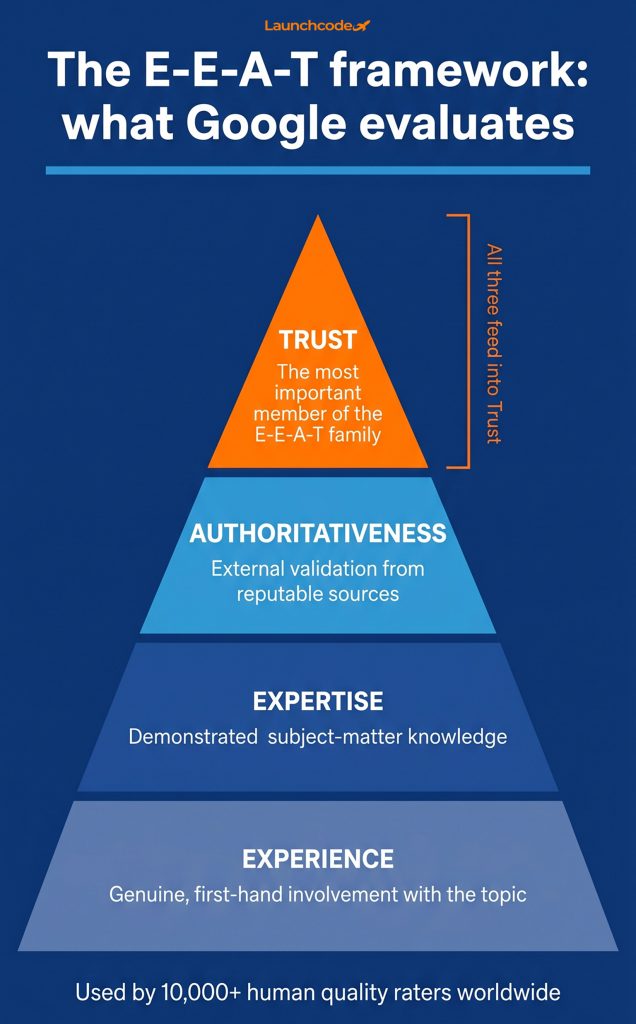
E-E-A-T stands for Experience, Expertise, Authoritativeness, and Trustworthiness. Google uses this framework inside its Search Quality Rater Guidelines (SQRG), a public document used by over 10,000 human reviewers worldwide to assess search result quality. E-E-A-T is not a direct ranking factor and carries no single score. It shapes the signals Google’s algorithms use, and those signals influence how content ranks and which sources AI systems cite.
Google introduced the original framework as E-A-T years before AI Overviews existed. In December 2022, Google added Experience as a fourth pillar, making the acronym E-E-A-T. That addition was deliberate. It signaled that Google values content from creators with real, first-hand knowledge of a topic, beyond credentials and citations alone.
Google also clarified the hierarchy inside the framework. Trust is the most important member of the E-E-A-T family. Experience, Expertise, and Authoritativeness all feed into it. A page that lacks trustworthiness fails the framework regardless of how strong the other signals appear.
Human raters do not set rankings directly. They evaluate pages using Page Quality ratings and Needs Met ratings, and their aggregated feedback trains Google’s algorithms over time. Reading the SQRG is one of the most underused research activities in SEO. It tells you exactly how a trained human evaluates content quality and, by extension, what signals Google’s systems are built to detect.
Many brands treat E-E-A-T as a checklist with an end state. It is not. E-E-A-T is an ongoing evaluation of signals across the content, the author, and the domain. Sites that focus narrowly on technical SEO while neglecting authorship, entity signals, and sourcing miss the structural layer that search quality raters, and by extension Google’s algorithms, are trained to evaluate.
E-E-A-T is no longer a quality signal for traditional rankings alone. It is the primary mechanism that determines whether AI systems cite your content at all. According to an analysis of 15,847 AI Overview results across 63 industries, 96% of Google AI Overview citations come from sources with strong E-E-A-T signals. Weak E-E-A-T signals do not lower your citation position. They exclude you from citation entirely.
This matters because AI-referred sessions jumped 527% year-over-year in the first five months of 2025, according to Previsible’s 2025 AI Traffic Report. At the same time, 60% of Google searches now end without any click to a website. On mobile, that rate reaches 77%. Earning a citation in an AI Overview is increasingly the primary way a brand stays visible for informational and research queries.
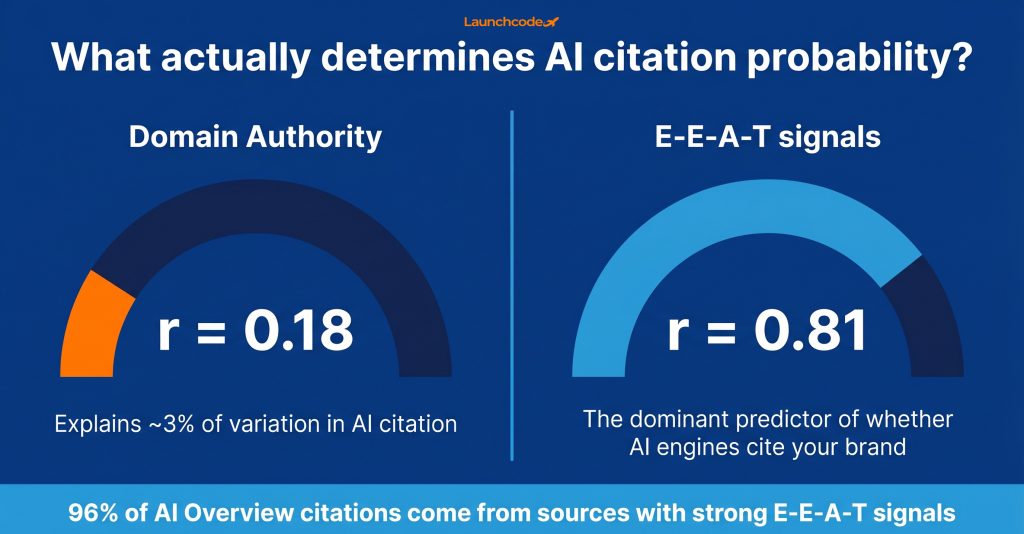
Many teams still allocate budget to Domain Authority improvement as their primary lever for AI visibility. The data does not support this.
According to a 2026 analysis of AI citation signals by Wellows, Domain Authority correlates at r=0.18 with AI citation probability. E-E-A-T signals correlate at r=0.81. Domain Authority explains roughly 3% of the variation in whether AI engines cite a brand. Teams spending budget on guest posts and link campaigns to improve AI visibility are measuring the wrong thing.
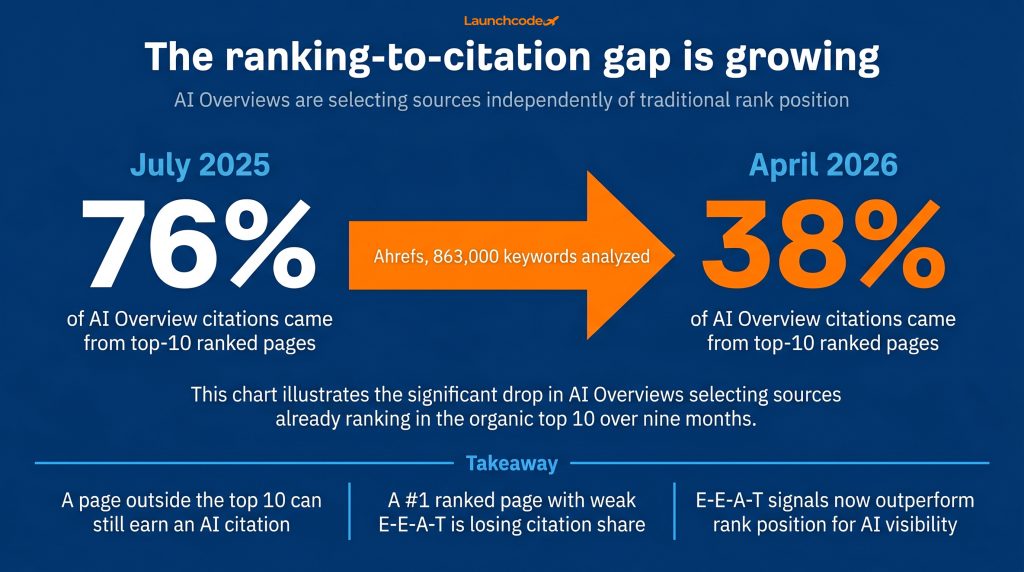
Traditional SEO rank and AI Overview citation no longer move together. In July 2025, 76% of pages cited in Google AI Overviews also ranked in the top 10 organic results for the same query. By April 2026, Ahrefs found that figure had dropped to 38%, based on analysis of 863,000 keywords.
A page outside the top 10 can still earn an AI Overview citation if its E-E-A-T signals are strong enough. A page that ranks first but carries weak E-E-A-T signals is losing citation share to better-sourced alternatives.
Danny Sullivan, Director at Google Search, put it plainly at WordCamp US in August 2025: “Good SEO is good GEO. The basic things have not changed.” Quality content, clear authorship, and real-world expertise remain the connective tissue between both disciplines.
Each pillar of E-E-A-T represents a distinct quality signal. Understanding them separately helps you identify which signals are strongest on your site and which gaps to close first. Trust is the apex. Experience, Expertise, and Authoritativeness all feed into it. Weakness in any pillar weakens the whole evaluation.
Experience means the content creator has genuine, first-hand involvement with the topic. It is the newest pillar, added in December 2022. Melissa Fach, Lead SEO Content Manager at Kelley Blue Book and Autotrader, described the distinction at SMX Advanced: “The experience aspect is really great because anyone can learn to write about any topic, but only someone with experience can provide the insights people need to make a decision that could impact their life.”
In practice, Experience shows up through:
Expertise is demonstrated subject-matter knowledge. Google evaluates it at both the author level and the domain level. A site that consistently publishes accurate, well-sourced content on a specific topic builds domain-level expertise over time. A named author with verifiable credentials, a consistent publishing history, and third-party recognition builds author-level expertise.
Anonymous author pages are a liability in 2026. Publishing content under generic author names works against rankings and citation probability. Google builds and references specific author entities: named individuals with verifiable credentials, consistent digital footprints, and traceable professional histories.
Authority is external validation. It comes from others recognizing you as a trusted source. Backlinks from relevant, reputable domains remain a signal, but relevance and quality now outperform raw link volume. Digital PR and genuine citations outperform campaigns that prioritize quantity over fit.
Reddit, LinkedIn mentions, press coverage, and third-party review platforms all contribute to the authoritativeness signals Google evaluates. Reddit now appears in 5.5% of AI Overview citations, reflecting the weight AI systems place on authentic, community-sourced perspectives.
Trust is the apex of the framework. A page can demonstrate Experience, Expertise, and Authoritativeness and still fail if it lacks clear sourcing, omits a named author, or shows signs of manipulation. The trust signals Google and AI systems evaluate include:
YMYL stands for Your Money or Your Life. Google applies this label to content that could directly affect a person’s health, financial stability, legal standing, or safety. For YMYL topics, E-E-A-T evaluation is significantly more rigorous. Failing to meet the standard does not result in a lower position. It results in lost visibility across the category.
The September 11, 2025 SQRG update expanded YMYL to explicitly include elections, civic institutions, and government trust. The update also added, for the first time, explicit evaluation criteria for AI Overviews, parallel to guidance previously provided for featured snippets. The same E-E-A-T standards now apply to both traditional results and AI-generated answers.
For YMYL content, the requirements are substantially higher:
Industries most affected by elevated YMYL standards include healthcare, financial services, insurance, legal, pharmaceuticals, and content involving minors or personal safety decisions.
Non-YMYL brands should not assume this framework does not apply to them. Google applies E-E-A-T evaluation across all content. YMYL categories trigger stricter thresholds, but the underlying signals, authorship, sourcing, and trustworthiness, matter across every niche.
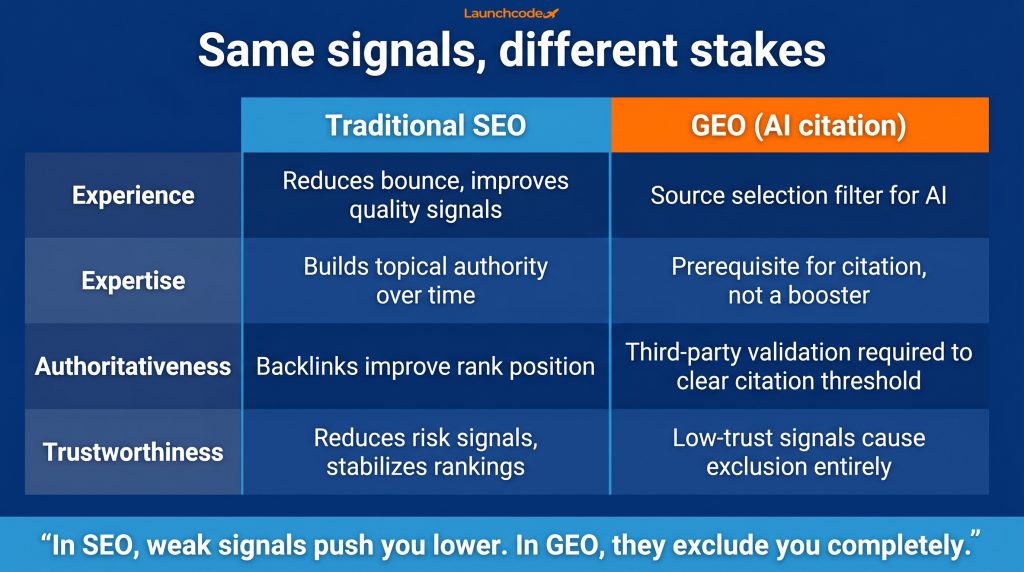
In traditional SEO, E-E-A-T functions as a quality signal that improves ranking probability over time. In GEO (Generative Engine Optimization), it functions as a binary gate. Weak E-E-A-T signals in traditional search push you lower in results. Weak E-E-A-T signals in GEO exclude your content from citation entirely. The frameworks overlap, but the consequences are different.
The table below shows how each pillar maps to each channel:
| E-E-A-T pillar | Role in traditional SEO | Role in GEO |
|---|---|---|
| Experience | Improves content quality signals, reduces bounce signals | AI systems use first-hand experience as a source selection filter |
| Expertise | Supports topical authority and author entity recognition | Named experts and verifiable credentials are prerequisites for citation |
| Authoritativeness | Backlinks and brand mentions improve rank position over time | Third-party validation is required for a source to clear the citation threshold |
| Trustworthiness | Reduces risk signals and supports long-term ranking stability | Low-trust signals cause exclusion from AI Overview sources entirely |
Lily Ray, VP of SEO Strategy and Research at Amsive, described the dependency plainly: “GEO will amplify practices founded on EEAT principles. What AI engines trust and cite is key. If your content is absent, your visibility is effectively erased.”
Entity optimization, creating clear, structured references to named individuals, organizations, tools, and topics, is one of the highest-impact GEO actions a content team can take. Pages with 15 or more recognized entities show 4.8 times higher AI Overview citation probability, according to research across 15,847 AI Overview results and 63 industries.
AI retrieval systems evaluate content differently from traditional crawlers. The highest-performing GEO content:
Building E-E-A-T is not a one-time project. It is a content and credibility system. Named authorship, entity-rich content, schema markup, and topical depth are within reach for brands of any size. The December 2025 Core Update confirmed the stakes: SE Ranking measured 66.8% movement in top-3 positions, above average for a core update. Sites with clear E-E-A-T signals held or gained. Sites with thin content and missing authorship dropped.
Every article published without a named author carries a missed E-E-A-T signal. Strong author implementation includes:
“Every time we audit a site’s content library, anonymous author pages are in the top three issues we find. AI citation systems are entity-based. If there is no verifiable author entity, the content is invisible to them regardless of how well it is written.” — Tanner Medina, Co-Founder & Chief Growth Officer, Launchcodex
Schema markup translates your E-E-A-T signals into formats that AI retrieval systems and search engines read efficiently. The most impactful schema types for E-E-A-T and GEO:
“When we set up content workflows for clients, the first thing we verify is whether the author entity is machine-readable. Schema turns authorship from a claim into something AI retrieval systems can actually evaluate.” — Derick Do, Co-Founder & Chief Product Officer, Launchcodex
A single well-sourced article does not build E-E-A-T. A content cluster does. Topical authority, the depth of coverage your domain demonstrates across a subject, is one of the most durable signals in both traditional SEO and GEO. AI systems reward sources that help answer a cluster of related questions across multiple pages, not only the single page that matches one keyword.
Build depth on one topic before expanding. Publish content that covers core terms, adjacent questions, sub topics, and practical applications in a structured sequence. Twenty well-sourced articles on one topic consistently outperform two hundred thin pieces spread across fifty topics.
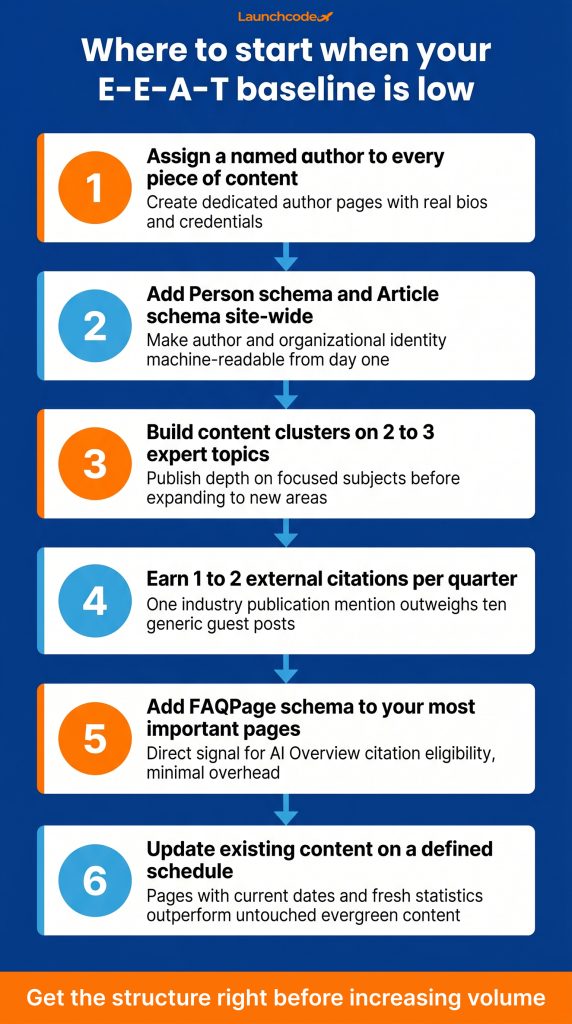
E-E-A-T is not reserved for brands with years of publishing history. Smaller brands can build meaningful signals in months by focusing on the highest-impact actions first. Start with authorship, then entity signals, then topical depth. Get the structure right before increasing volume.
The December 2025 Helpful Content guidance confirmed that AI-generated content without human review and original value is rated as Lowest Quality in Google’s SQRG. Volume without quality does not compound. It accumulates liability. Organic CTR for queries where AI Overviews are present dropped 61% year-over-year from June 2024 to September 2025, largely affecting sites that had prioritized output over quality signals.
Priority sequence for brands starting from a low E-E-A-T baseline:
There is no E-E-A-T score. Tracking progress requires proxy metrics: observable signals that reflect whether your Experience, Expertise, Authoritativeness, and Trustworthiness signals are improving over time. Use a combination of Google Search Console, Ahrefs, and manual AI citation checks to build a picture quarter over quarter.
The proxy metrics below map to each E-E-A-T pillar:
| Pillar | Proxy metric | Where to track |
|---|---|---|
| Experience | Organic CTR for content with named authors versus anonymous content | Google Search Console |
| Expertise | Topical keyword cluster ranking growth | Ahrefs or Semrush |
| Authoritativeness | Referring domains from relevant, non-paid sources | Ahrefs |
| Trustworthiness | Brand search volume growth over time | Google Search Console, Google Trends |
| GEO citation | AI Overview appearances for target queries | Manual spot checks, AI citation monitoring tools |
Every E-E-A-T signal discussed in this article produces the strongest results when it is built into production from the first step. Author attribution added weeks after an article goes live is less effective than authorship built in from the start. Schema applied only to new content leaves the existing library unoptimized. Topical clusters assembled from disconnected older posts carry weaker authority signals than clusters planned and built together.
The brands that close ground fastest in both SEO and GEO treat E-E-A-T as a production standard. At Launchcodex, our SEO and GEO content process integrates named authorship, expert review, structured data, and cited sourcing into every article before it publishes. Retrofitting these signals across an existing library costs more and produces slower results than building them in from the start.
The steps are clear:
Every brand that applies these steps consistently builds a credibility profile that Google’s quality raters and AI retrieval systems can evaluate and trust. That profile is what earns visibility in search results and AI-generated answers over the long term.
No. E-E-A-T is not a direct ranking factor and has no single score in Google’s algorithm. It is a framework used by human quality raters whose aggregated feedback trains Google’s systems over time. The signals that reflect strong E-E-A-T, named authorship, cited sourcing, topical depth, and authority mentions, do influence rankings indirectly through Google’s quality evaluation systems.
Google introduced E-A-T (Expertise, Authoritativeness, Trustworthiness) as the original quality evaluation framework. In December 2022, Google added Experience as the first new pillar, extending the acronym to E-E-A-T. The addition reflects Google’s recognition that real, first-hand involvement with a topic is a meaningful quality signal, distinct from credentials or cited expertise alone.
Yes. E-E-A-T is not reserved for brands with years of publishing history. Named authorship, structured data, topical focus, and cited sourcing are available to any brand regardless of size or age. Starting with a narrower topic area and building depth before expanding is the most effective approach for brands with limited existing authority.
Significantly. Research across 15,847 AI Overview results found that 96% of citations come from sources with strong E-E-A-T signals. AI Overviews use E-E-A-T as a gating filter, not a ranking nudge. Weak signals lead to exclusion rather than a lower position. Named authorship, entity-rich content, FAQPage schema, and external citations are the primary signals that determine AI Overview citation eligibility.
YMYL stands for Your Money or Your Life. Google uses this category for topics where inaccurate content could directly harm a reader’s health, financial stability, legal standing, or safety. The September 2025 SQRG update expanded YMYL to include government, elections, and civic information. Medical content should involve licensed practitioners. Financial guidance should come from certified professionals. Generic, anonymous content in these categories faces significant ranking and citation headwinds.
Yes, under specific conditions. Google’s December 2025 helpful content guidance evaluates content based on who created it, how it was produced, and why it was created. AI-generated content that is reviewed by a subject-matter expert, enriched with original insights, attributed to a named author, and aligned with genuine user intent can meet E-E-A-T standards. AI-generated content that is generic, unreviewed, and produced primarily for search volume is rated as Lowest Quality in Google’s SQRG.
The most impactful structured data types are Article schema (with named author and organization), Person schema (linking the author to credentials and affiliations), Organization schema (with contact details and location signals), and FAQPage schema in JSON-LD format. FAQPage schema directly increases AI Overview citation eligibility by making question-and-answer pairs machine-readable for generative retrieval systems.


Real stories from the people we’ve partnered with to modernize and grow their marketing.