

Tattoo shop SEO: Ranking on Google, Maps, and AI search
Most tattoo shops rank on one search surface and miss the other two. This guide covers Google organic, Maps, and AI search w...





Most YouTube channels upload consistently and get almost nothing back. The videos exist, but they do not rank, they do not appear in search, and they do not drive traffic. The reason is almost always the same: the team optimized the content but not the system that gets it found.
YouTube is the world's second-largest search engine. Google owns it, indexes it, and increasingly pulls from it to populate AI-generated answers. A well-optimized YouTube video can rank on YouTube, appear in Google search results, and get cited inside an AI Overview, all from a single upload. This guide covers the full system: keyword research, metadata, retention, thumbnails, channel structure, and analytics, with the evidence and processes behind each step.
YouTube SEO is how brands capture search demand that text content cannot reach. According to data compiled by Searchatlas from YouTube's 2024 statistics, YouTube processes over 3 billion searches per month, making it the second-largest search engine in the world. Video results achieve 41% higher click-through rates than text-based results and are 50 times more likely to appear on Google's first page. Most marketing teams treat YouTube as a content channel. The ones who treat it as an SEO channel grow faster.
Ready to grow your organic traffic?
Get a free SEO audit from the Launchcodex team.
89% of businesses use video as a marketing tool and 95% consider it integral to their strategy, according to Wyzowl. But using video and optimizing video are not the same thing. Most channels upload and hope the algorithm finds the right audience. An optimized channel builds a system where every video is structured to rank, hold attention, and drive the next action.
The compounding effect is the real business case. A well-optimized video keeps generating organic views months or years after upload. Unlike paid media, it does not stop when the budget runs out. Unlike most blog posts, it creates a presence on two search engines at once: YouTube and Google.
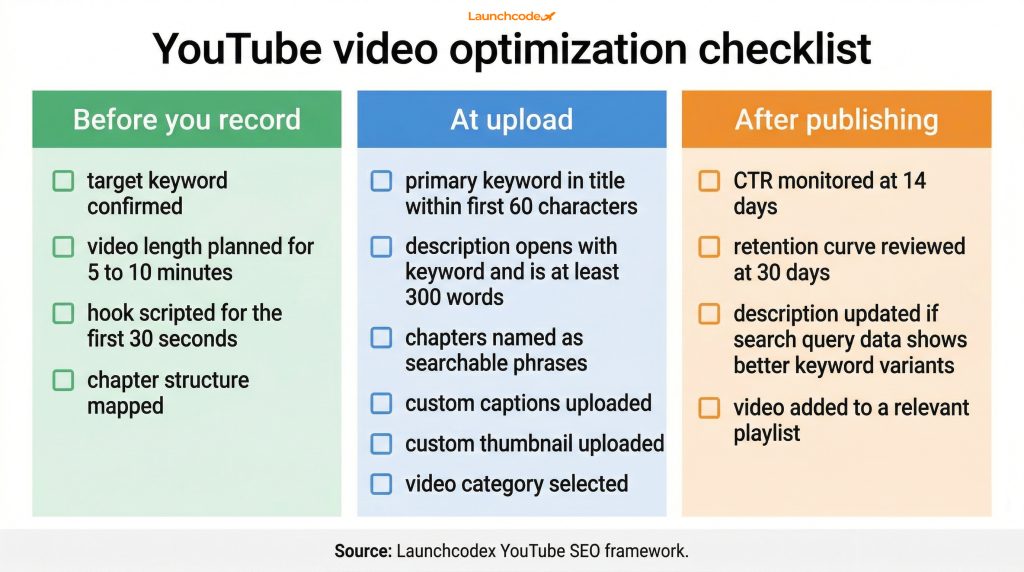
Optimization is not a checklist you run at upload time. It starts before production and continues after the video goes live. A fully optimized video has:
Every one of these elements affects whether the video ranks, who it reaches, and whether viewers stay long enough to generate the watch time signal that drives further promotion.
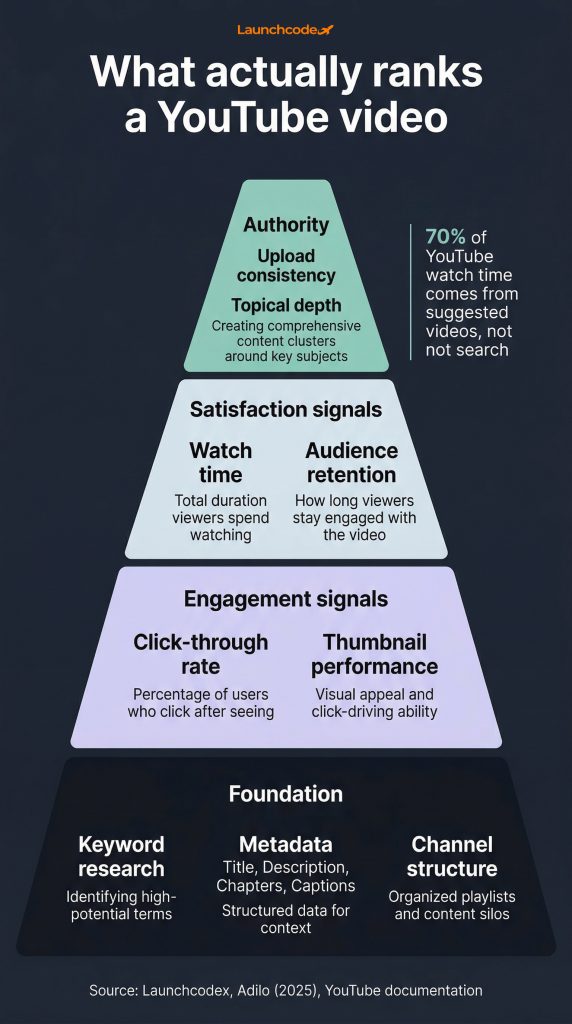
YouTube's ranking system runs on two distinct signals: relevance and satisfaction. Relevance tells the algorithm what a video is about. Satisfaction tells it whether viewers were glad they watched. According to YouTube's own documentation on ranking, factors include how well the title, description, and video content match the viewer's query, and which videos have driven the most engagement for a query. You need both to rank consistently.
Most guides frame YouTube SEO as a metadata problem. Get the title right, write a good description, add tags. Those things matter, but they only address the relevance signal. The satisfaction signal, which drives sustained rankings, comes from what viewers actually do after they click.
YouTube surfaces content in two separate ways. Search results show videos when a user types a query. Suggested videos appear alongside or after other videos based on viewer behavior and interest patterns. 70% of all watch time on the platform comes from suggested videos, not search results.
The optimization strategies for each surface are different. Search optimization is primarily a metadata and relevance task. Suggested video optimization is a retention and engagement task. Most YouTube guides focus entirely on search and barely touch suggested. A brand that optimizes for both will consistently outperform one that only optimizes for search.
| Signal | What it measures | How to improve it |
|---|---|---|
| Watch time | Total minutes viewers spend on the video | Strong hooks, tight editing, clear structure |
| Audience retention | Percentage of the video watched | Remove filler, use chapters, preview value early |
| Click-through rate | How often viewers click when shown the video | Thumbnail quality, title clarity |
| Engagement rate | Likes, comments, shares, and subscriptions | Clear calls to action, strong topic relevance |
| Keyword relevance | How well metadata matches the query | Keyword placement in title, description, chapters, captions |
| Upload consistency | How regularly a channel publishes | Fixed publishing schedule |
A 2025 Adilo study analyzing 1.6 million YouTube videos found that top-ranked videos averaged a 2.65% engagement rate, compared to the platform average of 0.09%. Videos ranking at the top of competitive queries generate roughly 29 times more engagement than the average video on the platform.
The right keyword determines whether a video has a realistic path to discovery before a single frame is recorded. Start with YouTube's autocomplete feature. Type a broad topic into the search bar and record every suggestion that appears. These are real queries from real users. Layer in tools like TubeBuddy or VidIQ to check search volume, competition, and click potential. Target long-tail phrases of three or more words. They convert better and are far easier to rank for on a new or mid-size channel.
Keyword research for YouTube differs from Google keyword research in one critical way: intent on YouTube skews heavily toward how-to, tutorial, and comparison content. Users come to watch someone do something, not just read about it. The keywords that perform best are question-based or task-based phrases rather than short informational queries.
Not every high-volume keyword is worth targeting. Avoid keywords where:
Every text field on a YouTube video is a ranking input. The title carries the most weight. It tells YouTube and Google what the video is about and directly influences CTR. Put your primary keyword within the first 60 characters. Keep the full title under 70 characters so it does not truncate in search results or suggested feeds. After the title, descriptions and chapters are the next most valuable fields, and most channels underuse both.
Your title has two jobs: help the algorithm categorize the video, and convince the viewer to click. A clear, specific title with the primary keyword at the front does both.
Use this structure as a starting point:
"YouTube SEO for brands: 7 steps to rank faster in 2025" outperforms "The ultimate guide to YouTube SEO" for both search relevance and click appeal.
YouTube allows up to 5,000 characters in a video description. Most channels use fewer than 200. An optimized description should:
Chapters are timestamps you add to a video description. They appear as navigable segments in the YouTube player and, critically, they appear as individual search results in Google. In April 2025, Google began testing AI video carousels that surface specific video segments in search results rather than full videos. A video with well-named chapters has multiple opportunities to appear in search: one for the full video and one for each relevant chapter.
Name chapters with searchable phrases, not generic labels. "Introduction" adds no SEO value. "How to find YouTube keywords with low competition" does.
Custom captions give YouTube a full text transcript of your spoken content. A 10-minute video contains roughly 1,300 to 1,500 spoken words, all of which YouTube indexes when captions are present. According to research from ALM Corp, videos with captions average 12% longer watch time than uncaptioned videos. That watch time improvement ties directly back to the ranking signal that matters most.
Auto-generated captions are indexable but contain errors. Upload a corrected transcript to reinforce your target keywords exactly as intended.
Your thumbnail determines whether your video gets clicked. It is not a visual decoration. It is the primary CTR lever, and CTR is how YouTube decides which videos to test against larger audiences. Custom thumbnails increase click-through rates by 60 to 70%, according to video SEO benchmark data. A poorly designed thumbnail sets a ranking ceiling before the video is ever watched.
CTR works as a test signal. YouTube shows a video to a small audience and measures what percentage clicks. If CTR is strong, it widens the test. If CTR is weak, the video stops receiving impressions. Thumbnail quality directly affects total reach, not just first-click volume.
High-performing thumbnails share a few consistent traits:
Use TubeBuddy's thumbnail A/B testing feature to run controlled tests on your top-priority videos. Small improvements in CTR compound quickly across a full channel.
Watch time is YouTube's most important ranking signal. The more total minutes viewers spend on a video, the more YouTube promotes it. Audience retention, the percentage of the video people watch, is the quality layer on top. According to the Retention Rabbit YouTube Benchmark Report, the average YouTube video retains only 23.7% of viewers to completion, and only 1 in 6 videos surpasses 50% retention. If your videos consistently hold viewers above that 50% mark, you are already outperforming 83% of videos on the platform.
Most guides respond to this data by telling you to make better content. That is not actionable. Retention is something you engineer before production through scripting, structure, and pacing decisions.
Videos between 5 and 10 minutes currently hold viewers best, averaging 31.5% retention. That is the sweet spot for informational and educational content. Longer videos can rank well if retention holds, but they require tighter scripting and clear chapter structure.
Apply these structural choices before you record:
"The clients who see the biggest retention gains are almost always the ones who front-load value. They stop introducing themselves and start with the answer. That one change alone can move retention by 10 to 15 percentage points in the first video."
Tanner Medina, Co-Founder and Chief Growth Officer, Launchcodex
YouTube Studio's audience retention report shows a graph of exactly where viewers drop off. Use it as a diagnostic tool, not a performance report.
YouTube evaluates channels, not just individual videos. A well-structured channel tells YouTube exactly what topics it covers and who it serves. That context helps YouTube recommend your videos to relevant audiences beyond your existing subscribers. Channel optimization covers your name, handle, about section, channel keywords, banner, and playlist architecture, and most brands spend almost no time on any of it.
YouTube uses channel authority and topical consistency as signals when deciding which videos to surface in suggested feeds and browse features. A poorly structured channel limits the reach of every video it contains, regardless of how well each individual video is optimized.
YouTube's algorithm favors channels that publish on a predictable schedule. A consistent upload cadence signals that the channel is active and reliable, which increases the likelihood that new videos get tested against wider audiences at launch.
Quality without consistency means each video starts from zero with no algorithmic momentum. The channel that publishes one well-optimized video per week, every week, will almost always outperform the channel that publishes six videos in one month and then goes quiet.
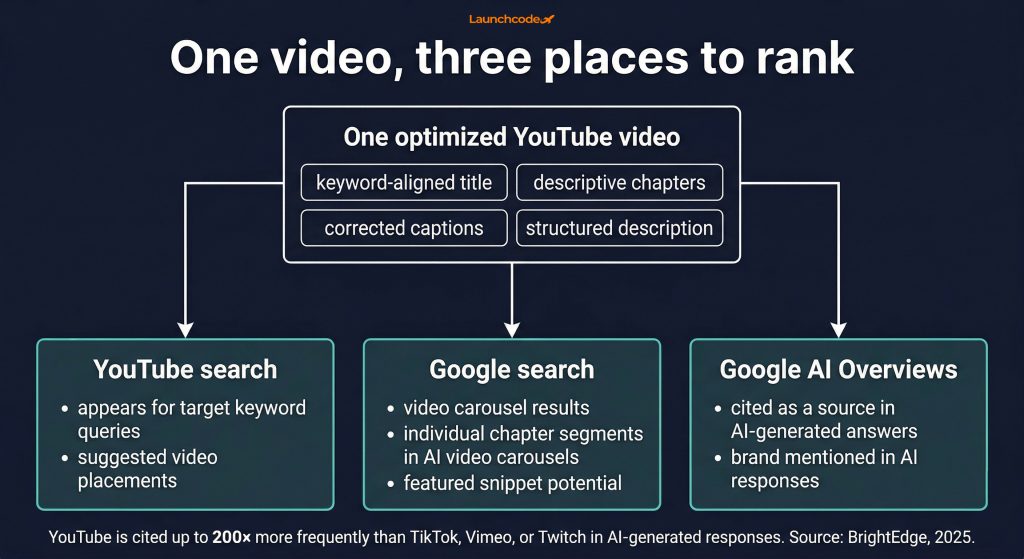
YouTube is now a primary source for AI-generated search answers. Research from BrightEdge cited by WebProNews found that YouTube is cited up to 200 times more frequently than TikTok, Vimeo, or Twitch in responses from ChatGPT, Perplexity, and Google AI Overviews. AI systems treat YouTube the same way they treat authoritative written content: as a credible, indexable source. A well-optimized YouTube video is now a GEO asset, not just an SEO asset.
Google AI Overviews now appear in 16% of all US searches, more than doubling since March 2025. When an AI Overview is present, the top organic search result sees a 34.5% drop in clicks. Appearing inside an AI-generated answer is becoming as valuable as holding a traditional top-three ranking. As Search Engine Land noted: if YouTube still sits in the nice-to-have category of your SEO strategy, you are quietly ceding visibility in both traditional rankings and Google AI Overviews to competitors.
AI systems extract from YouTube differently than traditional search engines do. They use transcripts, chapter titles, and structured metadata to understand what a specific video teaches. To improve the likelihood of being cited in an AI Overview:
Rand Fishkin, founder of SparkToro, offered a useful frame when speaking with Search Engine Land: treat channels like YouTube as places to capture attention and build brand memory, not just drive clicks. The goal is to make your brand memorable enough that when a viewer later faces the problem you solve, they search for you by name. That branded search behavior feeds back into your overall authority across both traditional and AI-driven search surfaces.
Most brands check YouTube analytics to see how videos performed. Few use them to decide what to change next. YouTube Studio contains enough data to run a continuous optimization loop: identify what is working, understand why, and apply those lessons to the next upload. The metrics that matter most are CTR, audience retention, impressions, watch time, and traffic source breakdown.
"One thing we see consistently across client channels is that traffic source data gets ignored completely. But that breakdown tells you everything about whether your SEO work is actually driving search-driven views or just recycling your existing audience."
Brittany Charles, SVP, Client Services, Launchcodex
Check these five numbers every week:
YouTube SEO is a compound system. Each well-optimized video increases the authority and reach of the next one. Channels that rank consistently share a few specific behaviors: they research keywords before scripting, they engineer retention into the production process, they test thumbnails with data, and they review analytics with enough discipline to actually change what is not working.
The competitive gap is real. Most brands competing for the same search terms on YouTube are not doing most of this. They upload without keyword research, write descriptions that are two sentences long, and never check whether their thumbnails are generating clicks.
The piece most competitors miss is the GEO layer. YouTube content already feeds AI-generated answers in Google. That is a ranking surface that requires no additional production effort. It only requires that the content is structured clearly enough for AI systems to extract and cite. That means descriptions written as summaries, chapters named as queries, and topical depth built across multiple related videos.
If you want to build a YouTube presence that generates organic traffic, brand authority, and AI search visibility as a connected system, the SEO and GEO team at Launchcodex can map the full strategy from channel audit to ongoing optimization.
Watch time is the most important signal. The more total minutes viewers spend on a video, the more YouTube promotes it to wider audiences. Audience retention is the quality layer underneath watch time. Both matter more than metadata optimization alone.
Videos between 5 and 10 minutes currently show the best average retention rates at 31.5%. Longer videos can rank well if retention holds, but length alone does not improve rankings. A tight 7-minute video that retains viewers will outperform a padded 20-minute video.
Tags are less important than titles, descriptions, and spoken keywords. YouTube confirmed that titles and descriptions are the primary metadata signals. Tags help YouTube understand general topic context but do not compensate for weak titles or low retention.
Yes. 80% of video results in Google search come from YouTube. Videos optimized with keyword-aligned titles, descriptions, and chapters can appear in Google's standard results, the video carousel, featured snippets, and Google AI Overviews.
Remove preamble from the first 30 seconds and open with your most important point or outcome. Use chapters to give viewers a clear structure. Review your retention curve in YouTube Studio to identify specific drop-off moments and restructure those sections in future videos.
Generative Engine Optimization (GEO) is the practice of structuring content so that AI-powered platforms cite or recommend it. YouTube is cited up to 200 times more frequently than other video platforms in AI-generated answers. Optimizing descriptions as standalone summaries, naming chapters as searchable queries, and building topical depth across multiple videos all improve the likelihood of being cited in AI responses.




Most tattoo shops rank on one search surface and miss the other two. This guide covers Google organic, Maps, and AI search w...
Screaming Frog v24.0 ships with a native MCP server. Learn how to connect it to Claude in under 15 minutes, run technical SE...
Learn how AI lead scoring works, what signals it uses, and how to set it up for your team. Includes a tool comparison table,...