
Share:

AI marketing & automation


AI deployments do not fail because the models are bad. They fail because the infrastructure underneath them was never built for the volume, variety, and velocity of modern AI workloads. A team running 20 AI microservices, each with its own GPU requirements, model version, and data contract, cannot manage that environment with manual console clicks and shell scripts.
This guide covers the core practices for managing AI microservices at scale using infrastructure as code. You will learn how to structure IaC modules for AI-specific service types, how GitOps and policy-as-code reduce operational risk, and how to build cost governance into your infrastructure from the start.
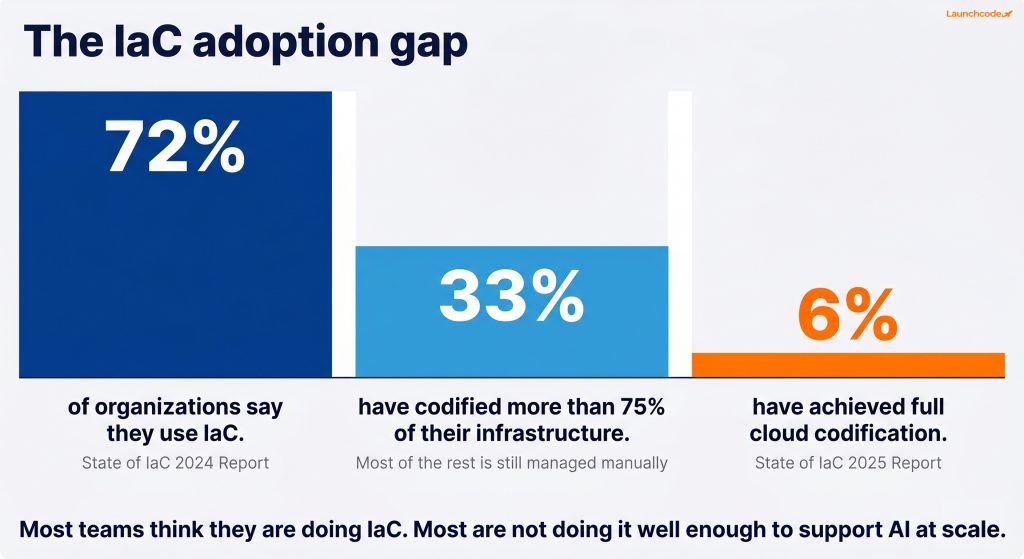
Calling something “infrastructure as code” does not make it IaC-mature. According to the State of IaC 2024 report covered by The New Stack, 72% of organizations used IaC in 2024, but only one-third had codified more than 75% of their infrastructure. By 2025, only 6% of organizations had achieved full cloud codification. The rest are running partial IaC while managing significant portions of their cloud manually.
That gap matters everywhere. For AI workloads, it is critical. An AI microservice fleet involves inference services, training pipelines, feature stores, data preprocessing jobs, and monitoring stacks. Each component has a different resource profile. Managing them manually across even two environments creates constant conditions for breakage.
The problem compounds as teams scale. Manual configuration introduces inconsistencies between dev, staging, and production. Emergency console changes create shadow state that no tool tracks. When something breaks at 2am, no one can recreate the environment because it was never defined as code.
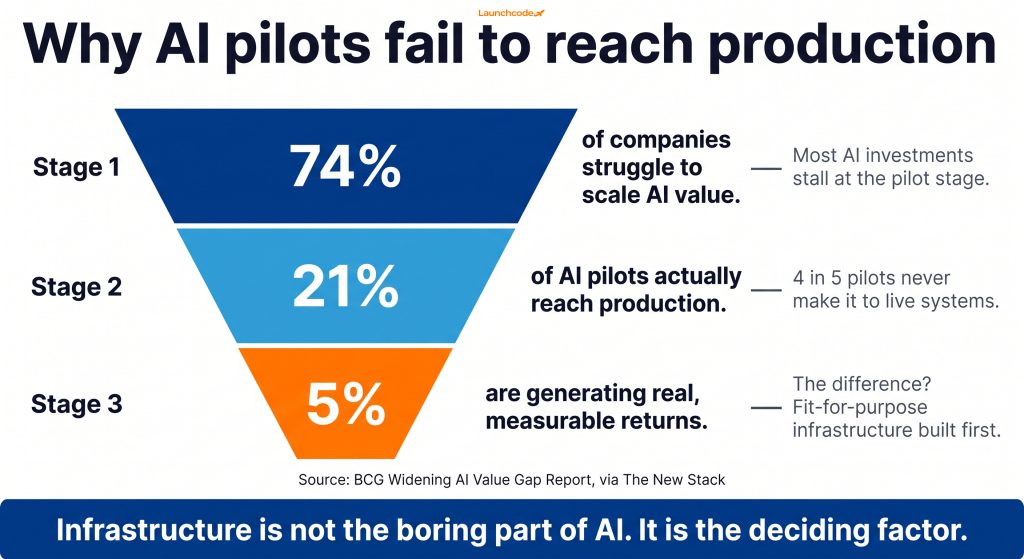
The BCG Widening AI Value Gap report, reported by The New Stack, found that 74% of companies struggle to scale AI value. Only 21% of AI pilots make it to production. The 5% generating real returns had one thing in common: they built fit-for-purpose technology architecture and data foundations before scaling their AI investments.
DORA research reinforces this. As AI adoption increased across software teams, delivery throughput declined by 1.5% and stability declined by 7.2%. Code is being written faster than ever. It is not reaching production any faster because the infrastructure underneath it is not ready.
Infrastructure as code for AI workloads means defining every compute resource, networking rule, scaling policy, IAM permission, and deployment configuration in version-controlled files. The goal is that any engineer on the team can destroy and recreate the entire AI microservice environment from a single git clone and a handful of commands. That standard makes AI systems testable, auditable, and reproducible across environments.
Sarah Wells, author of “Enabling Microservices Success,” captured it clearly in The New Stack’s IaC reference: because infrastructure configuration is code and lives in source control, it is easy to see what changed, who changed it, and how to roll back when something breaks.
For AI teams, this means three specific things:
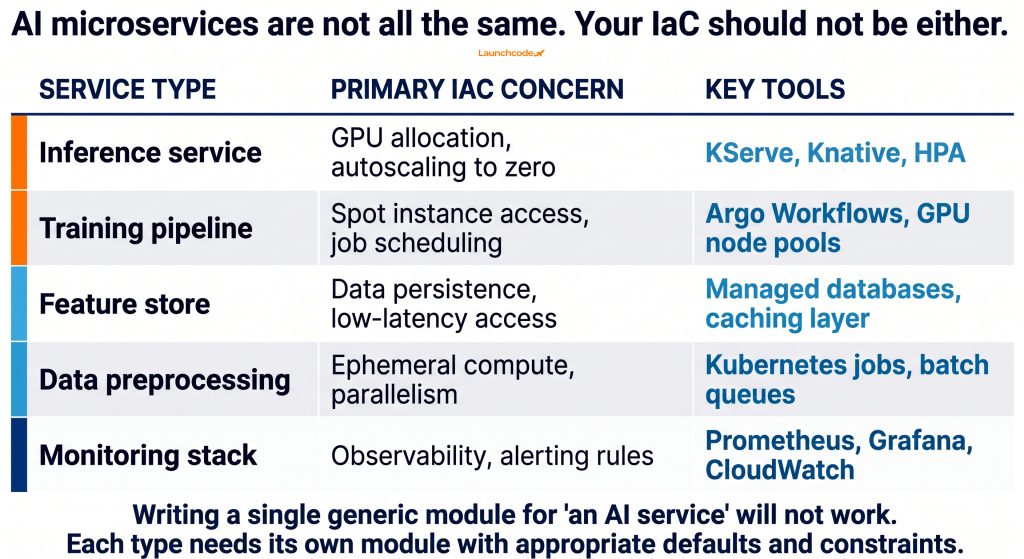
AI systems are not monolithic. Each service layer has different infrastructure needs, and those differences matter when you design your modules.
| Service type | Primary IaC concern | Key tools |
|---|---|---|
| Inference service | GPU allocation, autoscaling to zero | KServe, Knative, HPA |
| Training pipeline | Spot instance access, job scheduling | Argo Workflows, GPU node pools |
| Feature store | Data persistence, low-latency access | Managed databases, caching layer |
| Data preprocessing | Ephemeral compute, parallelism | Kubernetes jobs, batch queues |
| Monitoring stack | Observability, alerting rules | Prometheus, Grafana, CloudWatch |
Writing a single generic module for “an AI service” will not work. Each type above needs its own module with appropriate defaults, variable inputs, and policy constraints.
The right IaC structure for an AI microservice fleet is a module-per-service-type pattern, not a module-per-team or a flat file-per-service approach. Write one reusable module for each type of AI service you run, inference, training, feature store, preprocessing, and monitoring, then instantiate those modules with service-specific variables. This cuts duplicated configuration to near zero and makes it possible to update a policy once and apply it across every service.
Terraform is the dominant tool for this work, with 76% market share according to the CNCF 2024 Annual Survey. OpenTofu, the Linux Foundation-backed open-source fork, is a compatible alternative for teams avoiding the HashiCorp Business Source License. Pulumi supports Python, TypeScript, and Go for teams that want to write infrastructure in the same language as their application code.
“The teams that struggle most are the ones trying to manage GPU workloads with the same Terraform patterns they wrote for web servers two years ago. The resource profiles are completely different, and your module structure needs to reflect that from the start.” Eric Bledsoe, VP Engineering, Launchcodex
A Terraform module for a Kubernetes-hosted inference service should expose these inputs at minimum:
The module handles everything else as opinionated defaults: RBAC roles, network policies, resource quotas, and required labels for cost tracking. Developers deploying a new model call the module with their specific values. They do not rewrite infrastructure from scratch.
Four mistakes teams repeat when building IaC modules for AI workloads:
Terragrunt is worth evaluating for teams managing multiple environments. It wraps Terraform and enforces DRY (don’t repeat yourself) configuration across dev, staging, and production without duplicating module calls.
GitOps makes Git the single source of truth for both application code and infrastructure state. A GitOps operator, either ArgoCD or Flux, continuously reconciles what is declared in your Git repository against what is actually running in your Kubernetes clusters. When someone makes an unauthorized change directly in the cluster, the operator detects the drift and rolls the cluster back to the declared state. For AI microservice fleets, this automated reconciliation loop is the difference between predictable deployments and constant firefighting.
GitOps was formalized by Weaveworks and is now the standard delivery model for Kubernetes-native teams. Companies using GitOps maintain 100-plus clusters globally with a fraction of the operational overhead required by manual approaches.
| Operator | Best for | Key strength | Watch out for |
|---|---|---|---|
| ArgoCD | Teams needing visualization and multi-cluster UI | Rich UI, RBAC, multi-cluster support | Higher resource overhead |
| Flux v2 | Multi-tenant, Kubernetes-native environments | Lightweight, GitOps-as-code patterns | Steeper CLI-first learning curve |
For AI teams, GitOps extends beyond application deployment. Model retraining jobs, triggered by data drift or a schedule, should flow through the same Git-based pipeline. A retraining run that produces a new model artifact can trigger a pull request against the inference service module, updating the model version variable. A human reviews and merges. ArgoCD or Flux picks up the change and rolls out the update. Every step is auditable.
Argo Workflows handles orchestration of training pipelines inside Kubernetes. KServe handles the inference side with autoscaling via Knative, including scale-to-zero when a model endpoint is idle.
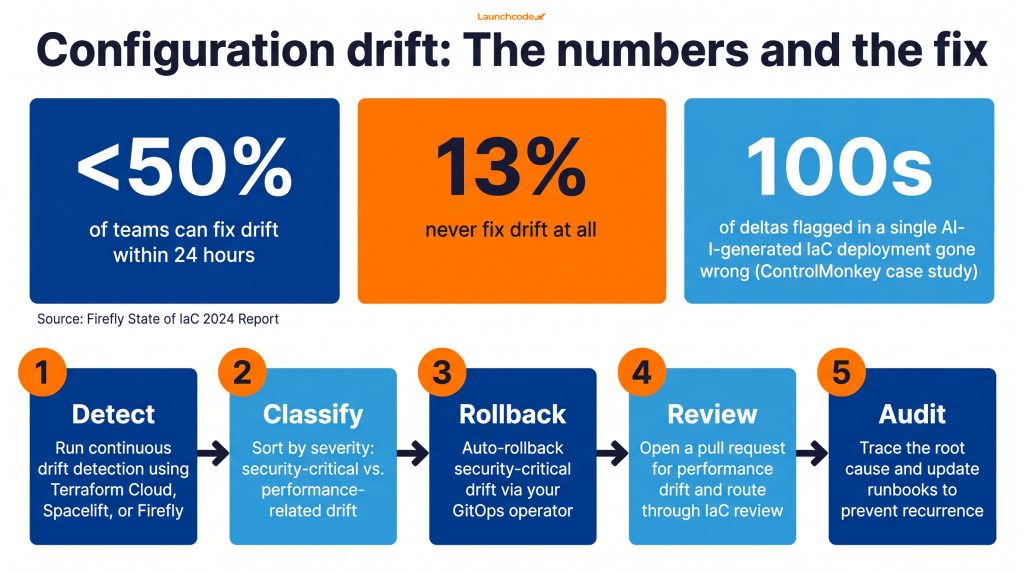
Configuration drift occurs when the actual state of your deployed infrastructure diverges from what your IaC declares. For AI workloads, drift is particularly dangerous because GPU node configurations, model serving parameters, and scaling rules are often adjusted manually during incidents and never reflected back in code. The Firefly State of IaC 2024 report found that fewer than half of teams can remediate drift within 24 hours. Thirteen percent do not fix it at all.
Drift accumulates slowly. A developer adjusts a GPU memory limit during an outage. A security team adds a network policy rule directly in the console. An autoscaling threshold gets bumped manually before a product launch. None of these changes make it back into the IaC. Over time, the gap between declared and actual state grows until something breaks in a way that is nearly impossible to trace.
Spacelift and Firefly both add enterprise-grade drift detection and policy enforcement on top of Terraform. Open Policy Agent (OPA) and HashiCorp Sentinel can enforce policies that prevent out-of-band changes from being applied in the first place.
Policy as code means writing your governance rules, tagging requirements, IAM boundaries, naming conventions, and cost thresholds as machine-enforceable code that runs inside your CI/CD pipeline. Instead of auditing deployed infrastructure after the fact, policy-as-code tools reject non-compliant infrastructure before it reaches your clusters. For AI teams managing dozens of services, this is the only scalable approach to governance.
HashiCorp reports that teams using Sentinel with pre-plan validation see a 45% reduction in policy violation-related build failures compared to teams that run enforcement after planning. Earlier feedback means fewer broken deployments and less time debugging policy violations in production.
A production-ready policy-as-code setup for an AI microservice fleet should cover:
OPA is the CNCF-standard tool for policy-as-code across Kubernetes, CI/CD, and IaC pipelines. Sentinel integrates directly with Terraform for pre-plan enforcement.
The risk is not hypothetical. InfoWorld reported a real-world case where a team used AI to bulk-generate Terraform files for 80 microservices. The code ran. But it violated every tagging policy, module convention, and RBAC rule the organization had. Drift detection flagged hundreds of deltas against the baseline. Remediation took weeks. Policy-as-code enforced at plan time would have caught every violation before a single resource was created.
AI tools can accelerate IaC authoring. They cannot replace organizational context. AI does not know your tagging standards, your RBAC structure, your naming conventions, or what lives in your Terraform state file. Teams that use AI to generate IaC without injecting that context get code that runs but creates operational chaos. The safe approach is to wrap AI tooling in a layer of organizational context and treat the output as a first draft that your policy pipeline must validate before anything reaches production.
Ori Yemini, CTO of ControlMonkey, described the correct framing in InfoWorld: the most successful organizations treat generative AI like an untrained junior engineer. Useful for accelerating tasks. Requires validation, structure, and access to internal standards.
Ivan Novikov, CEO of Wallarm, identified the core problem: prompts do not carry full context. Your infrastructure includes dozens of services, secrets, RBAC rules, sidecars, CI/CD flows, and naming rules spread across Terraform state. When you ask AI to write config for a new API service, it works in a vacuum.
StackGen’s intent-to-infrastructure approach illustrates the right relationship between AI and GitOps: engineers describe what they need in plain language, the tool generates Kubernetes manifests or Terraform with policy validation built in, and all output flows through Git before any reconciliation happens. As the StackGen engineering team put it, Git remains the control plane. AI assists the humans who operate Git, making every commit smarter and every reconciliation faster.
65% of executives report that automation technologies including IaC are enhancing their IT teams’ productivity, according to the IBM Institute for Business Value. That number will grow as AI-assisted tooling matures. The gains require a governance layer underneath them.
GPU compute is expensive. An inference service that autoscales without bounds, or a training job that provisions on-demand instances when spot pricing was available, can erase a month of efficiency gains in a single runaway workload. Teams that control AI infrastructure costs embed cost governance directly into their IaC modules as a default constraint that every service inherits from day one, not as a configuration applied later.
Using spot instances for batch AI training workloads can reduce compute costs by up to 80% compared to on-demand pricing. Capturing that saving requires configuring spot instance access in your IaC, not enabling it manually on a per-job basis.
“Teams that skip cost tagging in their module defaults spend months trying to figure out which team owns a five-figure monthly GPU bill. Put it in the module once and the problem does not come back.” Derick Do, Co-Founder and Chief Product Officer, Launchcodex
Practical cost governance at the IaC level means:
The IaC market is projected to reach USD 6.14 billion by 2033, growing at more than 22% CAGR. That growth reflects the increasing complexity of multicloud environments. More than 50% of companies already manage three or more clouds simultaneously. In that environment, cost visibility without IaC is close to impossible.
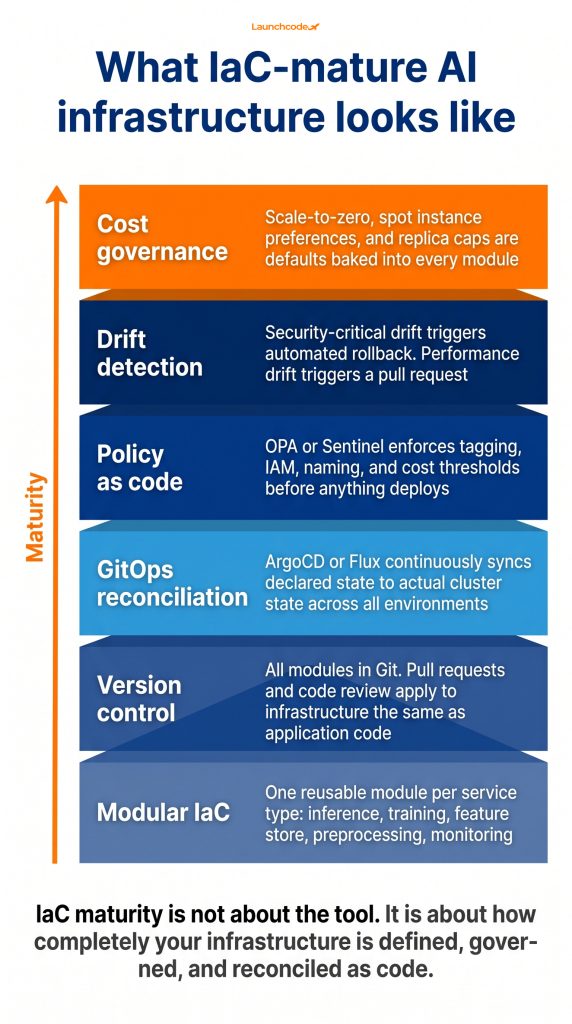
Full IaC maturity for AI workloads is not about which tool you pick. It is about how completely and consistently your infrastructure is defined, governed, and reconciled as code.
A mature AI infrastructure stack includes these characteristics:
The path to this state is incremental. Codify your highest-risk AI services first, the inference endpoints serving production traffic. Get GitOps reconciliation working for those services. Add policy-as-code. Then expand the pattern to training pipelines and supporting services.
64% of organizations report a shortage of skilled cloud and automation staff, according to HashiCorp’s State of Cloud Strategy Survey. A well-designed IaC system compensates for that gap by making the right configuration the easy configuration. Teams that invest in this foundation before scaling their AI investments will translate productivity gains into actual production throughput. Teams that skip it will spend growing engineering capacity managing infrastructure instead of building models.
If you are building out an AI data infrastructure program and want a structured approach from day one, Launchcodex builds AI data infrastructure with cost governance and IaC-first architecture built in from the start, not retrofitted after the bills arrive.
Infrastructure as code defines your cloud resources in version-controlled configuration files. GitOps is the operating model that uses Git as the single source of truth and automates the process of keeping your actual infrastructure synchronized with those files. IaC describes what you want. GitOps enforces it continuously.
Terraform holds 76% market share per the CNCF 2024 Annual Survey and is the most practical starting point for most teams. For Kubernetes-native environments, Crossplane manages cloud resources through familiar Kubernetes CRDs. Pulumi suits teams that prefer writing infrastructure in Python, TypeScript, or Go. The right choice depends on your cloud providers, team skills, and multi-cloud requirements.
Run continuous drift detection using Spacelift, Firefly, or Terraform Cloud. Route all infrastructure changes through pull requests and policy-as-code validation. Use ArgoCD or Flux to automatically reconcile your clusters back to declared state when drift is detected. Make your GitOps pipeline the only approved path for changing production infrastructure.
It can be, with the right guardrails in place. AI tools lack organizational context including your tagging policies, RBAC rules, naming conventions, and Terraform state. Inject that context into every prompt, route all AI-generated IaC through your existing policy validation pipeline, and require a human engineer to review the plan before applying anything to a live environment.
IaC lets you encode cost governance as defaults inside your modules. That means scale-to-zero for idle inference services, spot instance preferences for training jobs, maximum replica caps in autoscaling policy, and required cost-center tags for billing attribution. These constraints apply to every new service that uses the module, automatically, without relying on manual configuration or team discipline.


Real stories from the people we’ve partnered with to modernize and grow their marketing.