
Share:

AI marketing & automation


Medical queries can affect money and life, so search systems grade them with tougher standards. Google’s quality rater guidelines call for strong experience, expertise, authoritativeness, and trust for sensitive topics, and Search Central explains how to create helpful people-first content. This makes healthcare SEO closer to a regulated discipline than a growth tactic, especially compared to general SEO strategy.
Google also tightened spam policies in March 2024 to address scaled content abuse and thin tactics, see Google’s announcement on new ways we are tackling spammy low-quality content. These updates raise the bar for any program that relies on automation without governance, including AI-assisted content.
“Clear methods, named reviewers, and sources are not extras in healthcare content. They are the point.”
— Brittany Charles
Publish measures that matter to patients and referring clinicians. Link every figure to a public source. This mirrors how strong content marketing programs earn trust over time.
For structure ideas, look at NCQA’s programs such as HEDIS measures and CAHPS survey resources. These are useful reference points for outcome-led pages that also perform well in AI search.
List the clinician or committee that reviewed the page and the date of review. This aligns with the spirit of E E A T for sensitive health topics, see Google’s explainer on rater guidelines and E E A T. In practice, this mirrors review discipline used in high-risk AI SEO environments.
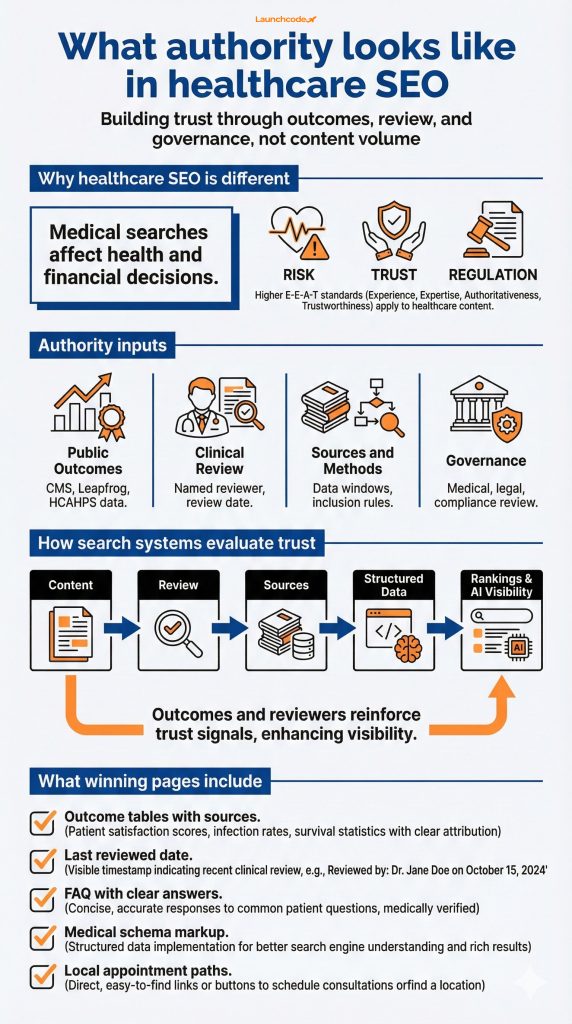
This separation of duties reflects a systems-first approach similar to regulated AI automation programs, where outputs are reviewed before scale.
If content mentions prescription drugs, follow FDA promotion rules. The FDA finalized the clear conspicuous neutral standard for TV and radio ads, see the final rule summary and Q and A in the Federal Register and FDA guidance, final rule overview, and small entity compliance guidance. The Office of Prescription Drug Promotion explains its mission and enforcement on the OPDP site.
Map trackers on your site and document where any identifiers could be combined with health intent. HHS OCR maintains its bulletin on the use of online tracking technologies. A federal court vacated parts of that bulletin in June 2024, and HHS did not appeal, see coverage from the American Hospital Association and legal analyses such as Holland and Hart. Build your approach from your risk analysis, limit data flows, and keep a paper trail. This discipline should also extend to analytics setups used for conversion rate optimization.
Local healthcare SEO often overlaps with broader local SEO work, but with stricter review and privacy constraints.
Ask for reviews, but never reveal protected health information in public replies. The AMA explains what is allowed in replies, see are physicians prohibited from responding to online patient reviews and how to respond to bad online reviews. HHS explains the HIPAA Privacy Rule.
Google rolled out AI Overviews widely, which favors concise answers with citations. See the launch post generative AI in Search, the expansion to more countries in October 2024, and developer guidance on AI features and your website. This makes healthcare SEO increasingly connected to local AI SEO.
Name the condition, symptoms, who should seek care, and the first step to book.
Explain the pathway, team roles, and expected timeline.
Show your outcomes with links to CMS, Leapfrog, or peer-reviewed sources.
Use simple language and balanced framing. Link to FDA and society guidelines if relevant.
One click call, online booking, and directions.
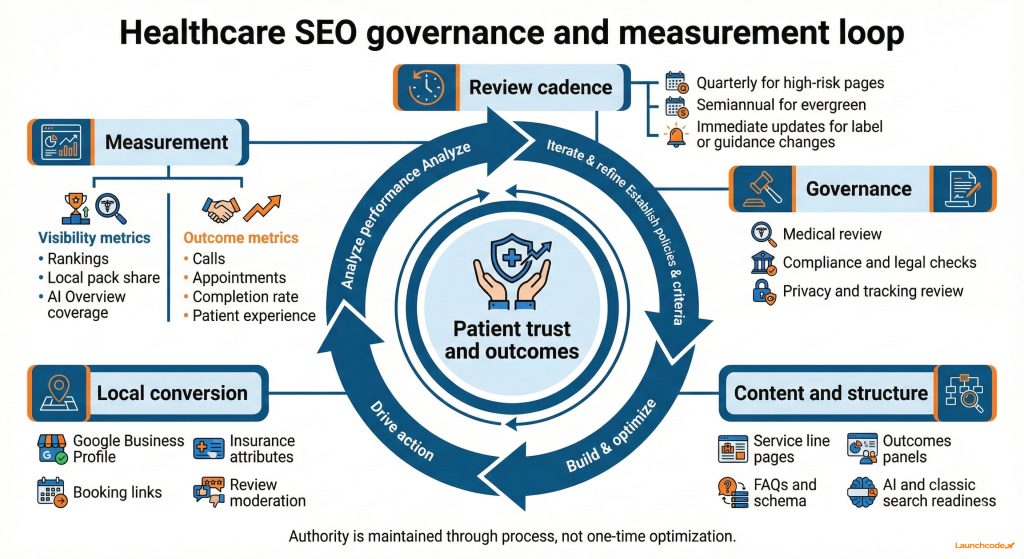
Most hospitals now have public scores on CMS and Leapfrog, which means your competitors can compare too. Show your numbers and explain them using CMS Care Compare resources and Leapfrog methodology notes. This mirrors outcome-driven reporting used in advanced SEO reporting.
Healthcare SEO is different because medical topics affect high-risk decisions, so search systems expect strong experience and trust signals. Use named reviewers, public outcomes, and clear sources to raise confidence. See Google’s quality rater guidelines.
You pick outcomes that patients and clinicians use to compare care, for example mortality, readmission, safety events, and patient experience. Link each number to CMS measures or Leapfrog safety grades and date-stamp your page.
You should review high traffic or high-risk pages every quarter. Review evergreen pages twice a year. Update any page that mentions a label change or new warning as soon as you can confirm the source.
Yes, you can reply to patient reviews without breaking privacy rules by avoiding any details that confirm someone is your patient. Keep replies general and move to a private channel for help. See the AMA on responding to online reviews and HHS on the HIPAA Privacy Rule.
Yes, booking links and insurance details help search because they remove friction and can appear in profiles that patients use to choose care. Use Google’s Bookings with a provider, manage local business links, and Business Profile attributes. For programmatic health attributes, see the Business Profile API reference.
If you discuss prescription drugs, make sure benefit and risk are balanced. The FDA’s clear conspicuous neutral standard for TV and radio ads is described in the final rule overview and the compliance guidance. OPDP’s role is outlined on the OPDP site.
You can use analytics pixels on health pages only after a risk review. Read OCR’s tracking technologies bulletin and the AHA update that HHS did not appeal the court ruling. Document your analysis and limit data sharing.



Real stories from the people we’ve partnered with to modernize and grow their marketing.