


How tattoo artists get found on Google and AI search
Learn how tattoo artists rank in Google's local map pack and get recommended by AI tools like ChatGPT and Perplexity in 2026...





Most loan officers running Facebook ads have the same complaint: plenty of leads, very few closings. The problem is not the platform. It is the strategy. Facebook can generate high-quality mortgage leads at a lower cost than Google Ads, but only if the campaign is built to attract the right borrowers, not just the highest volume of form fills.
This article covers the full system: how to set up campaigns within Facebook's mortgage advertising restrictions, how to write creative that qualifies leads before they click, how to connect your CRM for instant follow-up, and how to feed funded loan data back into the algorithm so it keeps improving. Every section is based on current platform policy, real benchmarks, and tactics practitioners use to close business.
The average close rate for purchased digital mortgage leads sits between 3% and 5%, according to the Mortgage Bankers Association. That means for every 100 leads you generate, 95 to 97 produce nothing. The root cause is almost always the same: campaigns optimized for cost per lead attract low-intent prospects who were never going to borrow from you.
Ready to grow your organic traffic?
Get a free SEO audit from the Launchcodex team.
Facebook's algorithm does exactly what you tell it to. If you optimize for the cheapest form submissions, it finds people who fill out forms. It does not care whether those people have the credit score, income, or intent to fund a loan. The result is a full CRM and an empty pipeline.
The shift that changes outcomes is moving your optimization target from cost per lead to cost per funded loan. That means building a system where the ad, the landing experience, the follow-up, and the CRM data all work together.
Loan officer Daniel Lopez at BrightBridge Realty Capital described this directly: when his campaigns led with zero-doc DSCR loan details and specific numbers, like loan amounts and close timelines, the quality of leads improved significantly. The creative did the pre-qualification work before anyone clicked.
Ryan McCallister, President of F5 Mortgage, puts the failure mode plainly: generic ads with stock images and vague rate claims always waste money.
Specificity in creative is not just a copywriting preference. It is a targeting mechanism. The right borrower recognizes themselves in your ad. The wrong borrower keeps scrolling.
Facebook's average cost per lead across all industries is $21.98, compared to $66.69 for Google Ads, based on WordStream's 2024 benchmark data. The average cost per click for lead objective campaigns is $1.88 on Facebook versus $4.66 on Google.
Lower cost does not mean lower quality if the campaign is built correctly. The real estate category, which includes mortgage, recorded a click-through rate of 3.69% on Facebook Lead Ads in 2023, above the overall platform average of 2.50%. The platform works for this vertical. The setup is what determines results.
Facebook requires mortgage advertisers to declare a Special Ad Category before launching any campaign. This designation, introduced after civil rights lawsuits in 2019 and updated through a HUD settlement in 2022, removes age, gender, zip code, and most interest-based targeting. Standard Lookalike Audiences are also gone. What remains are broad geographic targeting, behavioral signals, and first-party data custom audiences.
Many mortgage advertisers do not know how severely the targeting options have changed. Articles published before late 2022 still recommend using Special Ad Audiences, which Meta phased out completely by October 2022. Campaigns built on that guidance will either be rejected or delivered to broadly unqualified audiences.
| Targeting option | Available for mortgage HEC ads |
|---|---|
| Age ranges | No |
| Gender | No |
| Zip code | No |
| Standard Lookalike Audiences | No |
| Special Ad Audiences | No (removed October 2022) |
| Broad geographic area (15-mile minimum radius) | Yes |
| Interest categories (limited set) | Partial, restricted |
| Custom Audiences from first-party data | Yes |
| Website Custom Audiences via Pixel | Yes |
| Video engagement audiences | Yes |
| CRM upload matching | Yes |
The restrictions are not as limiting as they appear if you use them correctly. Here is what works:
You must declare the Housing Special Ad Category when you create any mortgage-related campaign in Ads Manager. Failing to do so risks ad rejection and account suspension. The Fair Housing Act of 1968 underpins these rules and they are not going away.

Run separate campaigns for each borrower persona. Do not mix first-time buyers, refinance candidates, VA borrowers, and investor loan prospects in a single campaign. Each persona has different motivations, different timelines, and different responses to creative. Mixing them forces the algorithm to average across incompatible signals and produces worse results for all of them.
This approach, sometimes called creative siloing, is one of the few remaining targeting levers mortgage advertisers control under HEC restrictions. The Level Agency team describes the mechanic clearly: structuring campaigns by creative theme pushes the Facebook algorithm to identify users interested in a specific value proposition, without violating fair lending rules.
Each campaign creative should follow four rules:
"The biggest waste we see is mortgage teams running one ad to everyone. When you speak to a specific borrower with a specific problem, the cost per lead goes up a little and the close rate goes up a lot."
Brittany Charles, SVP, Client Services, Launchcodex
| Option | Cost per lead | Lead intent | Best use case |
|---|---|---|---|
| Facebook Lead Ads (in-platform form) | Lower | Lower, easier to submit | Volume-first campaigns, retargeting warm audiences |
| Landing page (off-platform) | Higher | Higher, requires extra effort | Quality-first campaigns, cold audience acquisition |
Using landing pages raises the friction of converting. That friction filters for people who are serious enough to leave Facebook, find the form, and fill it out. For mortgage, where a single funded loan is worth thousands of dollars in commission, the higher cost per lead on a landing page often produces a better cost per funded loan.
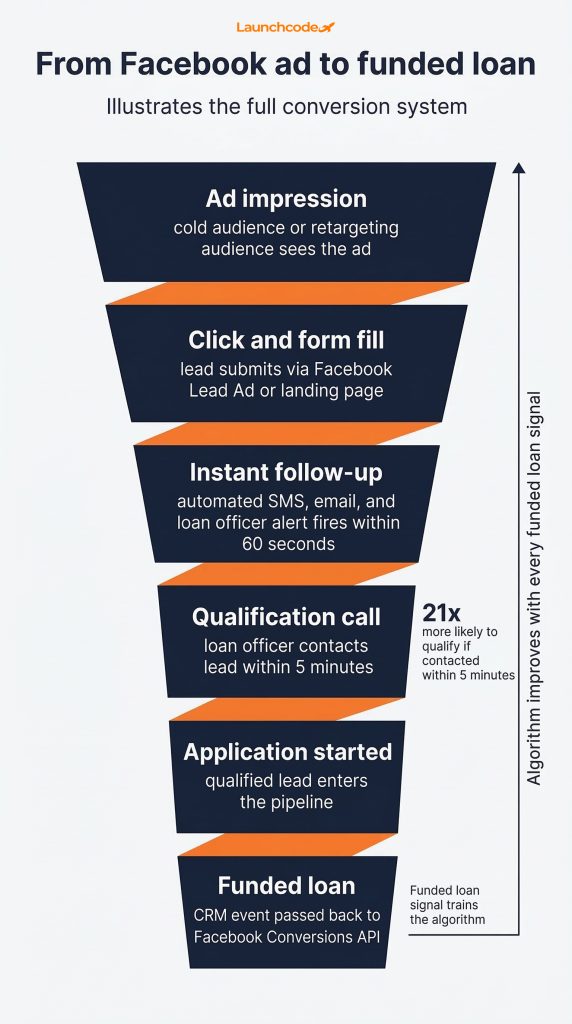
Connect Facebook Lead Ads directly to your CRM using an automation tool like Zapier or Make. The moment a lead submits their information, the system should fire an SMS, an email, and a task for a loan officer. Leads contacted within five minutes are 21 times more likely to enter the sales process than those contacted after 30 minutes. Without automation, most mortgage teams miss that window every time.
Manual follow-up does not work at scale. By the time a lead notification arrives in your email and a loan officer picks up the phone, the window is usually closed. According to research cited by Aged Lead Store, responding after five minutes drops your odds of qualifying the lead by 80%. Responding within one minute produces a 391% lift in conversion rate.
Use this flow for any new Facebook lead:
Approximately 80% of mortgage leads are not ready to apply right away and require nurturing before making a decision. That means the majority of your Facebook leads belong in a drip sequence, not a discard pile. Staying present over weeks or months with useful content, rate updates, and market information keeps you top of mind when the borrower is ready to move.

Send funded loan data back to Facebook through the Conversions API. When Facebook receives signals about which leads became funded loans, its algorithm uses that data to find more people who match those borrower profiles. This is called Revenue-Driven Optimization (RDO), and it is the most underused tactic in mortgage Facebook advertising.
Most advertisers send form submission data back to Facebook and stop there. That tells the algorithm to find more people who fill out forms. It says nothing about creditworthiness, loan size, or likelihood to close. The loop between advertising and revenue stays broken.
The Conversions API (CAPI) is Meta's server-side integration. It lets you send events from your website and CRM directly to Facebook, bypassing browser-based tracking limitations from iOS updates and cookie restrictions.
For mortgage advertisers, the highest-value events to pass back are:
Each step up the funnel tells Facebook something more specific about what a real borrower looks like. Over time, the algorithm shifts from finding form fillers to finding closeable leads.
"When clients start sending funded loan data back into the platform instead of just form fills, the lead quality shift is visible within 60 to 90 days. The algorithm learns what a real borrower looks like across your specific market."
Olivia Tran, AVP, Media Services, Launchcodex
This approach takes longer to show results than a standard lead volume campaign. The payoff is an algorithm that gets progressively better at finding borrowers your team can actually close.
Retargeting warms up potential borrowers before asking them to fill out a form. People who have watched 50% of a mortgage explainer video, visited your rate calculator, or clicked a previous ad are already familiar with your brand. Converting them costs less and produces better leads than converting cold traffic.
Retargeting audiences remain available to HEC advertisers because they are built from first-party engagement data, not demographic profiles. This makes them one of the most valuable targeting assets in a compliant mortgage campaign.
For each retargeting audience, use creative that matches where the person is in the decision process. Someone who started a form and stopped should see a reassurance message. Someone who visited your rate calculator should see a specific payment example.
Run educational content campaigns with no conversion goal before you launch your lead generation campaign. A short video explaining the difference between FHA and conventional loans, or a video answering common first-time buyer questions, builds a warm audience at low cost. When you are ready to convert, you already have a pool of people familiar with your brand.
This approach also sidesteps some HEC restrictions because purely educational content does not always require the Special Ad Category designation.
Track these metrics in order: cost per qualified lead, contact rate within five minutes, and cost per funded loan. Most mortgage advertisers track only cost per lead. That metric tells you almost nothing about revenue. The other three tell you whether your ad, your follow-up, and your pipeline are functioning as one system.
Here is how to define each metric and what benchmarks to use for context:
| Metric | How to define it | Benchmark context |
|---|---|---|
| Cost per lead | Total ad spend divided by total leads | Facebook average across industries: $21.98. Google average: $66.69. |
| Cost per qualified lead | Ad spend divided by leads that pass your minimum criteria (credit, timeline, loan type) | Will vary. Start by tracking the ratio of qualified to total leads. |
| Contact rate within 5 minutes | Percentage of leads reached by call, SMS, or email within five minutes of submission | Target above 50%. Below 30% signals a broken follow-up system. |
| Close rate | Funded loans divided by qualified leads | MBA industry average: 3% to 5%. Referral leads close at 20% or more. |
| Cost per funded loan | Total campaign spend divided by funded loans | Calculate this for every campaign and use it to compare channels and creative. |
When you have all five metrics tracked, you can diagnose exactly where the system breaks. High lead volume with a low contact rate is a CRM and automation problem. High contact rate with a low close rate is a qualification or sales problem. High close rate with a high cost per funded loan is a creative or targeting problem.
Running Facebook ads for mortgage leads that close is a systems integration task, not an ad management task. The ad attracts the right person. The landing page or lead form qualifies them. The CRM and automation sequence contacts them immediately and nurtures them over time. The funded loan data feeds back into the algorithm and makes every next campaign more accurate.
At Launchcodex, the campaigns we build for financial services clients treat the Facebook ad platform as one input into a full funnel architecture, not a standalone lead generation tool. The difference in outcomes between a standalone campaign and a connected system is significant. AI-powered lead management tools, when integrated into the follow-up layer, can lift conversion rates by more than 30%.
The mortgage market remains active. The Mortgage Bankers Association reported purchase applications rising 15% year-over-year in Q2 2025, and origination volume is forecast to grow through 2026. The loan officers who build this infrastructure now will compound the advantage as volume returns.
Here is the full system in sequence:
If you want to build this infrastructure for your lending team or your agency clients, Launchcodex works with mortgage and financial services brands on paid media, AI automation, and full funnel systems design.

The system described in this article depends on one thing above everything else: speed. The loan officer who responds first wins the lead. The team that automates that response wins consistently.
Launch Portal is built for exactly this problem. It replaces the disconnected stack of tools most mortgage teams use with one system that captures every lead, responds instantly, and automates follow-up until the conversation turns into a booked appointment.
Messaging, scheduling, reviews, and reporting all run from one place. No more leads falling through the cracks because a notification went to the wrong inbox or a loan officer was on another call.
If your Facebook campaigns are generating leads but your contact rate is low, the issue is almost never the ad. It is what happens in the 60 seconds after the form is submitted.
Yes. Any ad that promotes a mortgage loan, mortgage service, or related credit product must be declared under the Housing or Credit Special Ad Category in Meta Ads Manager. Failure to declare can result in ad rejection or account suspension.
No. Standard Lookalike Audiences are not available for Housing, Employment, or Credit category ads. Special Ad Audiences, which were a restricted alternative, were also phased out by Meta in October 2022. First-party Custom Audiences and website retargeting audiences are your primary options.
Cost per lead varies based on targeting, creative, and location. A real-world case study from 39 Celsius documented mortgage leads at $4 to $16 per lead using Facebook Lead Ads with narrowed persona targeting in California. The industry-wide average cost per lead for Facebook Lead Ads across all categories is $21.98, according to WordStream's 2024 benchmark data.
Speed of follow-up is the most common cause. Leads contacted more than five minutes after submission are 21 times less likely to enter the sales process. If your team is calling leads manually from email notifications, you are almost certainly outside that window. Automated CRM integration that fires an SMS and email at the moment a form is submitted dramatically improves contact rates.
Revenue-Driven Optimization (RDO) is the practice of passing funded loan data back into the Facebook algorithm through the Conversions API. Instead of optimizing for form fills, you give Facebook signals about which leads actually closed. Over time, the algorithm finds more users who match your funded borrower profile rather than users who simply fill out forms.
Both work for different reasons. Google Ads reaches borrowers at the moment they search, which means higher intent but also higher cost. Facebook reaches borrowers before they search, which means lower cost but more nurturing required. The average CPC on Facebook Lead Ads is $1.88 versus $4.66 on Google. For teams with strong follow-up systems, Facebook often produces a better cost per funded loan.



Learn how tattoo artists rank in Google's local map pack and get recommended by AI tools like ChatGPT and Perplexity in 2026...
Build your first email nurture flow the right way. This guide covers trigger selection, sequence structure, segmentation, an...
Learn how to build an email list that actually grows. Covers lead magnets, form placement, segmentation, deliverability, and...