




Core Web Vitals guide: What they are and how to improve them
Learn what Core Web Vitals are, what thresholds you need to hit, and how to fix LCP, INP, and CLS. Includes a prioritization...


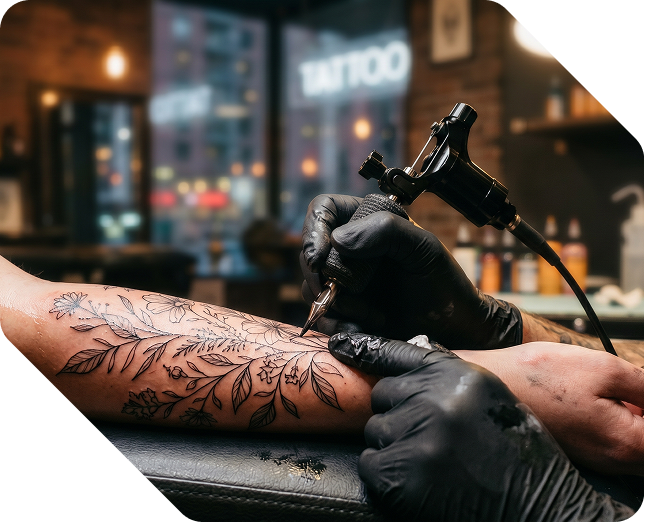


A potential client wants a custom sleeve tattoo. They open Google to research blackwork artists, check Google Maps to find studios near their zip code, then ask ChatGPT which shop in their city does the best traditional Japanese work. Three searches. Three separate results. Most tattoo shops show up in one of them, maybe two, and are invisible in the rest.
This guide covers how to rank across all three surfaces with tactics specific to tattoo studios. You will come away with a clear system for your Google Business Profile, Maps rankings, keyword strategy, on-page and technical SEO, review volume, and AI search visibility.
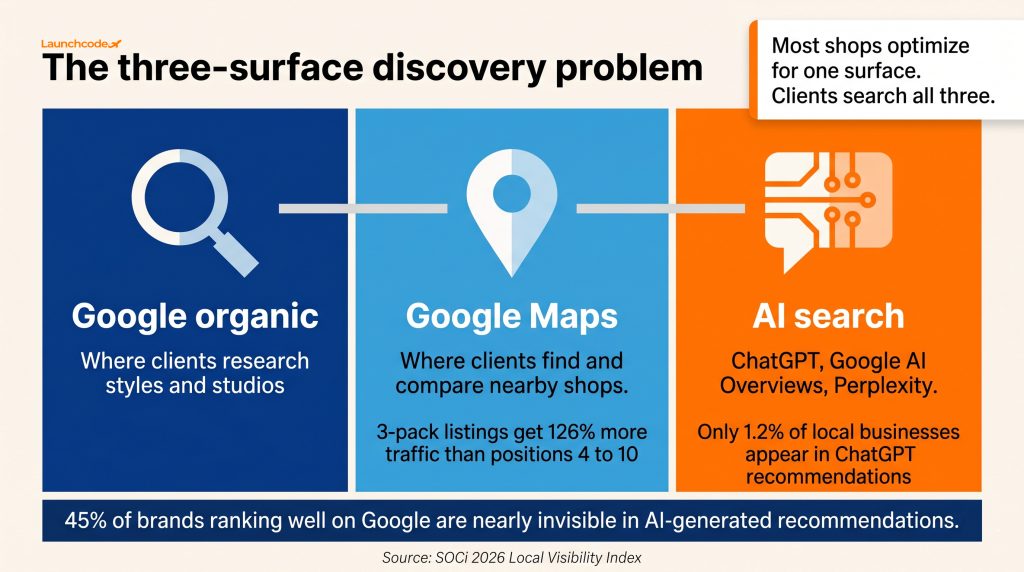
Most tattoo shop SEO guides focus on Google organic search. That is one of three surfaces where clients discover businesses in 2026. The other two are Google Maps and AI tools like ChatGPT, Google AI Overviews, and Perplexity. A shop can rank on page one of Google and still be invisible in the Maps 3-pack and absent from AI-generated local recommendations.
Ready to grow your organic traffic?
Get a free SEO audit from the Launchcodex team.
The data on AI search is clear. According to the SOCi 2026 Local Visibility Index, which audited more than 350,000 business locations, only 45% of brands that perform well in traditional Google rankings also appear in AI-generated recommendations. ChatGPT currently recommends just 1.2% of all local business locations.
That gap exists right now. Shops that act on it early have a real first-mover advantage.
At the same time, Google and Maps still drive the majority of local tattoo bookings. Research from Orbit Media Studios in 2026 found that only 24% of users prefer AI chat over traditional search for local and business queries. The goal is not to abandon what works. The goal is to extend your visibility onto every surface where clients look for you.
Your Google Business Profile (GBP) is the single most important lever in your local search system. It controls your Maps ranking, feeds directly into Google AI Overviews, and determines what potential clients see before they ever visit your website. A complete, active, and specific GBP improves performance across organic search, Maps, and AI visibility at the same time.
According to Google data cited by Tattoo Studio Pro, a well-optimized GBP makes potential clients 70% more likely to visit your business. Most shops have profiles that are partially filled out, infrequently updated, and generic enough that Google cannot categorize them accurately for style-specific queries.
Generic descriptions get passed over. "Professional tattoo studio with experienced artists" tells Google nothing it can use to match your shop to specific searches.
Your description needs your style specialties and your neighborhood. A description like "Fine line and botanical tattoos in Austin's South Congress neighborhood" is specific enough for Google to categorize your shop accurately for style-based queries. It also surfaces in AI Overview summaries when someone asks for style-specific recommendations in your area.
Write for humans, but include the style terms and location language your clients actually type into search.
Most shops treat GBP photos as a portfolio showcase. The smarter approach treats them as a ranking signal, because that is exactly what they are.
Google's Vision AI reads the subjects of your photos to match your shop to style-specific queries. Photo strategy is keyword strategy.
Apply these rules to your photo uploads:
Google monitors what users do when they find your listing. Clicks, calls, direction requests, and time spent on your profile all feed into your Maps ranking. A complete profile with strong photos and relevant content generates more of those signals naturally.
In late 2025, Google confirmed that messaging response time became a formal input to local ranking. Businesses that respond to messages within an hour see improved local visibility. Enable messaging in your GBP settings and create quick-reply templates for common client questions about pricing, style availability, and booking.
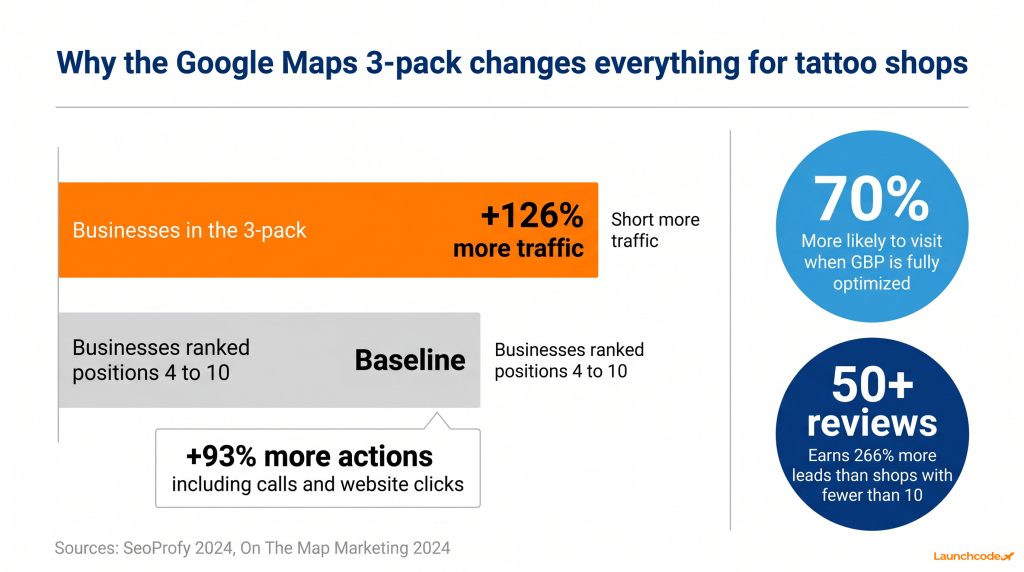
The Google Maps 3-pack captures the top three local business listings for any location-based query. According to SeoProfy, businesses in the 3-pack get 126% more traffic and 93% more actions such as calls and website clicks than listings ranked between positions 4 and 10. Getting there requires consistent optimization across three factors Google uses to evaluate local results.
Google ranks local businesses on three core signals:
| Signal | What it means | How to improve it |
|---|---|---|
| Relevance | How well your profile matches the search | Complete every profile field, choose precise categories, use style-specific language in your description |
| Distance | How close you are to the searcher | Verify your address is accurate everywhere it appears. Incorrect location data is a fixable problem. |
| Prominence | How well-known and trusted your business is online | Build reviews, earn citations, maintain an authoritative website, and stay active on your profile |
Proximity accounts for 31 to 55% of ranking weight depending on the market. You cannot move your shop, but you can dominate relevance and prominence.
NAP stands for name, address, and phone number. These three pieces of information must match exactly across every platform where your shop appears. A suite number missing on Yelp, a phone number formatted differently on Foursquare, or an outdated address on Apple Maps erodes the trust signals Google uses to confirm your business is legitimate.
Priority directories for tattoo shops:
Tools like Whitespark and BrightLocal can audit your citations across dozens of platforms and flag discrepancies. For shops competing in dense urban markets, clean citations are a measurable ranking advantage most competitors overlook.
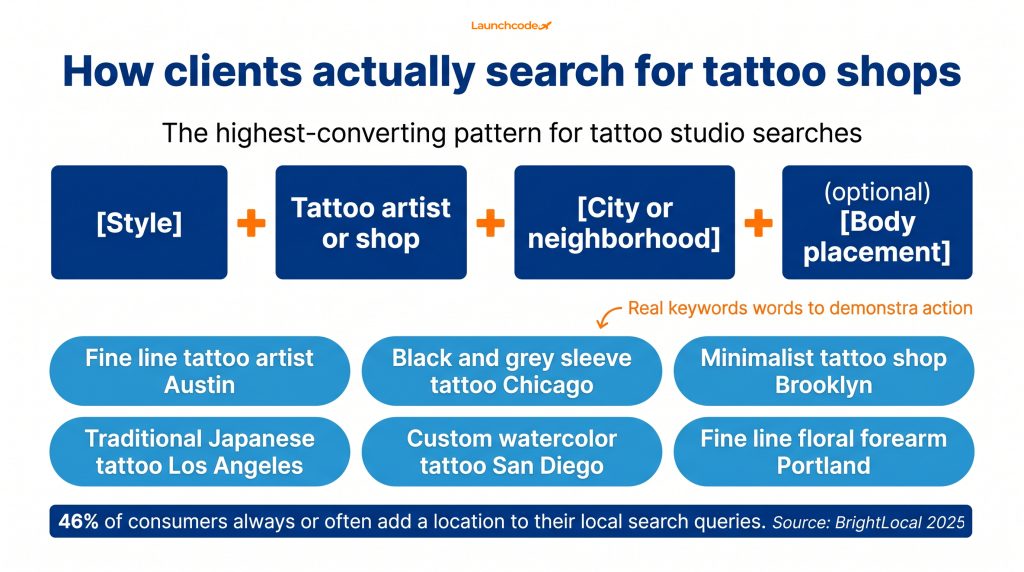
Clients do not search for "tattoo shop." They search for a style combined with a location. "Fine line tattoo artist Denver" or "Japanese sleeve tattoo Los Angeles" are the queries that convert. Targeting generic terms costs more effort and brings in lower-quality traffic. The right keyword strategy starts with your specialty and your city.
BrightLocal's 2025 consumer research found that 46% of consumers always or often add "near me" or a specific location to their local search queries. For tattoo studios, that behavior pairs with style intent. Clients usually know what they want before they know where to get it.
The highest-converting keyword pattern for tattoo shops follows this structure:
[Style] + tattoo artist + [city] [Style] + tattoo shop + [neighborhood] Best + [style] + tattoo + [city] [Style] + tattoo + [city] + [body placement]
High-converting long-tail examples:
Start your research with Google autocomplete. Type "tattoo shop [your city]" and watch the suggestions. They show exactly what people in your market are searching for. Then use a tool like Ahrefs or Semrush to validate search volume and competition before building pages around those terms.
One homepage targeting your city is not enough if your shop serves multiple neighborhoods or if your artists specialize in distinct styles. Dedicated style or neighborhood pages let you rank for multiple high-value queries at the same time.
When a Portland studio created a dedicated "Black and grey tattoos in Portland" hub page, they moved from page 3 to position 2 in Google in four months, according to the Tattoo Studio Pro digital marketing playbook. The deciding factor was not technical complexity. It was location-specific content that directly answered a specific query.
Build each location or style page with:
Do not copy content between pages. Each page needs to reflect the specific style, placement, or neighborhood it is built to rank for.
Your GBP gets clients interested. Your website closes the deal and reinforces your Maps prominence score. A slow, hard-to-navigate mobile site signals distrust to both users and search engines. Google rewards fast, mobile-first sites with better organic rankings, and those rankings feed directly into your Maps visibility.
Most clients find tattoo artists from their phones. A site that loads in more than three seconds loses a share of potential bookings before anyone sees your work.
Run your site through Google PageSpeed Insights and focus on:
Your booking button should be visible without scrolling on mobile. If a client has to hunt for it, they will leave and find a shop that makes it easier.
Structured data is the clearest signal you can send to both Google and AI systems about who you are and what you offer. Most tattoo shop websites have none of it, which is one of the most actionable gaps in the market right now.
Use LocalBusiness schema as your baseline. A simplified example:
{
  "@context": "https://schema.org",
  "@type": "LocalBusiness",
  "name": "Your Studio Name",
  "address": {
    "@type": "PostalAddress",
    "streetAddress": "123 Main Street",
    "addressLocality": "Portland",
    "addressRegion": "OR",
    "postalCode": "97201"
  },
  "telephone": "+15035550100",
  "openingHours": "Mo-Sa 10:00-19:00",
  "url": "https://yourstudio.com",
  "image": "https://yourstudio.com/images/studio.jpg",
  "priceRange": "$$"
}Add FAQPage schema to any page where you answer common client questions. Questions like "how much does a fine line tattoo cost" or "do I need a consultation before booking" are exactly the types of queries that now trigger Google AI Overviews. FAQPage schema makes your answers machine-readable and more likely to be pulled into those summaries. This is one of the most underused tactics available to local service businesses right now.
If you want to understand how structured content and schema fit into a full SEO and GEO strategy, the system goes deeper than any single page can carry on its own.
Reviews are one of the top three local ranking factors for Google Maps. They also directly determine whether your shop appears in AI-generated recommendations. Industry benchmark data from On The Map Marketing shows that businesses with 50 or more Google reviews earn 266% more leads than businesses with fewer than 10. That gap widens over time as competitors pull further ahead.
Quantity matters, but Google now weights review diversity and response rate alongside raw count. A shop with 45 reviews and a response to every one of them will outperform a shop with 60 reviews that never engages.
Review content matters too. When clients naturally mention style terms in their reviews, such as "best fine line work I've seen in the city," those keywords reinforce your relevance for style-specific queries. You cannot ask clients to include specific phrases, but you can prompt them to describe their style and experience when you send your review request.
The most effective moment to ask for a review is immediately after a session, when the client is satisfied and the experience is fresh.
A straightforward process:
"Every client we work with that crosses 50 Google reviews with consistent responses sees a measurable Maps lift within 60 to 90 days. The shops ignoring reviews are handing that ground to whoever shows up." Tanner Medina, Co-Founder and Chief Growth Officer
BrightLocal's 2024 consumer data found that 88% of consumers say they would use a business that replies to all its reviews, compared to only 47% who would use a business that ignores them. Responding to a negative review with a clear, professional message recovers conversions more often than most shop owners expect.
Google AI Overviews now appear in 40.2% of local business queries. ChatGPT currently recommends just 1.2% of all local business locations. If someone asks ChatGPT for the best fine line tattoo shop in your city, almost no results come up at all. This is an open window right now, with almost no competition inside it.
The SOCi 2026 Local Visibility Index found that more than half of businesses dominating the Google Map Pack are nearly invisible in the AI discovery layer. Ranking on Google alone no longer guarantees discovery across all the surfaces where clients are looking.
AI engines do not just crawl your website. They draw from your GBP data, your review platforms, third-party directories, press mentions, and structured content they can extract and verify across multiple sources.
Research from Position Digital in 2025 found that brands are 6.5 times more likely to be cited in AI responses through third-party sources than through their own domains. Your Yelp profile, your presence in local arts publications, and your mentions in neighborhood directories are all AI visibility inputs.
"AI systems don't decide what to surface from one signal. They cross-reference GBP data, review platforms, directory listings, and website content before assigning confidence to a business. Inconsistency anywhere in that network lowers your probability of being cited." Derick Do, Co-Founder and Chief Product Officer
For local queries, traditional search retains a strong advantage. The Orbit Media Studios 2026 data found only 24% of users prefer AI chat over traditional search for local and business queries. You are not replacing your Google and Maps strategy. You are layering AI visibility on top of a strong foundation.
AI systems extract information more efficiently from well-organized, specific content. Pages with clear headings, short paragraphs, and direct answers to specific questions get cited more frequently than dense, unstructured pages.
AirOps research from April 2026, cited by Position Digital, found that pages with three or more comparison tables earn 25.7% more citations in AI answers. Pages with eight or more list sections earn up to 26.9% more citations. Structure is not just a readability decision. It is a citation strategy.
Apply these principles across your website:
According to Mersel AI, 76.1% of AI Overview citations also rank in Google's top 10. Strong local SEO and GEO reinforce each other. The investment in one makes the other more effective.
Most shops starting to think about AI visibility run into the same problems:
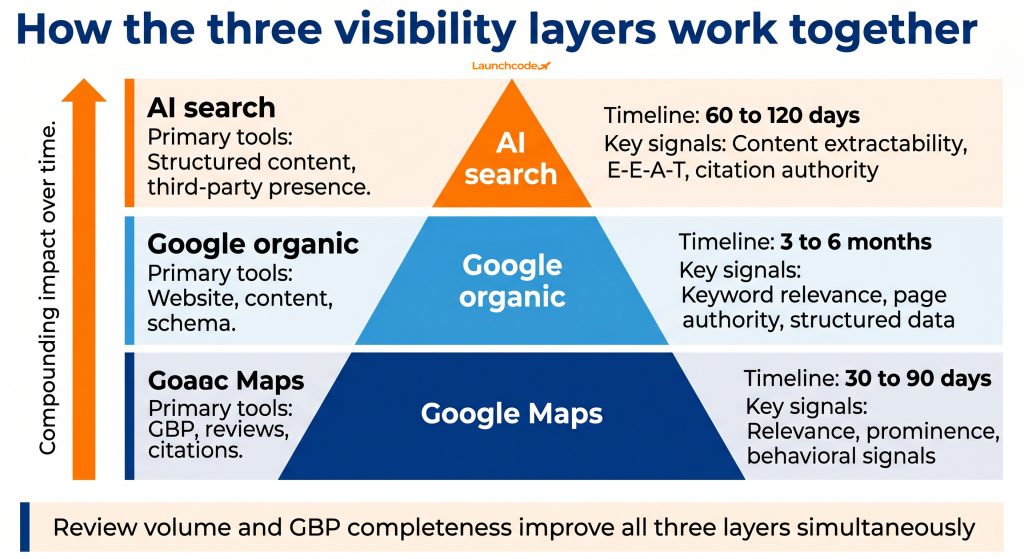
Your search visibility across Google organic, Maps, and AI search works as a single compounding system. Each layer reinforces the others. A strong GBP improves Maps rankings. Maps rankings build the behavioral signals that lift organic prominence. A well-structured website with schema feeds AI Overviews. Review volume improves all three surfaces at once.
Here is how the three layers work together:
| Layer | Primary tools | Key signals | Typical timeline |
|---|---|---|---|
| Google organic | Website, content, schema | Keyword relevance, page authority, structured data | 3 to 6 months |
| Google Maps | GBP, reviews, citations | Relevance, prominence, behavioral signals | 30 to 90 days |
| AI search | Structured content, third-party presence | Content extractability, E-E-A-T, citation authority | 60 to 120 days |
The US tattoo industry reached $1.3 billion in 2025, growing at a 10.9% CAGR since 2020, with approximately 23,774 businesses in operation. Competition for local search visibility will only grow from here. Shops that build a complete system now, covering all three layers, make it very difficult for competitors to catch up later.
Start with your GBP. Fix NAP consistency across every directory. Build your review count above 50 with a consistent response to every one. Then layer in style-specific location pages with LocalBusiness schema and structured FAQ content. Each step raises the ceiling on what the next step can achieve.
At Launchcodex, we build this kind of integrated local visibility system for service businesses serious about organic growth. The compounding effect is real, and the advantage of starting now versus six months from now is measurable.
Most shops see measurable changes in impressions and click-through rates within 30 to 90 days of fully completing their GBP and building consistent review volume. Organic rankings typically take three to six months to shift meaningfully.
Complete your Google Business Profile fully, get your NAP consistent across all directories, and build your review count above 50 with responses to every review. Those three steps move the needle faster than anything else for Maps visibility.
The same fundamentals that rank your website help here. Adding LocalBusiness and FAQPage schema markup, earning citations on Yelp and other review platforms, and structuring your website content with clear headings and direct answers all improve your chances of being cited by AI systems significantly.
Target style-plus-location combinations such as "fine line tattoo artist Portland" or "black and grey tattoo shop Chicago." These queries carry higher purchase intent than broad terms like "tattoo shop" and face less competition from national directory sites.
Aim for a minimum of 20 to 30 photos covering your studio interior, artists at work, and a strong portfolio of finished pieces. Upload two to three new photos every week to maintain the active-profile signals Google tracks as a ranking factor.
Yes. Review response rate is a confirmed signal in Google's local ranking algorithm. BrightLocal data shows 88% of consumers would use a business that replies to all its reviews, compared to 47% who would use a business that does not respond at all.
NAP stands for name, address, and phone number. These details must match exactly across every platform and directory where your shop appears. Inconsistencies reduce the trust signals Google uses to validate your business, which weakens your Maps ranking.




Learn what Core Web Vitals are, what thresholds you need to hit, and how to fix LCP, INP, and CLS. Includes a prioritization...
E-E-A-T is Google's framework for evaluating content quality. Learn what it means in 2026, why it determines AI Overview cit...
Learn how to optimize every page you publish with this complete on-page SEO guide. Covers title tags, schema markup, Core We...