
Link building guide: How to earn authority that moves rankings
Learn which link building tactics move rankings in 2026. Covers digital PR, HARO, linkable assets, anchor text strategy, and...





Most companies know backlinks matter. Few know why some links move rankings and others do nothing. The gap between link building that compounds over time and link building that wastes budget usually comes down to one thing: treating links as a volume game instead of an authority signal.
This guide covers how link building works in 2026, which tactics earn high-quality backlinks, how to build a system around them, and what the rise of AI search changes for your program. You will leave with a clear process you can run or hand to a team.
Backlinks remain a foundational ranking signal. Pages that rank first on Google have, on average, 3.8 times more backlinks than pages in positions 2 through 10, according to Backlinko's research. More links do not automatically produce better rankings. Sustained, quality-focused link building is still one of the most direct levers for building organic visibility, especially in competitive categories.
Ready to grow your organic traffic?
Get a free SEO audit from the Launchcodex team.
Google's algorithm has changed considerably since PageRank launched, but links are still how the search engine understands which pages are trusted, relevant, and worth surfacing. The 2024 Google data leak confirmed PageRank remains in active internal use. Each new backlink you earn from a relevant, authoritative source adds to a compounding trust signal over time.
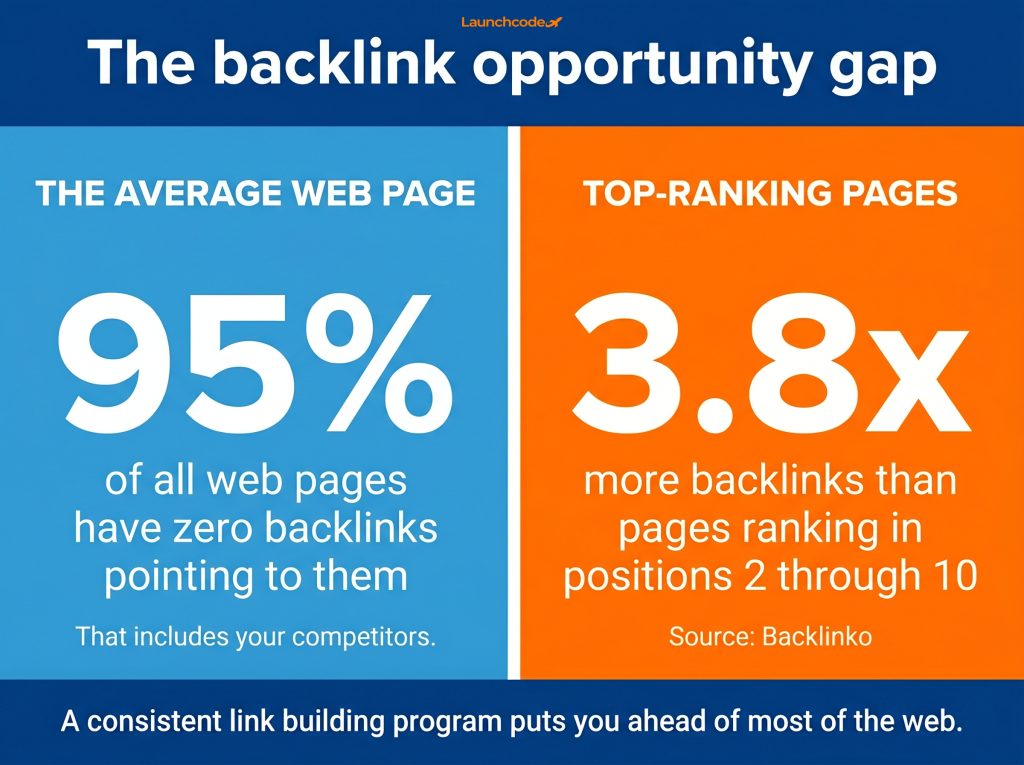
95% of all web pages have zero backlinks pointing to them. That includes competitor pages, thin blog posts, and dormant brand sites. A brand running a moderate and consistent link building program pulls ahead of the vast majority of competing pages in authority over time.
The challenge is real. 65% of digital marketers say link building is the most difficult part of SEO. It requires strategy, content, outreach, and patience. Data from Authority Hacker's link building research shows the impact of new backlinks typically becomes visible within 3.1 months on average, with 46.6% of link builders seeing ranking movement within 1 to 3 months.
That gap between effort and result is where most programs stall. Building the right structure from day one shortens it.
Links do more than pass ranking authority. They also signal to Googlebot that your pages exist and are worth crawling. John Mueller, Google's Search Advocate, has said: "Links are really important for us to find content initially. If nobody links to your website ever, then we are going to have a hard time recognizing that it even exists."
Authority compounds over time. A page with 50 referring domains from trusted sources continues earning passive links from people who discover it through search or citation. The backlink profile you build today keeps working without additional spend.
A high-quality backlink comes from a domain that is relevant to your topic, trusted by search engines, and links to your page editorially within body content. Those three factors, relevance, authority, and editorial placement, determine how much authority a link passes. Volume without these qualities adds little to rankings and can create a link profile that looks unnatural.
Mueller defines the ideal link clearly: "The traditional good link is someone who comes across your website and thinks it is a fantastic website and recommends it to other people with a link." The question for every link opportunity is whether it reflects genuine endorsement.
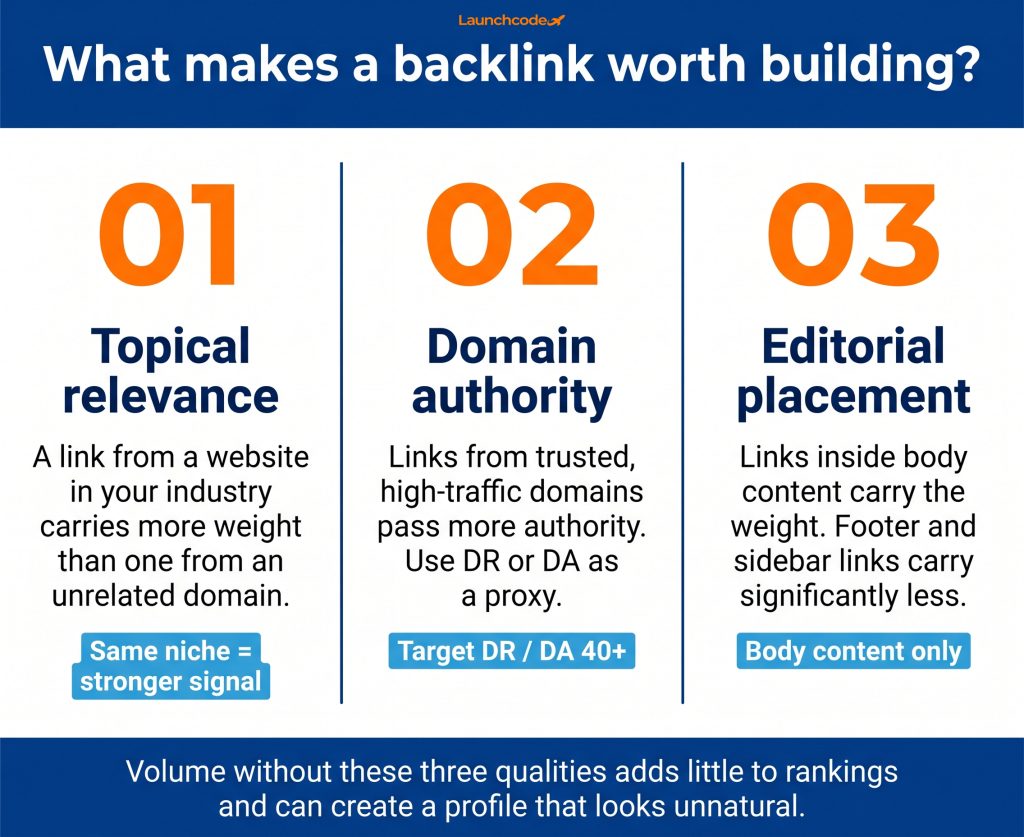
1. Topical relevance. A link from a website covering the same industry or subject carries more weight than a link from an unrelated domain. A SaaS company earning a backlink from an enterprise software publication is valuable. The same company earning a link from a travel blog is effectively worthless for ranking purposes.
2. Domain authority. Links from domains with strong backlink profiles pass more authority. Tools like Ahrefs' Domain Rating (DR) and Moz's Domain Authority (DA) estimate this on a 0 to 100 scale. Both are proxy metrics, not Google signals directly, but they are practical for vetting link sources. Target linking domains with a DR or DA above 40 for meaningful impact.
3. Editorial placement. Links embedded within body content as a cited reference carry the most weight. Links in footers, sidebars, or author bios carry significantly less. Google describes editorial links within relevant body content as the most natural and trustworthy link type. A link buried in a footer is not an endorsement. A link within a paragraph explaining why your research matters is.
| Factor | Strong signal | Weak signal |
|---|---|---|
| Topical relevance | Same industry or adjacent topic | Unrelated niche |
| Domain authority | DR or DA 40+ | DR or DA under 20 |
| Link placement | Body content, within a relevant paragraph | Footer, sidebar, or author bio only |
| Link type | Dofollow editorial | Paid, directory-listed, or forced nofollow |
| Traffic | Active audience, real organic traffic | Near-zero monthly visits |
A note on nofollow links: they do not pass direct ranking authority, but they contribute to referral traffic, brand visibility, and a natural-looking profile. A backlink profile made entirely of dofollow links can itself appear manufactured.
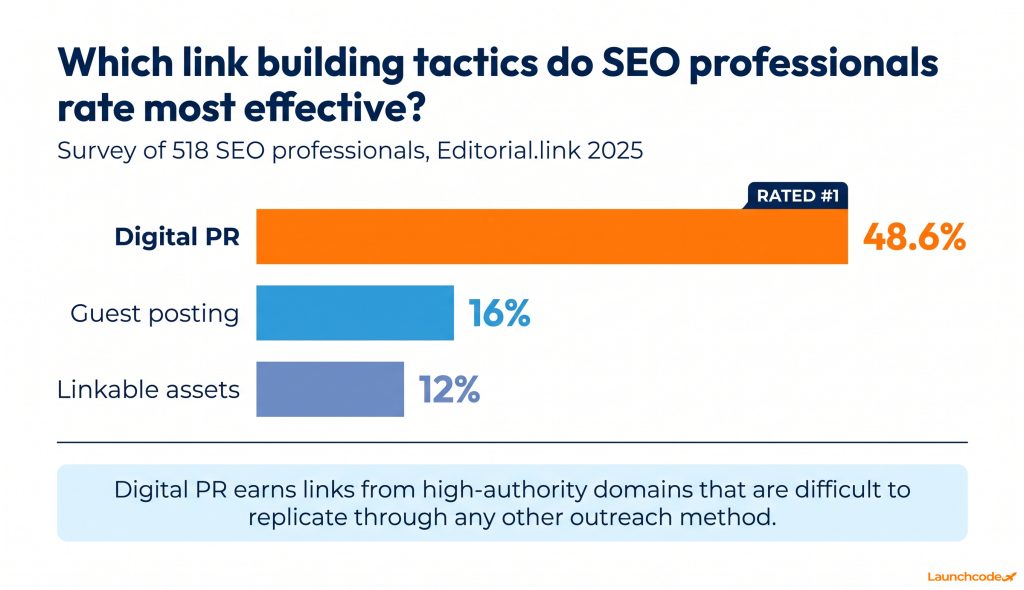
Digital PR earns backlinks from media publications, industry outlets, and authoritative websites by producing newsworthy content or expert commentary that journalists want to cover. In a 2025 survey of 518 SEO professionals, Editorial.link found that 48.6% of respondents rated digital PR as the most effective link building tactic, far ahead of guest posting at 16% and linkable assets at 12%.
The reason digital PR outperforms other tactics is link quality. Coverage in established publications generates backlinks from high-authority domains that are difficult or impossible to earn through outreach alone. A single placement in an industry publication with a DR of 80 can move a ranking more than 20 lower-quality placements combined.
The most linkable campaign types for B2B and SaaS companies include:
Each of these formats gives journalists a reason to cover your brand and their readers a reason to click.
In October 2025, Google's spam update explicitly targeted AI-generated guest post farms. Machine-generated thin content published solely to embed paid backlinks became a distinct spam violation category. As Blue Tree Digital's analysis of the update explains, SpamBrain can now identify this content pattern with enough precision to devalue contaminated links without applying a sitewide penalty.
This matters for any team using AI to scale guest posting. Mueller confirmed the risk at Search Engine Roundtable: "Using generative AI to create blog posts and content for the purpose of getting backlinks is almost certainly against Google's spam policies."
AI tools can assist your link building workflow, including research, prospecting, and drafting outreach emails. They should not be used to produce content whose sole purpose is to place a backlink.
Journalist sourcing platforms connect brands with reporters who need expert commentary for articles they are already writing. When your response is selected, you typically earn an editorial backlink from that publication. These links come from major outlets including Forbes, Entrepreneur, Inc., and TechCrunch, making them among the highest-quality backlinks available without a pre-existing media relationship.
The original HARO (Help a Reporter Out) service shut down its free tier in 2024, but it was relaunched in April 2025 by Featured.com with the original email-based format restored. This revived one of the most accessible backlink tactics available to brands of any size, including those without a dedicated PR team.
| Platform | Best for | Format |
|---|---|---|
| Featured.com (HARO) | Broad media coverage, major national outlets | Email queries three times daily |
| Qwoted | B2B and technology press | Platform-based query submissions |
| Muck Rack | PR professionals, relationship management | Journalist profiles and query monitoring |
| Prowly | Agency and brand PR teams | Press release distribution plus query alerts |
| SourceBottle | ANZ and UK market coverage | Email-based query alerts |
Monitor at least two platforms. Volume of relevant queries varies by industry and season, and each platform surfaces different journalist relationships.
Speed matters. Many queries close within hours. Set up keyword filters or alerts for your industry categories to stay ahead of the queue.
Linkable assets are pieces of content so useful, original, or thorough that other sites link to them without being asked. They extend the value of a single production effort across months or years of passive link acquisition. Ahrefs data shows that content exceeding 3,000 words earns 3.5 times more backlinks than shorter articles, and posts with more than three embedded videos attract 55% more backlinks.
The strongest linkable assets give other writers something they cannot find elsewhere: a dataset, a free tool, a named framework, or a definitive reference on a topic their audience cares about.
The key across all of these is specificity. A generic "ultimate guide" earns fewer links than a targeted study: "We analyzed 10,000 SaaS landing pages. Here is what drove conversions."
"The assets that earn the most links are the ones that answer a question your audience is already asking, with data or depth nobody else has published. A strong original study does more for a link profile than a year of email outreach to random sites."
Tanner Medina, Co-Founder & Chief Growth Officer, Launchcodex
Brian Dean, founder of Backlinko, formalized the skyscraper technique as a systematic method for earning links from pages that already link to similar content in your space.
This works because every site on that outreach list has already shown a willingness to link to content in this space. Dean documented this method producing 110% traffic growth for Backlinko in a published case study.
Most link building guides focus entirely on blog content. That is a mistake. According to a 2025 survey by Editorial.link, 52.7% of SEO professionals say service and product pages are the most important targets for link acquisition. A high-quality backlink pointing directly at a revenue-generating page produces a faster and more measurable business impact than a cluster of links to blog posts.
The practical approach: use blog posts and linkable assets as the primary outreach targets, then use internal links to pass some of that authority down to the service pages that generate pipeline.
Competitor backlink analysis finds the exact domains already linking to others in your space, which means they are already willing to link to content in your category. This is the most efficient prospecting method available because it removes the need to qualify every lead from scratch. Instead of guessing which sites might link to you, you start with a confirmed list of sites that have already done it for someone else.
Replicating a competitor's backlink profile wholesale is not a sufficient strategy. In the 2025 Editorial.link survey, 66.6% of SEO experts said finding unique backlink opportunities delivers greater value than copying a competitor's link profile. Use competitor research as a starting point, then build original opportunities on top of it.
Anchor text is the clickable text used in a backlink. The distribution of anchor text across your backlink profile is one of the signals Google uses to determine whether links were earned naturally or manufactured. Profiles weighted heavily toward exact-match keyword anchors trigger spam detection. The safest and most effective distribution uses a mix of partial-match, branded, and natural phrase anchors.
In the 2025 Editorial.link survey, partial-match anchor text was the preferred approach for 41.7% of respondents. Exact-match came in at 25.1% and branded anchors at 20.5%.
| Anchor type | Example | Best used when |
|---|---|---|
| Branded | "Launchcodex" | Any external link campaign |
| Exact-match | "link building services" | Sparingly, on high-authority placements only |
| Partial-match | "effective link building strategies" | Most editorial placements |
| Natural phrase | "this study from Ahrefs" | Resource and data citations |
| Naked URL | "launchcodex.com" | Directories and profile pages |
| Generic | "click here," "read more" | Avoid entirely |
Aiming for a distribution where no single anchor type dominates keeps your profile looking natural. If 60% of your links use the same exact-match keyword phrase, that pattern is detectable.
AI search is changing which authority signals matter most. Brand mentions now correlate three times more strongly with AI search visibility than traditional backlinks, according to an Ahrefs study of 75,000 brands published in August 2025. The correlation for brand mentions was 0.664 versus 0.218 for backlinks. AI language models are trained on raw text, not hyperlink graphs, so they learn which brands are credible through editorial coverage, independent of whether a link is present.
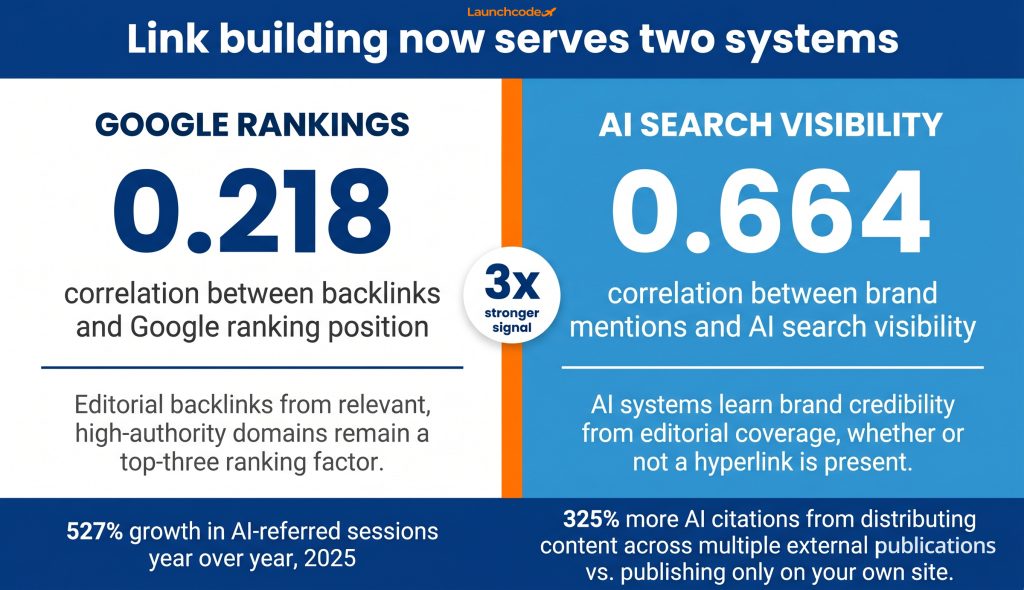
This does not mean backlinks matter less for Google rankings. It means that link building and brand visibility are now two sides of the same authority strategy, and the tactics that earn links are often the same ones that build AI citation share.
AI-referred sessions grew 527% year over year in the first five months of 2025. Distributing content across a wide range of external publications increases AI citations by up to 325% compared to publishing only on your own site, according to research from Princeton, Georgia Tech, and IIT Delhi.
Google's algorithm and AI search engines are separate systems with different signals. For Google, backlinks remain a top-three ranking factor. The 2024 Google data leak confirmed PageRank is still active. Mueller's nuanced position is that over-focusing on links at the expense of content quality wastes effort, not that links are irrelevant.
For traditional SEO, the priority is still earning editorial backlinks from high-authority, topically relevant domains. What has changed is that those same editorial placements now carry a second benefit: they signal to AI systems that your brand is a credible entity worth citing in generated answers.
Our SEO and GEO services combine traditional link building with brand authority programs designed for visibility across both Google and AI search platforms.
The right metrics for link building are referring domain growth, organic traffic to target pages, and keyword ranking movement measured over 60 to 90 day windows. Measuring total backlink counts is a vanity metric. What matters is whether the right pages are earning authority from relevant, trusted sources, and whether that authority is translating into measurable ranking and traffic gains.
Give any new program 90 days before evaluating results. Links accelerate authority on an already-capable technical foundation. If the site has indexing issues or thin content, fix those first.
"When we review link programs with clients, the first thing we look at is whether referring domain growth is translating into ranking movement on the pages that matter. Link count alone tells you very little."
Brittany Charles, SVP, Client Services, Launchcodex
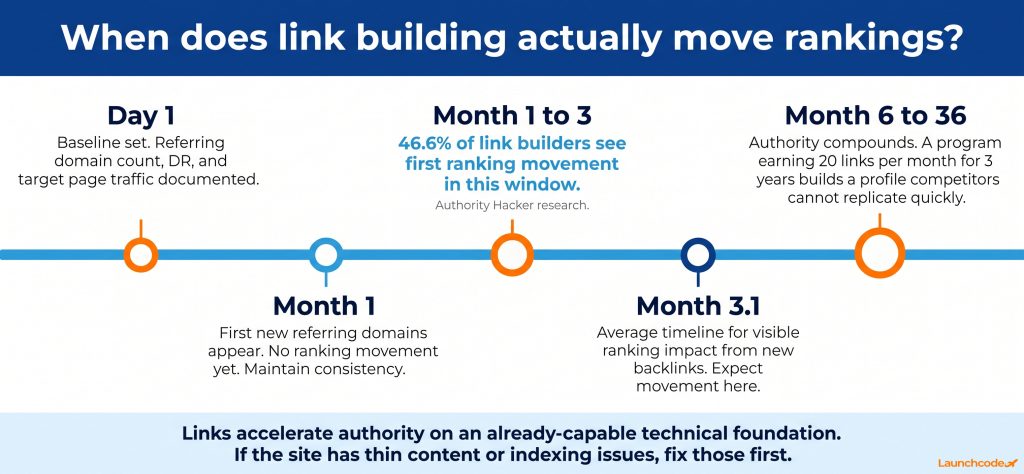
Link building that compounds over time looks different from a one-off campaign. A campaign earns 20 links. A program earns 20 links per month for three years and builds a backlink profile that becomes genuinely difficult for competitors to replicate. A strong backlink profile built over years is one of the hardest assets in organic search to close quickly from behind.
According to Editorial.link's 2026 survey, agencies allocate an average of 32.1% of their total SEO budget to link building. Treat it as a core operating investment. Budget and staff it accordingly.
As Outpace SEO notes: "No single tactic should account for more than 40 percent of your link acquisition. The brands that build the most resilient link profiles use a mix of proactive campaigns, reactive PR, and ongoing outreach."
Start with one tactic. Run it consistently for 90 days. Measure the result. Expand from there.
For most growth-stage brands, the fastest path to meaningful links is a combination of HARO monitoring and one linkable asset targeted at a core category keyword. HARO responses produce fast, high-authority links when executed well. A strong linkable asset produces compounding links over time. Together, they establish a baseline profile that opens the door to larger digital PR campaigns.
Establish your measurement baseline today, before any new links are built. Document your current referring domain count, DR, and organic traffic to your target pages. That baseline makes the impact of your first 90 days clear and gives you a foundation for every review cycle that follows.
Link building produces results when it is done consistently, with real outreach and genuine relationships behind every placement. Most teams do not have the time or the publisher network to run it at the volume that moves rankings. Launchcodex handles both.
Our team runs fully manual link building campaigns for clients across B2B, SaaS, and growth-stage brands. Every outreach is written by a person, targeted to a relevant publication, and placed within editorial content. No link farms, no automated blasts, no grey-hat shortcuts.
We have also built a vetted network of partner websites across industries over several years of client work. That network gives your site access to relevant, high-authority placements that most outreach campaigns take months to earn from scratch.
What we manage for you:
If you want a link building program built around your goals, get in touch with the Launchcodex team and we will walk you through what a white-hat program looks like for your site.
Most link builders report visible ranking movement within 1 to 3 months of earning new backlinks. The average is 3.1 months. Timeline depends on your site's existing authority, how competitive the target keywords are, and the quality of the specific links earned.
No. Purchasing links to manipulate rankings violates Google's spam policies and risks manual penalties or algorithmic devaluation. Google's SpamBrain system now identifies purchased links and the sites selling them with high precision. The October 2025 spam update also targeted AI-generated content created specifically to embed paid backlinks. Invest that budget in earned content and digital PR instead.
Neither DR nor DA is a Google ranking signal. They are proxy metrics from Ahrefs and Moz, respectively. As a practical threshold, prioritize linking domains with a DR or DA of 40 or above for meaningful authority transfer. Below that score, topical relevance becomes the primary deciding factor.
Yes. The original HARO service closed its free tier in 2024, but Featured.com relaunched it in April 2025 with the original email-based format. Qwoted, Muck Rack, and Prowly are active alternatives that operate on the same journalist-source connection model and surface different outlet types.
Yes, for Google rankings they remain a top-three factor. For AI search visibility, brand mentions now carry even more weight. An Ahrefs study of 75,000 brands found brand mentions correlate three times more strongly with AI citation frequency than backlinks do. A strong link building and digital PR program builds authority across both systems simultaneously.




Learn which link building tactics move rankings in 2026. Covers digital PR, HARO, linkable assets, anchor text strategy, and...
Google removed Business Profile messaging in 2024. In 2026, it returns as an AI chatbot that answers customers and hands off...
Most healthcare marketers track activity, not outcomes. Learn the five most common ROI measurement failures in healthcare ma...