


E-commerce marketing guide: How to acquire convert and retain customers online
A data-backed e-commerce marketing guide to acquire, convert, and retain customers as one profit loop. Benchmarks, checkout ...




Online stores face a squeeze. Ad costs rise every year while the average conversion rate sits near 2.5 percent and most first-time buyers never come back. Spending more on traffic no longer solves the problem, because the math often breaks before a customer turns a profit.
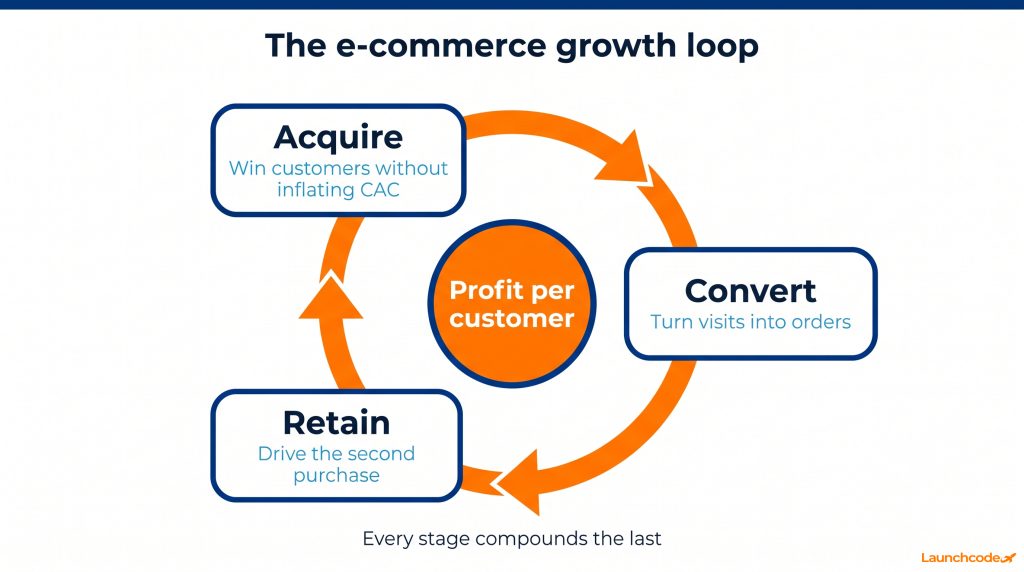
This guide treats e-commerce marketing as a single loop across acquisition, conversion, and retention. You will learn what to measure, which channels to prioritize, how to recover lost checkouts, how to drive repeat purchases, and how AI search is changing product discovery. Every section ties back to one number, profit per customer.
Volume marketing stopped paying off because acquisition keeps getting more expensive. Average e-commerce customer acquisition cost now runs about 68 to 84 dollars per customer, up roughly 60 percent over five years. The store that wins is not the one with the most traffic. It is the one that earns more from each customer than it spends to acquire them.
Ready to grow your organic traffic?
Get a free SEO audit from the Launchcodex team.
Most stores still report success in sessions and orders. That hides the real question. After ad spend, discounts, shipping, and returns, does a customer return a profit? Costs keep climbing from forces outside any single store. Google Shopping CPCs jumped 33.72 percent in 2025, and Meta Q4 CPM averaged near 23 dollars during the holiday peak. When the price of attention rises, the leverage moves to what you do after the click.
Three numbers decide whether your loop works.
Peter Fader of the Wharton School calls lifetime value the metric that ties everything together. In an interview on customer valuation, he treats acquisition, retention, and spend as parts of one model rather than separate goals. That is the mindset this guide follows.
"When we cut a client's checkout friction and switched on post-purchase flows, their LTV to CAC moved from about 2 to 1 up past 3 to 1 in a quarter. The ad budget never changed." Tanner Medina, Co-Founder and Chief Growth Officer
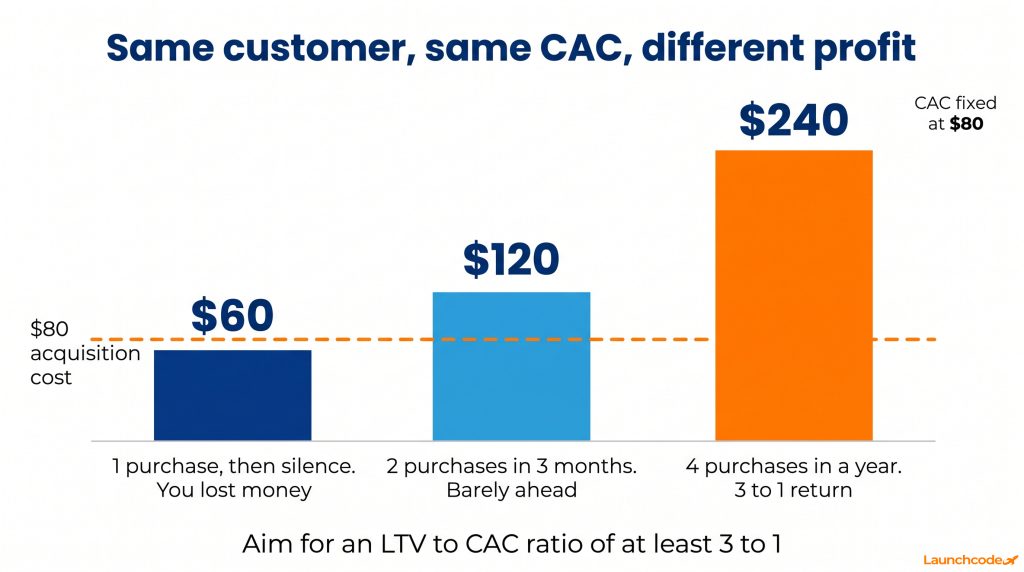
Picture a store with an 80 dollar CAC and a 60 dollar first order profit.
Same customer, same acquisition cost. The only variable is what happened after the first order. A 3 to 1 LTV to CAC ratio is the common floor for a healthy store. Below that, you are buying revenue, not building a business.
Smart acquisition spreads risk across paid, organic, and owned channels, then judges each one by the quality of customers it brings rather than the volume. Paid channels buy speed. Organic search and content build durable demand. Owned channels like email and SMS capture audiences you can reach again at almost no extra cost, which pulls your blended acquisition cost down over time.
Acquisition cost rose about 40 percent between 2023 and 2025 across e-commerce, driven by privacy changes, auction inflation from large marketplaces, and more brands bidding on the same keywords. A single channel strategy now carries real risk. If your store depends on paid social and CPMs spike during a peak season, your unit economics break overnight.
Balance three layers so no single cost increase sinks the store.
| Channel | Who it fits | Key strength | Watch out for |
|---|---|---|---|
| Paid social | Stores testing new products fast | Granular targeting, quick feedback | CPM spikes, weak first-party data |
| Paid search and Shopping | High intent product demand | Captures ready buyers | Rising CPCs, bidding wars |
| SEO and content | Stores building durable demand | Compounding, low cost over time | Slow to ramp, needs consistency |
| Email and SMS capture | Every store | Owned, repeatable, cheap to reach | Needs strong capture and consent |
A store moving 60 percent of budget into paid social often looks efficient on a good month, then watches CAC double during a competitive sales window. Shifting part of that budget into search visibility and email capture builds an owned audience. The next campaign reaches warm contacts at near-zero marginal cost, which lowers blended CAC. This is why pairing acquisition with strong search and AI visibility work protects margin instead of chasing it.
Conversion is the cheapest growth lever because you already paid to bring the visitor in. The average store converts near 2.5 percent, but Baymard Institute finds a typical large site can lift conversion by about 35 percent through better checkout design alone. Fixing friction recovers revenue you have already bought.
Most conversion loss happens at checkout. Baymard documents an average cart abandonment rate of 70.19 percent across 49 studies. That means seven in ten shoppers who add to cart leave without buying. Some of that is normal browsing, but a large share comes from solvable friction like surprise fees, forced account creation, and long forms.
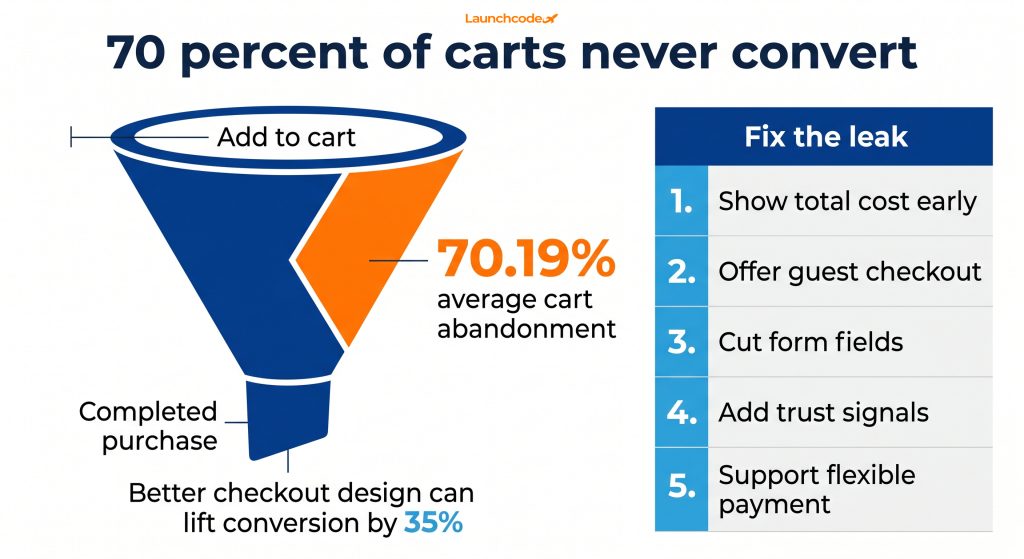
Work through these in order, since each removes a common reason shoppers quit.
Rashel Hariri, a CMO writing on why shoppers abandon carts, frames the problem well. She argues cart abandonment is rarely about weak intent and usually about unresolved hesitation. Your job at checkout is to answer the question still sitting in the shopper's mind.
Mobile drives most traffic and most lost carts. Mobile converts at roughly 1.8 to 2.8 percent against 3.2 to 3.9 percent on desktop, according to Dynamic Yield and Contentsquare data, and mobile cart abandonment runs above 80 percent. Treat mobile checkout as the priority surface, not an afterthought.
GA4 shows where sessions drop. Session replay and experience tools like Contentsquare show why. Most store platforms, including Shopify and BigCommerce, support one page or accelerated checkout that cuts steps. A focused conversion rate optimization program connects these tools so you fix the highest impact friction first.
Recovery flows turn near misses into revenue. Automated abandoned cart messages reach shoppers who already showed intent, and triggered emails generate about 320 percent more revenue than non-automated sends. A few well timed messages often recover a meaningful share of abandoned checkouts at almost no added cost.
Recovery is conversion you capture after the visit ends. Because the shopper already added to cart, intent is high and the cost to re-engage is low. The same logic applies to browse abandonment, where someone viewed a product but never added it.
A store with 1,000 abandoned carts a month and an 80 dollar average order has 80,000 dollars in stalled demand. Recovering even 10 percent through a three message flow returns 8,000 dollars a month from work that runs on autopilot once built. Compare that to buying the same revenue through paid ads at a rising CAC, and the priority becomes clear.
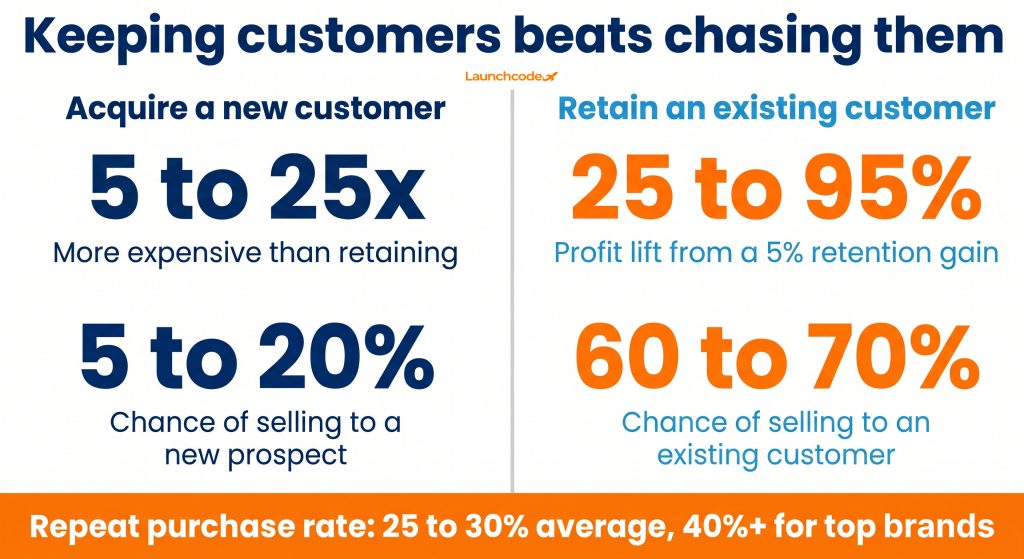
Retention is the highest leverage stage in the whole loop. Harvard Business Review, citing research by Fred Reichheld of Bain and Company, reports that a 5 percent lift in retention can raise profits by 25 to 95 percent, and that winning a new customer costs 5 to 25 times more than keeping one. Repeat buyers are also far more likely to purchase again.
The economics are hard to argue with. The probability of selling to an existing customer sits at 60 to 70 percent, against 5 to 20 percent for a new prospect. Yet most stores pour budget into acquisition and treat retention as an afterthought. That is the gap where profit hides.
Fred Reichheld of Bain and Company showed in his retention research that small reductions in churn produce large profit gains over time. Two stores can win customers at the same rate, but the one that loses fewer customers each year keeps growing while the other stays flat. Each retained customer keeps earning against an acquisition cost you paid only once.
The average DTC repeat purchase rate sits at 25 to 30 percent, and top brands clear 40 percent. The same research shows a 10 point lift in repeat rate can drive a 25 to 40 percent increase in average lifetime value. The reason is behavioral. Customers who make a second purchase are far more likely to make a third, and a third buyer is more likely still to make a fourth. Your retention work should focus on getting buyer number one to come back once.
Email marketing returns roughly 36 to 45 dollars per dollar spent, with e-commerce near the top of that range. SMS adds an immediate channel for time-sensitive offers and shipping updates. Together they form the backbone of retention, because they reach customers you already own at almost no marginal cost. A structured lifecycle email and SMS program usually drives the largest single share of repeat revenue.
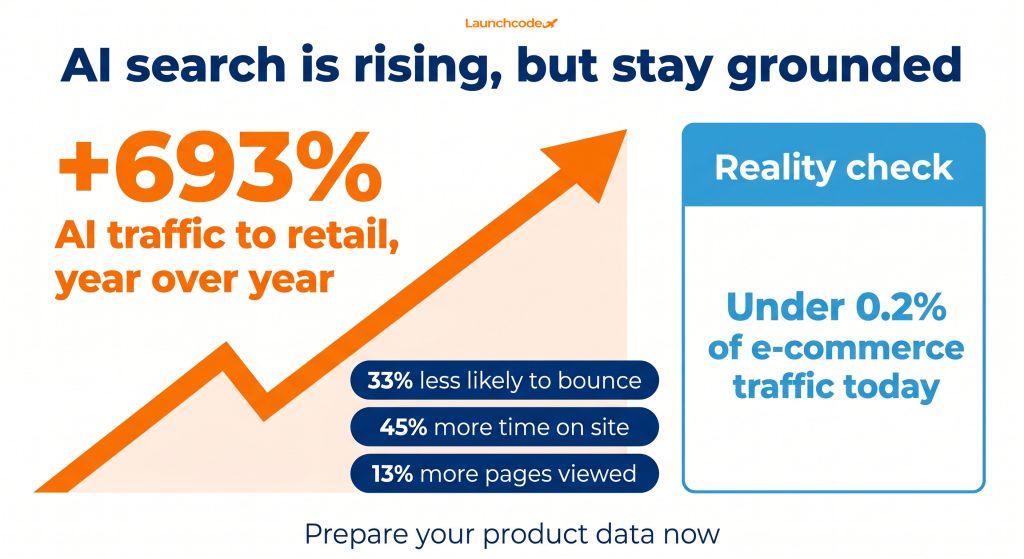
Shoppers increasingly start product research inside AI assistants, and the traffic shows high intent. Adobe Digital Insights found AI-driven traffic to retail sites grew 693 percent year over year during the 2025 holiday season. Visitors arriving from AI tools were 33 percent less likely to bounce, spent 45 percent more time on site, and viewed 13 percent more pages.
This is a new place shoppers find products, not a replacement for search or paid channels. When a shopper asks an assistant for a recommendation, the assistant pulls from content it can read and trust. Stores with clear, structured, accurate product information have a better chance of being named in that answer. Stores with thin or messy data get skipped.
"We audit a client's product feed before chasing AI traffic. When the prices and specs in the catalog match what an assistant reads, the referral converts. When they do not, the click is wasted." Tanner Medina, Co-Founder and Chief Growth Officer
The growth is real, but the channel is still early. One peer reviewed study by researchers Kaiser and Schulze found ChatGPT accounted for less than 0.2 percent of e-commerce traffic across 49 countries from August 2024 to July 2025. The lesson is not to chase volume yet. It is to prepare your store so you capture the share that exists and the larger share coming.
Vivek Pandya, lead analyst at Adobe Digital Insights, told Digital Commerce 360 that traffic from tools like ChatGPT, Gemini, and Perplexity is growing fast. The behavior data backs that up, even while the absolute share stays small.
AI referral conversion depends on accuracy more than volume. If an assistant describes your product with the wrong price or feature, the shopper arrives expecting something else and leaves. Clean, current product data is the best investment for this channel right now. This is the practical core of generative engine optimization, making your store readable and trustworthy to AI systems.
The three stages only produce profit when they connect. Acquisition feeds conversion, conversion feeds retention, and retention lowers the real cost of acquisition by raising lifetime value. Run them in isolation and you optimize the wrong number. Run them as one loop and every improvement compounds across the others.
Start with measurement. If you cannot see CAC, conversion rate, and repeat purchase rate side by side, you cannot tell which stage is leaking. Connect your store platform, ad accounts, GA4, and email or SMS data into one view so a change in any stage shows up across the others. This is where many stores stall, because the data sits in separate tools that never talk. Launchcodex builds this connected reporting so a client can trace one customer from first click to repeat order and see profit, not just sales.
"The clients who win connect Shopify, GA4, and Klaviyo into one view first. You cannot fix a stage you cannot measure, and most teams never see repeat purchase rate sitting next to CAC." Brittany Charles, SVP, Client Services
Pick the stage with the worst numbers and start there. A store with strong traffic but weak conversion should fix checkout before buying more ads. A store with decent conversion but no repeat buyers should build retention flows before scaling spend. The loop tells you where the next dollar earns the most.
One note on the data here. Benchmarks vary by category, region, and measurement method, so treat them as reference points and confirm against your own numbers. AI search figures in particular come from different methodologies and stay early.
Aim for at least 3 to 1, meaning each customer returns three dollars in lifetime profit for every dollar spent to acquire them. Below that, growth tends to burn cash. A ratio far above 5 to 1 can signal underinvestment in acquisition.
Fix the stage with the weakest numbers. If conversion is strong but few customers return, build retention flows before buying more traffic. Retention is usually the higher leverage lever, since keeping a customer costs far less than winning a new one.
A series of three usually outperforms a single message, with the first sent within about an hour. Lead with reminders and helpful information rather than an immediate discount, which can train shoppers to abandon on purpose.
Prepare now, but keep expectations grounded. AI referral traffic shows high intent and fast growth, yet still makes up a small share of total visits. Clean, accurate, structured product data is the best low-risk investment to capture the channel as it grows.
Track CAC, conversion rate, average order value, repeat purchase rate, and the LTV to CAC ratio. Viewed together, they show how the acquire, convert, retain loop is performing and where the next improvement will pay off most.




A data-backed e-commerce marketing guide to acquire, convert, and retain customers as one profit loop. Benchmarks, checkout ...
Build a SaaS marketing strategy as a connected growth engine. Learn the four stages, AI search visibility, the right GTM mot...
See how page speed, shorter forms, and trust signals lift conversion, with primary source data and a simple model to rank fi...