
Share:

AI marketing & automation


You pay for clicks that never convert. Traffic costs keep climbing, yet most visitors read a headline, scan a form, and leave. The problem is rarely the volume of traffic. It is the page that receives it.
This guide gives you an ordered system for converting more of the traffic you already have. You will learn what a strong conversion rate looks like in 2026, which fixes move the number most, how to handle the new wave of AI search visitors, and how to decide what to change first. Every recommendation here ties to data and to a real business outcome.
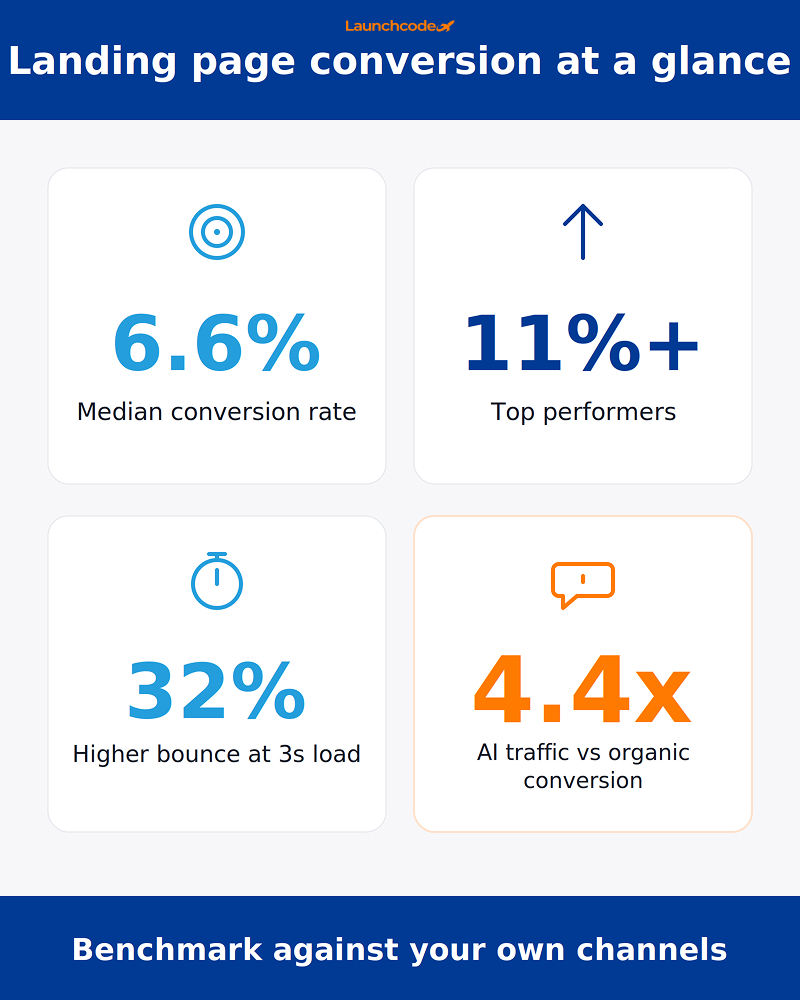
The median dedicated landing page converts at 6.6 percent, and top performers exceed 11 percent. There is no single good number. Traffic source affects the rate more than industry does, so a 4 percent page fed by cold social traffic can beat a 7 percent page fed by branded search. Benchmark against your own channels before chasing an external average.
A conversion rate without context misleads you. The 6.6 percent figure comes from Unbounce’s analysis of 41,000 landing pages and 464 million visits, as summarized in recent landing page conversion benchmarks. Other datasets land elsewhere. WordStream’s broad cross-industry sample puts the median near 2.35 percent, with the top 10 percent at 11.45 percent or higher, per a 2026 conversion rate breakdown. The spread is not an error. It reflects what each study counts as a conversion.
A page receiving email traffic can carry a longer form and a higher commitment ask because the audience already knows you. A page receiving paid social traffic needs low-friction entry and strong trust signals because intent is weak. Compare one page across its sources and you often find a single campaign converting at 7 percent and four others at 2 percent.
“Most clients walk in asking how they compare to the industry. The better question is how their email pages compare to their paid social pages, since that gap is usually 3x and it is theirs to fix.” Tanner Medina, Co-Founder and Chief Growth Officer
Message match is the highest leverage fix on most pages. If your ad promises a free 14-day trial and your page leads with a generic welcome, you break the connection and lose the click you already paid for. The page headline must echo the ad or email that sent the visitor. This single change often beats every design tweak combined.
Peep Laja, founder of the CRO training company CXL, frames it in one line. As he puts it in his work on advertising scent and conversions, the ad someone sees needs to smell like the landing page they reach. When the scent breaks, visitors feel they are in the wrong place and leave before reading a second line.
Sending several distinct campaigns to one general page is the most expensive mistake here. The page cannot match four promises at once. This is why more pages drive more leads. HubSpot found that companies with 40 or more landing pages generate 12 times the leads of those with five or fewer, and moving from 10 to 15 pages lifts leads by 55 percent, as shown in its data on creating more landing pages. One promise per page beats three.
Mobile drives most landing page traffic but converts at roughly 60 to 70 percent of the desktop rate. Speed widens that gap. A slow page loses visitors before they read the offer and raises your cost per lead through lower ad quality scores. For most advertisers, the mobile and speed gap is the single largest hidden leak, so fix it before rewriting copy.
The numbers are direct. One 2026 dataset puts mobile at 4.1 percent against desktop’s 6.3 percent, a 35 percent gap detailed in current conversion rate benchmarks by industry. Speed compounds the loss. The probability of a bounce rises 32 percent as load time moves from one second to three, a pattern reported in analysis of page speed and rankings.
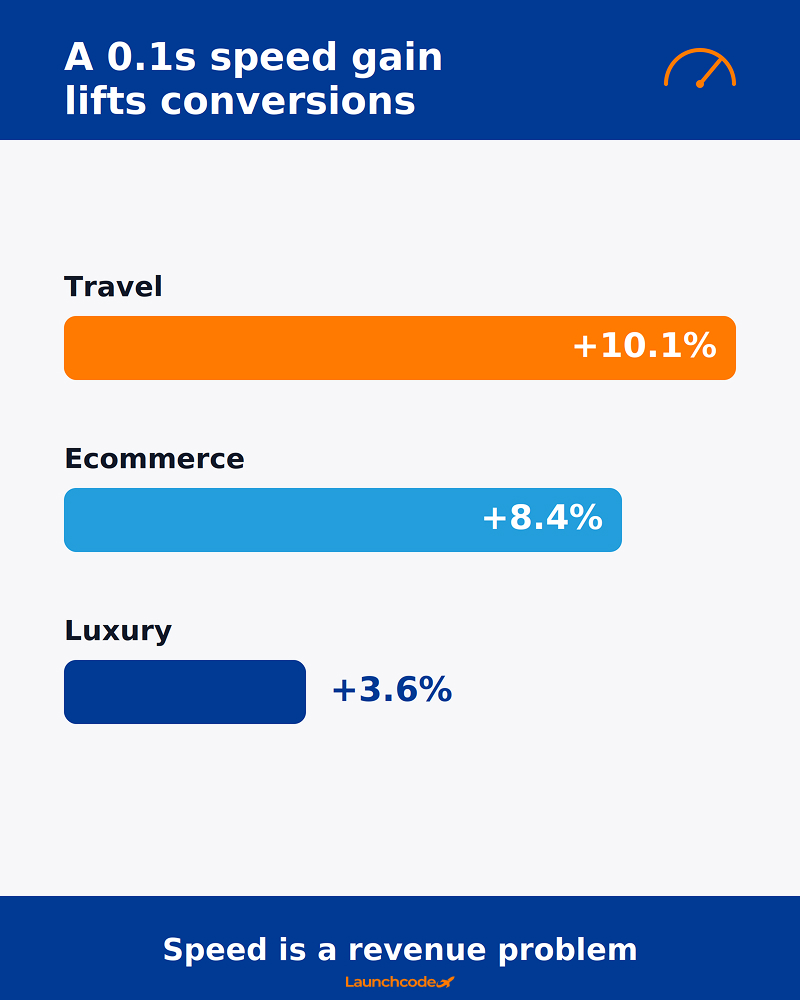
Research with Google found that a 0.1 second load improvement lifted ecommerce conversions by 8.4 percent and travel conversions by 10.1 percent, as covered in this review of load time and conversions. Named cases back it up. Google’s web.dev case studies report that Ray-Ban prerendered key pages and lifted mobile product conversion by 101.47 percent, while RedBus improved interactivity and saw a 7 percent rise in sales.
Aim for the thresholds Google publishes in its Core Web Vitals documentation: Largest Contentful Paint under 2.5 seconds, Interaction to Next Paint under 200 milliseconds, and Cumulative Layout Shift under 0.1.
| Fix | Effort | Typical impact |
|---|---|---|
| Image compression and WebP | Low | 20 to 40 percent faster load |
| CDN delivery | Low | 30 to 50 percent faster for global users |
| Remove unused scripts | Medium | Lower bounce, better ad quality score |
| Mobile first layout | Medium | Closes the largest conversion gap |
“We measure mobile LCP on a real mid-range Android, not a developer laptop. A page that hit 2 seconds in the lab was loading in 5 on the device most of the client’s traffic actually used.” Derick Do, Co-Founder and Chief Product Officer
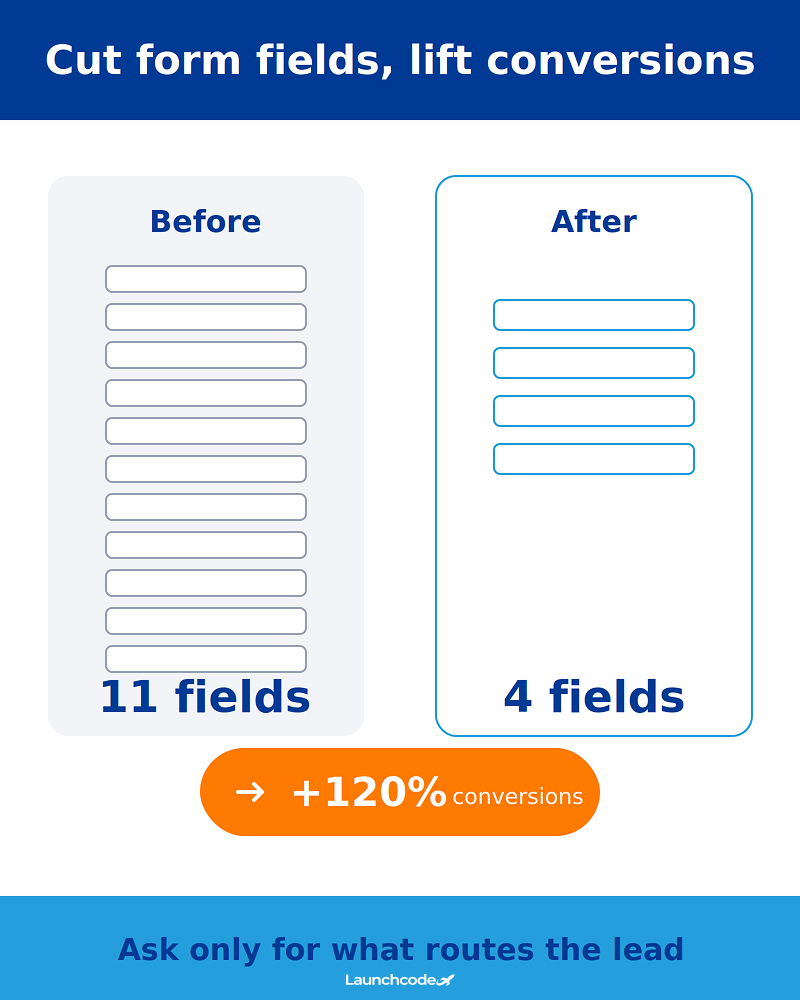
The form is the final step of almost every conversion, and it is the most fixable friction point. Every field you remove raises the completion rate. Ask only for what you need to route the lead, use a single column layout, and put easy fields first. Field reduction routinely produces some of the largest lifts of any change you can make.
Nielsen Norman Group, the most cited usability research firm in the field, states the rule plainly in its guidance on web form design: every time you cut a field, you increase the form’s conversion rate. The data is consistent. One documented case reduced a form from 11 fields to 4 and lifted conversion by 120 percent, reported in this study of user-centric forms. The same research flags three fields that consistently hurt results: age, phone number, and geographic location.
Single-column forms reach a 78 percent one-try submission rate against 42 percent for multi-column forms. Start with simple fields like name and email, then save sensitive fields for the end once the visitor feels committed. Group related fields with whitespace so the form reads short even when it is not.
Rashel Hariri, a marketing leader writing on checkout behavior, captures why this works. As she notes in a discussion of cart abandonment, abandonment is not about a lack of intent but about unresolved hesitation. A shorter, clearer form removes the hesitation before it forms.
Plain copy and specific calls to action outperform clever ones. Copy written at a fifth to seventh grade reading level converts far better than dense professional text. First-person button copy beats second-person, and personalized CTAs beat generic ones by a wide margin. Lead with the offer, name one action, and repeat that action down the page.
The reading level effect is large. Simple copy converts around 11.1 percent while complex text averages 5.3 percent, and advanced vocabulary correlates with a 24 percent drop, according to a 2026 set of landing page statistics. Short sentences and a single clear promise reduce the mental effort between arrival and action.
First-person copy such as Start My Free Trial outperforms Start Your Free Trial by 14 percent, and personalized CTAs convert 202 percent better than generic ones, per HubSpot data compiled in these conversion statistics. Test the words on your primary button before you test its color.
Every extra link is an exit. A focused page offers one primary action, repeated near the hero, mid-page, and at the close. Remove the navigation menu. Make benefits, not feature lists, the center of the copy, since a line like increased qualified leads by 47 percent in 60 days tells the visitor exactly what they get.
Visitors from AI search are a small but high-intent channel that rewards a sharper landing experience. They arrive after an AI engine compared options and recommended you, so they convert at multiples of organic traffic. Most pages waste that intent by dropping these visitors onto a generic form. Continue the conversation instead of starting it over.
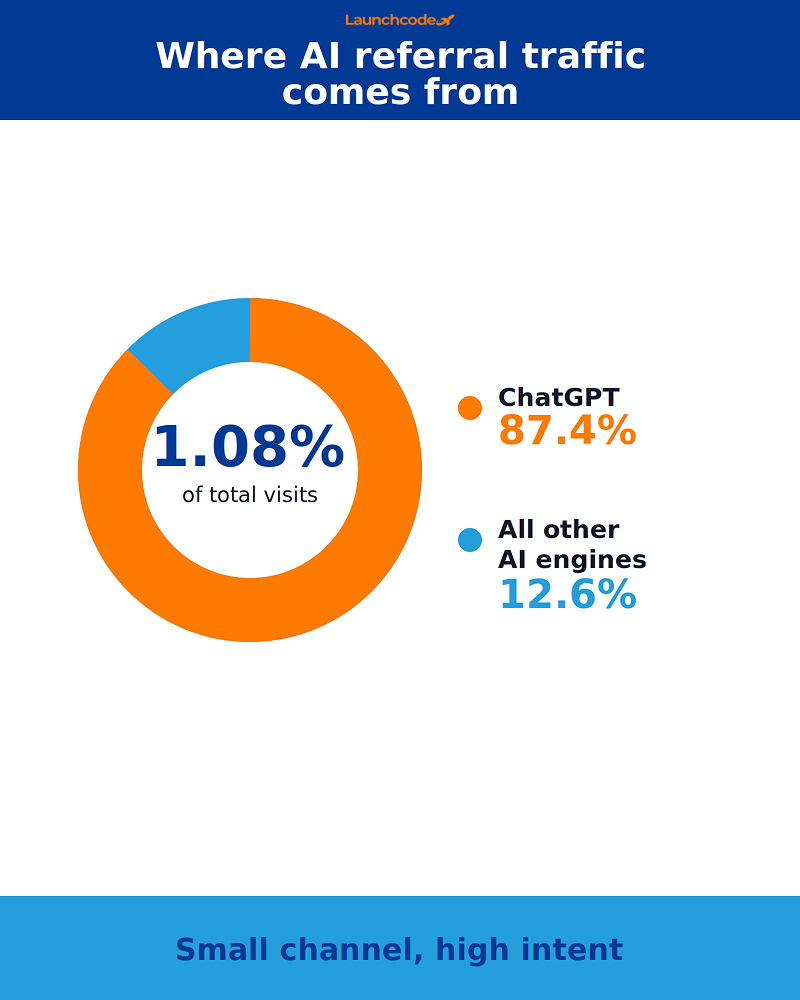
AI referral traffic is roughly 1.08 percent of total visits, with ChatGPT driving about 87.4 percent of it, and these visitors convert at around 4.4 times the rate of standard organic traffic while spending 68 percent more time on site, per the 2026 benchmark report on AI-referred traffic. For B2B the premium can be sharper. One client analysis found ChatGPT referrals converting at 15.9 percent and Perplexity at 10.5 percent against 1.76 percent for Google organic, as documented in this guide to tracking AI referral traffic in GA4.
These visitors already know the category and your name. Confirm you are the right fit in the headline rather than after a paragraph of context. Lead with the answer, keep the proof close, and offer a next step that matches their stage, such as a direct booking rather than a long contact form. This is the same generative engine optimization thinking Launchcodex builds into its SEO and GEO work, where the goal is to get cited in AI answers and then convert the traffic that follows.
The premium is real but uneven. Some 2025 research found ChatGPT referrals to ecommerce sites produced lower conversion and revenue per session than Google search, and one analysis recorded AI referral traffic falling 42.6 percent after July 2025, findings collected in this roundup of AI search statistics. Measure your own AI channel in GA4 with a custom channel group, then decide. The advantage is strongest in B2B and professional services, weaker in low consideration ecommerce.
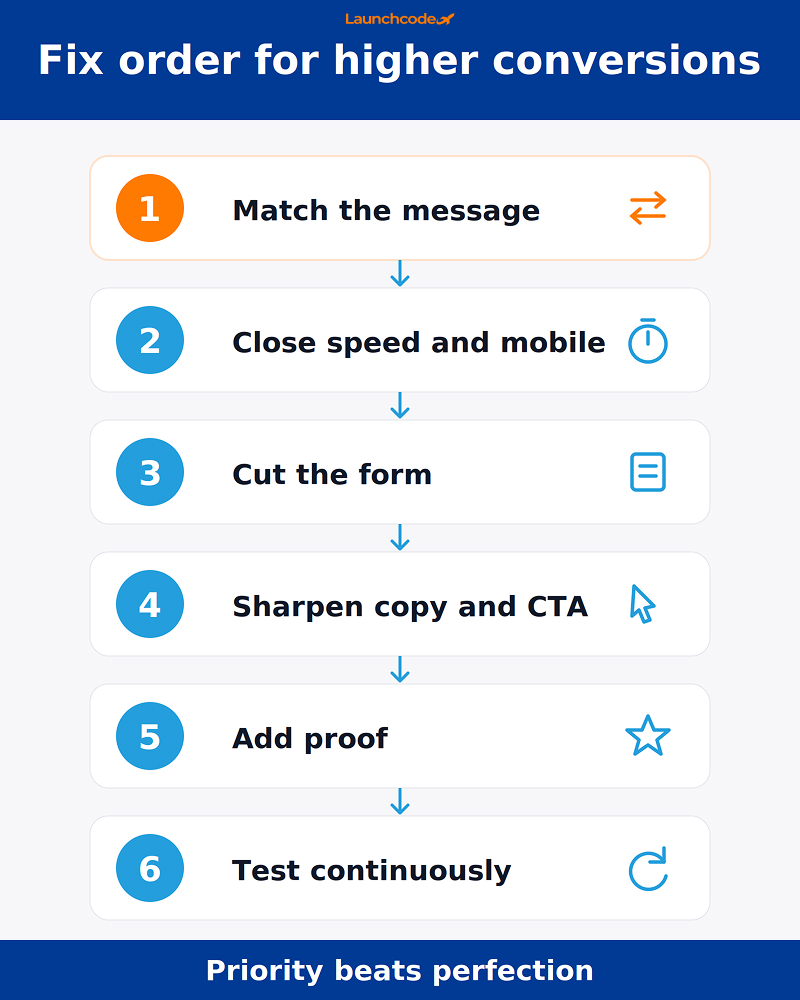
Priority beats perfection. Do not test at random or copy a generic checklist. Find where your own data shows the largest leak, fix the highest leverage element first, then work down a ranked order: message match, then speed and mobile, then form, then copy and proof, then continuous testing. Score every idea by impact, confidence, and ease so the backlog runs on evidence, not opinion.
Most guides list tactics without telling you what to do first. The order matters because message congruence between ad and page carries a higher conversion impact than any color or font change you will run. Start where the gap is widest for your situation. If pages load slowly, fix speed before headlines. If the funnel shows strong engagement but low form completion, fix the form before redesigning the hero.
Rank each hypothesis on three quick scales from one to five. Impact is how much the change could move conversions. Confidence is how sure you are based on data. Ease is how fast you can ship it. Average the scores and test the top item first. Launchcodex runs this same structured audit for clients, tying each recommendation to the metric it should move and reporting the result.
A high-performing landing page is never finished. The pages that convert at 9 percent instead of 3 percent got there through repeated cycles of measurement, hypothesis, and testing, not a single redesign. The difference is rarely budget or a fancier tech stack. It is the discipline to fix the right thing first.
Start this week. Pull conversion rate by traffic source, find your widest gap, and run the fix order from the top. Check your message match, then your speed and mobile experience, then your form. Measure each change against the metric it should move, keep what works, and bring the next idea through the same scoring. Small, ordered gains compound into a page that earns more from the traffic you already pay for.
The median dedicated landing page converts at about 6.6 percent, and the top 10 percent clear 11.45 percent. There is no universal good number. Benchmark against your own rate by traffic source and aim for roughly three times your median for that source.
Fix message match first, so the page echoes the ad or email that sent the visitor. Then close the speed and mobile gap, then cut form fields, then sharpen copy and the CTA. Let your own analytics decide which gap is widest.
Ask only for what you need to route the lead, often just an email and one qualifying question. Cutting fields raises completion. Use a single column layout, put easy fields first, and move higher commitment offers to a short multi-step form.
Yes. A 0.1 second improvement has been linked to an 8.4 percent rise in ecommerce conversions, and bounce probability climbs 32 percent as load moves from one to three seconds. Target LCP under 2.5 seconds, INP under 200 milliseconds, and CLS under 0.1.
These visitors arrive informed, so confirm you are the right fit in the headline and offer a next step that matches their stage. Track AI traffic separately in GA4, measure its conversion rate against other channels, then invest where the premium holds for your business.


Real stories from the people we’ve partnered with to modernize and grow their marketing.