
Share:

AI marketing & automation


One in six US adults asked an AI tool about mental health in the past year, according to a KFF poll on AI and health information. Most did not follow up with a provider. That gap is where your practice is either found or missed.
This guide shows you how AI tools pick practices and which popular advice to ignore. It also covers what your pages should say, the ethics and privacy rules that limit your choices, what to put in front of someone in crisis, and a 15-minute test you can repeat each month.
AI tools retrieve live web pages and local listings that match the question, then summarize the clearest sources. Google says its AI features run on its core Search ranking systems. OpenAI says ChatGPT search shows only sites that allow its OAI-SearchBot crawler. You need crawlable pages, consistent listings, and plain descriptions of who you help and where.
Patients ask full questions, such as “trauma therapist near me who takes my insurance.” The tool splits that into related searches, pulls pages, and writes one answer with a few names. You cannot control the answer. You can control what the tools find.
| Tool | Where it finds practices | What you control |
|---|---|---|
| Google AI Overviews and AI Mode | Google’s Search index and Business Profile data | Indexing, page content, Business Profile accuracy |
| ChatGPT search | Pages reached by OAI-SearchBot and other web sources | robots.txt, page content, listing accuracy |
| Perplexity | Live web search with cited sources | Public pages and honest third-party mentions |
OpenAI documents that sites opted out of OAI-SearchBot will not appear in ChatGPT search answers. GPTBot, the training crawler, is a separate setting. You can block training and still allow search.
“Check robots.txt before you touch any content. If OAI-SearchBot is blocked, every other fix is invisible to ChatGPT search.” Derick Do, Co-Founder and Chief Product Officer
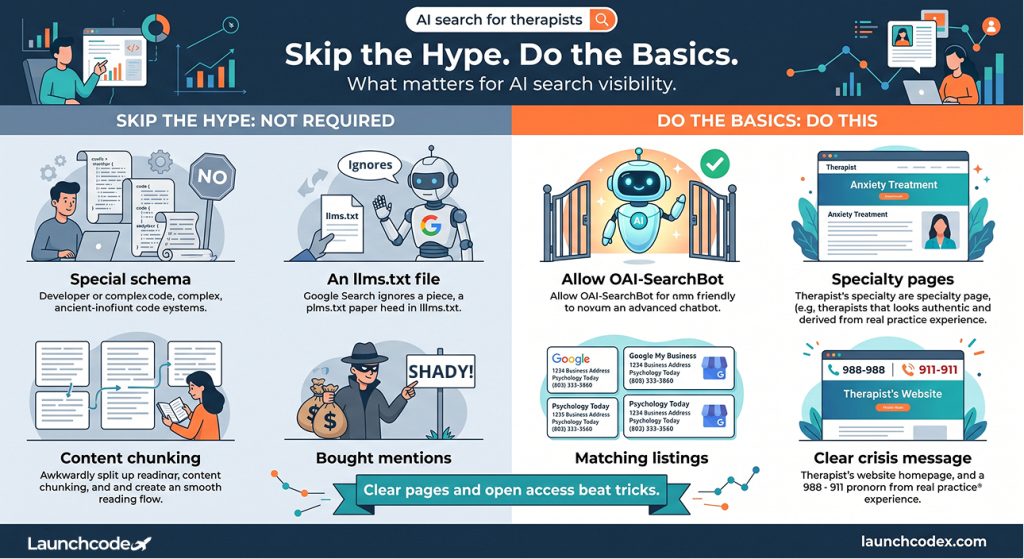
BrightLocal’s 2026 survey found 45% of consumers used AI for local business recommendations, up from 6% a year earlier. That is general local data, not therapy data. SOCi’s index, reported by BrightLocal, found fewer than half of businesses that lead Google local results also appear in AI local recommendations.
Clicks change too. Pew’s March 2025 browsing data showed users clicked a result in 8% of visits with an AI summary and 15% without one. Only 1% clicked a link inside the summary. Being named in the answer matters as much as ranking below it.
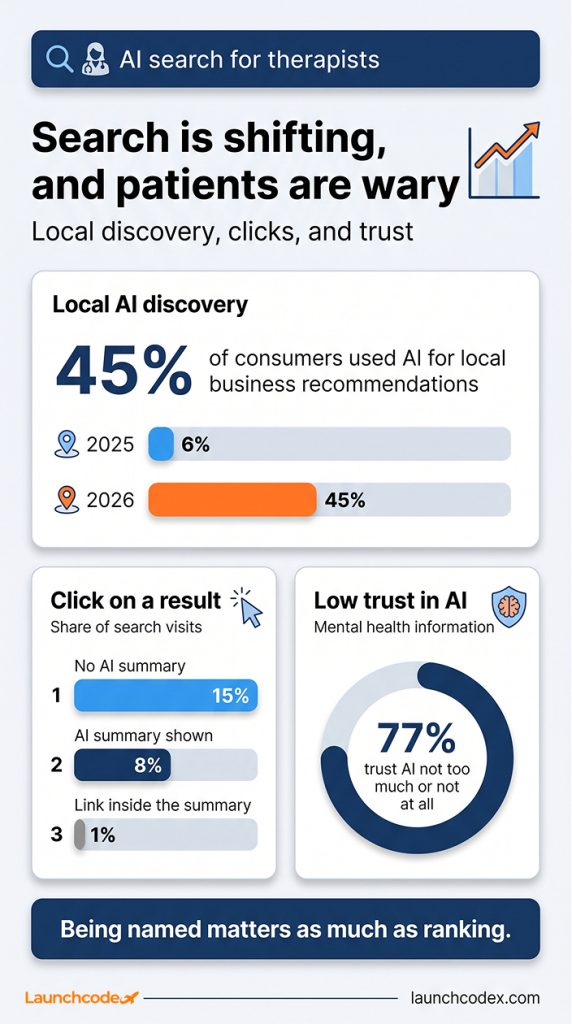
Ignore advice that says special markup, llms.txt files, content chunking, or bought mentions are required for AI visibility. Google’s July 2026 guide says generative AI search is still SEO and lists those tactics as unnecessary. Focus on crawlable pages, first-hand content, and accurate business details. Treat small vendor tests as hints, not proof.
Google’s guide also says structured data is not required for AI features. You can still use it for other search features. Priority is the point. A practice with thin pages gains nothing from a schema plugin.
“Schema takes an hour to add and an hour to skip. Spend that hour on a specialty page that describes what happens in a real first session.” Derick Do, Co-Founder and Chief Product Officer
| Common claim | What the evidence shows | Verdict |
|---|---|---|
| You need special schema to appear in AI answers | Google says no special markup is required | Not required |
| You need an llms.txt file | Google Search ignores these files | Skip for Google |
| Break pages into tiny chunks | Google says chunking is not required | Write for readers |
| Buy or seek mentions across the web | Google says inauthentic mentions are not helpful | Avoid |
| Allow OAI-SearchBot | OpenAI documents it as the ChatGPT search crawler | Do it |
| List on every directory | No independent data, and published tests conflict | Unproven |
Most therapist AI tests cover a few cities, one prompt type, and a few days. A narrative review in Nature found published estimates of AI use for mental health range from 3% to 70% of AI users. The authors estimate about 27%. Survey wording changes the result, so state ranges and limits when you cite these numbers.
State who you help, what you treat, how sessions work, your license and state, fees, insurance, and current availability in plain language on dedicated pages. Google’s guide says unique, first-hand content will likely influence generative AI visibility more than any other tip it lists. Generic pages with fifteen specialties give tools and patients little to match.
Google’s guide says, “Don’t just recycle what others on the internet have already said.” For a clinician, first-hand content means describing your actual approach, such as how you run the first session of exposure therapy for panic disorder.
Availability matters. In the 2025 Practitioner Pulse Survey of 1,742 psychologists, 46% had no openings for new patients and 87% could see new patients within three months. An accurate openings line saves time for you and the patient.
Yes, but treat them as verification sources, not as your only channel. Keep your Google Business Profile and any directory profile complete and identical to your website. Practitioners report shifting directory referrals, and Psychology Today says it has seen no system-wide decline. Judge each paid listing by your own referral data.
ClearHealthCosts reported one California therapist whose Psychology Today contacts fell from 357 in 2021 to 40 in 2025. The same article quoted a psychologist who saw “a much higher number of people who found me in ChatGPT.” Both accounts are anecdotal, and the directory disputes the trend.
| Listing | Who it fits | Key strength | Watch out for |
|---|---|---|---|
| Your own website | Every practice | You control content and claims | Needs regular updates |
| Google Business Profile | Practices with an office or service area | Feeds Google local details | Mismatched address or hours |
| Psychology Today | Private pay and insurance practices | Verified license directory | Referral volume varies, so track it |
| Insurance and referral platforms | Therapists who want panel referrals | Steady intake | The platform may control your profile and brand |
“Track every directory by booked consults, not contacts. Put a six-month review in a Google Sheet before you renew any paid listing.” Tanner Medina, Co-Founder and Chief Growth Officer
Advertising and testimonial rules apply to your website, your profiles, and any page AI tools repeat. APA Standard 5.01 bars false or deceptive public statements. APA Standard 5.05 bars soliciting testimonials from current therapy clients or others vulnerable to undue influence. HIPAA risk also applies to forms and tracking scripts on your site.
APA CEO Arthur C. Evans Jr., PhD, said in the 2025 Practitioner Pulse release that human oversight remains essential when AI is used in practice. Apply that to content. A clinician should review anything published under your name.
A Texas federal court vacated part of HHS’s 2022 tracking bulletin on June 20, 2024. The ruling covered visits to unauthenticated public pages, and other parts remain guidance, as Nixon Peabody explains. Forms and portals still carry risk.
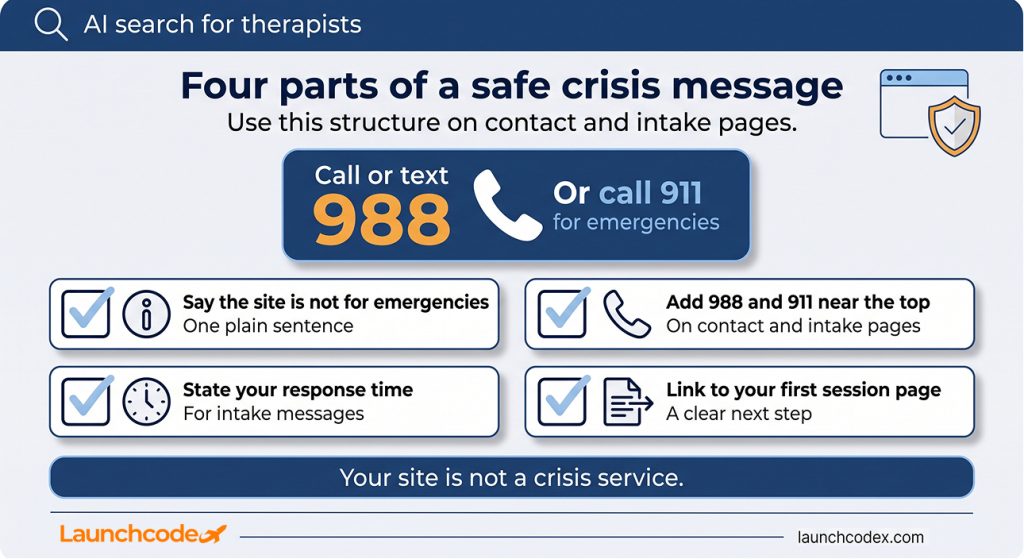
State plainly that your website is not a crisis service. Put the US 988 Suicide and Crisis Lifeline and 911 near the top of contact and intake pages, then give your response time. AI health answers can be wrong, and the American Psychological Association says chatbots are no substitute for a qualified professional.
The APA health advisory says to “do not use chatbots and wellness apps as a substitute” for qualified care. The accuracy risk is documented. In January 2026 Google removed some health AI Overviews after a Guardian investigation, and coverage noted concerns about other topics remained.
Pew found 22% of adults at least sometimes use chatbots for health information, per its April 2026 report. Only 18% of those users rate the answers highly accurate, Healthcare Dive reported. Among adults who asked AI about mental health, 58% did not follow up with a provider.
Have a clinician and your licensing board review the exact words. A safe structure has four parts:
Vaile Wright, PhD, of the APA told NPR that asking clients about chatbot use gives therapists a foundation for the therapist to better know how clients cope. Add it to your intake form as an optional question.
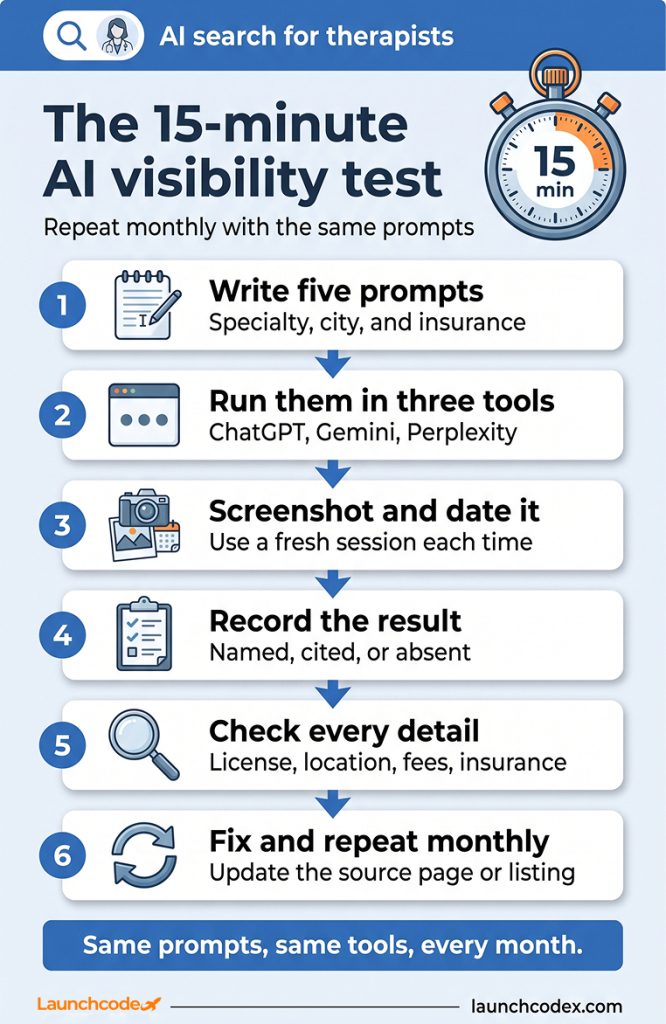
Run the same set of prompts monthly in ChatGPT, Gemini, and Perplexity, record what each tool says about your practice, and compare results over time. Add Search Console’s Generative AI performance report and a source question on your intake form. No public tool gives a true rank, so a dated, repeatable log is the most reliable method.
“Add a required ‘How did you find us?’ field to your intake form and tag the answers in GA4 or your CRM. Self-reported source catches AI referrals that analytics misses.” Tanner Medina, Co-Founder and Chief Growth Officer
Note the city, date, and tool for every test, because results vary by market. The Elon University and Washington Post poll from September 2026 found 27% of US adults turn to AI for personal, emotional, or social questions. That shows demand. It does not show your share.
Work in this order: access, accuracy, then safety. Week one, check robots.txt and listings. Week two, rewrite your core specialty pages. Week three, review ethics, privacy, and crisis language. Week four, run your first prompt test. Keep the log and repeat it monthly. Small, accurate changes beat a full redesign.
This article is general information. It is not legal, clinical, or ethics advice, so confirm details with your licensing board. If you want a technical review of your site, Launchcodex offers SEO and GEO services for professional practices.
Yes, when web search is on, ChatGPT can name practices in its answers. Results change by prompt, city, and date. Test your own prompts monthly and record what each tool says.
No. Google says no special markup is required for its AI features. Schema can still help other search features, but clear pages matter more.
Not from current clients. APA Standard 5.05 bars soliciting testimonials from current therapy clients, and ACA C.3.b also covers former clients. Check your own code and licensing board.
It depends on your data. Practitioners report mixed results, and the directory disputes a decline. Track contacts and intake answers for six months, then decide.
Yes. State that the site is not for emergencies and point to 988 and 911. Have a clinician review the wording.


Real stories from the people we’ve partnered with to modernize and grow their marketing.