
Share:

AI marketing & automation


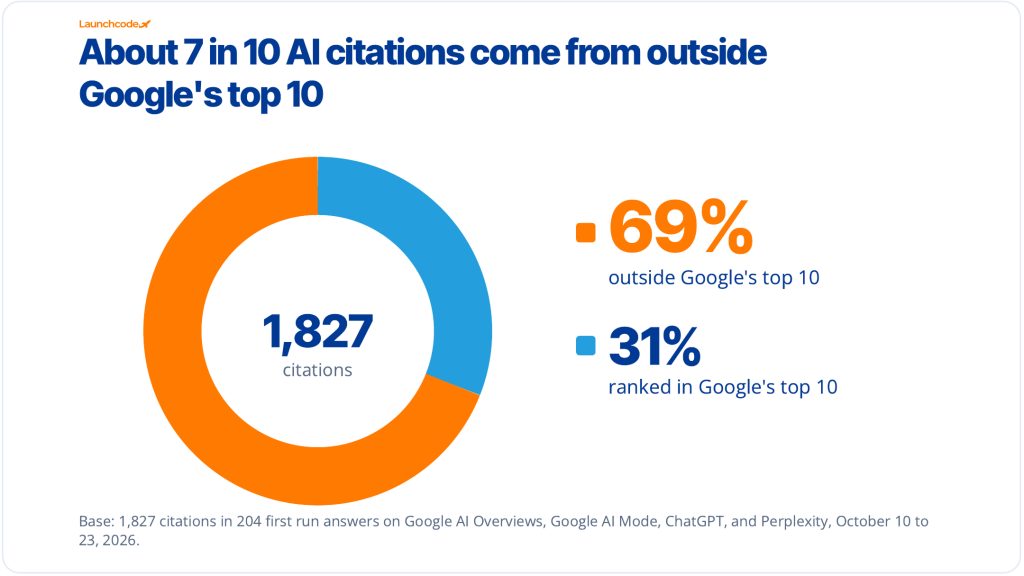
If you report rankings, you may assume a page that ranks well will also appear in AI answers. That assumption needs a test. In the Launchcodex AI visibility study, we checked every source cited by Google AI Overviews, Google AI Mode, ChatGPT and Perplexity against Google’s top 10 for the same query. Of 1,827 cited sources, 31% also ranked in the top 10. The other 69% came from outside page one.
The study ran 58 marketing and martech queries on those four platforms from October 10 to 23, 2026. The overlap check was valid for 204 first run answers. You can read the full findings for the details. Our view is that Google rankings still matter for AI answers, but they no longer predict most citations. A ranking report cannot tell you whether AI answers use your pages. This post gives the numbers by platform, explains why published studies disagree, states what our data does not show, and ends with the changes to make in your reporting.
Only 31% of cited sources also ranked in Google’s top 10 for the same query. The Launchcodex study checked 1,827 citations from four AI platforms against page one, and the other 69% came from outside it. Page one accounts for the smaller share of where AI answers find their sources.
We call the measure top 10 overlap. It is the share of cited sources that also rank in Google’s top 10 for the same query.
A ranking is a position on a list of ten links. A citation is a source named in an AI answer. Tanner Medina, Co-Founder & Chief Growth Officer at Launchcodex, explains why the difference matters:
“A ranking report tells you where you sit on a list of ten links. It does not tell you whether an AI answer used your page. Those are two different questions now, and a team needs an answer to both before it decides where to spend.”
Say a page ranks third for a marketing query. Your ranking report counts that as a win. The AI answer for the same query may name other sources and skip your page. The reverse also happens. A page outside the top 10 can still get cited, and 69% of the citations in our study came from outside page one.
Page one still matters, since 31% of cited sources ranked there. Do not read the 31% as a score for your own site. It pools four platforms and 58 queries.
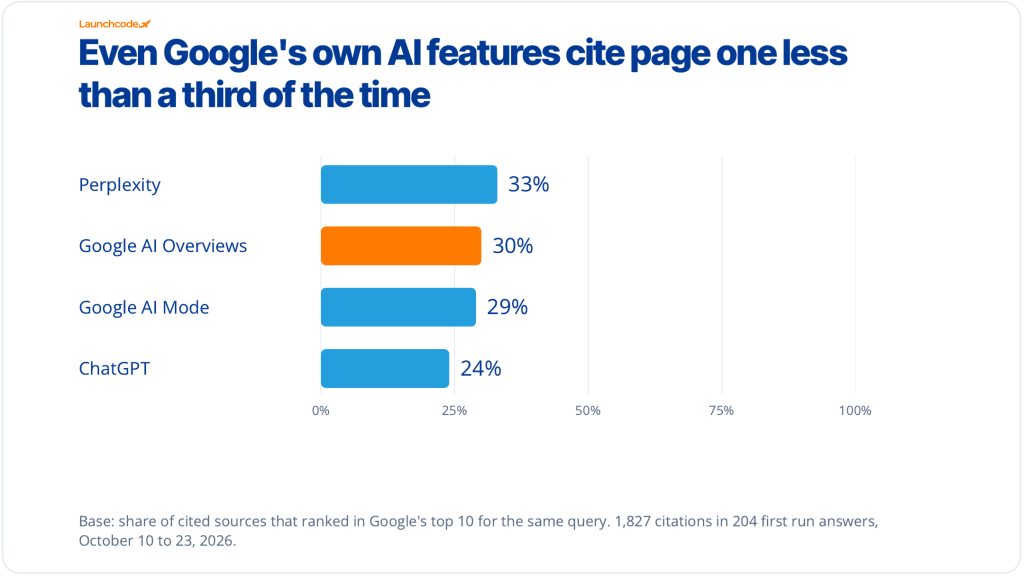
No. Only 30% of Google AI Overviews citations and 29% of Google AI Mode citations ranked in Google’s top 10. Both features come from Google, so you might expect more overlap. Both stayed under a third, and the two did not differ in a meaningful way from each other.
The AI Overviews base is 376 sources in 56 answers. The AI Mode base is 324 sources across 52 answers.
Tanner Medina adds:
“Google’s own AI Overviews pulled only 30% of their citations from page one. If your reporting stops at rankings, you are looking at the smaller share of where AI answers find their sources.”
Google’s Search Central guide, updated July 10, 2026, says its generative AI features rely “on our core Search ranking systems to retrieve relevant, up-to-date web pages” and use query fan-out to run related searches. It also says a page must be indexed and eligible to show with a snippet. It lists llms.txt files, content chunking and special markup as not required.
Google’s position on tactics is plain. In July 2025, John Mueller of Google relayed a comment from Gary Illyes of Google’s Search team, as reported by Search Engine Roundtable:
“Simply use normal SEO practices. You don’t need GEO, LLMO or anything else.”
Both statements fit our data. Google’s guidance tells you how to make a page eligible. It gives no figure for how much of an answer’s citation set comes from the top 10 for the original query. Normal SEO work still matters, because ranking systems supply pages to these features and 31% of all cited sources ranked on page one. A ranking alone cannot confirm AI visibility.
Yes, but no platform gets half of its citations from page one. In the Launchcodex study, the share ran from 24% for ChatGPT to 33% for Perplexity. Google AI Overviews cited page one 30% of the time and Google AI Mode 29%. A result on one platform does not carry over to another.
| Platform | Citations in Google’s top 10 | Base | How to read it |
|---|---|---|---|
| Perplexity | 33% | 51 first run answers | Highest share, and two thirds of its citations still came from outside page one |
| Google AI Overviews | 30% | 376 sources in 56 answers | Under a third, even for a Google feature |
| Google AI Mode | 29% | 324 sources across 52 answers | No meaningful difference from AI Overviews |
| ChatGPT | 24% | 45 first run answers | Lowest share in this study |
All four platforms were checked from October 10 to 23, 2026.
In an August 2025 study of 15,000 long-tail prompts, Ahrefs found that an average of 11.9% of AI citations appeared in Google’s top 10 for the same prompt. Perplexity was highest at 28.6%. ChatGPT in-text citations were 8.0%. Ahrefs measured overlap against the original prompt and not against fan-out queries.
The order matches ours. The levels do not. The query sets and collection dates differ, so compare the order and not the numbers. How each platform chooses its sources is a separate question, and our guide to AI platform source selection covers it.
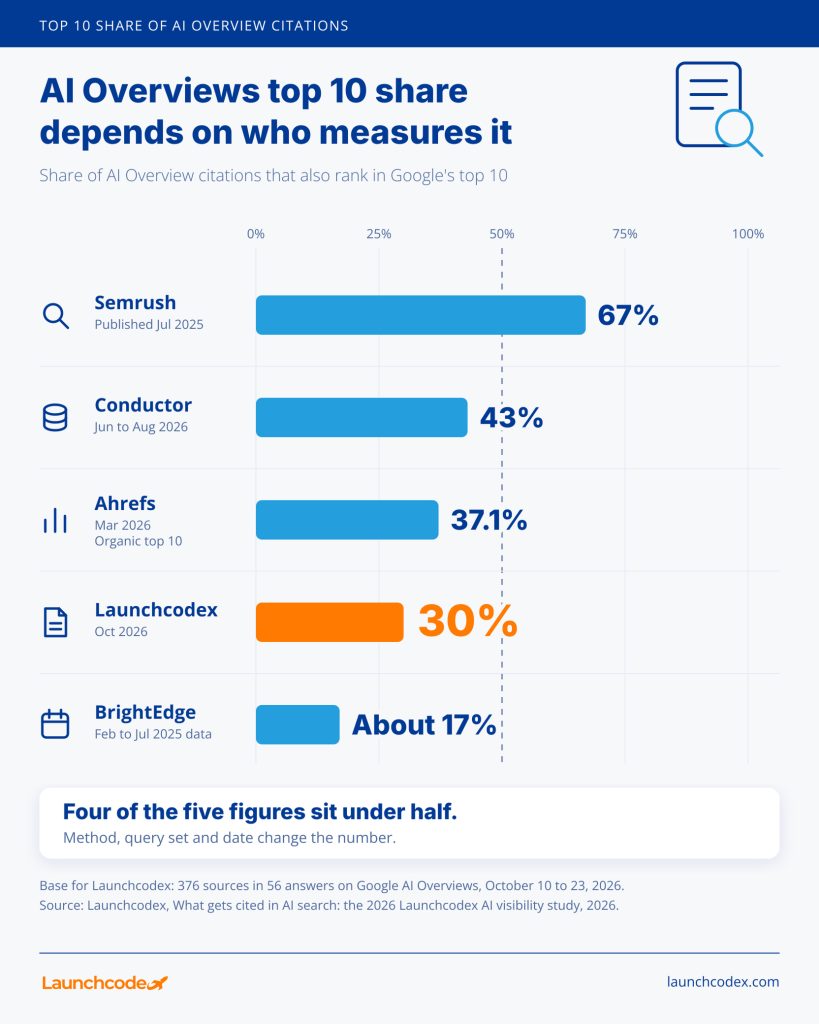
Method, query set and date change the number. For Google AI Overviews, the top 10 share runs from about 17% at BrightEdge to 30% in the Launchcodex study, 37.1% at Ahrefs and 43% at Conductor. Semrush reported 67% in July 2025. Four of the five figures sit under half, so read the range and check the date before you quote one.
| Source | Top 10 share for AI Overviews | Base | Period |
|---|---|---|---|
| BrightEdge | About 17% | Number of queries not stated | Monthly table runs February to July 2025, page published February 12, 2026 |
| Launchcodex | 30% | 376 sources in 56 answers | October 10 to 23, 2026 |
| Ahrefs | 37.1% in the organic top 10 | 863,000 keyword SERPs and 4 million AI Overview URLs | Published March 2, 2026 |
| Conductor | 43% | 167,867,680 citations | June 15 to August 15, 2026 |
| Semrush | 67% | 5,000 keywords and more than 150,000 citations | Published July 21, 2025 |
Conductor analyzed 167,867,680 AI Overview citations from U.S. Google searches. It found that 57% came from outside the organic top 10, so the top 10 made up 43%. Its authors note that the result shows correlation, not causation. We read our own result the same way.
A 2025 number may no longer describe what AI Overviews do.
Semrush reported 82% for Perplexity and 67% for AI Overviews. Our figures are 33% and 30%. Two facts matter here. The Semrush study came out in July 2025, and Ahrefs shows AI Overview overlap falling by about half in under a year. The Semrush page also does not make clear how it computed each rate. We cannot say which factor explains the gap, and we do not claim to.
Because they often search for more than the original query. Google says its AI features use query fan-out, which runs related searches before the answer is written. Ahrefs reads lower overlap as a sign of that. Launchcodex did not measure fan-out, so treat it as a plausible reason and not a proven cause of the 69%.
Query fan-out means an AI system splits one question into several related searches. Each search can return a different set of pages. The answer then cites sources from across those results. Say you track the query “marketing attribution software.” The AI system may also search for how attribution models differ, or for which tools connect to an ad platform. Your page could rank first for one of those searches and sit on page three for your tracked query. Your ranking report would show only the page three result.
Louise Linehan, Content Marketer at Ahrefs, wrote that “fan out queries are playing a bigger role in source selection”. That is her reading of the data, not a measured result.
Mahe Chen and Nick Koudas submitted an arXiv study on October 10, 2026. It covered 158,099 answers and 468,037 citations from two 90-day collections. Which pages the engine’s own search retrieved explained about 32% of the variation in citations. Page properties explained 2.8%.
The study does not measure Google rank, so we do not use it to explain our 69%. It does point to retrieval, the step where a system fetches candidate pages, as a bigger factor than a page’s own traits.
If rank is not the reason a page is cited, the next question is what cited pages have in common. Our post on answer first content looks at that.
Some still point to ranking. In the Launchcodex survey, 22% of marketers named Google ranking as the page trait that matters most for AI citations. In the answer study, 31% of citations came from Google’s top 10. The survey reports belief and the answer study reports citations.
The 22% rests on 152 marketers who answered the question. The survey ran from October 15 to November 5, 2026. The margin of error is plus or minus 8 points at 95% confidence for the full sample. Another trait, answer first content, drew 26%. With that margin, the two figures do not differ in a meaningful way, so neither trait led.
Ask your own team which page trait it thinks matters most for AI citations. Then compare the answer with your citation data. Our post on AI search effort versus evidence covers the wider gap between what marketers believe and what the data supports.
It shows how cited sources compare with Google’s top 10 for 58 marketing and martech queries. It does not show why a source was cited, how AI search behaves on other query types, or what fan-out searches returned. Read the 31% as a description of this query set in October 2026, not as a rule for all of AI search.
If your queries are local or transactional, run this check before you rely on our numbers. Our data has none of those queries.
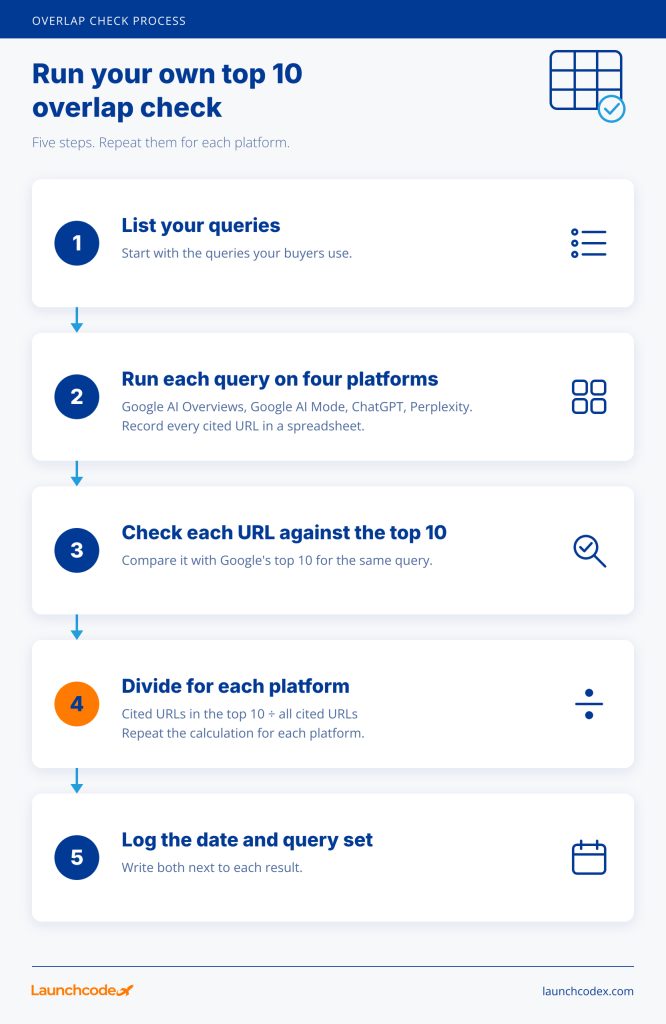
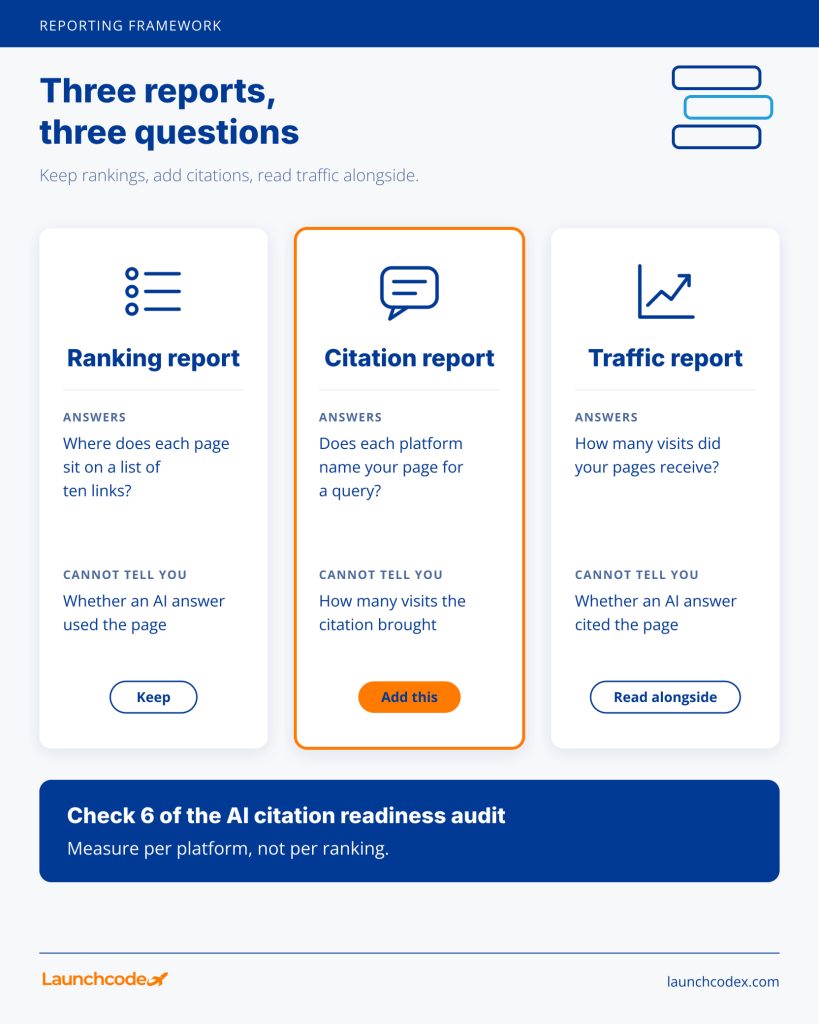
Keep your ranking report and add a citation report for each platform. Google’s AI features still rely on ranking systems, so your ranking report stays useful. It cannot tell you whether AI answers used your pages. This is check 6 of our AI citation readiness audit: measure per platform, not per ranking.
A report that stops at rankings leaves out the larger share of citations. Two changes fix that.
Derick Do, Co-Founder & Chief Product Officer, adds:
“A citation report only works if the query list stays fixed. Change the queries and you can no longer tell whether your pages moved or your list did.”
Google covers part of this. In its June 2026 announcement, Google said AI Overviews has more than 2.5 billion monthly active users and AI Mode has passed one billion monthly users. It also said Search Console now reports how pages appear in generative AI features, including impressions and which pages appear in AI responses, by country. That report covers Google’s features only. ChatGPT and Perplexity still need a separate check, and our guide to tracking AI citations explains how to run it.
| Report | Question it answers | What it cannot tell you |
|---|---|---|
| Ranking report | Where does each page sit on a list of ten links? | Whether an AI answer used the page |
| Citation report | Does each platform name your page for a query? | How many visits the citation brought |
| Traffic report | How many visits did your pages receive? | Whether an AI answer cited the page |
A citation is not a click. Pew Research Center tracked 900 U.S. adults in March 2025. When an AI summary appeared, users clicked a traditional result link in 8% of visits. When none appeared, they clicked in 15%. Keep your traffic report in GA4 next to the citation report and read the two together.
Google rankings still matter for AI answers, but they no longer predict most citations. In our study, 31% of 1,827 cited sources ranked in Google’s top 10, and no platform reached half. Keep your ranking report. Add a citation report for each platform, and label every number with its base and date.
Your next step is the full audit on your own pages. Our AI citation readiness audit checklist walks through each check, and our guide to how AI platforms pick sources explains why the platforms differ.
Download the full Launchcodex AI visibility study for the audit, the method and every base and date behind these numbers. If you want help adding citation checks to your SEO and GEO reporting, Launchcodex puts AI inside every engagement and can set it up with your team.
Only in part. In our study, 31% of 1,827 cited sources also ranked in Google’s top 10 for the same query, so rankings do not predict most citations. The study covers 58 marketing and martech queries, so test your own queries too.
No. A ranking is a position on a list of ten links. A citation is a source named in an AI answer. Our study counted how many cited sources ranked in the top 10. It did not count how many top 10 pages got cited, so it gives no citation rate for ranked pages.
In our study, Perplexity did, at 33%. ChatGPT followed it least, at 24%. Ahrefs found the same order in its August 2025 study. Even Perplexity got two thirds of its citations from outside page one.
Yes, as a base. Google says its AI features rely on core Search ranking systems, and 31% of cited sources in our study ranked in the top 10. Google’s stated position is that normal SEO practices apply. Rankings alone do not show AI visibility, so add a citation report.
Run your priority queries on each platform and record the sources each answer cites. Search Console reports how pages appear in Google’s generative AI features. ChatGPT and Perplexity need a separate check, and our guide to tracking AI citations covers the process.


Real stories from the people we’ve partnered with to modernize and grow their marketing.