
Share:

AI marketing & automation


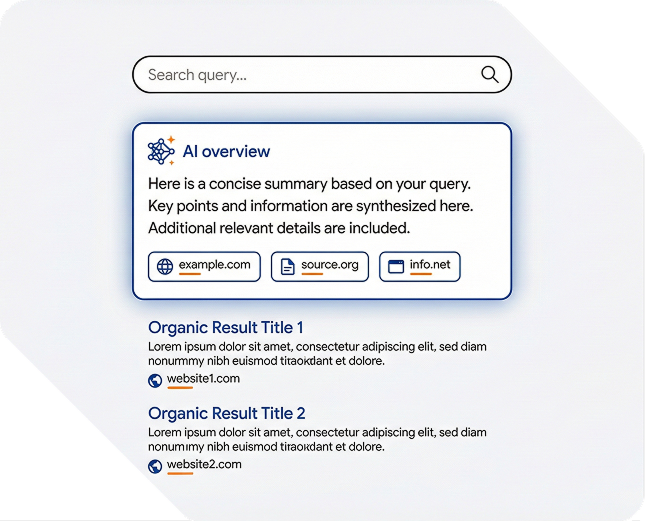
AI Overviews can change the value of a top ranking overnight. You can rank well, then watch clicks drop because the searcher gets their answer without visiting your site.
This guide gives you a practical playbook to earn more citations in AI Overviews and strengthen GEO at the same time. You will learn how Google selects sources, what technical gates matter, how to write pages that get cited, and how to measure performance in GA4 and Search Console without misleading stakeholders.
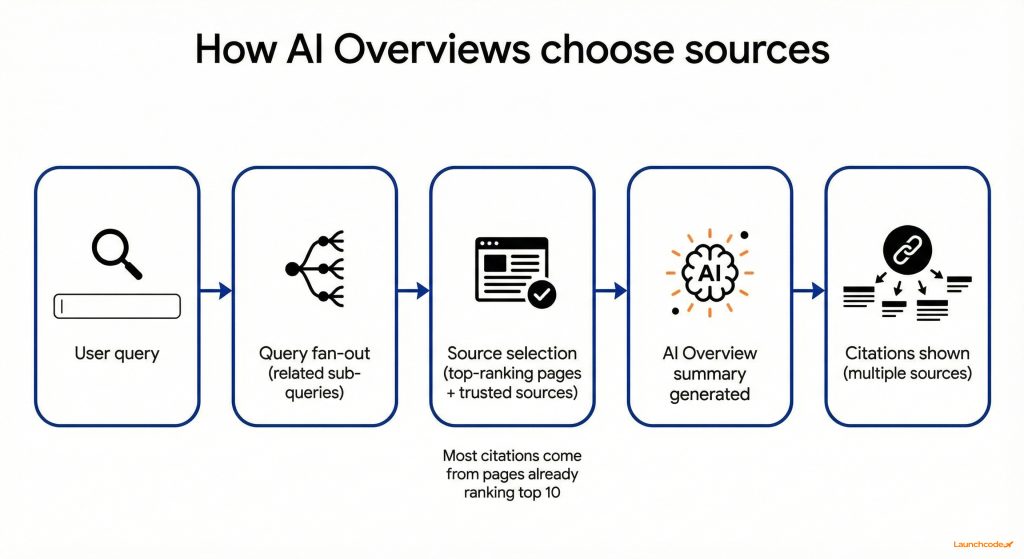
AI Overviews usually cite pages that already rank well, then assemble an answer by running multiple related sub-queries and choosing sources that address those subtopics clearly. Google states that SEO best practices still apply, and there are no special requirements to appear in AI Overviews beyond being indexed and eligible to show a snippet.
AI Overviews and AI Mode may use “query fan-out,” which means Google issues multiple related searches across subtopics and data sources. Your page does not need to match one keyword. It needs to cover the question set behind the query.
“AI Overviews rewards the page that answers the full question set, not the page that repeats the keyword the most.”
Tanner Medina, Co-Founder & Chief Growth Officer
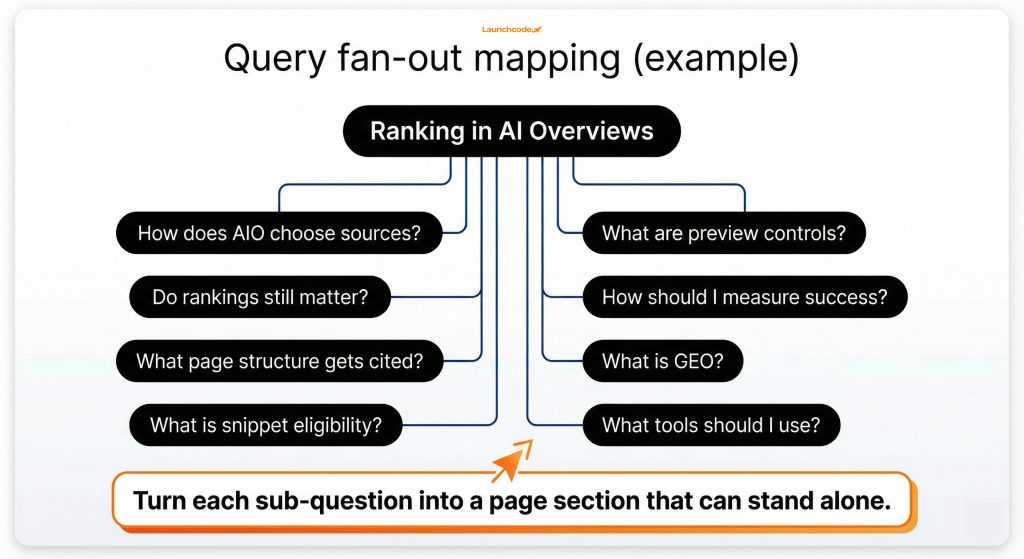
If fan-out drives sourcing, your page needs coverage across:
Practical mapping workflow:
Use answer chunks that are easy to quote:
This reduces extraction friction for both readers and AI systems.
If Google cannot index your page, render its main content, and show it as a snippet in search, you are unlikely to be eligible for AI Overviews citations. Google’s AI features guidance says the page must be indexed and eligible to appear with a snippet, and there are no extra technical requirements beyond that baseline.
Most AIO visibility issues come from standard SEO problems, not “AI problems.” Start with crawlability, indexation, canonicalization, and page experience. Then improve the structure of content so it is easy to extract and cite.
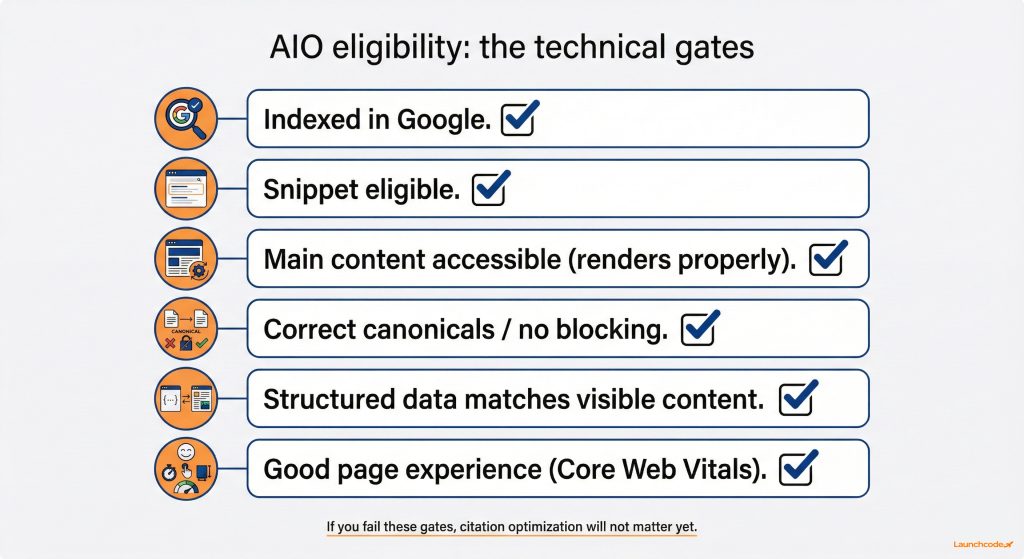
Use this checklist across top landing pages and top blog posts:
Tooling module:
If you have content you do not want reused in AI formats, Google points to controls like nosnippet, data-nosnippet, max-snippet, and noindex. Use these carefully, because they can reduce visibility if applied too broadly. https://developers.google.com/search/blog/2025/05/succeeding-in-ai-search
Practical rule:
To earn more citations, build pages that answer sub-questions in clean, self-contained chunks with clear definitions, steps, and evidence. Pew Research found AI summaries typically cite multiple sources, so your job is to become the best source for at least one key subtopic across your target query set.
Pew’s browsing data also shows click behavior changes when AI summaries appear. Users are less likely to click traditional results, which means you should treat citations as a core visibility KPI, then focus your site on converting the traffic you do earn.
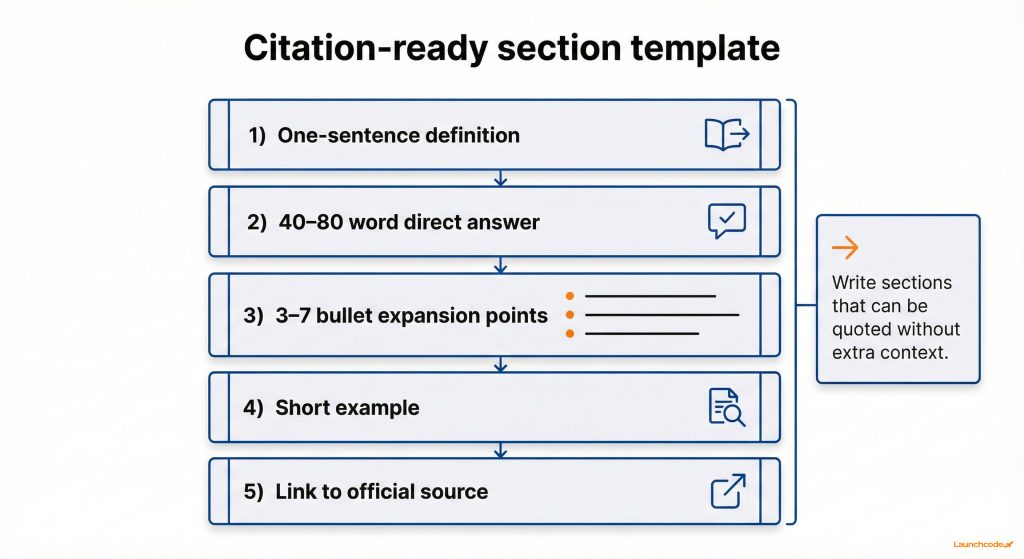
Use this format inside key pages and guides:
Example module:
If the query is “How do I rank in AI Overviews,” include a section like:
Fan-out rewards depth and coverage. A single guide helps, but clusters often outperform when:
Internal linking guidance:
AI Overviews tends to cite sources that look credible, consistent, and easy to verify, especially for sensitive or high-stakes topics. You can improve this by adding clear authorship, citing primary sources, aligning structured data with visible content, and tightening entity signals across your site and trusted profiles.
Entity clarity is the GEO layer. It helps systems understand who you are, what you offer, and why your information is reliable. When your brand, services, authors, and proof are consistent, citations become easier to earn and harder to lose.
Add trust signals that reduce ambiguity:
Practical note: If you sell complex services, add “Who this is for” and “When this will not work” sections. This improves trust and reduces low-quality leads.
Google highlights that structured data should match visible content. Misalignment creates trust issues and can suppress rich results.
High-value schema types to consider:
If you need schema to stay consistent across templates, treat it like a development deliverable, not a plugin toggle. Launchcodex typically addresses this through web development and ongoing maintenance so schema, internal links, and templates stay stable.
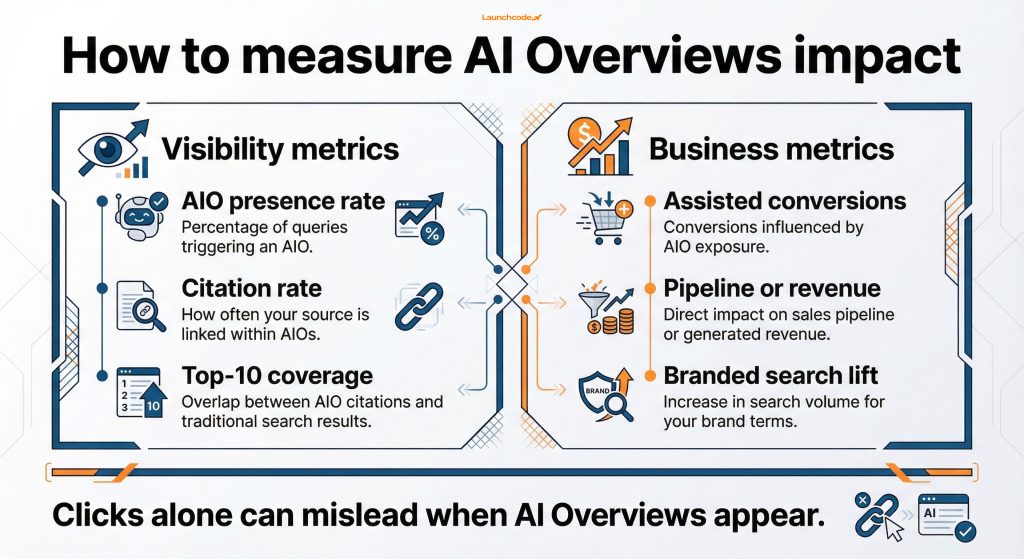
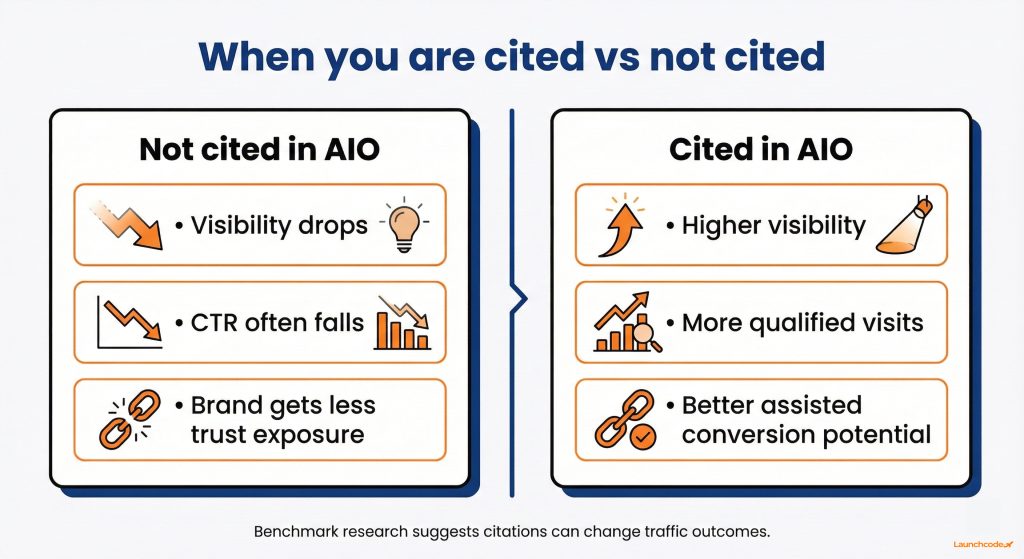
AI Overviews can reduce traditional organic clicks, so you need a measurement model that separates “AIO present” from “you are cited,” then ties citations to conversions. Pew found users click traditional results less often when AI summaries appear, and Seer reports meaningful differences when a brand is cited versus not cited.
“Your reporting has to reflect the buyer journey. If clicks fall but qualified leads rise, the program is working.”
Brittany Charles, SVP, Client Services
| KPI | What it measures | How to track | Why it matters |
|---|---|---|---|
| AIO presence rate | How often target queries trigger AI Overviews | SERP sampling tools plus manual checks | Shows how exposed you are to AIO click shifts |
| Citation rate | How often your domain is cited in AIO for target queries | SERP sampling, rank trackers with AIO features | Better indicator than rank alone |
| Assisted conversions | Revenue or leads influenced after AIO visibility | GA4 paths, CRM attribution notes | Captures value when clicks fall |
| Branded search lift | Demand growth tied to visibility and trust | Search Console branded queries | Strong proxy for brand impact |
| Top-10 coverage | Share of target queries in top 10 | Search Console plus rank tracking | AIO sourcing overlaps top-10 results |
Tooling module:
Most GEO work carries across platforms because it strengthens entity clarity, consistency, and verifiable proof across the open web. Focus on clean brand facts, consistent profiles, strong on-site definitions, and high-quality citations from trusted sources. Then tailor your measurement to Google-specific AIO behavior.
GEO is bigger than one feature. It is the practice of making your brand easy to understand and easy to cite across AI systems.
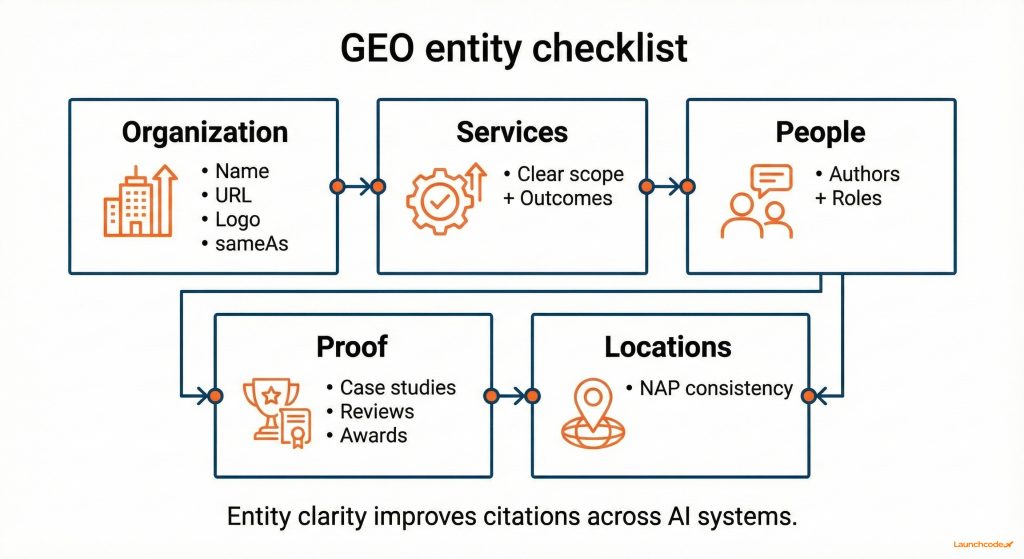
Audit and align these entities:
For multi-location brands, keep location pages consistent and specific. Use one standard layout and a shared proof section, then customize details like service area, local FAQs, and location-specific reviews.
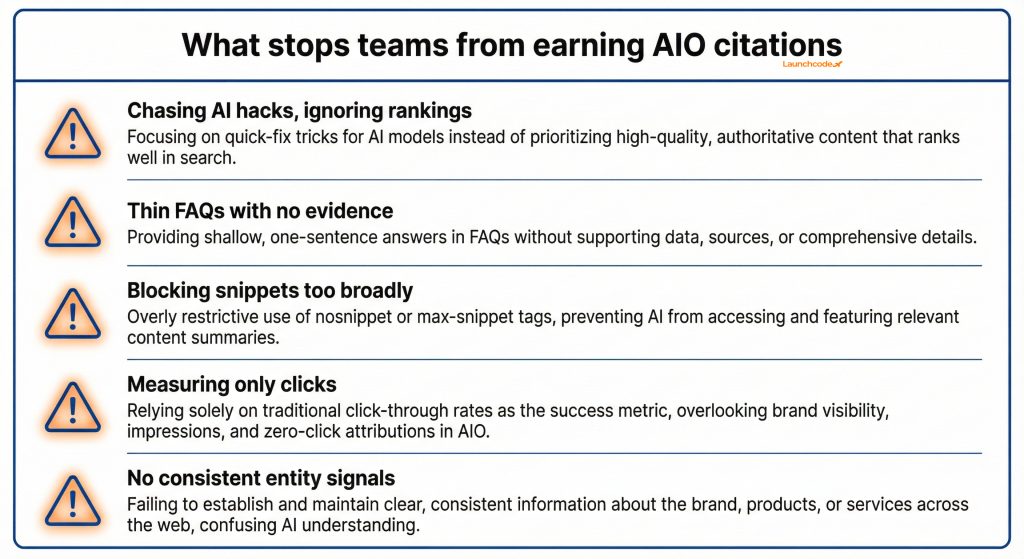
Common mistakes:
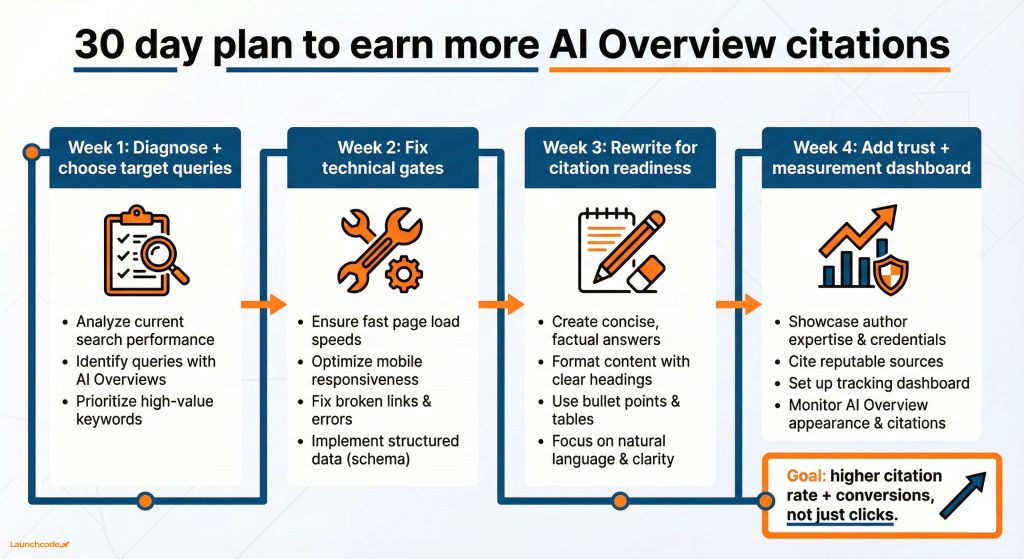
A focused 30 day plan can increase citation odds by fixing technical gates, rewriting key sections for extraction, strengthening trust signals, and setting up a citation tracking loop. Start with high value pages tied to revenue. Prioritize actions that improve both classic rankings and AIO citations, since research suggests AIO sourcing overlaps strongly with top-10 results.
Do not rebuild everything at once. Pick 10 to 20 revenue-linked queries and run a repeatable loop.
Week 1, diagnose and choose targets:
Week 2, fix technical gates:
Week 3, rewrite for citation readiness:
Week 4, add trust and measurement:
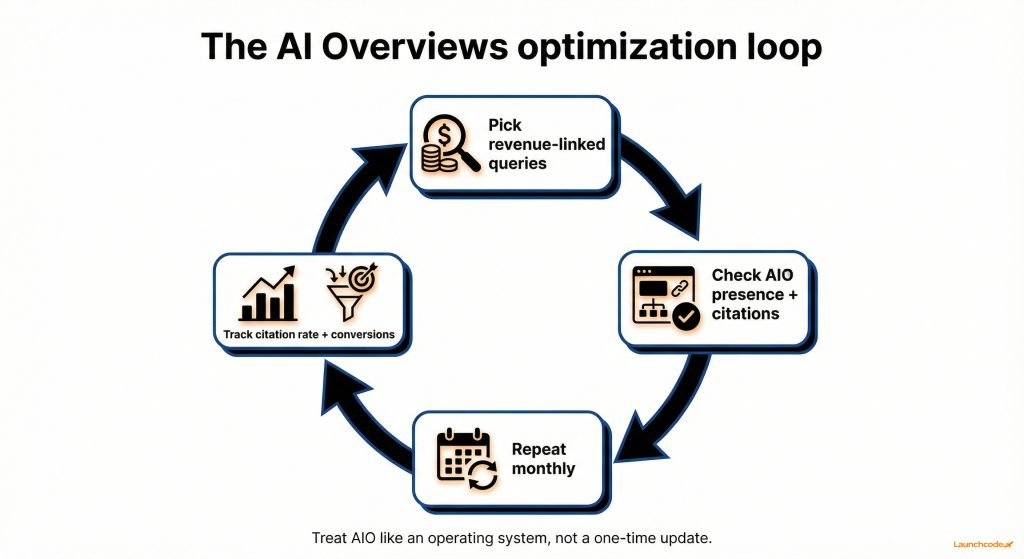
A good outcome after 30 days looks like:
Google says SEO best practices still apply and there are no extra requirements to appear in AI Overviews or AI Mode. Focus on indexing, snippet eligibility, and page quality.
Pew found users clicked traditional results less often when an AI summary appeared. If AI Overviews show for your queries, CTR can fall even when rankings hold.
It can, but it is not guaranteed. Seer reports meaningful differences when brands are cited versus not cited, so you should track citation rate and conversions.
Google references preview controls like nosnippet, data-nosnippet, max-snippet, and noindex. Use them narrowly because broad blocking can reduce visibility.
Add a short definition and a 40 to 80 word direct answer for the main query, then cover fan-out subtopics with steps, lists, and one strong source link per major section.


Real stories from the people we’ve partnered with to modernize and grow their marketing.