
Share:

AI marketing & automation


Your dental website probably does not have a traffic problem. It has a leaky booking system. A practice with 1,000 monthly visitors converting at 2 percent generates about 20 appointment requests. The same traffic at 5 percent generates 50. That gap of 30 potential patients per month, at typical first-year patient values, often represents six figures in annual production lost.
This guide walks through where dental websites leak bookings and how to fix each leak in priority order. You will get benchmarks, a comparison of booking paths, a plan for the missed call problem, mobile speed standards, and a measurement approach that respects HIPAA. Every recommendation ties back to data you can verify.
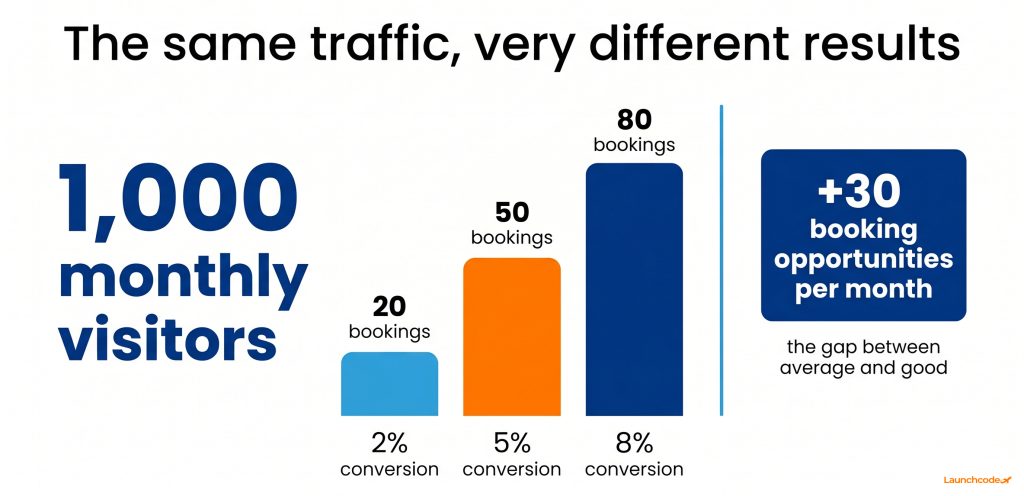
A typical dental practice website converts 2 to 5 percent of visitors into a booking action such as a call, form submission, or online appointment. Top performing practices reach 8 percent or more. If your site converts below 2 percent, fix conversion before spending another dollar on traffic, because every campaign you run pays the same leak tax.
Conversion rate is the percentage of website visitors who take a booking action. The 2 to 5 percent range appears consistently across dental industry benchmark data, which means 95 to 98 percent of visitors on an average site leave without acting.
“Almost every dental site we audit obsesses over rankings and ignores conversion. The math is brutal. Doubling conversion rate costs less than doubling traffic, and it pays out on every channel at once.” Tanner Medina, Co-Founder and Chief Growth Officer
The table below shows monthly booking opportunities at different conversion rates. Multiply the gap by your average new patient value to see what conversion work is worth to your practice.
| Monthly visitors | At 2 percent | At 5 percent | At 8 percent |
|---|---|---|---|
| 500 | 10 actions | 25 actions | 40 actions |
| 1,000 | 20 actions | 50 actions | 80 actions |
| 2,500 | 50 actions | 125 actions | 200 actions |
Conversion rate varies by traffic source. Paid search visitors looking for an emergency dentist convert differently than blog readers researching veneers. Measure conversion by channel, not just sitewide. A sitewide average can hide a paid landing page that converts at 12 percent and a service page that converts at 0.5 percent.
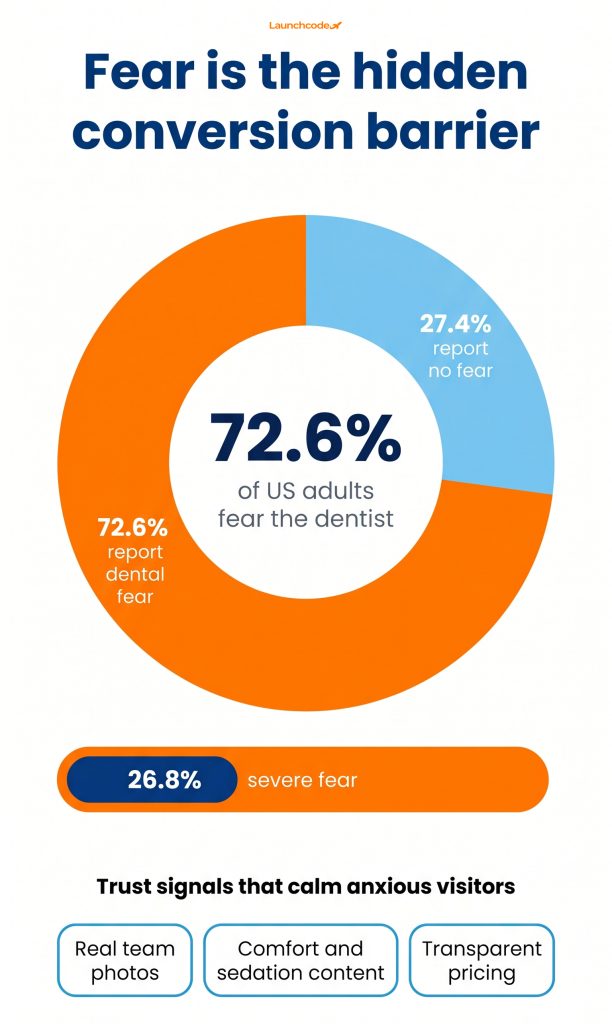
Visitors leave because the site fails to overcome fear and friction in the first few seconds. 72.6 percent of US adults report some fear of going to the dentist, and 26.8 percent report severe fear, according to a census-matched survey published in JADA. A website that only lists services, without addressing anxiety or proving trustworthiness, gives nervous visitors an easy reason to close the tab.
Dental conversion is not a generic usability problem. It is a trust problem layered on top of a fear problem. The NYU College of Dentistry study behind those numbers found fear was far more widespread than earlier estimates suggested. Richard Heyman, a professor at the NYU Dentistry Center for Oral Health Policy and Management, put it plainly: “Dental fear is so common that it is invisible to both dentists and patients.”
Usability research reaches the same conclusion from the other direction. Nielsen Norman Group research by Anna Kaley and Jakob Nielsen finds that users approach new websites with a skeptical mindset and expect to be disappointed. Nielsen has also warned that “a single violation of trust can destroy years of slowly accumulated credibility.” Your site has seconds to prove it deserves a booking.
Prioritize these trust elements above the fold and on every service page:
Kelly Daly, a research scientist at NYU Dentistry, notes that “there is often an enormous gap between patients and dentists” when it comes to fear. Practices write websites from the clinician’s point of view. Patients read them through anxiety. Audit your homepage as a nervous first-time visitor would. If the first screen talks about technology and credentials but never acknowledges how the visitor feels, you have found a leak.
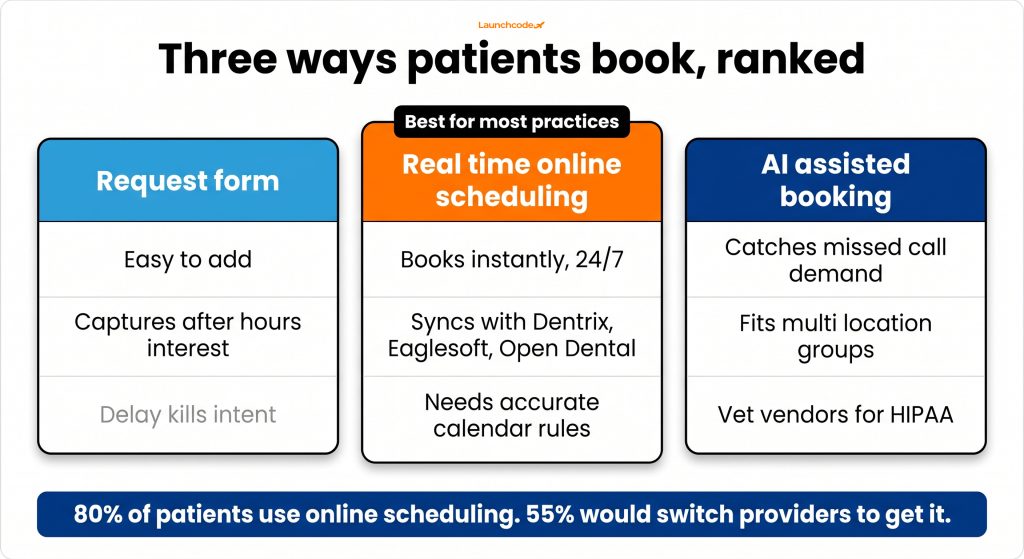
Yes. Real-time online scheduling, where the patient picks a slot that writes directly into your practice calendar, converts better than request forms and phone-only paths. A 2025 Healthgrades survey of 1,089 patients found 80 percent use online scheduling at least some of the time, and 55 percent would consider changing doctors to get it.
The patients choosing new dentists right now are digital-first. Millennials made up 46 percent of bookings on Zocdoc in 2025, with Gen Z next at 30 percent. These generations book flights, dinners, and haircuts without a phone call. They expect the same from your practice, especially at 9 pm on a Sunday when your front desk is closed.
| Booking path | Who it fits | Key strength | Watch out for |
|---|---|---|---|
| Appointment request form | Practices not ready for PMS integration | Easy to add, captures after-hours interest | Delay kills intent, requires fast staff follow-up |
| Real-time online scheduling | Most practices on Dentrix, Eaglesoft, or Open Dental | Patient books instantly, 24/7, no phone tag | Needs accurate calendar rules and PMS sync |
| AI-assisted booking via phone or chat | High call volume and multi-location groups | Catches demand the front desk misses | Vendor quality varies, requires HIPAA diligence |
Tools like NexHealth and LocalMed sync in real time with major practice management systems, so double booking fears rarely hold up in practice. The Healthgrades research also ties online scheduling to fewer no-shows and less front desk load, which compounds the conversion gain.
Roughly a third of calls to dental practices go unanswered during business hours. A 2026 study tracking 4,280 inbound calls across 26 practices found a 38 percent miss rate, with other analyses landing between 32 and 35 percent. If your primary call to action is a phone number, your conversion ceiling is whatever your front desk can answer.
The damage is bigger than it looks because callers do not try twice. Only about 14 percent of new patients leave a voicemail when no one picks up. The rest call the next practice on the search results page. These are not casual questions either. DenteMax reports that nearly 80 percent of missed dental calls relate to appointment scheduling.
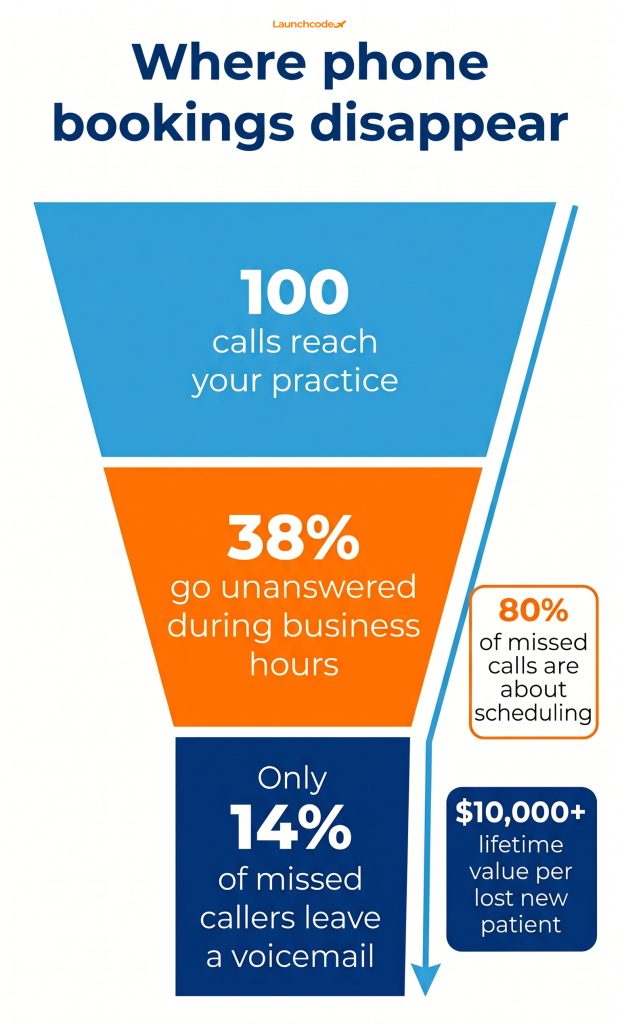
Pull a missed call report from your phone system or VoIP provider for the last 30 days. Multiply missed calls by 0.8 to estimate scheduling-related calls, then by your new patient close rate. The Peerlogic data summarized by Dentina pegs each missed new patient call at 250 to 350 dollars in first visit production and 10,000 dollars or more in lifetime value. A practice missing 15 calls per week can quietly lose six figures a year.
In conversion audits Launchcodex runs for appointment-based businesses, call tracking data is usually the single biggest surprise for owners. The website gets blamed for a leak that actually lives in the phone system, and no amount of design work fixes an unanswered ring.
“When we wire up call tracking for a client, the first report almost always changes the conversation. Owners expect a website redesign request, and instead, they see two dozen unanswered scheduling calls a week. An AI answering layer or even basic overflow routing fixes that in days, not months.” Derick Do, Co-Founder and Chief Product Officer
Aim for under three seconds on mobile, and ideally under two. Google data shows 53 percent of mobile visitors abandon a page that takes longer than three seconds to load, and the probability of a bounce rises 32 percent as load time goes from one second to three. Most dental traffic is mobile, so speed is a booking problem, not a technical detail.
Speed compounds across the funnel. Portent research found conversion rates drop by an average of 4.42 percent for each additional second of load time between zero and five seconds. A slow hero image on your homepage is a recurring tax on every campaign you run.
Run your homepage and top service pages through Google PageSpeed Insights and check Core Web Vitals, which measure load speed, interactivity, and visual stability. Do not assume you pass. Only around 41 to 43 percent of mobile sites meet Core Web Vitals thresholds, so the default assumption should be that your site needs work. Google’s own mobile page speed benchmarks found the majority of mobile pages remain slow and bloated.
Fix images, scripts, and hosting first. Those three usually recover the three-second threshold that mobile visitors expect without a redesign.
Track every booking action, but treat your analytics stack as a compliance decision. Dental practices are HIPAA-covered entities. HHS guidance on online tracking technologies prohibits disclosing protected health information to tracking vendors without a business associate agreement or valid patient authorization. Appointment forms and booking flows can create exactly that kind of data.
Most conversion guides tell dentists to install Google Analytics 4, heatmaps, and ad pixels everywhere. That advice ignores the HHS Office for Civil Rights tracking guidance, first issued in December 2022, updated in March 2024, and partially vacated by a federal court in June 2024. The core obligation survived: when tracking tools touch PHI, such as appointment details or health condition information entered in a form, HIPAA rules apply.
“The pattern we see in healthcare measurement is simple. Count outcomes, not behavior. You can build a clean conversion dashboard from booking confirmations, form counts, and answered call logs with BAAs in place, and never let a pixel near a patient form.” Tanner Medina, Co-Founder and Chief Growth Officer
Measurement discipline beats tool volume here. A practice that accurately counts answered calls and completed bookings will outperform a practice drowning in heatmaps it cannot legally use.
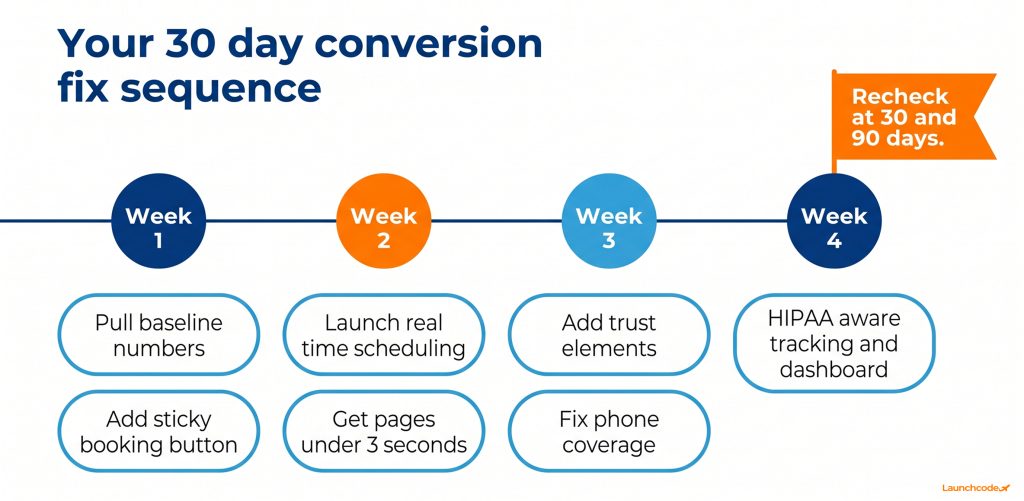
Run the fixes in this order. It front-loads the highest impact, lowest effort wins.
Recheck conversion rate 30 and 90 days after launch. Most practices see the largest single jump from steps 3 and 6, because they capture demand that previously had no path to book at all.
A dental website earns its keep when every visitor has a fast, trustworthy, always open path to a booked appointment. The order of operations matters: benchmark first, fix the booking path and the phones, then speed, then trust content, then compliant measurement. Each fix compounds the others, and none of them requires more ad spend.
If you want a second set of eyes, a conversion audit that combines analytics, call tracking, and booking flow review will usually locate the two or three leaks costing the most production. That full funnel approach is the difference between a website that looks good and one that fills chairs.
This article is for general information. Confirm HIPAA and tracking decisions with your compliance counsel before changing your setup.
Between 2 and 5 percent of visitors take a booking action such as a call, form fill, or online appointment. Top performers reach 8 percent or more through real-time booking, strong trust signals, and fast mobile pages.
Yes. A 2025 Healthgrades survey found 80 percent of patients use online scheduling at least some of the time, and 55 percent would consider switching to a provider that offers it. Millennials and Gen Z, the largest groups choosing new dentists, book digitally by default.
Not with the right tool. Platforms like NexHealth and LocalMed sync in real time with Dentrix, Eaglesoft, and Open Dental, so patients only see genuinely open slots and the calendar stays accurate.
Carefully. HHS guidance prohibits sending protected health information to tracking vendors without a business associate agreement or patient authorization. Keep pixels away from booking flows and forms, use compliant configurations, and confirm your setup with compliance counsel.
Check your missed call rate and your booking path before touching design. Around a third of dental practice calls go unanswered, and practices without online scheduling lose all after-hours demand. Those two fixes usually recover the most bookings the fastest.


Real stories from the people we’ve partnered with to modernize and grow their marketing.