
Share:

AI marketing & automation


Two facts define local link building right now. Link signals account for roughly 19 percent of local pack ranking factors according to the most recent Whitespark expert survey. At the same time, 213 US counties no longer have a single local news outlet, which removes the most cited link source from the playbook entirely. Links still matter. The traditional way of earning them is breaking down.
This guide gives you a prioritized plan for earning local links in that environment. You will learn which community sources carry the most ranking weight, how to win coverage in markets with little or no local press, when a sponsorship link complies with Google’s spam policies, and how to measure whether any of it moves rankings, traffic, and leads.
Yes. Link signals account for roughly 19 percent of local pack ranking factors, based on the Whitespark Local Search Ranking Factors survey, the industry’s most cited expert study. That makes links one of the largest ranking inputs a business can directly control, since proximity, the single biggest factor, cannot be changed.
The 2026 edition of the survey collected scores from 47 local SEO experts and was released in November 2025. It confirmed that links from locally relevant sources carry more weight in local results than links from random high authority sites with no geographic connection. A link from your city’s chamber of commerce tells Google something a national blog link cannot: this business is a real, trusted part of a specific community.
“When we audit a new local client in Ahrefs, the gap is almost never volume. The top competitor in the map pack usually holds 15 to 25 local referring domains and the client has three. Closing that specific gap moves local rankings faster than anything else we test.” Tanner Medina, Co-Founder and Chief Growth Officer
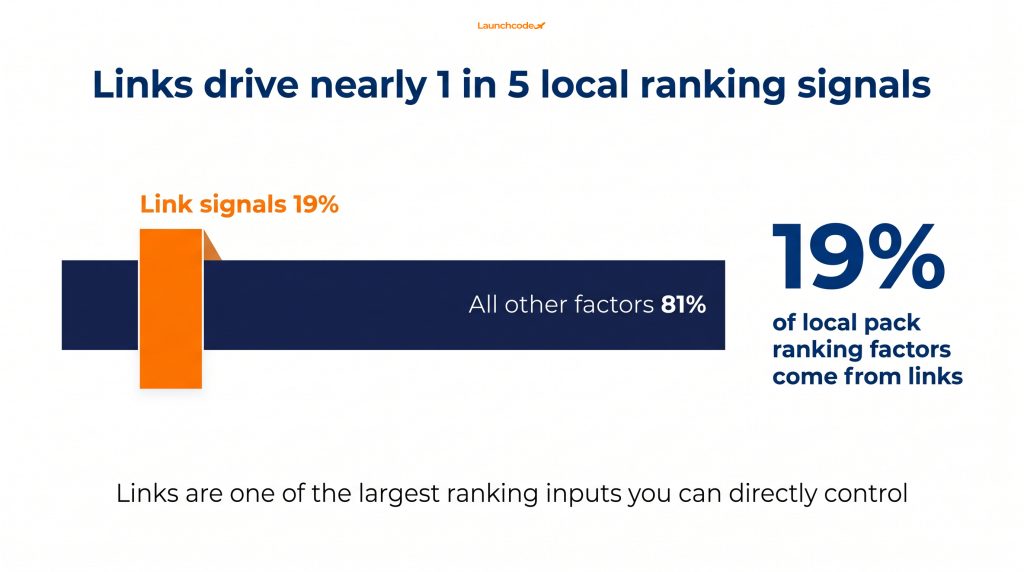
Treat links as one input among several. The same survey shows review signals and behavioral signals grew more than any other factor groups for local pack rankings. Local SEO author Miriam Ellis, writing on the Whitespark blog, described the year-over-year expert ratings of link signals as “a staircase going down to a dark basement.”
That decline in perceived importance cuts both ways. Fewer businesses invest in local links, which means each high-trust community link you earn separates you from competitors more, not less. The survey also ranked citation-related factors near the top of influence, with presence on expert-curated best-of lists first and quality of unstructured citations, meaning mentions in news, blogs, and association sites, fourth. Authority in your community now includes mentions, list placements, and links together.
If you split your local SEO effort across reviews, Google Business Profile management, on-page work, and links, links deserve a steady monthly share rather than a one-time sprint. Five to ten strong community links often outperform fifty generic directory submissions because relevance, not volume, drives local link value.
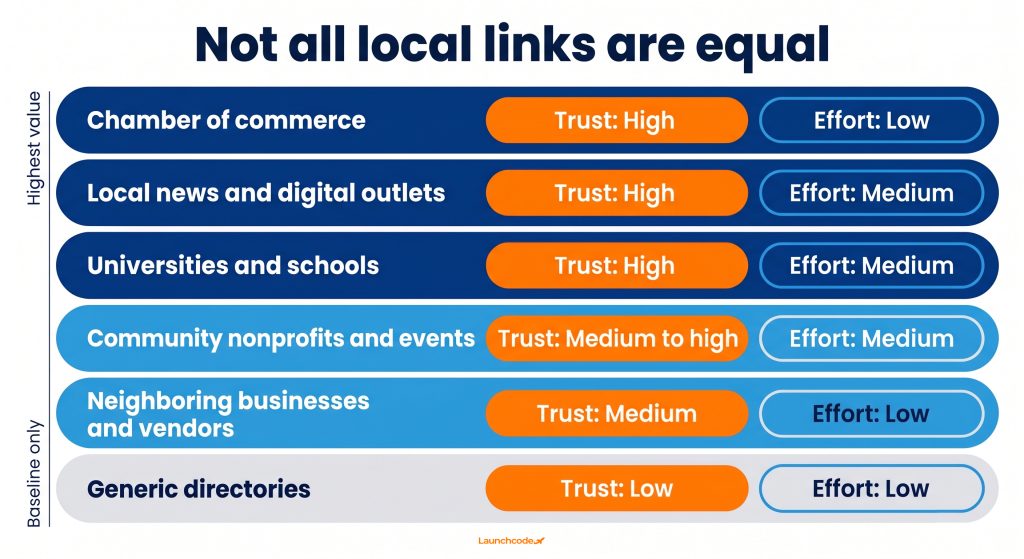
The strongest local links come from organizations Google already trusts as community anchors: chambers of commerce, local news outlets, universities and school districts, business improvement districts, and established community nonprofits. Generic directories sit at the bottom of the value scale, useful as a baseline but not a growth strategy.
The reason is relevance stacking. A chamber membership page confirms your name, location, and legitimacy at once. A local news mention adds editorial trust. An .edu scholarship or vendor page adds institutional authority. As the BrightLocal research team puts it, “The key to building local links is building relationships in your local area,” a point made throughout their local link building guide.
| Source | Trust level | Effort to earn | Best first move |
|---|---|---|---|
| Chamber of commerce | High | Low | Join and complete your member profile |
| Local news and digital outlets | High | Medium | Pitch a story with real local data |
| Universities and schools | High | Medium | Offer a scholarship or sponsor a program |
| Community nonprofits and events | Medium to high | Medium | Sponsor with a written link agreement |
| Neighboring businesses and vendors | Medium | Low | Request partner and supplier page links |
| Generic directories | Low | Low | Claim top listings once, then stop |
A three-location home services company can usually secure eight to twelve community links in one quarter without any cold outreach: three chamber memberships, two vendor partner pages, two event sponsor pages, one Little League sponsorship, and one or two local outlet mentions tied to a seasonal story. That single quarter of relationship work typically exceeds the local relevance of years of directory submissions.
Earning local links follows a repeatable five-step process: audit your current links, map community link prospects, build a linkable local asset, run relationship-based outreach, and confirm placements. Most single-location businesses can run a full cycle in 60 to 90 days with a few hours per week.
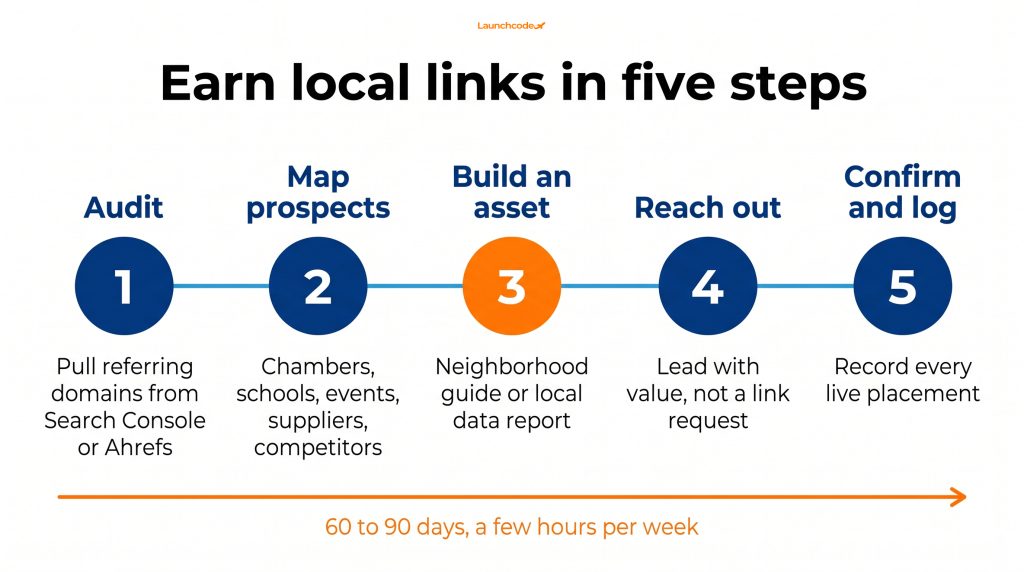
Send a short first email that names something specific about the organization, offers concrete value, and asks one question. Follow up once after five business days. Then call. Local organizations answer phones far more often than they answer cold email, and a five-minute call with an events coordinator beats ten templated messages.
Replace the newspaper pitch with a portfolio approach: digital-only local outlets, regional publications one tier up, niche community sites, local podcasts, and organization newsletters. The local press decline is real and accelerating, so businesses that adapt their media strategy now gain authority their competitors cannot easily copy.
The decline shows up clearly in the data. The Medill State of Local News Report 2025 from Northwestern University counted 213 news desert counties, up from 206 a year earlier, plus 1,524 counties with only one remaining outlet. Around 50 million Americans now have limited or no access to local news. Tim Franklin, who leads the Medill Local News Initiative, summarized it plainly in the 2025 report: “News deserts are widening. Newspaper closures continue unabated.” Poynter’s coverage of the same study notes that 136 newspapers disappeared in the past year alone, bringing total losses to roughly 3,500 papers since 2005.
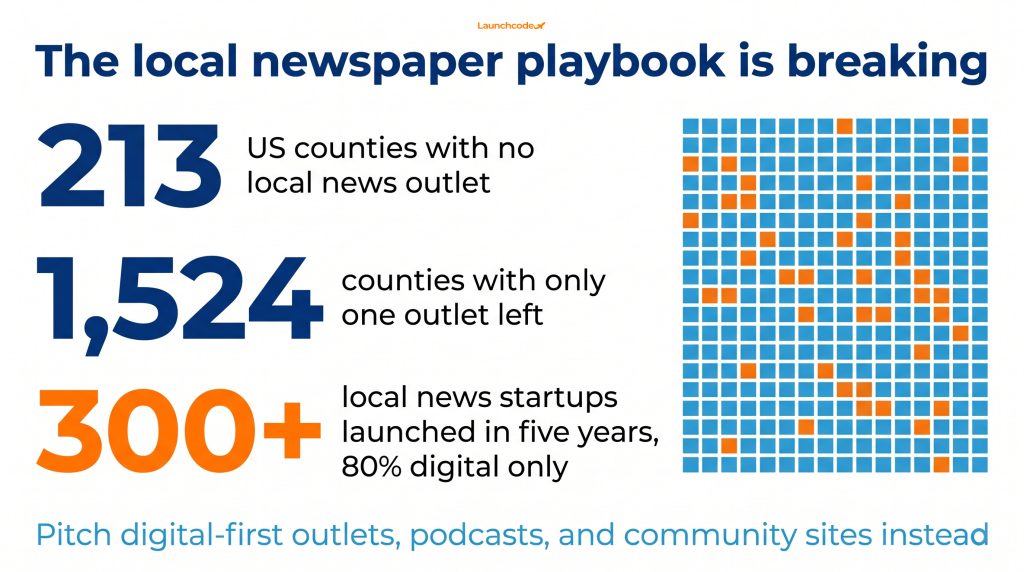
The same Medill research found more than 300 local news startups launched over the past five years, and about 80 percent of them are digital only. These outlets run lean, publish often, and need community stories and sponsors far more than legacy papers ever did. A digital-first outlet covering your county is usually one email away from a coverage conversation, and a modest sponsorship often includes a linked sponsor page.
A regional HVAC company in a one-outlet county can commission a simple survey of 200 area homeowners about energy costs, publish the results as a short report, and pitch the findings to the nearest digital outlet and the regional business journal. Original local data gives a thinly staffed newsroom a story they can run quickly, and the citation almost always includes a link to the source report.
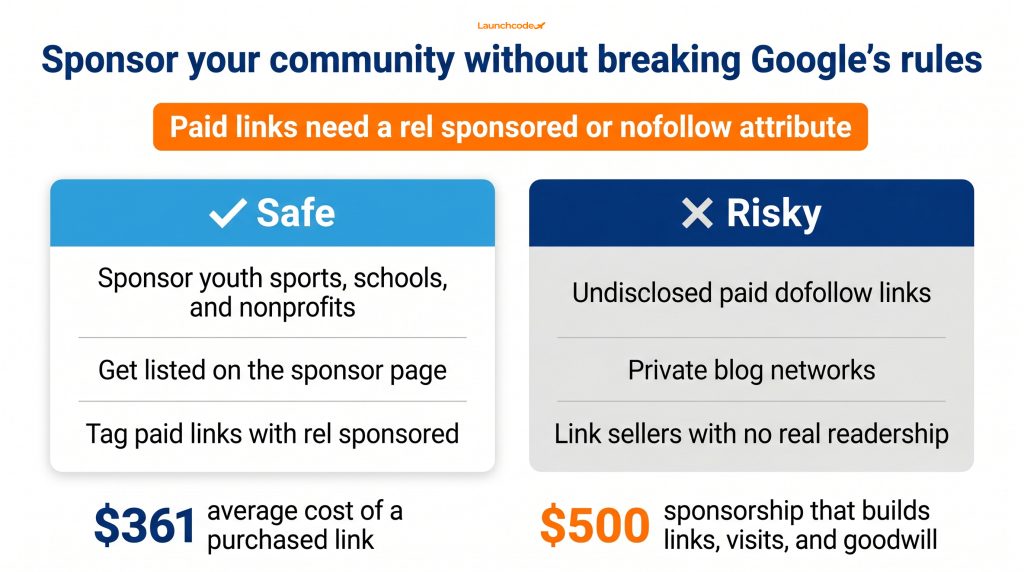
Yes, when handled correctly. Google’s spam policies state that “buying and selling links is a normal part of the economy of the web,” and paid placements only violate policy when they pass ranking credit without a rel sponsored or rel nofollow attribute. Sponsor your community freely. Just make sure paid links carry the right attribute.
Confusion about this rule pushes many owners to skip sponsorships entirely, which gives up easy authority. The official Google Search Central spam policies draw a clear line. A link given freely by an editor or organization is an endorsement and can pass full value. A link that exists because money changed hands needs a qualifying attribute. Both still build your local presence, your referral traffic, and your brand recognition.
An Ahrefs outreach study across 450 sites found the average price for a paid link placement was 361.44 dollars, paid guest post links averaged 77.80 dollars, and only 12.6 percent of sites would sell a link at all. The full Ahrefs analysis of buying backlinks also makes the risk plain, since undisclosed paid links violate Google policy and can trigger ranking losses.
“A 500 dollar youth league sponsorship has outperformed every paid placement we have tested. The link stays live for years, it sends real referral visits, and you never have to think about disavowing it.” Tanner Medina, Co-Founder and Chief Growth Officer
Yes. AI assistants summarize businesses from the sources they trust, and those sources overlap heavily with strong local link targets: news coverage, best of lists, association sites, and review platforms. The 2026 Whitespark survey examined AI visibility factors for the first time, and unstructured citations and list placements rank among the strongest signals.
Consumer behavior makes this urgent. BrightLocal’s consumer search behavior research found that 40 percent of consumers are actively using generative AI within search, and nearly 3 in 5 search online multiple times a day. When someone asks an AI assistant for the best plumber in your city, the answer draws on the mentions, links, and lists your community authority work created.
Generative engine optimization, often shortened to GEO, rewards being named in trusted places even without a hyperlink. An unlinked mention in a local news roundup, a spot on a regional best of list, or a quote in an association newsletter all feed the text AI systems learn from. The expert survey placed presence on expert-curated best-of lists as the single most influential citation-related factor, which means earning a spot on those lists now serves rankings and AI answers at once.
“We tested this across client accounts last year. The businesses that AI assistants named most often were the ones with mentions on three or more trusted local sites, like a chamber, a news outlet, and a best-of list. The pattern was consistent enough that we now score prospects on local relevance before anyone sends a single email.” Derick Do, Co-Founder and Chief Product Officer
The connection between local media and new customers is direct. The BrightLocal Local Consumer Review Survey 2025, run with a panel of 1,026 US adults, found 48 percent of consumers use local news sites as an alternative source for finding business reviews, up from 43 percent the year before. A placement on a local outlet works as a ranking signal and as a page your next customer reads before calling you.
Track four numbers monthly: referring domains from local sources, local pack and organic rankings for your priority keywords, referral traffic from earned placements, and leads attributed to those visits. Expect movement within one to two quarters, since local links compound slowly and then hold.
Set a baseline before outreach begins. Google Search Console shows your linking sites at no cost, Ahrefs or Semrush adds referring domain history and competitor comparisons, and a local rank tracker from BrightLocal or Whitespark shows position changes across your service area. Google Analytics 4 ties referral sessions from each placement to form fills and calls.
| Metric | Tool | Healthy signal |
|---|---|---|
| New local referring domains | Search Console or Ahrefs | 2 to 4 per month |
| Local pack positions | BrightLocal or Whitespark tracker | Steady gains over a quarter |
| Referral sessions from placements | Google Analytics 4 | Growth from named local sources |
| Leads from referral traffic | GA4 conversions or call tracking | Attributable calls and forms |
At Launchcodex we run community authority programs for multi-location brands by pairing AI assisted prospecting with human relationship work. AI handles the competitor link gap analysis, prospect scoring, and outreach drafting across every location, while account leads handle the calls, sponsorships, and editorial conversations that actually win placements. The scorecard above is the same one our clients review monthly, because a link program that cannot show referring domains, rankings, and leads moving together does not deserve next quarter’s budget.
Start small and sequence the work. In month one, audit your referring domains, join your chamber, and claim the handful of directories that matter. In month two, map twenty community prospects, line up two sponsorships with compliant links, and start one linkable local asset. In month three, pitch your asset to the digital outlets covering your area and record every placement in your scorecard.
The pattern across everything in this guide is the same. Authority in your community is earned through real participation, then captured as links, mentions, and list placements that move rankings and AI answers together. The businesses that treat link building as relationship building win twice: once in the search results and once with the neighbors who become customers.
There is no fixed number. Most local businesses compete with rivals holding modest link profiles, so 10 to 30 relevant local referring domains often changes positions in smaller markets. Check the referring domains of the top three businesses in your local pack and aim to match their local sources first.
No. Nofollow and sponsored links still confirm your location and legitimacy, drive referral visits, and contribute to the mention footprint AI systems read. They are a baseline, not a growth engine, so claim the major listings once and invest the rest of your time in community sources.
No. Sponsorships are normal web economics under Google’s spam policies. The link should carry a rel sponsored or nofollow attribute since payment was involved. The relevance, visibility, and community trust remain fully intact.
Plan for one to two quarters. New links need time to be crawled and weighed, and local rankings respond to the combined effect of links, reviews, and engage


Real stories from the people we’ve partnered with to modernize and grow their marketing.