
Share:

AI marketing & automation


On August 11, 2026, Anthropic confirmed that Claude weaves a machine-readable watermark directly into generated text. Every major outlet covered the announcement within hours. Almost none answered the question a content owner actually has, which is whether a hidden signal inside published copy creates a ranking problem, a legal problem, or no problem at all.
You get the answer first here, then the reasoning. Ahead: a plain read on search impact, what the EU AI Act asks of your business rather than Anthropic’s, a table mapping five content workflows to real risk, and a five-step disclosure policy your team can adopt this week.
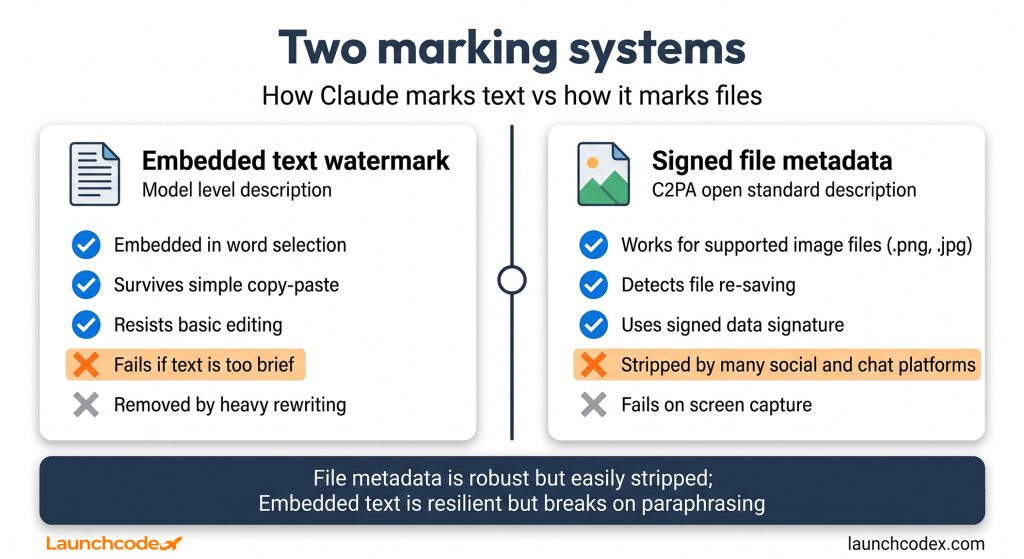
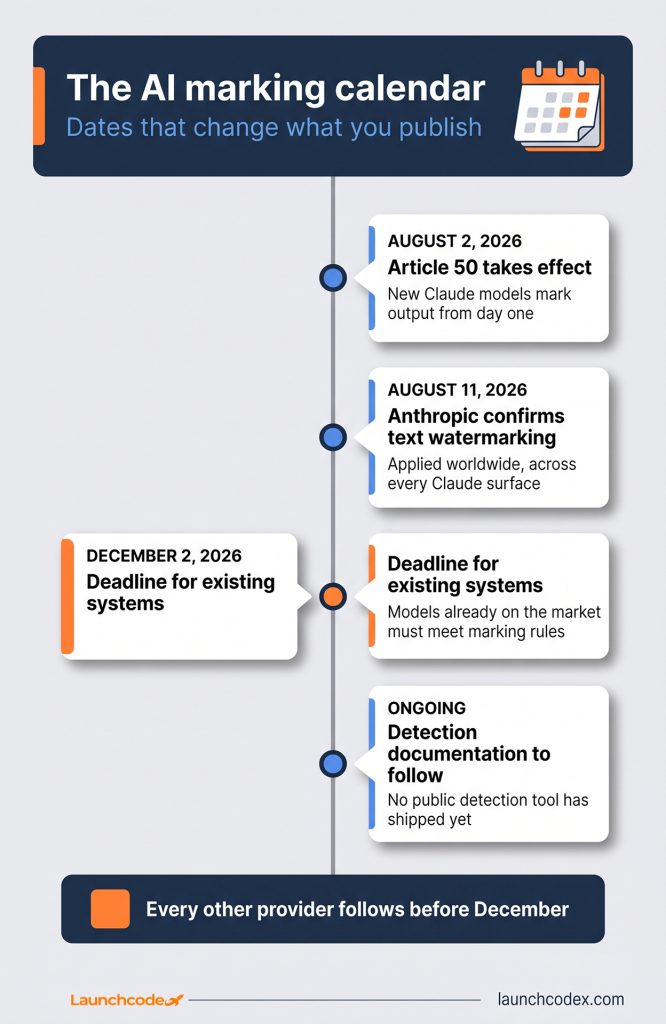
Claude models launched on or after August 2, 2026 embed an imperceptible watermark inside generated text, applied at the model level and active worldwide. Supported generated files receive signed C2PA provenance metadata instead. Anthropic states the watermark travels with copied text and may survive some editing. Older models are being retrofitted during the EU transition period.
The change follows Anthropic signing the EU AI Act’s Article 50(2) Code of Practice on Transparency of AI-Generated Content. Anthropic then applied the marking globally rather than to EU traffic only, so no region returns unmarked output.
Text and files are marked differently, and teams routinely conflate them.
Marking sits at the model level, so it is not limited to the chat app. According to the Claude Help Center documentation, marks apply across Claude, the Claude Platform API, Claude Code, Claude Cowork, and Claude Tag, plus supported models accessed through AWS, Google Cloud, and Microsoft Foundry.
If your content pipeline calls the Claude API inside an automation, that output carries the mark. Headless generation feeding a WordPress or Webflow install is affected the same way as a writer working in the chat window.
“Most teams only audit the chat app and stop there. The Claude API calls buried inside a Make or n8n automation are the ones people forget, and those usually run at ten times the volume.” Derick Do, Co-Founder and Chief Product Officer
No. Google evaluates content on quality, not on how it was produced. No announced Google ranking system detects or penalizes AI text watermarks, and the marking exists for provenance rather than enforcement. The standing spam policy targets content generated primarily to manipulate rankings, which is a behavior problem rather than a watermark problem.
Google’s position has not moved since it published guidance stating that its focus is on “the quality of content, rather than how content is produced.” That guidance in the Search Central post on AI-generated content remains the operative policy.
The spam line is drawn at intent and scale. Automation used mainly to game rankings violates policy. Automation used to research faster, structure better, and ship more consistently does not.
The teams that should pay attention publish model output close to verbatim, at volume, with no editorial layer. That pattern was already a liability under Google’s scaled content abuse policy. The watermark does not create the risk. It makes the risk legible to anyone running a detector.
Three signs your workflow sits in that bucket:
“We have never seen a ranking drop that traced back to how a draft got written. The drops trace back to thin pages that answer a query worse than the page ranking above them.” Tanner Medina, Co-Founder and Chief Growth Officer
A detected mark means content was processed by Claude. It does not prove Claude authored it, since people use Claude to translate, summarize, and proofread work that originated elsewhere. A missing mark proves nothing either. Short passages, heavy paraphrasing, and pre-August models all produce undetectable output.
Watermark detection is statistical, so it needs volume. John Kirchenbauer of the University of Maryland, lead author of the foundational paper behind this technique, explained in a research discussion of the original watermarking method that the signal holds when text stays untouched: “If you don’t mess with the text, the signal is extremely reliable.” The threshold in that paper sat near fifty words, roughly a short paragraph.
Rewriting degrades it. Follow-up work in the University of Maryland reliability study confirms that paraphrasing weakens detection considerably.
| Workflow | Watermark likely to persist | Real risk level |
|---|---|---|
| Model output published verbatim | Yes | High, mostly for quality reasons |
| AI draft with a substantive human rewrite | Weak or absent | Low |
| Ad headlines, meta descriptions, subject lines | No, below detection threshold | None |
| Claude-generated images and SVGs | C2PA metadata, easily stripped | Low |
| Client deliverables passed through your CMS | Yes, unless edited | Governance issue, not a ranking one |
Article 50 splits duties between providers and deployers. Anthropic carries the marking obligation as a provider. Your business carries a separate disclosure duty as a deployer when you publish AI-generated text to inform the public on matters of public interest. Content generated before August 2, 2026 needs no retroactive labeling.
Anthropic owns the machine-readable mark. You own telling readers, if you fall in scope. The European Commission’s Article 50 guidance confirms both the effective date and that pre-August content stays as published.
A narrow exemption also applies to outputs used in business to business or industrial contexts, subject to conditions in the guidelines. That matters for B2B teams producing internal documentation and partner materials rather than public-interest publishing.
Launchcodex is not a law firm. Scope questions under Article 50 belong with counsel who knows your jurisdiction and publishing model.
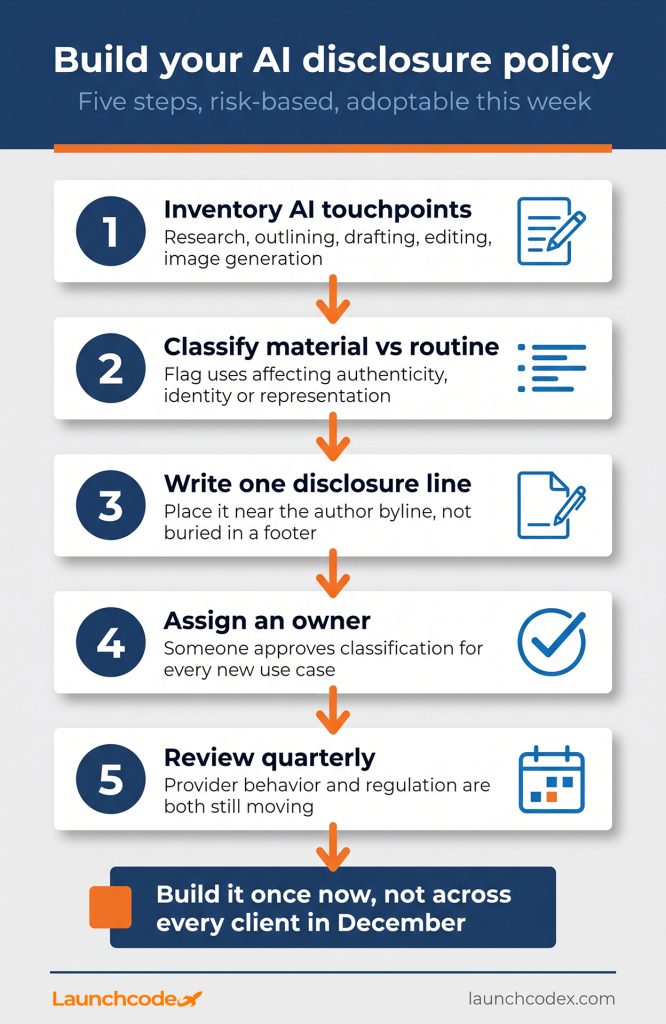
Skip blanket labeling. Use a risk-based rule where disclosure applies only when AI materially affects authenticity, identity, or representation in ways that could mislead a reader. That is the model the IAB adopted in January 2026, and it is defensible, proportionate, and far easier to operate than labeling every asset.
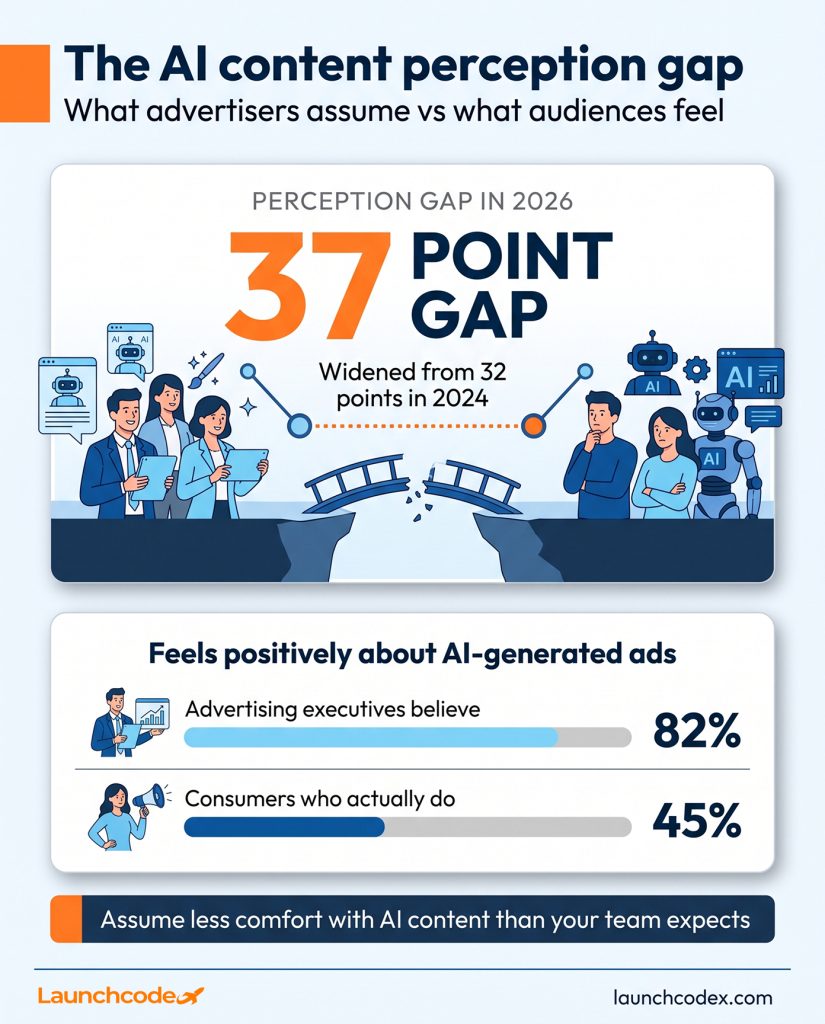
Marketers consistently overestimate audience comfort with AI content. IAB research published alongside the AI Transparency and Disclosure Framework found 82 percent of ad executives believed Gen Z and Millennial consumers felt positively about AI-generated ads, while only 45 percent actually did. That 37 point gap widened from 32 points in 2024.
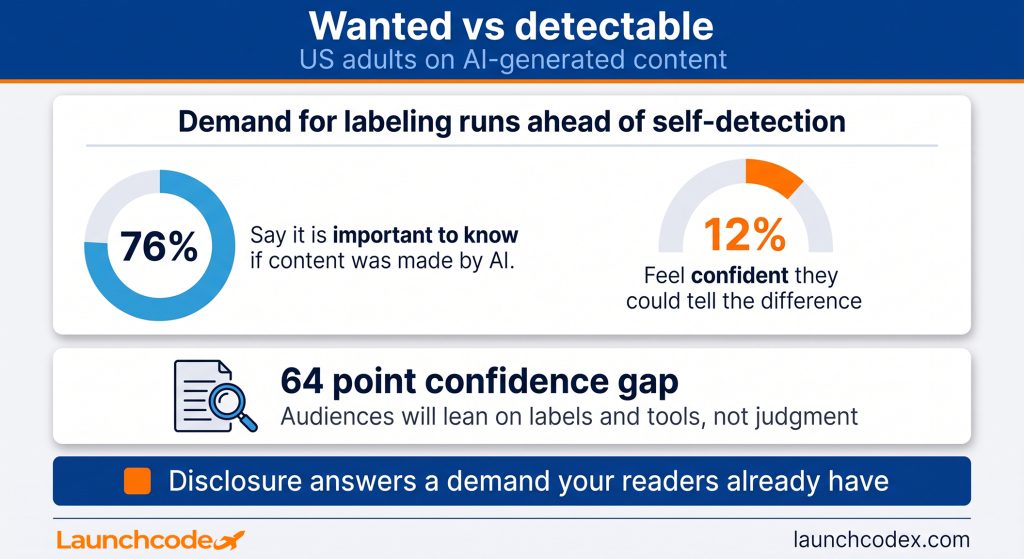
Consumer demand for labeling runs high. Pew Research found 76 percent of US adults consider it important to know whether content was made by AI, while only 12 percent trust their own ability to tell. As Search Engine Journal’s coverage of the Pew survey noted, “many don’t trust their own ability to spot AI-generated content.” That pushes audiences toward labels and detection tools instead of their own judgment.
David Cohen, CEO of the IAB, framed the stakes when the framework launched, saying “we must get transparency and disclosure right, or we risk losing the trust” that underpins the value exchange.
“One disclosure line under the byline has never cost us a conversion. Getting caught without one, on a client site in a regulated vertical, would cost the account.” Tanner Medina, Co-Founder and Chief Growth Officer
Anthropic has not published the technical method, a public detection tool, a minimum text length, or false positive rates. Anyone selling certainty about watermark detection right now is guessing. Treat third-party watermark removers with particular skepticism, since several still claim Claude does not watermark at all.
The Register raised the practical version of this concern, noting that “it’s unclear how Anthropic will make the watermarks hard to remove.” Read The Register’s coverage of the announcement for the full technical skepticism.
Three open questions worth tracking:
The watermark is a provenance signal, not a penalty. If your content process already includes real research, a human rewrite, and an editorial review, this announcement changes your compliance paperwork and nothing else. If it does not, the watermark is not your problem. Your process is.
Two actions this quarter. Audit every point where Claude output enters your publishing pipeline, including API calls inside automations. Then write the disclosure policy while the standard is still risk-based rather than mandatory. Building it once now costs less than retrofitting it across every client and channel in December, which is the kind of systems work our team handles inside AI automation and content operations engagements.
Last updated August 11, 2026. Regulatory claims come from the European Commission. Product claims come from Anthropic’s published documentation. This article was researched and drafted with AI assistance, then edited and fact-checked by a human before publication.
No. Google’s guidance evaluates content quality rather than production method, and no announced ranking system reads AI text watermarks.
Yes. The mark is part of the text rather than file metadata, so a copy and paste into any CMS carries it.
No. The European Commission confirmed that content generated before August 2, 2026 does not require retroactive labeling.
Substantive rewriting degrades the signal, and research shows paraphrasing evades detection. Anthropic has not published a specific threshold.
Yes. Marking happens at the model level and covers the Claude Platform API, Claude Code, Claude Cowork, Claude Tag, and supported cloud platforms.
No. Supported files get C2PA signed provenance metadata, which a screenshot or format conversion can strip.


Real stories from the people we’ve partnered with to modernize and grow their marketing.