
Share:

AI marketing & automation


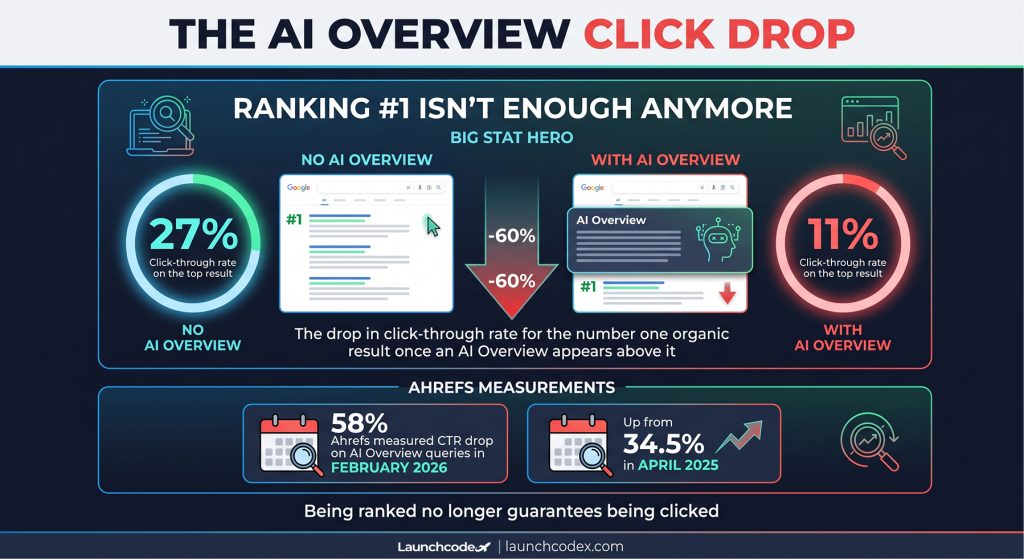
When an AI Overview appears above your search result, the click-through rate for the top organic position falls from 27 percent to 11 percent, according to Sistrix data reported by Search Engine Journal. That is a 60 percent drop on searches your content used to win outright. Ranking well is no longer enough on its own.
This article treats entity optimization and topical authority as one connected system instead of two separate SEO tasks. You will learn what an entity actually is, how Google’s Knowledge Graph uses it, how to build an entity map with schema markup, and how to turn that foundation into topical authority that Google and AI systems both trust.
Entity optimization means making your brand, people, products, and core concepts recognizable as distinct, well-defined entities to search engines and AI systems, instead of leaving them as loose keywords scattered across a page. An entity is anything with a unique identity, such as a company, a person, a product, or a concept, that a machine can identify independent of the exact words used to describe it.
Search engines stopped matching text strings years ago. They now try to understand what your page is actually about, which is a different question than what phrase your page happens to repeat.
A keyword is the phrase someone types into a search bar. An entity is the actual thing behind that phrase. If your keyword is “best project management software for agencies,” the entities inside that phrase include the software category itself, the specific tools people compare, and concepts like time tracking or resource allocation. A page that only repeats the keyword tells Google what phrase to match. A page that clearly references the related entities tells Google what the page means.
Google’s Knowledge Graph, launched in 2012, is a database of entities and the relationships between them, and it is what lets Google understand a query’s meaning instead of just matching its words, according to Google’s own developer documentation. One limit worth knowing: the public Knowledge Graph Search API only returns individual matching entities, not full graphs of how those entities connect. Google actually points developers to Wikidata for relationship-level data. That gap is exactly why your own schema markup and internal linking have to do the work of showing those connections on your site.
“Teams treat entity maps as a one-time project. We revisit ours with clients every quarter because product lines and messaging shift faster than that.” Derick Do, Co-Founder and Chief Product Officer
Topical authority is not an official Google ranking factor or a named metric anywhere in Google’s tools. It is an industry term for a real, confirmed behavior: Google recognizing that a site is genuinely strong across a broad topic area and rewarding it beyond any single page. The mechanism is real. The buzzword treatment of it is what Google pushes back on.
Getting this distinction right protects your credibility with a technical reader, and it keeps you from overselling a concept Google itself treats with some skepticism.
In a 2021 SEO office hours session, John Mueller, Google’s Search Advocate, said that if Google can recognize a website is really good for a broader topic area, it can show that website for related searches without focusing purely on individual pages. That is Google confirming the mechanism directly. In 2023, when a Redditor described “topical authority” as a rebranded version of plain relevance, Mueller replied simply, “Don’t worry about it,” as reported by Search Engine Journal. He was dismissing the term as marketing jargon, not the underlying value of covering a topic well.
What Google actually evaluates is documented in its Search Quality Rater Guidelines, a public 182 page document last updated September 11, 2025, which added rating examples for AI Overviews and expanded YMYL to cover government, civics, and society topics. That guideline sits on top of the E-E-A-T framework, which Google expanded from E-A-T to E-E-A-T in December 2022 to capture first hand experience, not just expertise. The same source notes the March 2026 core update moved 79.5 percent of top 3 positions, compared with 66.8 percent in December 2025, making it the most volatile update measured at that point. Volatility like that rewards sites Google already trusts across a topic and punishes everyone else.
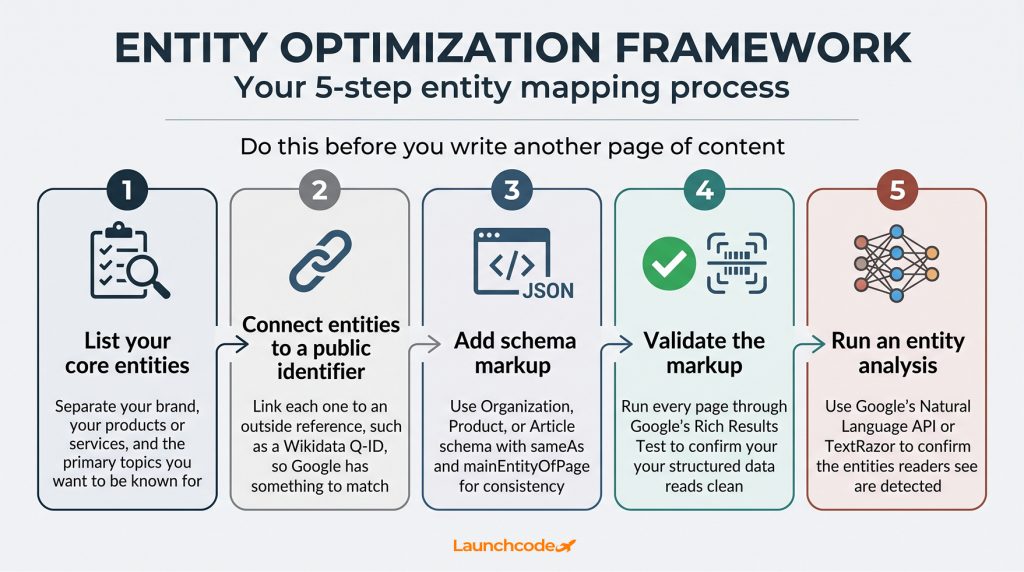
Entity optimization is the specific, buildable mechanism that produces topical authority. A single page becomes unambiguous about what it means through entity optimization. A whole site becomes trusted on a subject through topical authority. You cannot get the second without doing the first repeatedly and connecting the results.
The two disciplines usually get assigned to different teams, which is exactly why they stay disconnected in practice.
| Focus area | Entity optimization tactic | Topical authority tactic | Where they overlap |
|---|---|---|---|
| Definition | Making one page’s meaning unambiguous | Making a whole site trusted on a subject | Both depend on Google seeing relationships, not just words |
| Main tool | Schema markup, sameAs properties | Content clusters, internal linking | Internal links reinforce the entity relationships schema describes |
| Signal sent to Google | This page is about X | This site fully covers X | A well linked cluster with clean schema teaches Google both at once |
| Usually owned by | Technical SEO or a developer | Content or marketing lead | Needs one shared workflow, not two separate projects |
Treat these as one editorial calendar instead of two backlogs. The compounding effect shows up faster when both teams work from the same entity list.
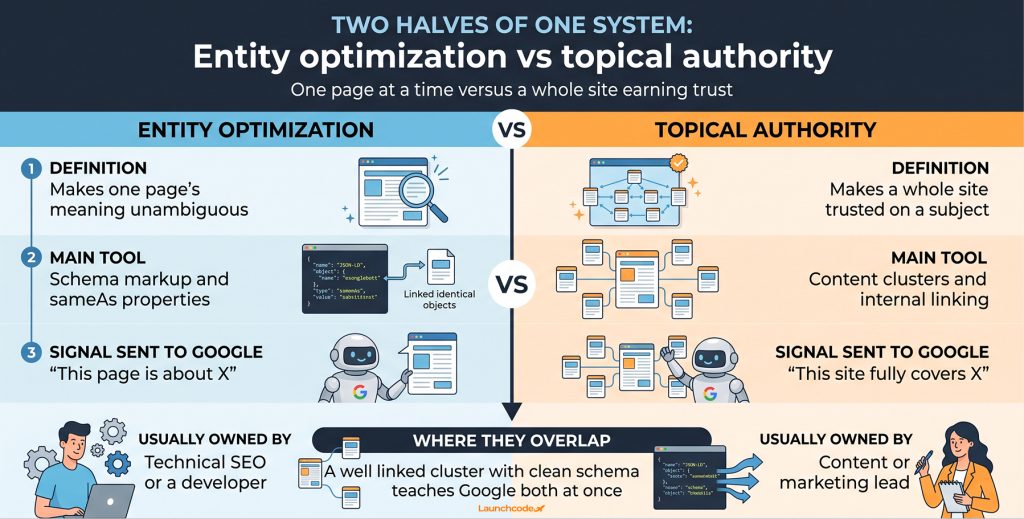
Building an entity map means listing the people, products, and concepts your content should reinforce, then connecting each one to a public identifier and to your schema markup. This is the foundation everything else in this article depends on, and most teams skip straight past it into content production.
Follow this order rather than jumping to content first.
Content clusters turn individual entity optimized pages into topical authority by grouping them around one pillar page and linking them together. A single page can be entity clear on its own. Only a connected group of pages, all reinforcing the same core entities, earns the broader trust Google described in Mueller’s 2021 comments.
The structure matters more than the volume of pages you publish.
Build one pillar page that introduces a topic comprehensively, then build supporting pages that each go deep on one subtopic. Every supporting page links back to the pillar, and the pillar links out to each supporting page, creating a loop that reinforces which page is the primary destination for the broader topic.
At Launchcodex, the clearest gains show up when a client restructures scattered blog posts around one entity map before writing anything new. One SaaS client had a dozen loosely related posts competing with each other for the same searches. Mapping them to a single pillar and rewriting the internal links, without touching most of the actual content, was often enough to stop the pages from cannibalizing each other.
“Cannibalization is usually the first thing we look for. Once those posts stop competing with each other, indexing speed improves within weeks.” Tanner Medina, Co-Founder and Chief Growth Officer
Use descriptive anchor text that names the entity, not generic phrases like “click here.” A link that reads “our guide to schema markup for SaaS pages” tells Google far more than a link that reads “learn more.” See our schema markup implementation guide for the technical detail this section does not have room to cover.
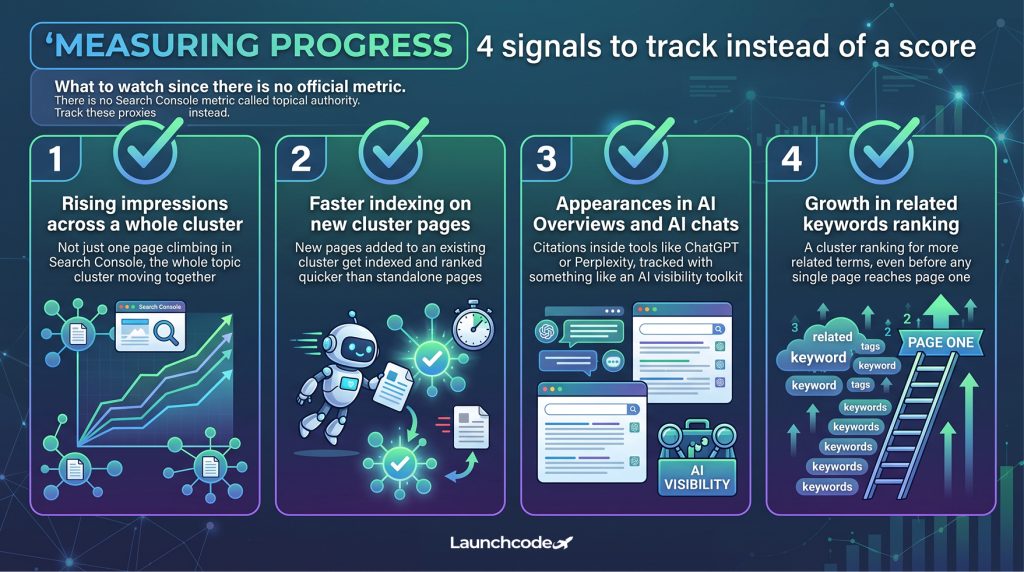
There is no Search Console metric called topical authority, so measure the proxy signals instead. Watch for impressions growing across every page in a cluster at once, new pages in that cluster getting indexed and ranked faster than pages outside it, and your brand starting to appear inside AI Overviews or getting cited by tools like ChatGPT or Perplexity.
Report these signals together, not one at a time, since any single metric can move for unrelated reasons.
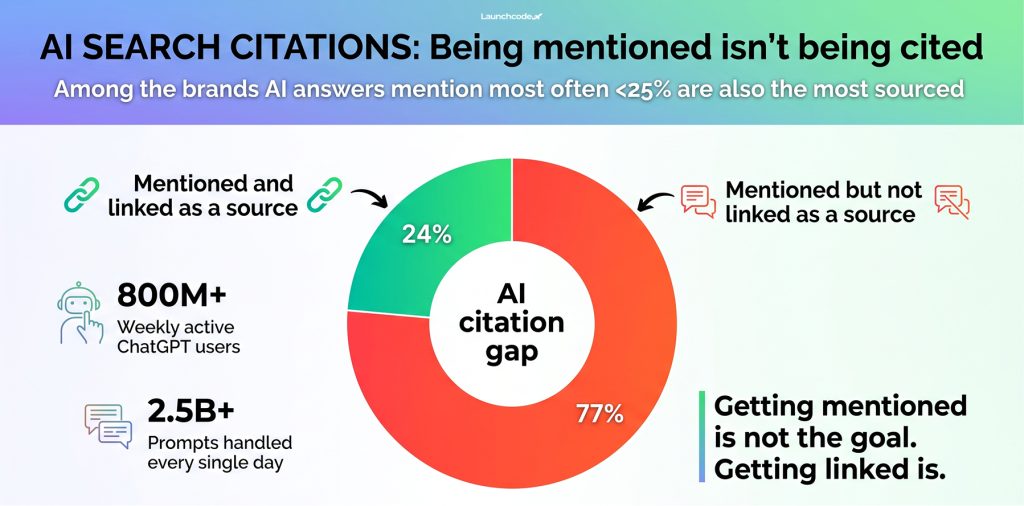
ChatGPT alone handles more than 800 million weekly active users and 2.5 billion prompts a day, yet fewer than 25 percent of the most mentioned brands in AI answers are also the most sourced ones, a gap entity clarity is built to close. The same research found that visitors arriving from AI-powered search convert more than four times as often as traditional organic visitors, which turns this measurement work into a revenue conversation, not just a traffic one.
“We stopped putting single page rankings on client dashboards two years ago. Cluster-level impressions and AI citation tracking tell a much more accurate growth story.” Tanner Medina, Co-Founder and Chief Growth Officer
Start with the entity map, not the content calendar. Spend a week listing your core brand, product, and topic entities before you write another post. Audit your five highest traffic pages for schema gaps and fix those first, since they already have Google’s attention. Then group your existing content into clusters around the entities you just mapped, even before producing anything new. Only after that foundation is in place should you plan net new content.
“If a client cannot tell me what their five core entities are, we start there before touching a single page. Everything downstream depends on that list being right.” Derick Do, Co-Founder and Chief Product Officer
Johannes Beus, founder of Sistrix, summed up the shift bluntly in a March 2026 newsletter, where he also noted Ahrefs measured a 58 percent drop in position one click-through rate on AI Overview queries: “ranking alone is no longer a business model.” If your team needs help sequencing this work against everything else on the roadmap, that is the kind of prioritization our SEO and GEO services at Launchcodex are built to handle.
No. It is not a named metric in Search Console or a confirmed algorithm input. John Mueller has called the term overhyped, but the underlying behavior, Google trusting sites that cover a topic thoroughly, is real and documented in Google’s own guidance.
A keyword is the exact phrase someone searches. An entity is the actual person, place, product, or concept behind that phrase. Optimizing for entities means making sure your content clearly represents the right underlying concepts, not just the right words.
You need it to build clean entity optimization, which is the foundation topical authority sits on. Schema alone will not make a thin site authoritative, but skipping it makes it harder for Google to connect your pages to the entities they represent.
It improves your odds. AI systems favor content with clear, well-structured entities and consistent terminology, since that is what they can extract and cite confidently. It is not a guarantee, but unclear entity signals make citation far less likely.
There is no fixed timeline, since Google has never published one. Most teams see early proxy signals, like faster indexing on new cluster pages, within a few months of restructuring content around a clear entity map, with fuller effects building over two to three quarters of consistent work.


Real stories from the people we’ve partnered with to modernize and grow their marketing.