
Share:

AI marketing & automation


Your brand ranks well on Google. Leadership still asks why competitors show up in ChatGPT and you do not. That gap is real, and it is not solved by the SEO playbook you already run.
This guide explains how generative engines like ChatGPT, Perplexity, and Google AI Overviews actually select sources, what earns a citation instead of a passing mention, and how to build a sequence you can hand to your team this quarter. You will leave with a clear answer on schema markup, a framework for content structure, and a way to measure whether any of it is working.
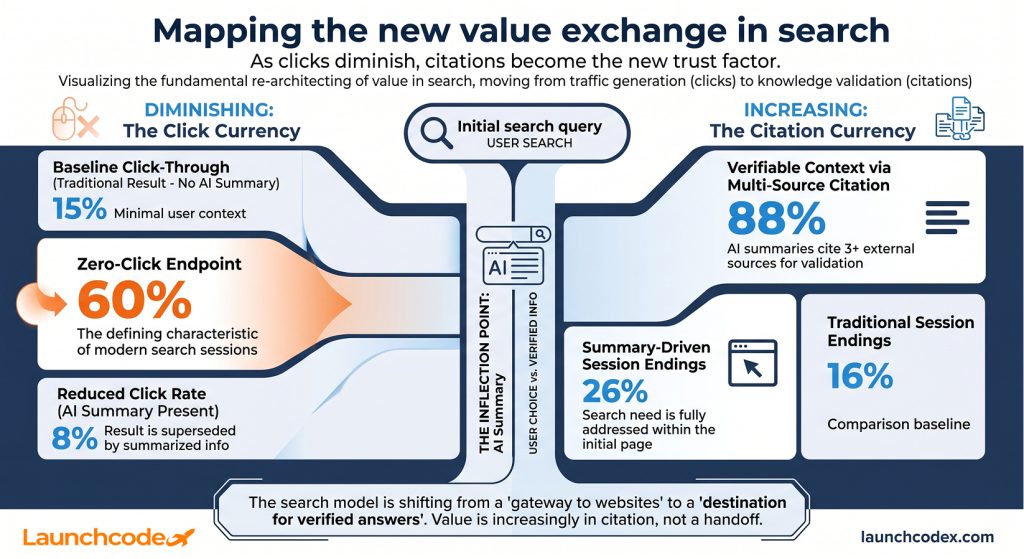
About 60% of searches now end without a click to any website, and roughly 80% of consumers rely on AI-written results for at least 40% of their searches. That shift means a ranking with no citation inside the answer itself often produces zero visibility. The citation has become the new click.
The stakes show up clearly in Bain & Company’s research on consumer search behavior, and they compound once an AI summary actually appears on the page.
When Google shows an AI summary, users click a traditional result in only 8% of visits, compared with 15% when no summary appears. Sessions end entirely 26% of the time with a summary present, versus 16% without one, based on Pew Research Center’s analysis of nearly 69,000 real searches. Fewer total clicks means each citation slot is worth more, not less.
The traffic that does arrive converts unusually well. AI-referred traffic to US retail sites converted 42% better than non-AI traffic in March 2026, a full reversal from a year earlier when it converted 38% worse, according to Adobe Analytics. Smaller and newer brands have a real opening here too. A Princeton and Georgia Tech study found that fifth-ranked websites gained 115% more visibility from adding source citations, while first-ranked sites actually lost visibility from the same tactic, based on research presented at KDD 2024. Rankings alone do not decide who gets cited.
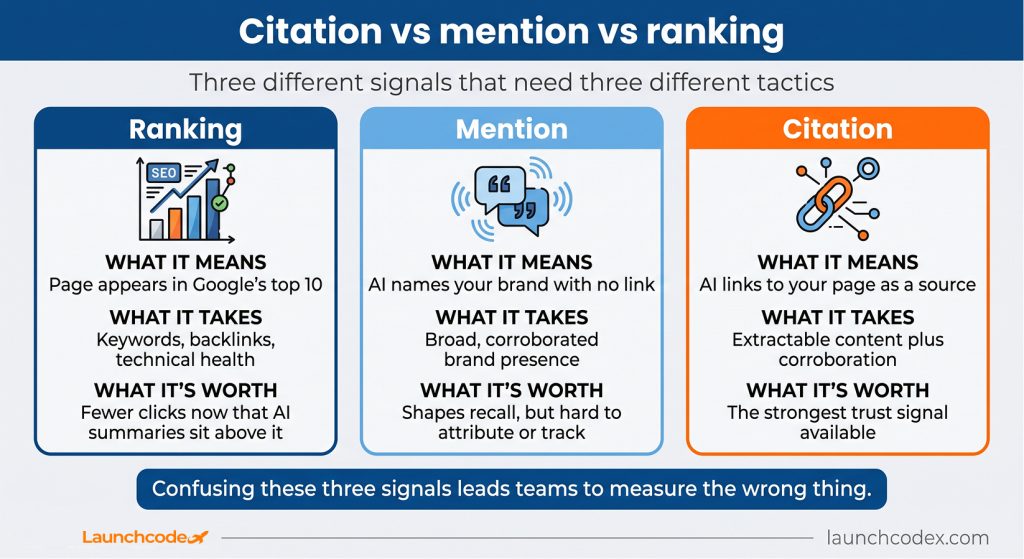
A ranking places your page in a list of ten blue links. A mention is when an AI names your brand with no link. A citation is when an AI links directly to your content as a source. Each one requires a different tactic, and confusing them leads teams to measure the wrong thing.
| Concept | What it means | What it takes | What it is worth |
|---|---|---|---|
| Ranking | Your page appears in Google’s organic results | Traditional SEO: keywords, backlinks, technical health | Fewer clicks now that AI summaries sit above results |
| Mention | An AI names your brand with no link | Broad, corroborated brand presence across the web | Shapes recall, but is hard to attribute or track |
| Citation | An AI links to your page as a source | Extractable content plus independent corroboration | The strongest trust signal, even at lower click volume |
Teams that track only rankings miss the fact that 88% of Google’s AI summaries cite three or more sources, and only 1% cite a single source. Brands are competing for one of several slots, not one of ten. Rankings still matter for one specific case: a separate Ahrefs study found that 76.1% of pages cited in Google AI Overviews also ranked in Google’s top 10 organic results for the same query, reported by Search Engine Land. Traditional SEO and GEO overlap for Google specifically, but not for ChatGPT or Perplexity, which pull from a much wider set of sources.
Generative engines retrieve candidate passages from the web, break a question into several related sub-queries, and select the sources that answer each piece most clearly and consistently. This is retrieval-augmented generation, or RAG, and it explains why keyword optimization alone does not work here.
Three signals decide whether your content gets pulled into an answer.
“When we build content workflows for clients, we map every page to the sub-queries it should answer, not just the primary keyword. A page that only answers one angle of a query fan-out gets skipped for the other four.” Derick Do, Co-Founder and Chief Product Officer
A user asking an AI assistant “best project management tool for remote teams” does not trigger one search. The system fans that question out into related sub-queries covering pricing, integrations, and reviews, then pulls different sources for each piece. A brand that only optimizes one landing page misses every sub-query except the one that page happens to answer. Covering a topic across a small cluster of pages, not a single hero page, is what earns citations across the full fan-out.
No. Google’s own developer documentation states there are no additional requirements to appear in AI Overviews or AI Mode. Vendors selling “AI schema” packages are selling something Google says you do not need.
Google’s Search Central documentation is explicit that there are no additional requirements to appear in AI Overviews or AI Mode. You do not need a new machine-readable file, an AI-specific text file, or any special schema.org markup. Ahrefs’ own large-scale research reached a similar conclusion, finding that adding schema markup showed no meaningful impact on AI citation rates.
“We stopped selling schema as an AI citation fix over a year ago. Clients get better results from rewriting their first two sentences than from adding another JSON-LD block.” Tanner Medina, Co-Founder and Chief Growth Officer
Schema is not worthless. It remains useful for standard rich results, product listings, and helping search engines parse your page correctly, which supports the retrievability signal described above. Treat it as SEO hygiene, not a citation shortcut. The budget your team might spend chasing an “AI schema” is better spent on the content structure and off-site work covered next.
Write the direct answer first, support it with a specific statistic or citation, and organize the page in short, self-contained sections. This single change accounts for the largest documented gains in generative visibility.
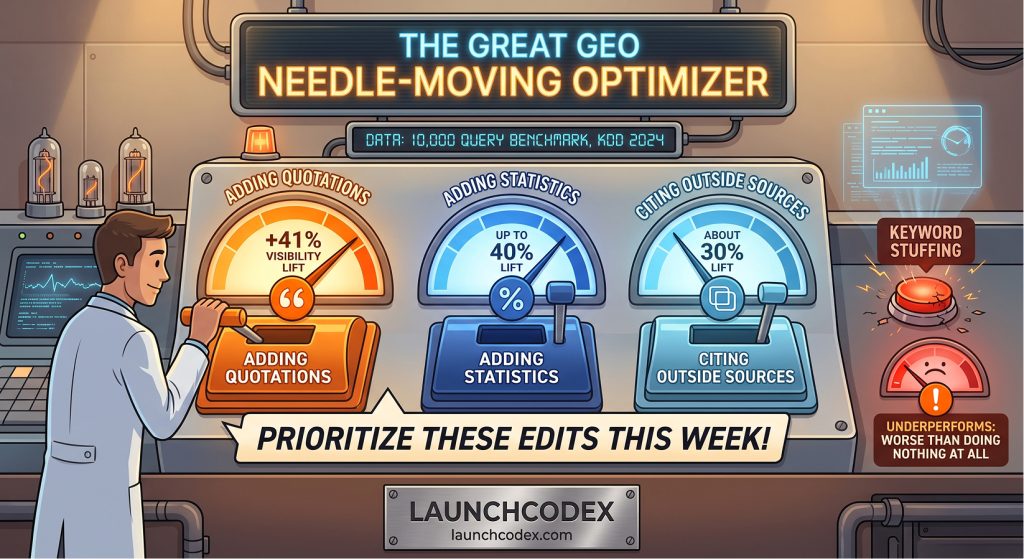
The Princeton and Georgia Tech study behind modern generative engine optimization, or GEO, tested specific tactics head to head. Adding quotations lifted visibility by up to 41%, adding statistics lifted it 30% to 40%, and citing outside sources lifted it about 30%. Keyword stuffing performed worse than doing nothing at all, based on the KDD 2024 research. That ordering should set your editing priorities directly.
Unlinked brand mentions across the open web now predict AI citations more strongly than backlinks do, which means earned media and community presence deserve real marketing budget. This is the single biggest shift from traditional SEO thinking.
Ahrefs studied 75,000 brands and found that unlinked brand mentions correlated with AI Overview citations at 0.664, compared with just 0.218 for backlinks, roughly a three-to-one gap. Ahrefs CMO Tim Soulo summarized the shift in one line, calling citations “the new backlinks” for the AI search era. Ahrefs’ technical SEO lead Patrick Stox has described the same trend as the era of off-page SEO.
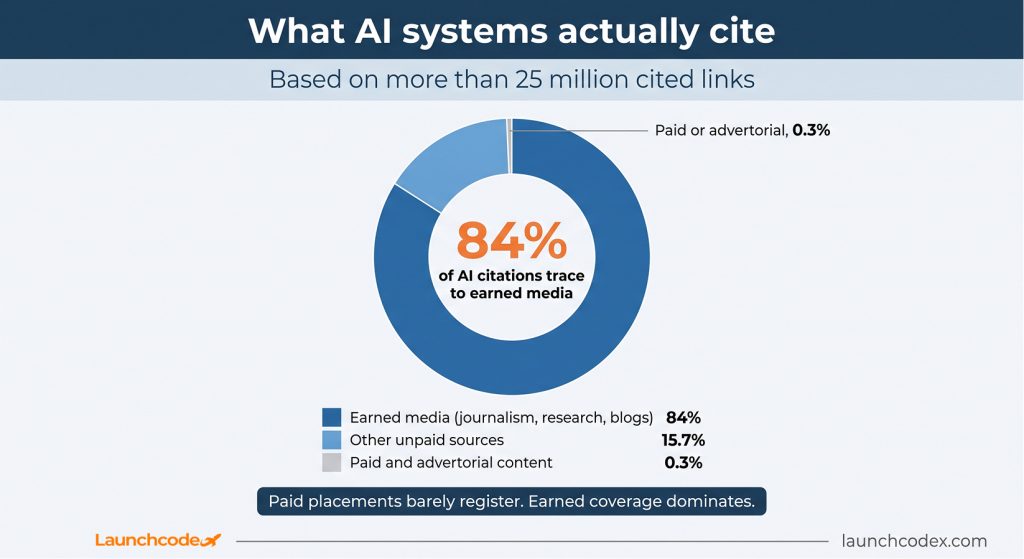
Earned media carries even more weight than general mentions. Journalism, academic research, and unpaid editorial coverage account for 84% of all AI citations, while paid and advertorial content accounts for just 0.3%, based on Muck Rack’s Generative Pulse research across more than 25 million links. Muck Rack CEO Greg Galant frames the consequence plainly: brands absent from the media coverage AI reads become absent from the answers AI gives. Community platforms matter here too. Reddit ranked first or second among cited domains across every major AI platform studied, based on Peec AI’s analysis of 30 million cited sources.
“A single press mention rarely moves a client’s citation rate. We only see it shift once three or four independent sites are saying the same thing about a brand.” Tanner Medina, Co-Founder and Chief Growth Officer
Google Search Console and GA4 can show partial signals, such as AI Mode impressions and referral traffic from known AI domains, but neither tool separates AI Overview citations from standard organic data. Dedicated tracking closes that gap.
GA4 can identify some AI referral traffic through a custom channel group matching domains like chatgpt.com and perplexity.ai, though free ChatGPT users and most mobile app referrals do not pass reliable data. Search Console reports AI Mode impressions but folds AI Overview citations into standard web search data, so a citation with no click stays invisible. Do not mistake a quiet GA4 report for a lack of AI visibility. Cloudflare’s crawler data shows why: OpenAI crawled roughly 1,091 pages for every visitor it referred, and Anthropic roughly 38,066, compared with 5.4 for Google. Crawling happens at a scale traffic reports never capture.
“GA4 tells you almost nothing about AI Overview citations. We build a simple weekly prompt log for clients in a spreadsheet before we ever recommend a paid tracking tool.” Derick Do, Co-Founder and Chief Product Officer
Platforms such as Ahrefs Brand Radar, Peec AI, Otterly.ai, Profound, and AirOps Insights run a fixed set of prompts across ChatGPT, Perplexity, Gemini, and Google AI Overviews on a schedule, then report citation frequency, mention rate, and share of voice against named competitors. The opportunity is still wide open. The share of US websites earning any AI citation presence grew from 1.6% in June 2025 to 6.8% in May 2026, according to Similarweb, which means most brands in most categories have not built a citation presence yet. This is the kind of gap analysis Launchcodex’s SEO and GEO team runs for clients before recommending where to focus first.
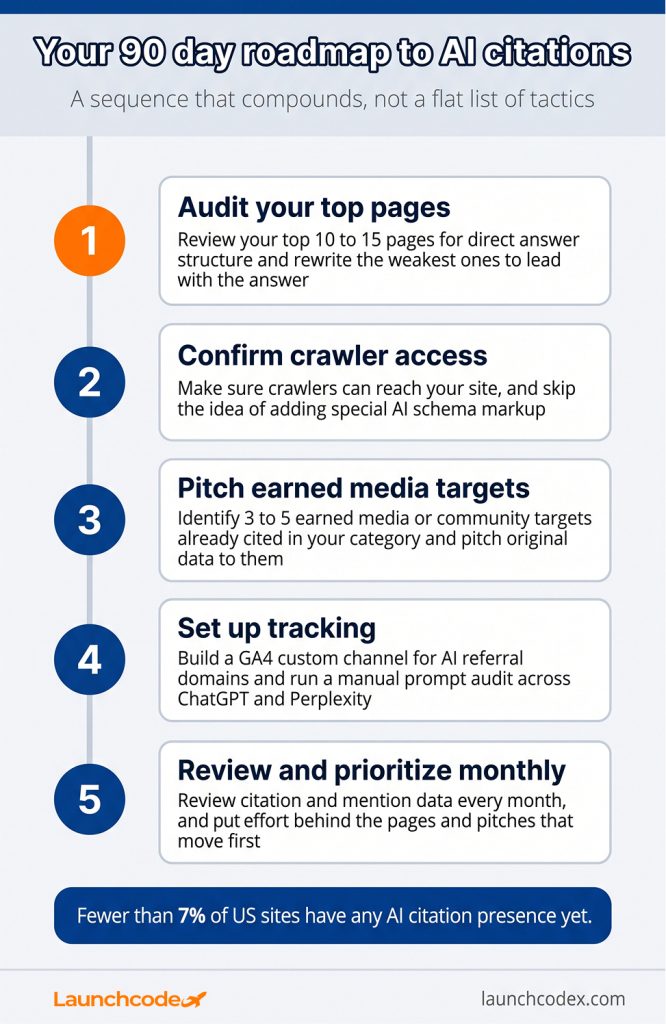
Start with the sequence that compounds, rather than a flat list of tactics.
Citations compound the way backlinks once did. Brands that start building corroborated, extractable content now, while under 7% of US sites earn any AI citation presence, get a real head start before the category catches up.
No. ChatGPT and Perplexity pull from a much wider set of sources than Google’s top 10, so a well-structured page can earn a citation without a top organic ranking. Google’s own AI Overviews are the exception, where top rankings still correlate strongly with citations.
No. A mention names your brand with no link. A citation links directly to your page as a source. Mentions build the corroboration that eventually leads to citations, but they are not interchangeable in measurement or strategy.
Not directly. Google’s own documentation confirms no special schema is required for AI Overviews or AI Mode, and Ahrefs research found no meaningful citation lift from adding it. Schema still supports standard rich results and page parsing.
Brands with existing earned media, active reviews, and well-structured content can see movement within weeks. Brands starting from a thin off-site presence should plan on a 90-day runway before citation frequency becomes measurable.


Real stories from the people we’ve partnered with to modernize and grow their marketing.