
Share:

AI marketing & automation


Most med spas post content without ever connecting it to bookings. Your practice might post daily, gain followers steadily, and still watch the appointment book stay flat. The problem is rarely effort. It is the absence of a system that ties content type, timing, and compliance together into something that converts a scroll into a scheduled visit.
This playbook lays out what to post, when to post it, and why each choice moves the needle on bookings rather than likes. You will find the content pillars that outperform the rest, platform-specific posting times pulled from healthcare data instead of generic social media benchmarks, the FTC and HIPAA rules that should shape content before it gets filmed, and a simple way to measure cost per booked appointment by channel.
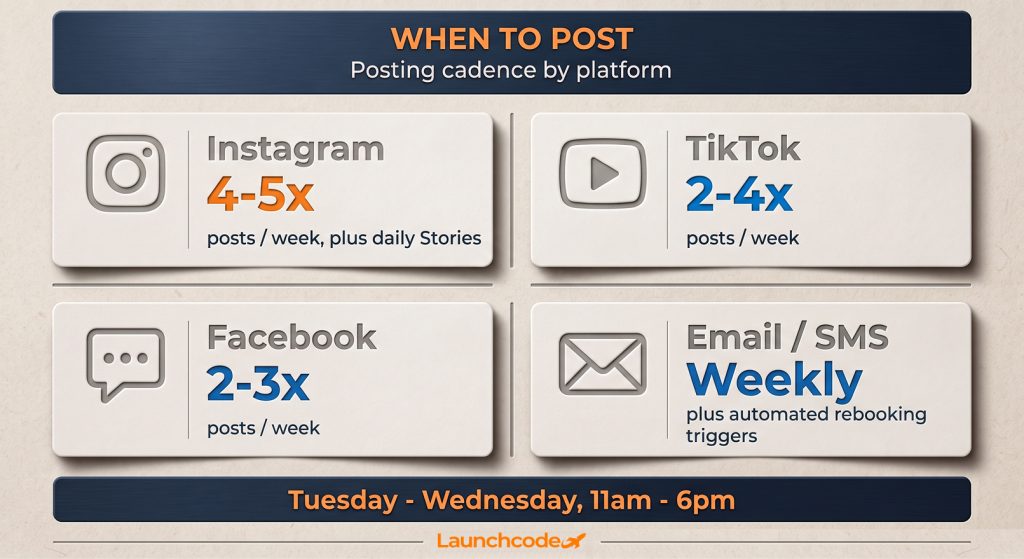
Five content pillars cover nearly everything a med spa should post: provider-led education, before-and-after results, patient reviews and user-generated content, behind-the-scenes and staff content, and offers or promotions. Education and before-and-after content consistently drive the most DMs and booking clicks, because they answer the two questions every prospective patient has: does this work, and can I trust this provider.
Each pillar plays a different role in moving a follower toward a booked appointment. Education content builds the trust that gets someone to click your bio link. Before-and-after content proves the outcome. Reviews and UGC confirm it from someone other than your practice. Behind-the-scenes content lowers the anxiety of walking into a treatment room for the first time. Offers close the loop for someone already on the fence.
| Content pillar | What it does | Booking impact | Best platform |
|---|---|---|---|
| Provider-led education | Answers “does this work” before a consultation | High | Instagram, TikTok |
| Before-and-after results | Proves the outcome visually | High | |
| Reviews and UGC | Builds trust from a source other than the practice | Medium to high | Google Business Profile, Instagram |
| Behind-the-scenes and staff | Lowers first-visit anxiety, builds familiarity | Medium | Instagram Stories, TikTok |
| Offers and promotions | Converts an already-warm follower | Medium | Email, Facebook |
A 2023 narrative review of peer-reviewed dermatology literature, published in JMIR Dermatology, found that physician and nurse-led educational content is one of the strongest drivers of patient trust on social media, while content from non-clinical creators carries a meaningfully higher risk of spreading medical misinformation. For your med spa, that means the provider explaining a treatment on camera, not a stock graphic or a generic caption, is the content most likely to move a viewer toward booking a consultation.
“When we build a content system for a med spa client, we default to putting the actual injector or nurse practitioner on camera for the first post of every week. That one habit changes DM volume more than anything else we test.” Derick Do, Co-Founder and Chief Product Officer
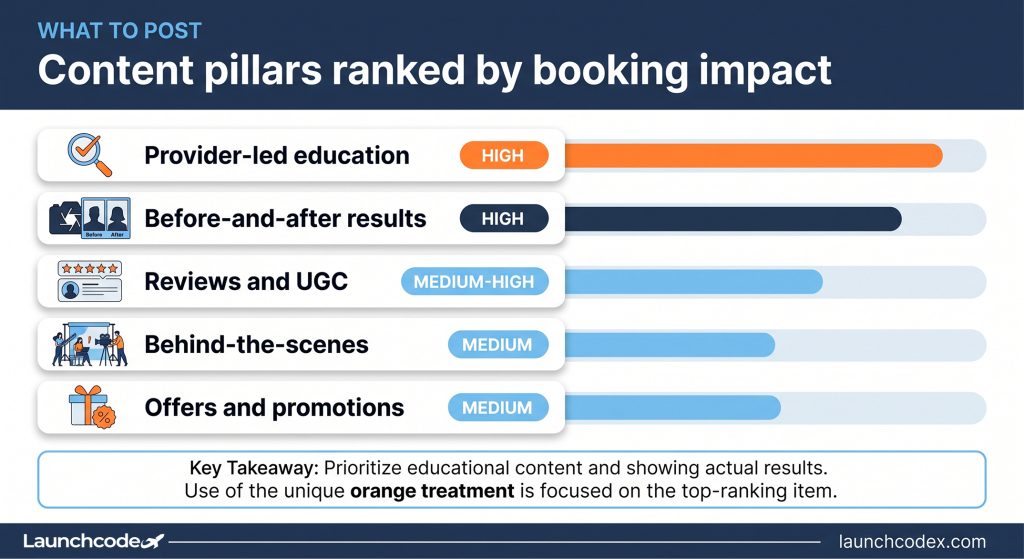
Post three to five times a week on your primary platform, and lean on healthcare specific timing rather than generic social media advice. Healthcare accounts on Instagram see engagement peak Mondays from noon to 9 p.m. and Wednesdays from 11 a.m. to 5 p.m., a pattern closer to a hospital’s social calendar than a retail brand’s weekend-heavy schedule.
Generic best-time-to-post data comes from retail, entertainment, and tech accounts. Med spa audiences check social media the way they check health information, during work breaks and midweek downtime, not primarily on weekends. Sprout Social’s 2026 posting time data, based on nearly 2 billion engagements across roughly 307,000 profiles, puts the overall best window between 11 a.m. and 6 p.m. with Tuesdays and Wednesdays outperforming every other day. Its healthcare specific benchmarks for Instagram narrow that further for practices in this category.
| Platform | Recommended frequency | Best days and times |
|---|---|---|
| 4 to 5 times a week, plus daily Stories | Mondays 12 to 9 p.m., Wednesdays 11 a.m. to 5 p.m. | |
| TikTok | 2 to 4 times a week | Midweek, midday to early evening |
| 2 to 3 times a week | Tuesday and Wednesday, midday | |
| Email or SMS | Weekly newsletter plus automated rebooking triggers | Tied to treatment timeline, not a fixed day |
“We pulled six months of posting data across our med spa clients, and Wednesday between 11 a.m. and 5 p.m. beat every other slot we tested. That lines up with what Sprout Social found at scale, so we stopped guessing and started scheduling around it.” Tanner Medina, Co-Founder and Chief Growth Officer
Med spas have an advantage most industries do not: predictable rebooking windows by treatment. Zenoti’s medical spa marketing guide points to a Botox rebooking window of roughly 10 to 12 weeks and a filler window of roughly 10 to 11 months. A content calendar that fires a treatment specific reminder inside those windows, rather than a generic monthly newsletter, turns content into a retention channel instead of just an acquisition one.
A large following does not book appointments. A booking link a follower can tap in three seconds does. The single biggest lever for converting content into bookings is removing friction between the moment someone trusts a post and the moment they can schedule, whether that means a bio link, a pinned post, or a DM auto-reply that sends a booking page.
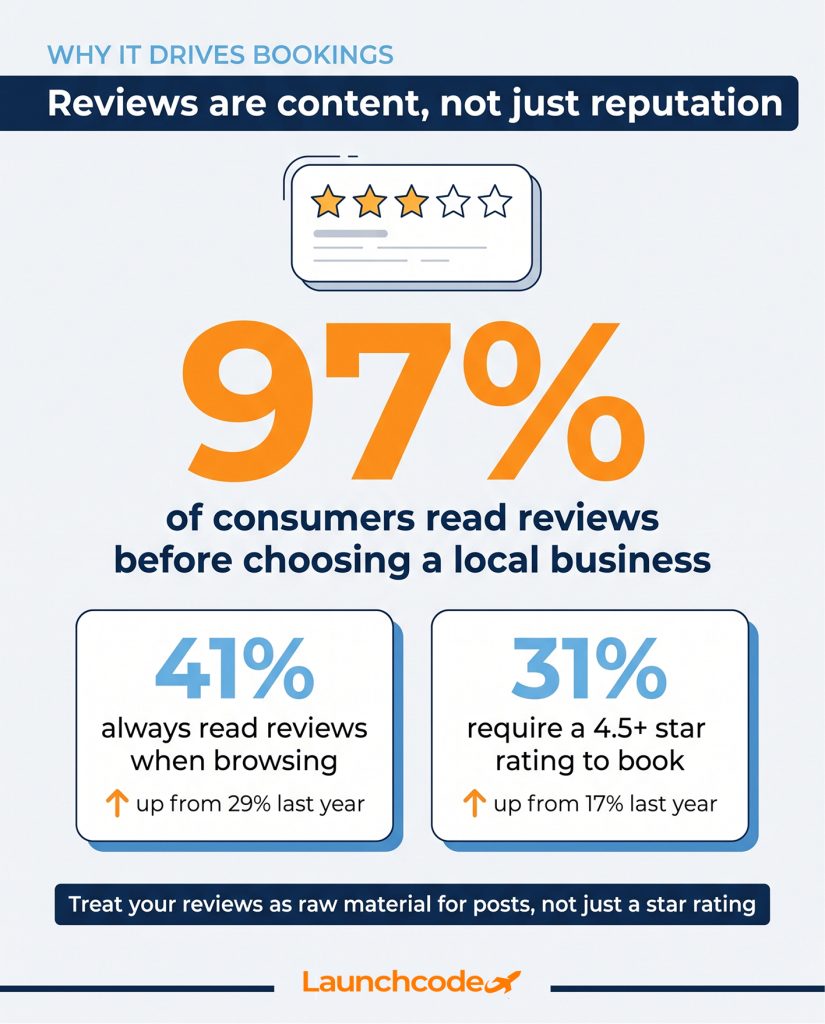
Reviews now function as content in their own right, not a separate reputation task. BrightLocal’s Local Consumer Review Survey found that 97 percent of consumers read reviews before choosing a local business, and 41 percent now always read reviews when browsing, up from 29 percent the year before. The same survey found that 31 percent of consumers will only consider a business rated 4.5 stars or higher, up from 17 percent the prior year. If you treat your reviews as raw material for posts, not just as a star rating on Google, you are publishing proof that closes a trust gap a before-and-after photo alone cannot.
Most med spa content guides stop at social media. Litmus found that email marketing returns an average of 36 dollars for every dollar spent, the highest return of any digital channel measured. Pairing social content that builds awareness with email and SMS sequences timed to the rebooking window closes a gap that pure social strategies leave open.
FTC rules require that any testimonial or before-and-after photo used in advertising come with a clear disclosure of what a typical patient can expect, and HIPAA requires a standalone signed marketing authorization before a patient photo or testimonial gets posted, separate from general treatment consent. Building both requirements into your content calendar up front avoids reshoots and takedowns later.
Compliance gets treated as a footnote in most med spa marketing guides. It should be a planning input instead, because it changes what gets filmed, not just what gets written in the caption.
FTC’s health advertising guidance is specific. Results shown in a testimonial or a before-and-after photo must reflect what a typical consumer can actually expect, not an outlier case, and any material connection, such as a free treatment given in exchange for a testimonial, must be disclosed clearly.
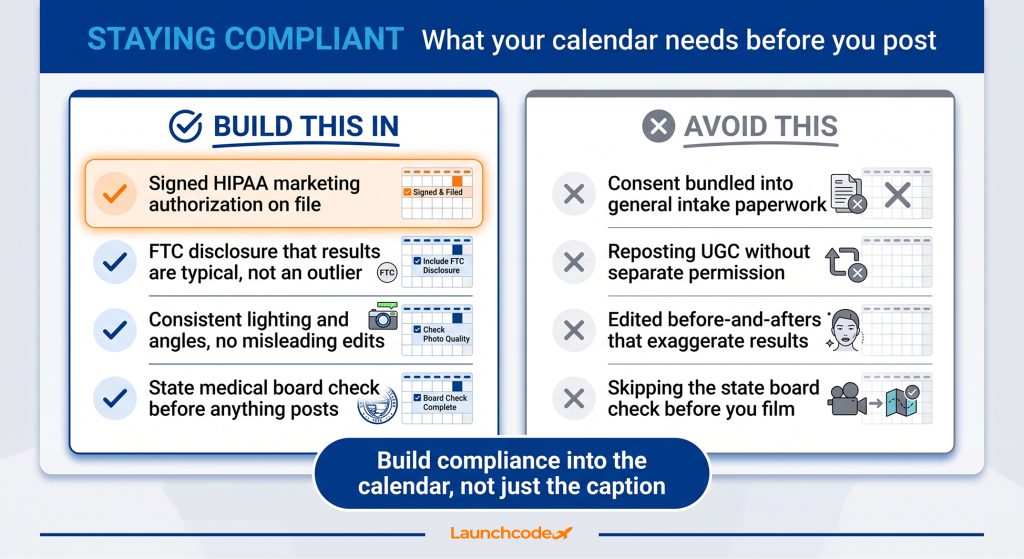
A signed treatment consent form does not cover marketing use. HIPAA requires a separate, standalone marketing authorization before a patient’s photo, video, or testimonial appears in an ad or a post. That authorization needs to exist before the camera comes out, not after the post is already scheduled.
“We build the marketing authorization step into the same workflow as the shot list now. If the form is not signed, the photo does not go in the content queue. That one rule has saved us from more takedown requests than anything else we have changed.” Derick Do, Co-Founder and Chief Product Officer
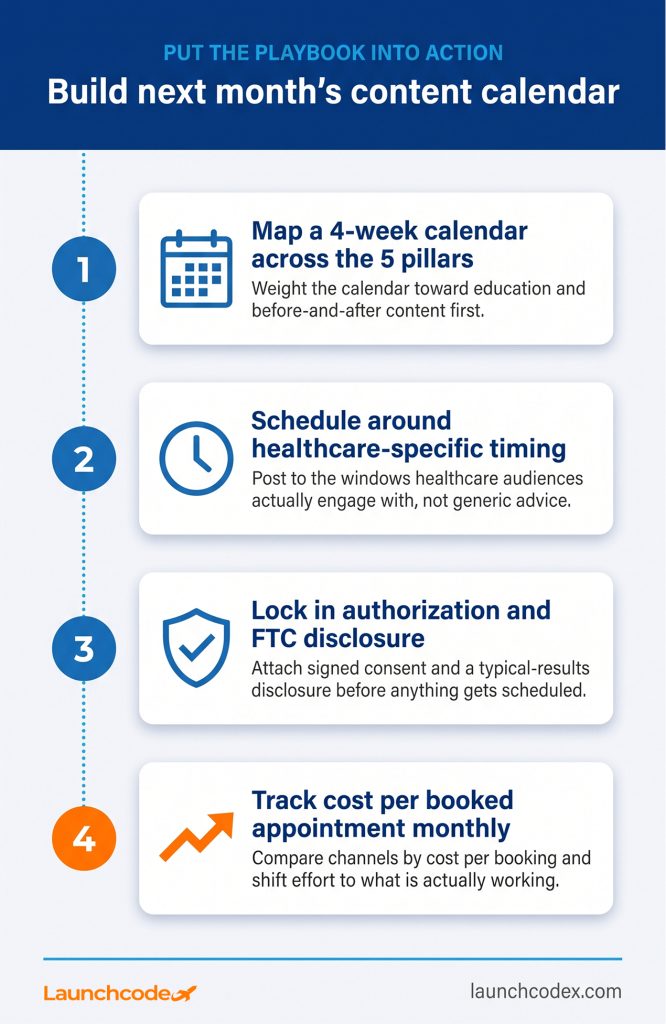
Cost per booked appointment, not likes or follower growth, is the metric that tells you whether your content strategy is working. Calculate it by dividing total time and spend on a channel by the number of appointments that channel produced in a month, then compare organic social, paid social, email, and Google Business Profile side by side.
Owners are often told to post more without being shown how to connect that activity to patient acquisition cost. A simple monthly routine closes that gap.
“Cost per booked appointment is the number we report on every month with med spa clients. Once an owner sees that email is returning more per hour than an extra Instagram reel, the whole content plan gets easier to prioritize.” Tanner Medina, Co-Founder and Chief Growth Officer
This is the layer where a content calendar becomes a growth system instead of a creative task. Treat each post as an input to a measurable pipeline, not a standalone piece of creative.
Building the system described here takes four steps.
This is the operating model we build for med spa clients at Launchcodex: content mapped to pillars, timed to healthcare engagement data, and measured against cost per booked appointment every month. Run this cycle consistently and you stop treating content as a daily scramble. It becomes a channel with its own return, measured the same way a paid ad campaign would be.
Three to five times a week on your primary platform, most commonly Instagram, plus daily Stories. Consistency across weeks matters more than posting every single day.
Yes, with a signed HIPAA marketing authorization separate from treatment consent, and an FTC compliant disclosure that the results shown are typical rather than exceptional.
Provider-led education and before-and-after results consistently outperform lifestyle or generic promotional posts, because they directly answer whether a treatment works and whether the provider can be trusted.
Instagram first, since it carries the strongest healthcare engagement data and doubles as a visual portfolio. TikTok works well as a second channel for short educational video once Instagram has a consistent cadence.
Track cost per booked appointment by channel every month, not likes or follower count. A channel with a lower cost per booking deserves more of next month’s content effort.


Real stories from the people we’ve partnered with to modernize and grow their marketing.