
Share:

AI marketing & automation


In March 2026, a Google research paper wiped nearly 100 billion dollars off memory chip stocks in a single week. Cloudflare CEO Matthew Prince called it “Google’s DeepSeek” moment on X. Within days, SK Hynix, Samsung, and Micron shares all fell. The paper was not about search rankings. It was about a compression algorithm called TurboQuant. SEOs and marketers noticed fast anyway, because TurboQuant touches the same technology behind Google’s AI Overviews.
This article covers what TurboQuant actually does, what Google has confirmed, and what remains speculation. Then it covers what this means for your SEO and GEO strategy, with a checklist you can act on this quarter.
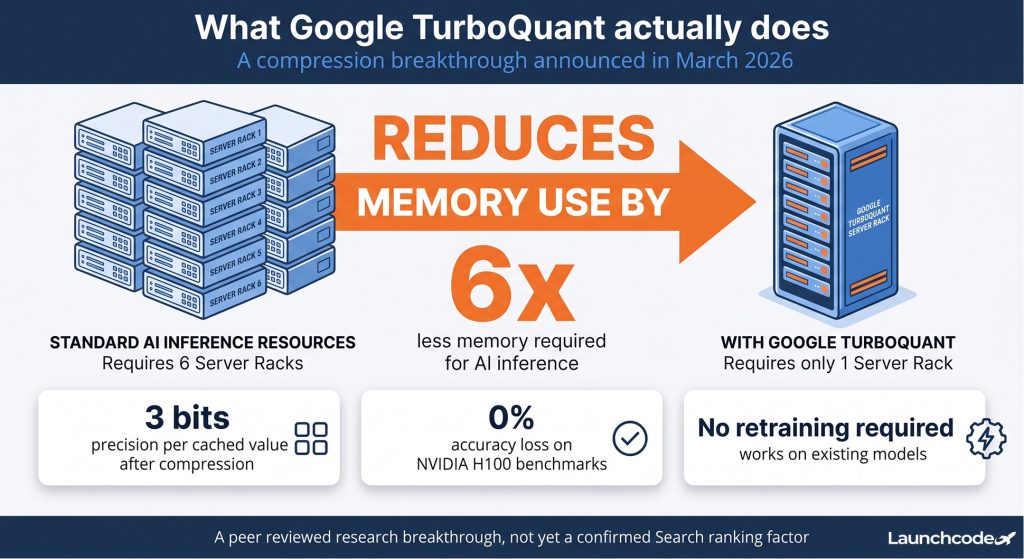
TurboQuant is a Google Research compression algorithm that shrinks the memory large language models need during inference by up to 6 times, with zero accuracy loss and no retraining required. It targets the key-value cache, the short-term memory an AI model uses to avoid recalculating earlier parts of a conversation. The same technique speeds up vector search, the system behind semantic search and AI-generated answers.
Google published the research in a Google Research blog post crediting a named team, including Praneeth Kacham and Rajesh Jayaram at Google, Majid Hadian at Google DeepMind, Insu Han at KAIST, Majid Daliri at NYU, and Lars Gottesbüren at Google. The paper was accepted to ICLR 2026, a peer-reviewed machine learning conference. This passed academic review before Google promoted it publicly.
TurboQuant runs in two steps:
Together, these steps compress data to roughly 3 bits per value while keeping retrieval quality close to the uncompressed original.
Every time a large language model processes a longer conversation or document, its key-value cache grows. Standard cache values are often stored at 16 or 32 bits of precision, so a long context window can consume enormous amounts of memory. That cost has been one of the biggest limits on how much text AI systems can handle at once, and TurboQuant attacks that limit directly.
“When compression cuts memory cost this much, it does not just save money. It changes what becomes technically possible to build, including how much context a retrieval system can afford to check before it answers.” Derick Do, Co-Founder and Chief Product Officer
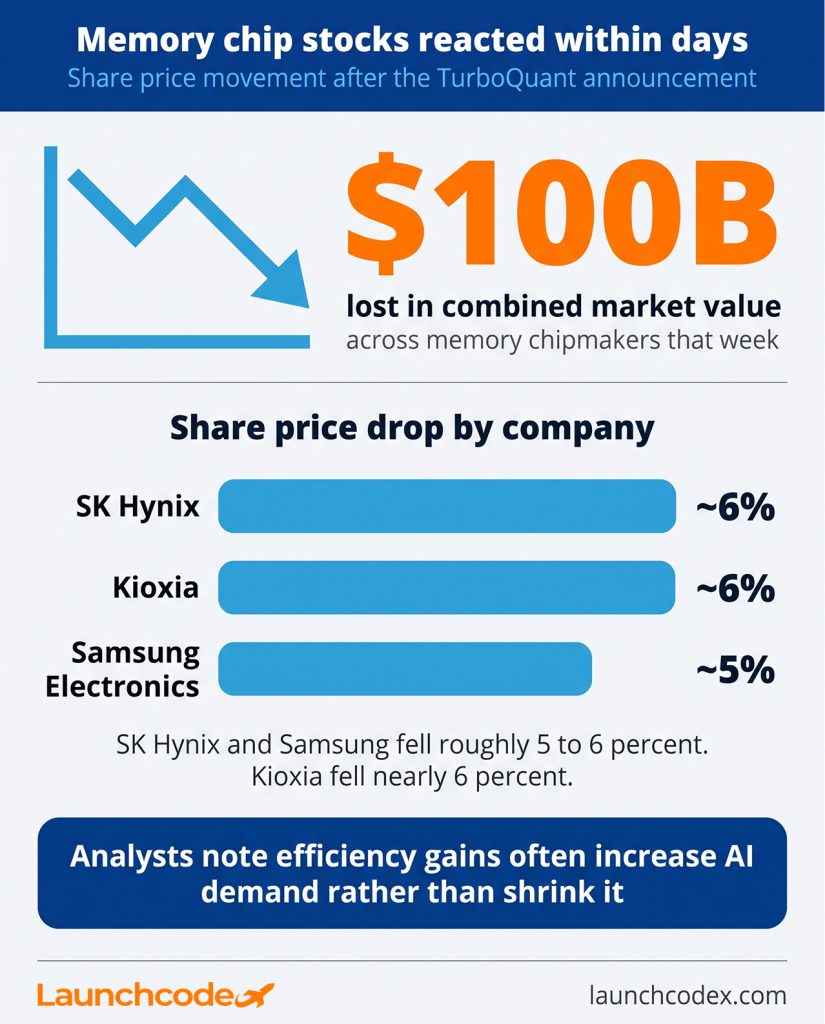
Memory chip stocks fell because investors read TurboQuant as a signal that AI infrastructure will need far less hardware, not because Google confirmed any change to Search rankings. SK Hynix and Samsung Electronics shares fell roughly 5 to 6 percent. Kioxia dropped nearly 6 percent. Micron fell in US premarket trade, according to the South China Morning Post. Combined, memory chipmakers lost close to 100 billion dollars in market value that week.
Matthew Prince, co-founder and CEO of Cloudflare, drove much of the panic with a single post. He described TurboQuant as “so much more room to optimize AI inference for speed, memory usage, power consumption,” according to Computing UK’s coverage. Investors compared it to the DeepSeek selloff from early 2025, when a Chinese AI lab claimed dramatically lower training costs and triggered a similar market shock.
Financial analysts pushed back fast. Morgan Stanley’s Shawn Kim argued in a research note that TurboQuant increases the throughput possible per chip, which lowers inference costs and could increase memory demand rather than shrink it, per the South China Morning Post. KB Securities’ Jeff Kim made a similar point, calling these “software optimization technologies aimed at low-cost, high-efficiency AI” that alone cannot absorb surging AI demand, as reported by Korea JoongAng Daily.
Google has confirmed TurboQuant works as a compression technique for KV cache and vector search. Google has not confirmed that TurboQuant is live inside Google Search rankings. That distinction matters, because most coverage of this topic blurs the line between a research breakthrough and a ranking factor.
Google’s blog post describes TurboQuant as a method for vector search and KV cache compression, not as a search ranking update. The compression claims, the 3 bit precision, the 6x memory reduction, and the accuracy preservation are backed by benchmark results on NVIDIA H100 GPUs. None of that is speculative. What is speculative is how, when, or whether Google applies this specific technique inside live Search infrastructure.
There is reason to think it eventually will. A separate Google vector search technology called MUVERA is believed to have been reflected in Google’s June 2025 core update, based on analysis reported by DigitalToday. Google has a track record of folding retrieval research into live ranking systems without a formal announcement. That history is why SEOs are paying attention now, before any confirmation.
TurboQuant makes vector search cheaper and faster, which removes a major cost barrier to running AI Overviews at scale, and AI Overviews are already the main driver of declining organic clicks. This part of the story matters more for your traffic than the stock market headlines.
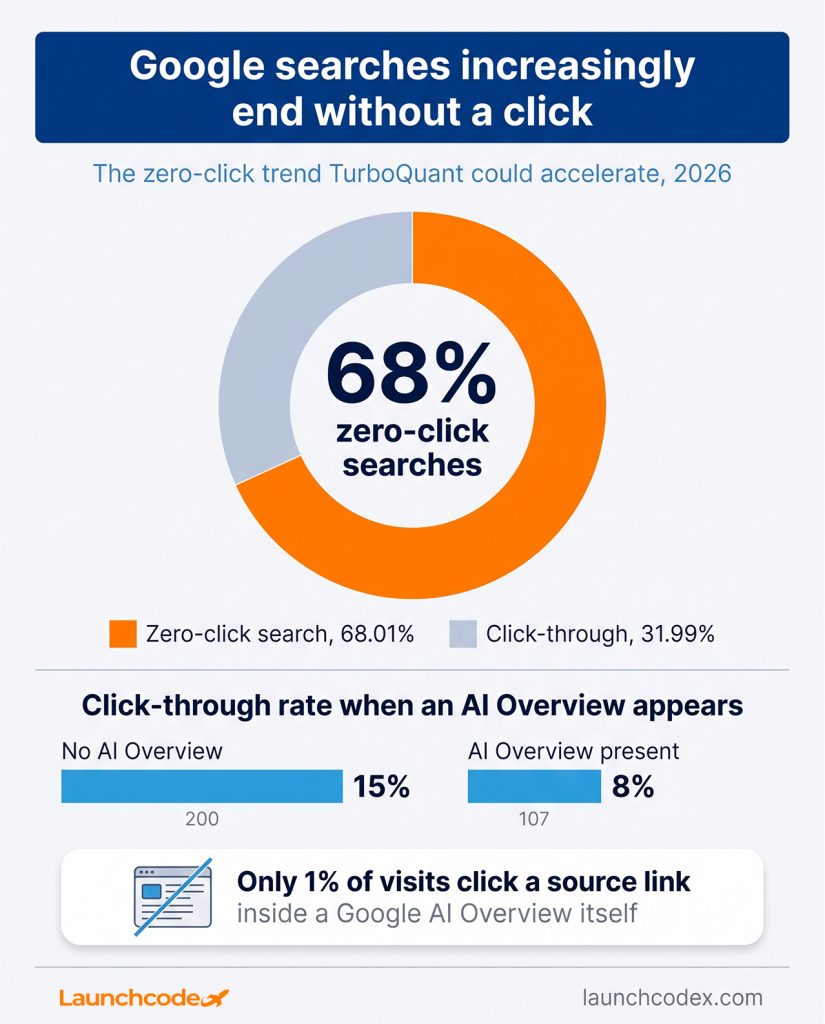
The trend predates TurboQuant by years, but it is accelerating. According to SparkToro’s 2026 research, 68.01 percent of US Google searches ended without a click to any website in the first four months of 2026, up from 60.45 percent in 2024. When an AI Overview appears, people click a traditional organic result about 8 percent of the time, compared to 15 percent when no AI Overview shows, based on Pew Research Center browsing data covering 68,879 searches, cited in a broader AI search statistics roundup. Only about 1 percent of visits result in someone clicking a source link inside the AI Overview itself.
If TurboQuant or a similar technique reaches production Search, Google can evaluate far more candidate pages per query in real time. That does not mean more AI Overviews appear automatically. It means the ones that do appear can pull from a wider, more precise set of sources, which raises the bar for what counts as a citation-worthy page. Thin, keyword-matched content becomes less competitive once the system can afford to look past surface-level phrase matching.
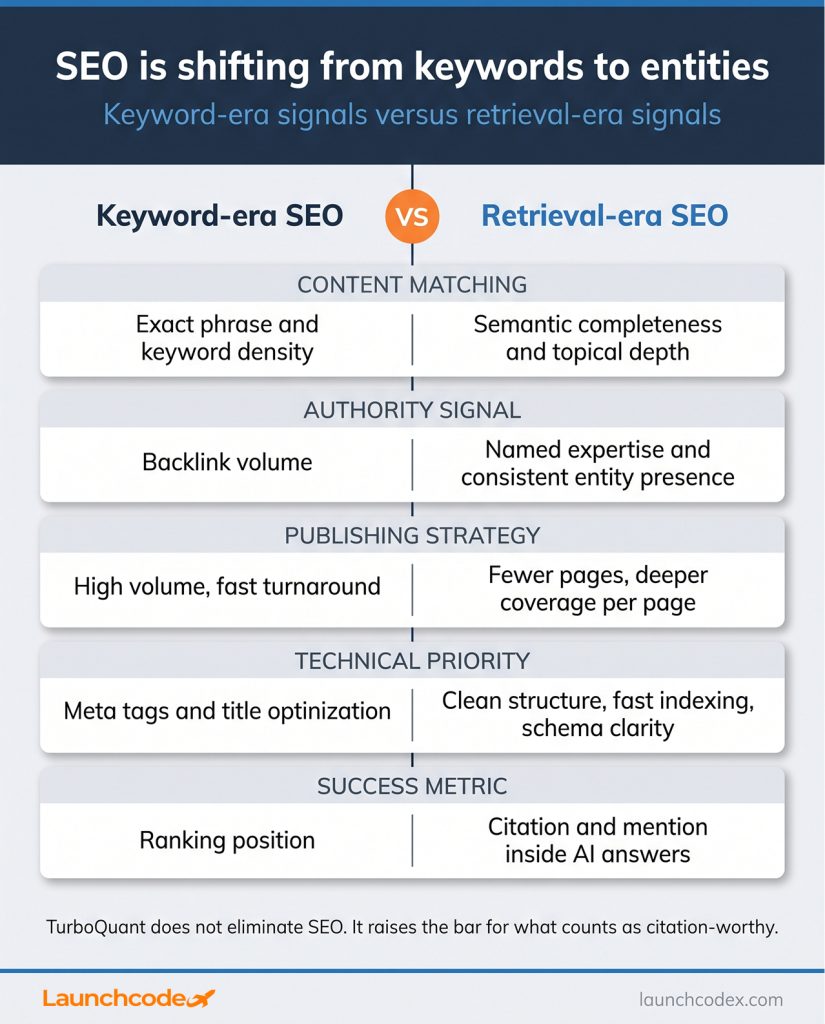
TurboQuant strengthens a shift already underway, where Google rewards content recognized as coming from a trusted, specific source over content that simply matches a search phrase. SEO and AI consultant Marie Haynes captured this directly, telling DigitalToday that search is likely to shift toward “content itself is reflected in rankings more than SEO phrases or links.”
“We stopped measuring content success by ranking position alone two years ago. Citation inside an AI answer is the number our clients actually care about now.” Tanner Medina, Co-Founder and Chief Growth Officer
| Signal type | Keyword-era SEO | Retrieval-era SEO |
|---|---|---|
| Content matching | Exact phrase and keyword density | Semantic completeness and topical depth |
| Authority signal | Backlink volume | Named expertise and consistent entity presence |
| Publishing strategy | High volume, fast turnaround | Fewer pages, deeper coverage per page |
| Technical priority | Meta tags and title optimization | Clean structure, fast indexing, schema clarity |
| Success metric | Ranking position | Citation and mention inside AI answers |
The right response to TurboQuant is not a full strategy overhaul. It is a focused audit of content depth, technical readiness, and entity signals that were already worth strengthening before this announcement. Here is a process to run this quarter.
“The technical audit almost always surfaces more opportunity than the content audit. Sites lose visibility to slow indexing and messy schema long before AI ever gets involved.” Tanner Medina, Co-Founder and Chief Growth Officer
At Launchcodex, this is the same audit sequence run for clients before any content sprint, starting with technical and structural readiness before touching a single headline. That order matters more than most teams assume, because no amount of good writing fixes a page a retrieval system cannot process cleanly.
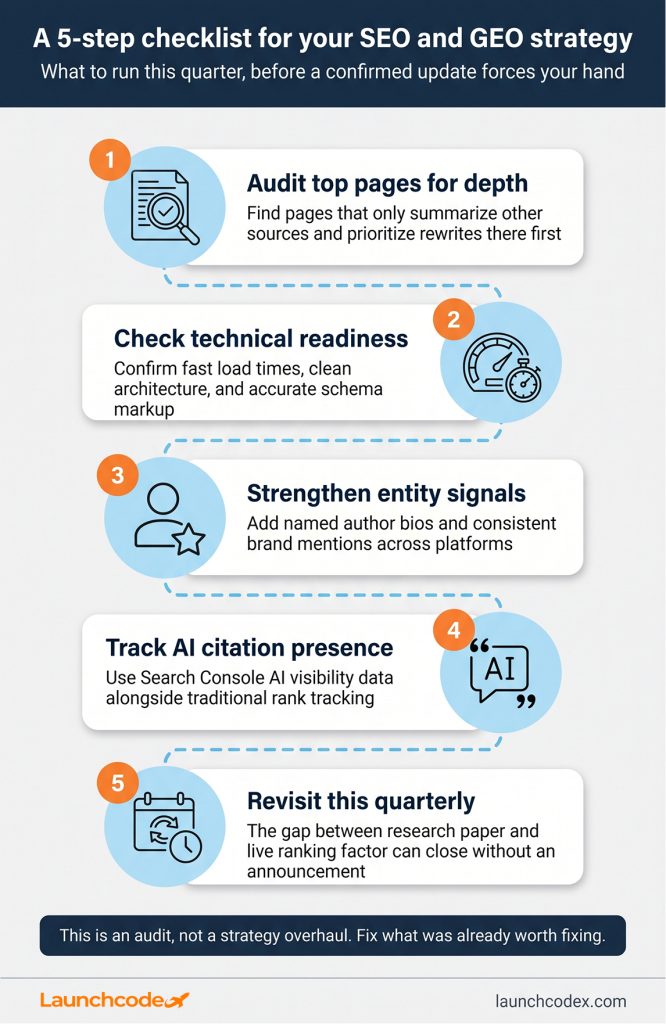
TurboQuant is not a search algorithm update. It is infrastructure. It makes Google’s existing direction, pulling AI answers from more sources, cheaper to run at scale. The SEO fundamentals that already mattered for AI Overviews, depth, technical readiness, and recognizable expertise, now matter faster and more broadly.
The teams that adapt well will not be the ones who panicked over a stock market headline. They will be the ones who used this moment to fix the thin content and technical debt they already knew about. If you want a second set of eyes on where your site stands against these retrieval-era signals, Launchcodex runs SEO and GEO audits built around exactly this kind of shift.
No confirmation exists either way. Google has confirmed TurboQuant as a compression technique for AI models and vector search. It has not confirmed the technique is active inside Search rankings.
No. Keyword research still tells you what people search for. What changes is how much weight exact phrase matching carries compared to topical depth and semantic completeness.
No. TurboVec is a third-party open-source library that implements the TurboQuant technique for vector databases. Google published TurboQuant. Google did not publish TurboVec.
It could, since cheaper vector search removes a cost barrier to scaling AI Overviews. Google has not confirmed a change in AI Overview frequency tied specifically to TurboQuant.
Audit your highest traffic pages for genuine depth. Pages that only summarize other sources are the most exposed, regardless of whether TurboQuant reaches live Search this year or later.


Real stories from the people we’ve partnered with to modernize and grow their marketing.