

Share:

AI marketing & automation


Most creative teams don’t have a talent problem. They have a systems problem. As demand scales across paid, organic, email, and web channels, production breaks down. Assets go out inconsistently. Reviews pile up. Leadership responds by hiring more people, which doesn’t fix the structural issue.
This article covers how to build a creative system that solves the problem at the root. You’ll learn the five-layer architecture behind scalable creative production, where AI fits and where it doesn’t, and the KPIs that tell you whether your system is actually working.
Creative demand now grows faster than headcount can absorb. The math stops working around the 25-to-30-client mark for agencies, or when a brand expands across three or more active channels at once. The problem is not effort or talent. It is that the production model is built for single requests, not systems. Adding designers treats the symptom, not the cause.
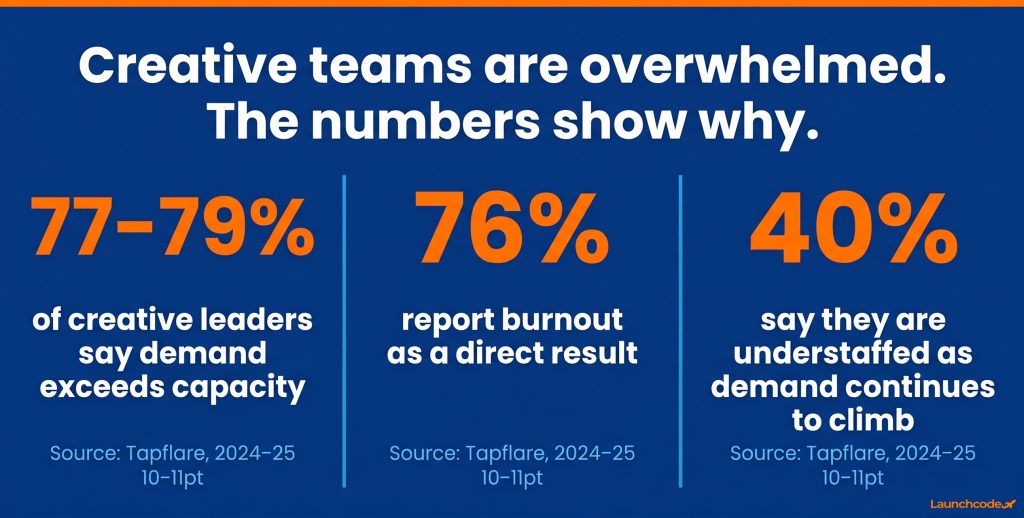
According to 2024 to 2025 benchmarks from Tapflare, 77 to 79 percent of creative leaders say demand exceeds their team’s capacity, and 76 percent report burnout as a direct result. Meanwhile, 40 percent say they are understaffed even as demand continues to climb.
The bottleneck compounds fast. Ad performance is driven up to 80 percent by content quality, which means falling behind on creative output directly hurts campaign results. Brands that can’t produce fresh, on-brand creative at speed don’t just slow down. They lose ground to competitors who can.
Teams without a system show predictable signs:
These are not execution failures. They are architecture failures. The team doesn’t have a system. It has a series of manual steps that don’t connect.
Adding designers increases output linearly at best. It also increases overhead, management complexity, and the risk of brand inconsistency as more people make independent creative decisions without a shared governance framework. The brands that scale output without proportionally scaling headcount treat production as a system, with defined inputs, governed processes, and structured outputs.
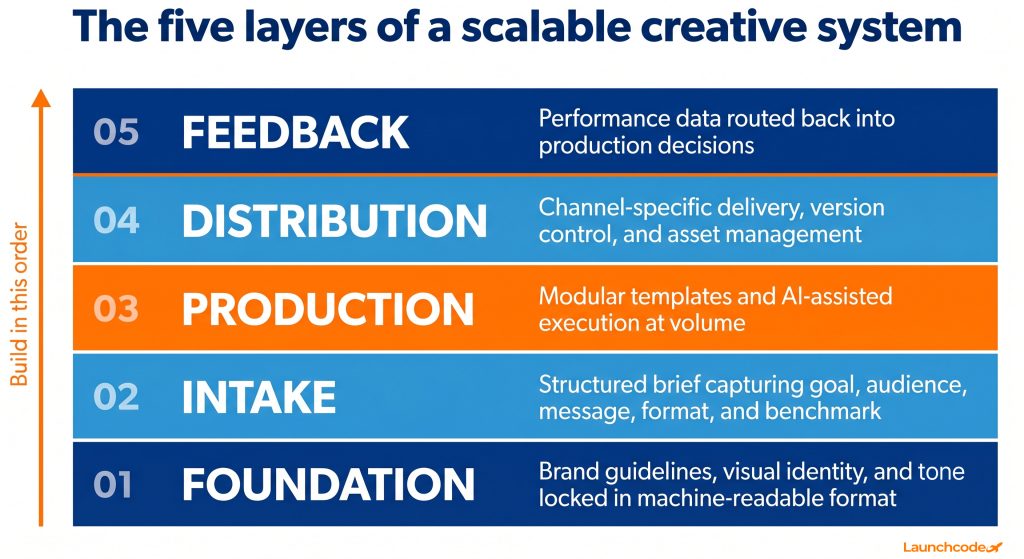
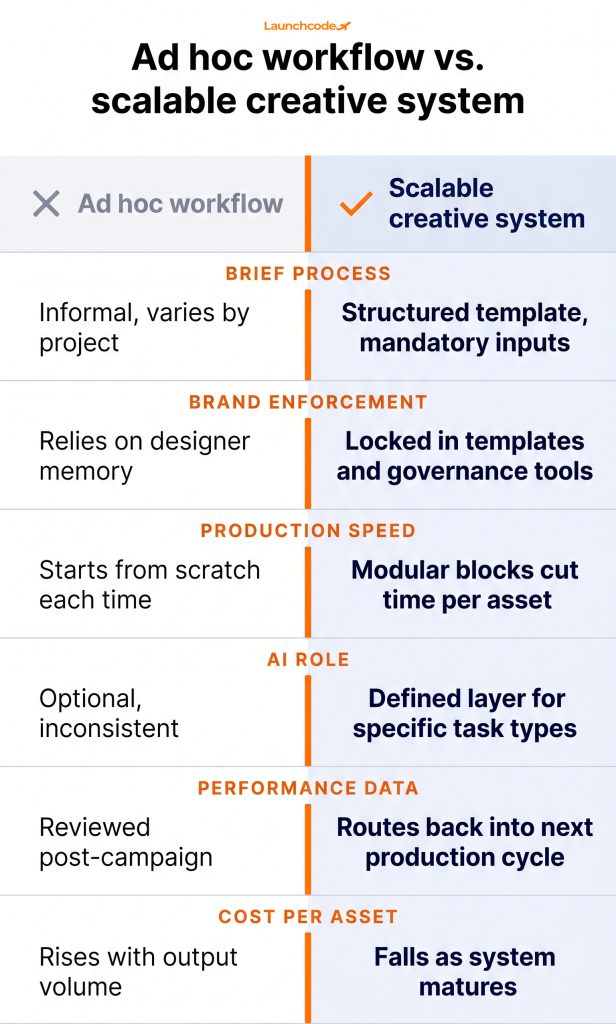
A creative system is a layered architecture that connects brand inputs to finished assets through repeatable, governed processes. It is not a workflow. A workflow describes how tasks move. A system describes how inputs become outputs through rules, tools, and feedback. Only a system scales reliably without constant human oversight at every step.
Each layer depends on the one before it. Teams that add automation without a solid foundation, or scale production without a feedback loop, end up with volume without value.
| Dimension | Ad hoc workflow | Scalable creative system |
|---|---|---|
| Brief process | Informal, varies by project | Structured template, mandatory inputs |
| Brand enforcement | Relies on designer memory | Locked in templates and governance tools |
| Production speed | Starts from scratch each time | Modular blocks cut time per asset |
| AI role | Optional, inconsistent | Defined layer for specific task types |
| Performance data | Reviewed post-campaign | Routes back into next production cycle |
| Cost per asset | Rises with output volume | Falls as system matures |
Brand governance is the first and most critical layer of any scalable creative system. Before you automate production or introduce AI tools, your brand guidelines need to exist in a format that machines can interpret, not just designers. Vague rules produce inconsistent results at human scale. At AI-assisted scale, they produce brand dilution at speed.
The team at Monigle puts it plainly in their blueprint for converting brand guidelines into AI-ready systems: “If you treat AI like a creative hire who’ll figure it out, you’re setting yourself up for brand dilution at scale.”
Consistent brand systems also pay off on the revenue side. Holistic brand identity systems can increase revenue by up to 23 percent and improve customer trust across digital platforms. That return only materializes when guidelines are enforced, not just documented.
Standard brand guidelines cover logo rules, color palette, typography, and tone. A system-ready version goes further:
A locked brand foundation is only as useful as the brief that activates it. Every production cycle in a scalable system starts with a structured brief that captures:
Without a structured brief, production relies on interpretation. Interpretation at scale means inconsistency.
Modular content is the production architecture of a scalable creative system. Instead of building each asset from scratch, modular design treats creative as a set of reusable building blocks: headlines, visuals, proof points, CTAs, and benefit statements. One core concept becomes dozens of on-brand variations across formats and channels without duplicating effort or restarting production.
Microsoft Advertising describes modular content as breaking campaigns into smaller, reusable blocks tagged with metadata for audience, intent, and format. These components mix and match across paid search, social carousels, email, and display without rebuilding the underlying concept each time.
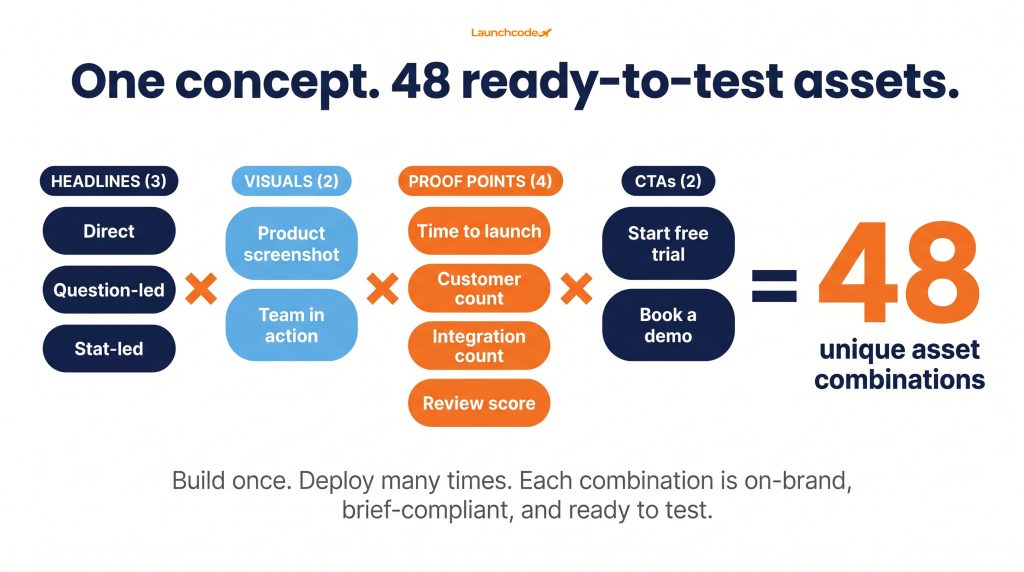
A practical example: a SaaS brand runs a campaign around fast onboarding. In a modular system, the creative team builds:
That combination produces 48 unique asset variations from a single concept build. Each combination is on-brand, brief-compliant, and ready for testing. The team builds once and deploys many times.
Agencies that break through the 30-client barrier do so because they separate creative concept from mechanical versioning. Modular production makes that separation structural.
“The fastest creative teams aren’t starting from scratch every time. They’ve built the decisions into the system so the work is about making smart choices within the guardrails, not rebuilding the foundation for every brief.”
Georgia Callahan, Executive Creative Director
Modular systems fail when templates become too rigid. If every asset looks identical because the template leaves no room for variation, the system produces volume without distinctiveness. The fix is to design templates with locked zones and flexible zones. Lock the brand elements: colors, fonts, logo placement, legal disclaimers. Leave flexible zones open for headlines, images, and CTAs. Designers set the rules. The system executes within them.
AI belongs in the execution layer of a creative system, not the strategy layer. It handles mechanical tasks: generating variants, translating assets for new markets, resizing formats, producing copy drafts, and checking brand compliance. Human judgment sets the creative direction, approves the output, and decides which concepts are worth scaling. Confusing these two roles is where most AI creative integrations break down.
According to Google and Kantar research on the creative measurement gap, 57 percent of marketers already use AI for creative production, and 45 percent use it to produce campaign asset variants. Gartner projects that by 2026, 80 percent of creative professionals will integrate generative AI into their daily workflows. It is no longer a strategic differentiator. It is a baseline operational expectation.
Rachael Murphy, Head of Solutions Marketing at Adobe, describes the shift in Adobe’s analysis of AI-driven brand storytelling: “The tools that are evolving with AI are becoming a foundational platform. This makes it easier to get really impactful brand content out into market much quicker, so that marketing teams and creatives can really focus on brilliant creative and the rest can be agile and automated.”
Mirella Crespi, a DTC creative strategist, outlines a concrete application in her scaling workflow documented by Motion: “If you have proven ads in the US and you want to scale to other countries, use AI to overdub, translate, and test these new markets.” A proven concept can be adapted and tested in a new context before committing production resources to it, whether you are expanding internationally or moving into a new channel.
The results at enterprise scale are well-documented. MegaFood used an AI-assisted production platform to create and approve 1,100 assets in under four weeks, cutting costs by 40 percent compared to freelance production that had taken eight months for equivalent scope. Samsung went from brief to 500 approved assets in one hour.
According to 2026 marketing operations benchmarks, 62 percent of campaigns are now end-to-end automated, up from 38 percent in 2023. The remaining 38 percent, covering briefs, creative review, and reporting interpretation, still requires human judgment. That is not a capability gap. It is the design.
| Tool | Best for | Key capability |
|---|---|---|
| Adobe GenStudio | Enterprise creative teams | Brand-trained AI for personalized ads and emails |
| Adobe Firefly | Visual asset production | On-brand image generation from structured prompts |
| Hunch | Agency multi-channel versioning | Dynamic creative automation across Meta, TikTok, Snap |
| Rocketium AI Studio | High-volume enterprise production | AI agents with human QA built into the workflow |
| AdCreative.ai | Paid social creative at scale | Predictive creative scoring before launch |
| Motion | Creative analytics | Routes performance data back into creative decisions |
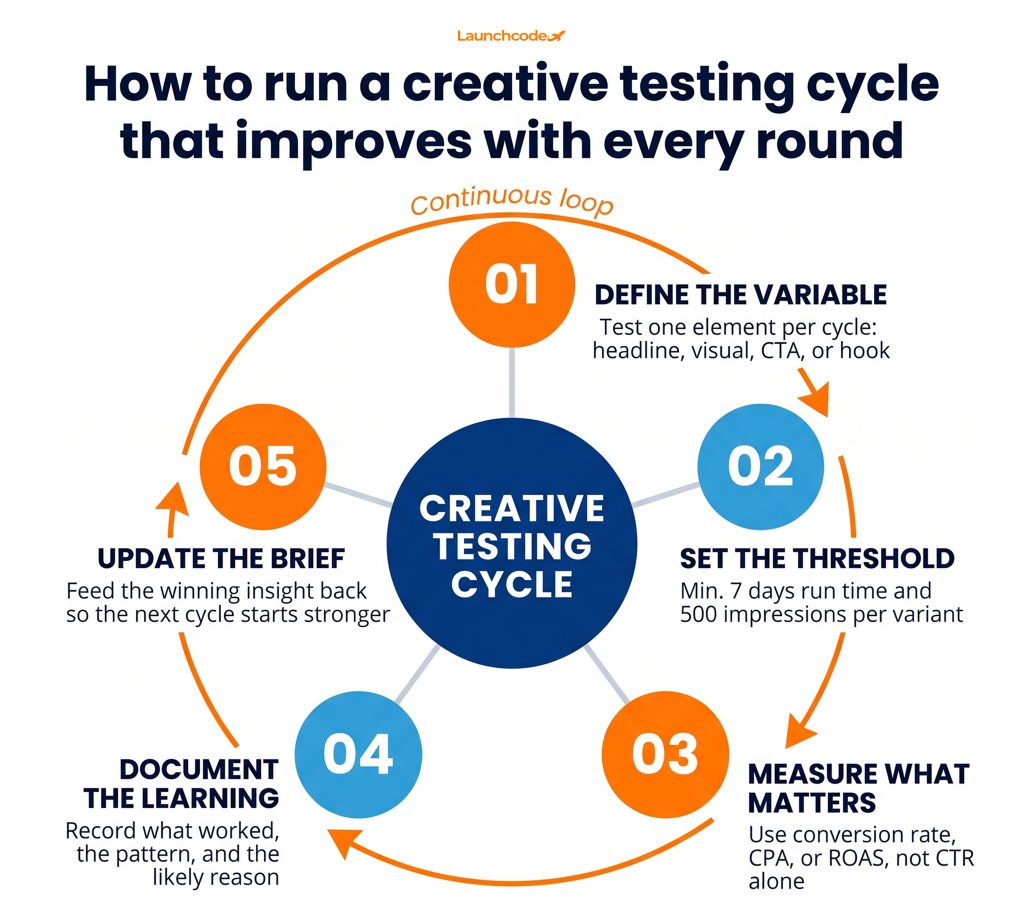
The feedback loop is what separates a creative system from a creative factory. A factory produces volume. A system learns what works and routes that knowledge back into the next production cycle. Without this loop, scale amplifies good and bad creative equally. With it, the system improves over time and the cost of producing winning assets falls as data accumulates.
Brands that use structured creative testing frameworks scale campaigns four times faster than those relying on unstructured launches. That speed advantage comes from knowing what works before committing full media spend to it.
“Most clients don’t have a creative quality problem. They have a feedback problem. The creative that performs sits in a campaign dashboard that nobody connects back to the next brief. Building that loop is where the real efficiency comes from.”
Brittany Charles, SVP, Client Services
Scale a creative when it holds performance across at least two consecutive measurement windows. A single strong result may be variance. Two consistent results indicate a pattern worth backing with budget.
Retire a creative when frequency rises and engagement drops. On most platforms, this happens within 10 to 14 days for high-reach placements. The signal is a declining hook rate or rising CPA, not a fixed calendar date.
Patterns in what stops working are as informative as patterns in what converts. Document both with the same rigor. Retired creative informs your next concept direction just as much as your winners do.
Creative system performance is not the same as campaign performance. Campaign metrics tell you whether a specific asset worked. System metrics tell you whether the architecture is functioning. A healthy creative system improves on three dimensions over time: speed, cost, and consistency. If any of these regresses while volume grows, the system has a structural problem.
Only 3 percent of companies can attribute more than 50 percent of their marketing spend to measurable return, according to monday.com’s overview of creative strategy best practices. Closing that gap requires tying creative decisions to business outcomes at the system level, not just the campaign level.
| KPI | What it measures | Target direction |
|---|---|---|
| Time to market | Brief intake to live asset | Decreasing |
| Cost per asset | Total production cost divided by assets produced | Decreasing as system matures |
| Revision rate | Number of rounds before approval | Decreasing |
| Brief-to-launch ratio | Assets produced per brief submitted | Increasing |
| First-pass approval rate | Assets approved without revision | Increasing |
Track the right metrics at the right level. Production KPIs measure the system. Performance KPIs measure the output. Both need to be visible to the same team at the same time.
A scalable creative system does not eliminate creative roles. It shifts what those roles do. Designers stop versioning and start directing. Strategists stop writing briefs and start analyzing performance patterns. Production managers stop chasing approvals and start governing a workflow. The team contracts in execution headcount and expands in strategic contribution per person.
High-quality creative drives more than 4.7 times as much profit as low-quality creative, according to research from Kantar and WARC. The competitive advantage doesn’t come from producing more creative. It comes from producing better creative faster, which requires people focused on quality decisions rather than mechanical tasks.
Florind Metalla, founder of METALLA, identifies the core failure point in his guide to scalable creative strategy: “Most brands don’t fail because of bad ideas. They fail because they lack a clear, repeatable creative strategy that consistently connects thoughtful planning to impactful execution.”
These are not always separate hires. In smaller teams, they are responsibilities distributed across existing roles. The requirement is that someone owns each function explicitly, not by default.
The most common mistake when building a creative system is building the technology layer first and restructuring the team last. When roles are not clearly defined before automation goes live, the system produces output but no one is accountable for quality decisions. Governance breaks down within months.
Set the governance and role structure before switching on automation. Then run the system, observe where it strains, and adjust both the roles and the tooling from there.
A creative system is built in sequence: brand foundation, then structured intake, then modular production, then AI-assisted execution, then a testing and feedback loop. Each layer depends on the one before it. Skipping layers produces short-term velocity and long-term inconsistency.
The teams that scale creative successfully share one trait. They treat production as a business discipline with defined inputs, governed processes, and measurable outputs, not as something that depends entirely on who is available and talented enough to carry it.
Angad Singh of Segwise frames the competitive reality clearly: the organizations that win will be the ones that “can produce 10 new, data-backed creative iterations in the time it takes their competitors to launch one unproven concept.”
At Launchcodex, we build creative systems as part of our full-service engagements, connecting brand strategy, AI automation, and performance feedback into a single operating model. If your creative production has become a bottleneck rather than a growth driver, our creative and AI automation services are designed to help you change that.
A creative system is a layered architecture that connects brand governance, structured briefs, modular production, AI-assisted execution, and a performance feedback loop. It governs how creative output moves from intake to finished asset through repeatable, governed processes.
A workflow describes how tasks move from person to person. A system describes how inputs become outputs through defined rules, templates, tools, and feedback. Systems scale reliably without requiring constant human oversight at every step. Workflows break down as volume grows.
AI belongs in the production and distribution layers, not in strategy or governance. It handles variant generation, format resizing, market adaptation, and brand compliance checks. Human judgment sets direction, approves all output, and interprets performance data.
Track time to market, cost per asset, revision rate, and first-pass approval rate as production KPIs. Track ROAS by creative type, hook rate, and creative fatigue signals as performance KPIs. Both sets are required to know whether the system is functioning as intended.
Not necessarily. A mature creative system shifts designer effort from production to direction. Teams often hold flat on headcount while producing significantly more output. What changes is the distribution of effort: less time on mechanical tasks, more time on concept, direction, and quality decisions.
Bring in external support when the governance layer needs to be built from scratch, when AI tools need to be configured and trained on your brand assets, or when your team has execution skills but lacks the systems design experience to build the architecture correctly from the start.


Real stories from the people we’ve partnered with to modernize and grow their marketing.