
Share:

AI marketing & automation


Empty chairs cost real money. A peer-reviewed study of more than 15,000 dental appointment records found about 9 percent of appointments missed and nearly 17 percent canceled. Each gap is chair time you cannot resell that day. Most practices answer this with one more reminder text and hope for the best.
This guide takes a different angle. You will learn why patients skip appointments, how patient education changes attendance and treatment acceptance, and how to build a content system that pairs with reminders to keep your schedule full. The goal is fewer no-shows and higher case acceptance, backed by data instead of guesswork.
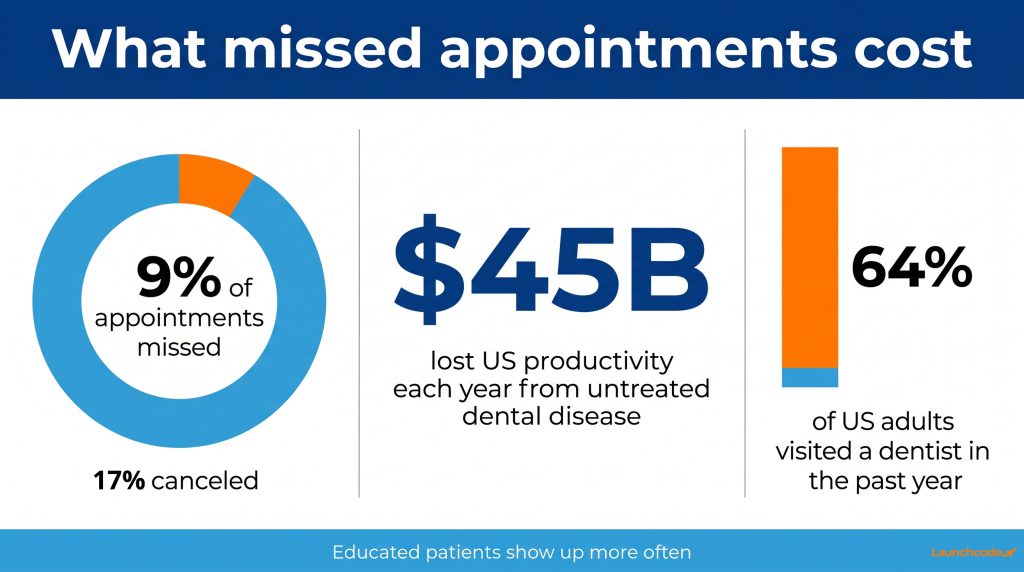
Every no-show is lost production you cannot recover. Peer-reviewed records show roughly 9 percent of dental appointments missed and almost 17 percent canceled. With untreated dental disease costing the United States over 45 billion dollars in lost productivity each year, missed care hurts patients and practices alike. Fixing it starts with knowing who misses and why.
A no-show differs from a cancellation. A cancellation gives you a chance to refill the slot. A no-show leaves the chair empty with no warning. Both drain revenue, but no-shows also break your hygiene schedule and delay needed care.
The same CDC data shows only 64 percent of US adults visited a dentist in the past year. That gap between need and attendance is your opening. Patients who understand the value of regular care close it. The math is simple. Fewer empty chairs means more production from the same staff and the same overhead.
No-show risk varies by patient. A 2025 study in the International Journal of Dentistry found adolescents ages 12 to 17 had the highest no-show rate at 24 percent. The same study found self-pay appointments produced more no-shows than publicly insured ones, 16 percent versus 11 percent. Cost uncertainty drives behavior. Segment your content and reminders so the right message reaches the right patient.
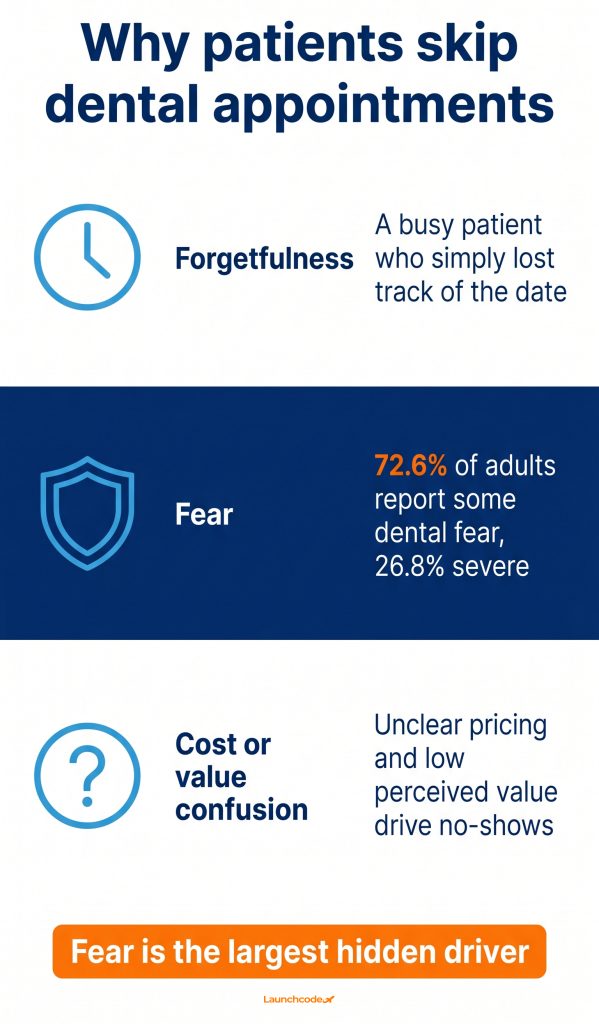
Patients miss appointments for three main reasons. They forget, they fear the visit, or they do not understand the cost or value of care. Fear is the largest hidden driver. A 2024 census matched survey found most US adults report some level of dental fear. Content that addresses each cause directly can change behavior long before the appointment date.
You cannot fix a problem you have not named. Group your no-shows by cause and you can match content to each one.
Fear keeps patients away more than any reminder system can fix on its own. A national survey published in the Journal of the American Dental Association found 72.6 percent of adults reported some dental fear, with 26.8 percent severe. A global meta-analysis confirmed that dental fear drives avoidance and worse oral health. The JADA survey also found that 71 percent of fearful patients wanted digital tools to help. Content that walks through a procedure step by step, in plain language, lowers that fear.
Many no-shows come down to a busy patient who simply forgot, or one who feared a surprise bill. Both have content fixes:
Educated patients act. When people understand why a cleaning matters and what a procedure involves, they keep appointments and accept more treatment. Research ties clear communication to lower anxiety and higher adherence. Most practices under-communicate, which makes structured educational content one of the cheapest ways to win back lost production.
This is the bridge between marketing and operations. Content is not only for new patients. It changes how existing patients behave.
A peer-reviewed literature review on dentist-patient communication found that clear communication empowers patients to make informed decisions, reduces anxiety, and increases adherence. The American Dental Association notes that dentists with the fewest complaints spend more time with patients and listen actively. Content extends that listening beyond the chair, where most of the patient’s life happens.
The opportunity is large because the bar is low. A study of California providers found most used only a fraction of recommended communication techniques, 6 of 18 in one count, with a lack of plain-language patient materials as a key barrier. Common mistakes to avoid:
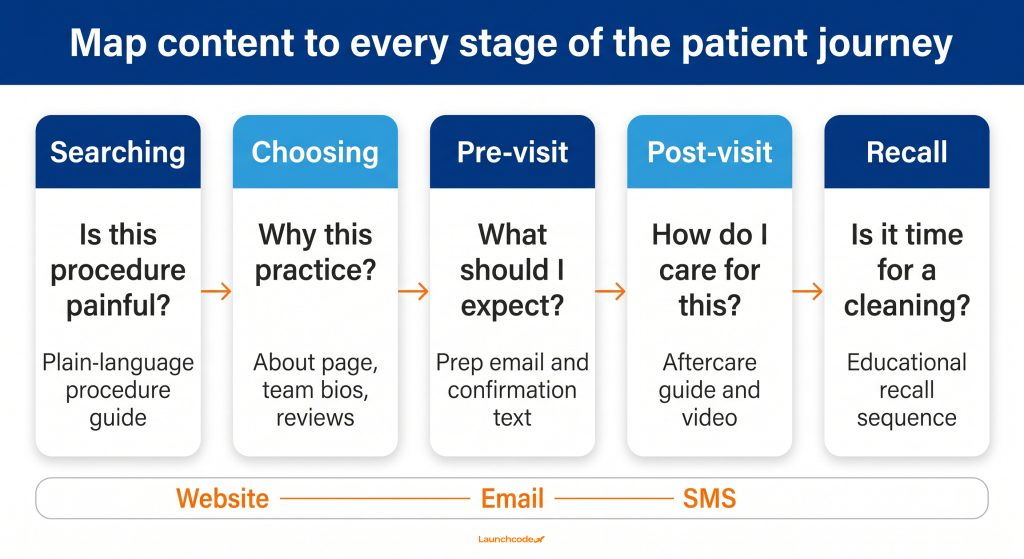
A content system beats random posting. Map each piece of content to a stage of the patient journey, from first search to recall. Patients research before they book, so answer their questions where they look. One strong article can become website pages, emails, texts, and social posts, which spreads the work and reaches patients at every touchpoint.
Patients arrive informed. In one study, 64.6 percent of prospective patients searched the web before their visit, with Google the top platform across all ages. The practice that answers their questions earns the appointment.
“Patients decide on you before they ever call. If your procedure pages answer the fear and cost questions first, you win the appointment in search, not at the front desk.” Tanner Medina, Co-Founder and Chief Growth Officer
| Journey stage | Patient question | Content type | Where it lives |
|---|---|---|---|
| Searching | Is this procedure painful? | Plain-language procedure guide | Website blog, GEO and search results |
| Choosing | Why this practice? | About page, team bios, reviews | Website, Google Business Profile |
| Pre-visit | What should I expect? | Prep email and confirmation text | Email, SMS |
| Post-visit | How do I care for this? | Aftercare guide and video | Email, patient portal |
| Recall | Is it time for a cleaning? | Educational recall sequence | Email, SMS |
You do not need a full content team. Start with one thorough article, then repurpose it. A guide on root canals becomes a confirmation text snippet, a pre-visit email, a short social video, and an FAQ answer. This is the repurposing model that keeps a practice visible without endless new writing. It is the same build and ship approach Launchcodex uses to turn one piece of research into a full set of channel-ready assets.
“We take a single root canal guide and split it into eight assets across email, SMS, and social. One write-up does the work of a month of posts.” Derick Do, Co-Founder and Chief Product Officer
Named tools map to each layer of the system:
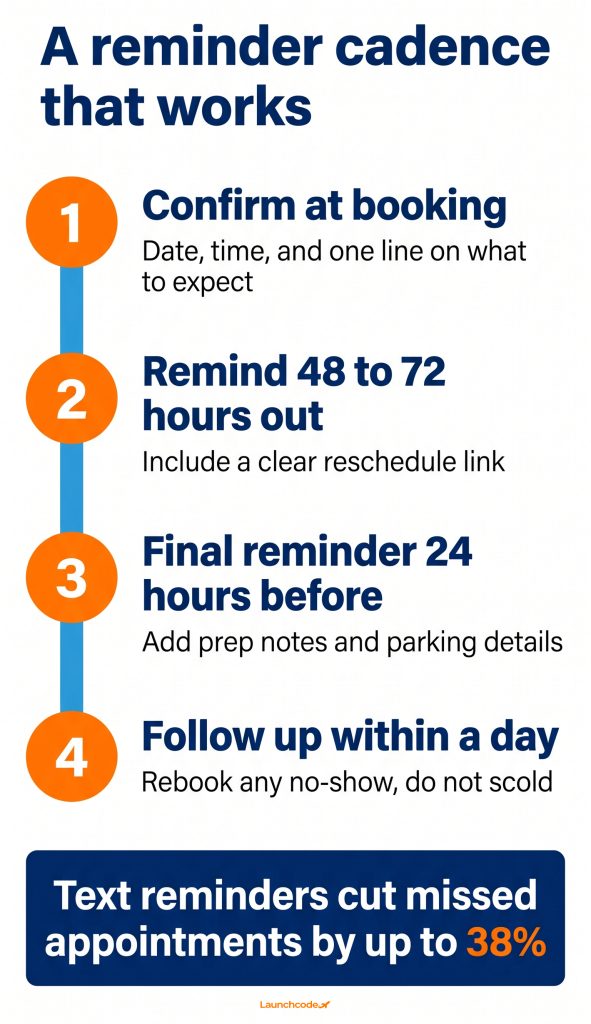
Reminders are the most proven no-show lever, and educational reminders work harder than plain ones. Text reminders cut missed appointments by up to 38 percent. Add a short note on why the visit matters and what to expect, and you reduce forgetfulness and fear in one message. Cadence and targeting matter far more than volume.
A reminder that only says “you have an appointment” wastes the moment. A reminder that also reassures an anxious patient does double duty.
Use a simple, repeatable sequence. The ADA advises confirming the same way every time so patients learn the pattern.
Research backs the impact. The 38 percent reduction from text reminders is one of the strongest figures in patient communication.
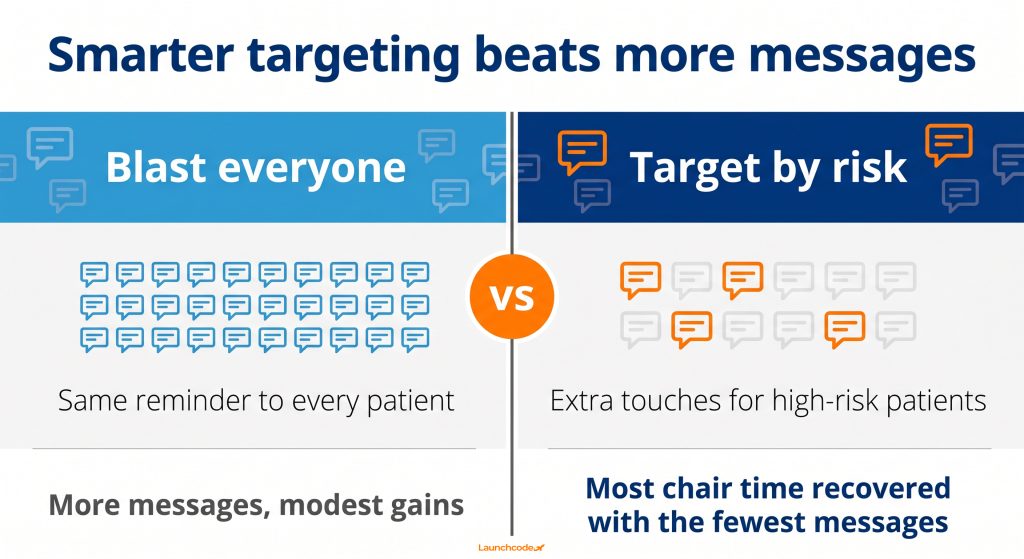
More reminders are not always better. A randomized Kaiser Permanente study found that targeting reminders by no-show risk used resources more efficiently than blasting everyone, and a second reminder added only modest gains. Focus extra touches on high-risk patients such as new self-pay bookings or past no-shows. Keep all messaging within HIPAA limits by sharing only the details a reminder needs.
“Segment reminders by risk instead of sending the same blast. We see practices recover the most chair time with the fewest messages when the second text only goes to flagged patients.” Derick Do, Co-Founder and Chief Product Officer
Track the numbers that tie content to attendance. Watch your no-show rate, recall rate, and case acceptance month over month. Compare patients who engage with your educational emails and texts against those who do not. If the engaged group shows up more and accepts more treatment, your content is working. Review reports monthly and adjust.
Measurement turns content from a cost into a line you can defend. Without it, you cannot tell what to keep or cut.
A no-show signals more than a scheduling glitch. It often means a patient does not yet understand or trust the value of their care. Reminders treat the symptom. Patient education treats the cause. When you explain procedures clearly, ease fear, and answer real questions across your website, email, and text, patients show up more often and say yes to more treatment.
Start small. Pick your three most common procedures, write one clear guide for each, then turn each guide into a pre-visit email and a confirmation text. Track your no-show rate by segment for 90 days. The practices that win build the system once and run it consistently.
Note: This article is informational and not clinical advice. Have a licensed dentist review any clinical content before publishing it for patients.
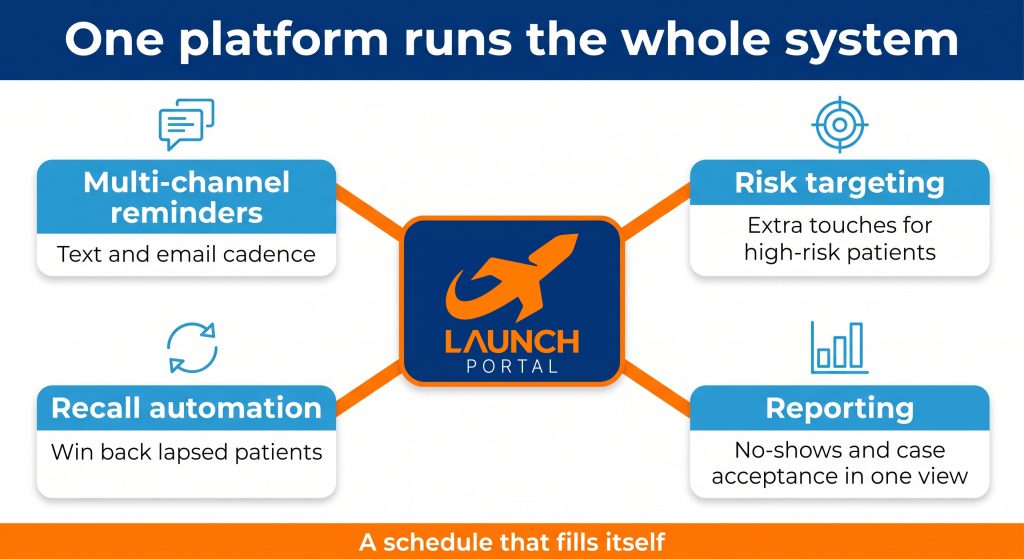
Everything in this guide depends on the same backend: multi-channel reminders, recall sequences, segmented messaging, and reporting that ties content to kept appointments. Launch Portal brings those pieces together so your front desk is not stitching tools together by hand. Send the four-step reminder cadence by text and email, flag high-risk patients for an extra touch, automate recall for lapsed patients, and watch no-show and case acceptance numbers in one dashboard. Pair it with the educational content you publish, and you get a practice schedule that fills itself. Book a walkthrough to see how Launch Portal fits your practice.
Yes, both indirectly and directly. Educational content lowers fear and builds trust, which improves attendance. Paired with reminders, it works even better, since text reminders alone cut no-shows by up to 38 percent and educational context strengthens each message.
Start with plain-language guides for your three most common procedures and one on costs and financing. These answer the questions patients search for before booking and the fears that cause cancellations.
A simple sequence works best. Confirm at booking, remind 48 to 72 hours out, and send a final reminder 24 hours before. Add extra touches only for high-risk patients to avoid wasted messages.
Texting is allowed when you limit the message to the details a reminder needs, such as date and time. Use a platform built for healthcare and avoid sharing diagnoses or treatment details over standard SMS.


Real stories from the people we’ve partnered with to modernize and grow their marketing.