
Share:

AI marketing & automation


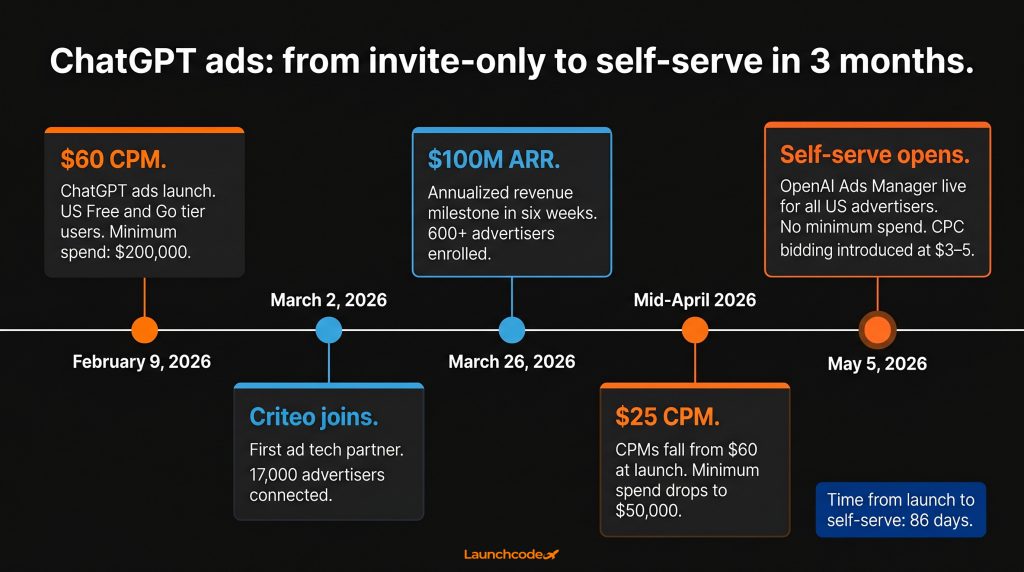
ChatGPT began serving ads on February 9, 2026. Within six weeks, the program crossed $100 million in annualized revenue with over 600 brands enrolled. OpenAI projects $100 billion in ad revenue by 2030. This is not a test.
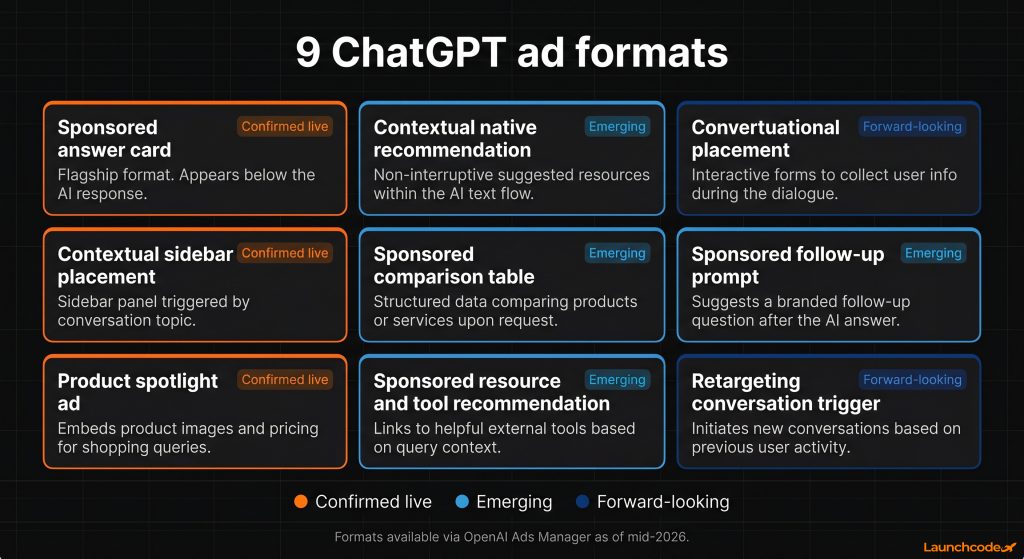
For marketers, the platform introduces a creative challenge that Google and Meta do not. ChatGPT users are mid-thought. They are not scrolling a feed. They have asked a question and received an answer. Your ad appears in that moment as either a useful extension of the conversation or an intrusion. This guide breaks down all nine ChatGPT ad formats, identifies which are live today versus emerging, and gives specific creative guidance for each so your placements earn attention rather than dismissal.
The core difference between ChatGPT ads and search or social ads is context, not channel. On Google, users signal intent through a query and then scan results. On ChatGPT, they are mid-conversation and have already received an answer. Your ad is a follow-up suggestion. Copy that reads like a search ad feels like an interruption. Copy that reads like a useful next step earns a click.
ChatGPT matches ads using contextual intent targeting. The system reads the topic and implied intent of the active conversation, the user’s past chat history, and previous ad interactions. There are no keyword lists, behavioral profiles, or cookie-based audiences in the current build. According to Adthena’s analysis of over 29 million ChatGPT queries, most ads appear on the first prompt in a session. Words like “best” and “new” are strong commercial intent triggers. A query as simple as “I need a new phone” is enough to surface a placement.
Isaac Rudansky, founder of AdVenture Media Group, defines the creative challenge precisely: format is not cosmetic. It is structural. The format you choose determines not just how your ad looks, but when it appears, how the user processes it, and whether it feels native or intrusive.
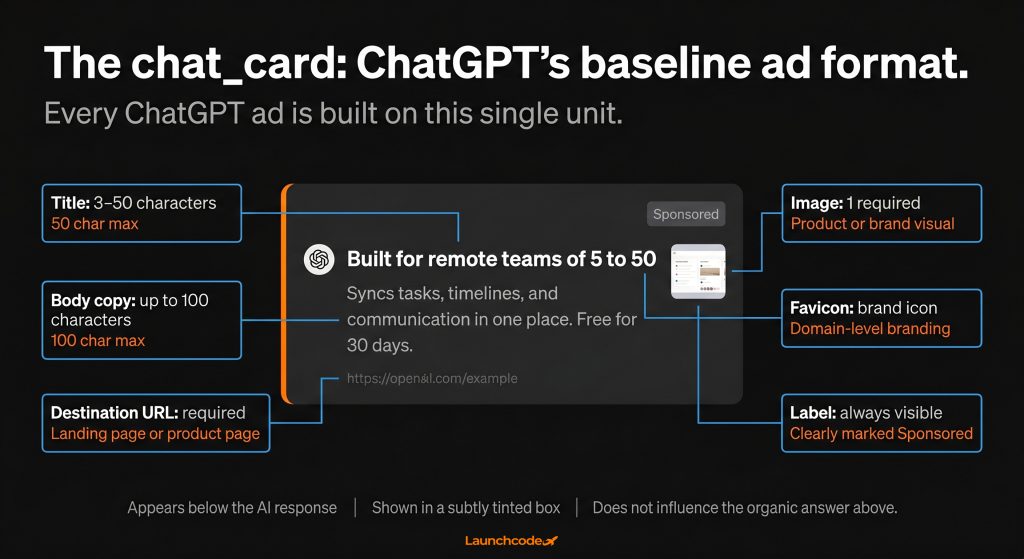
Every ChatGPT ad builds on the same base spec. According to Artzen’s breakdown of the current ad format, the chat_card carries a title of 3 to 50 characters, up to 100 characters of body copy, one image, a favicon, and a destination URL. All placements appear in subtly tinted boxes below the AI response, clearly labeled as sponsored. OpenAI’s answer independence principle guarantees the organic response above your ad remains uninfluenced by advertiser spend.
Ads reach logged-in adults on the Free and Go tiers in the United States, Canada, Australia, and New Zealand. Users on Plus ($20 per month), Pro ($200 per month), Team, Business, Enterprise, and Education plans see no ads. Fewer than 20% of eligible users are shown ads daily, per an OpenAI spokesperson. Reach projections built on total ChatGPT user counts will significantly overstate actual addressable inventory. Plan for the real audience, not the headline figure.
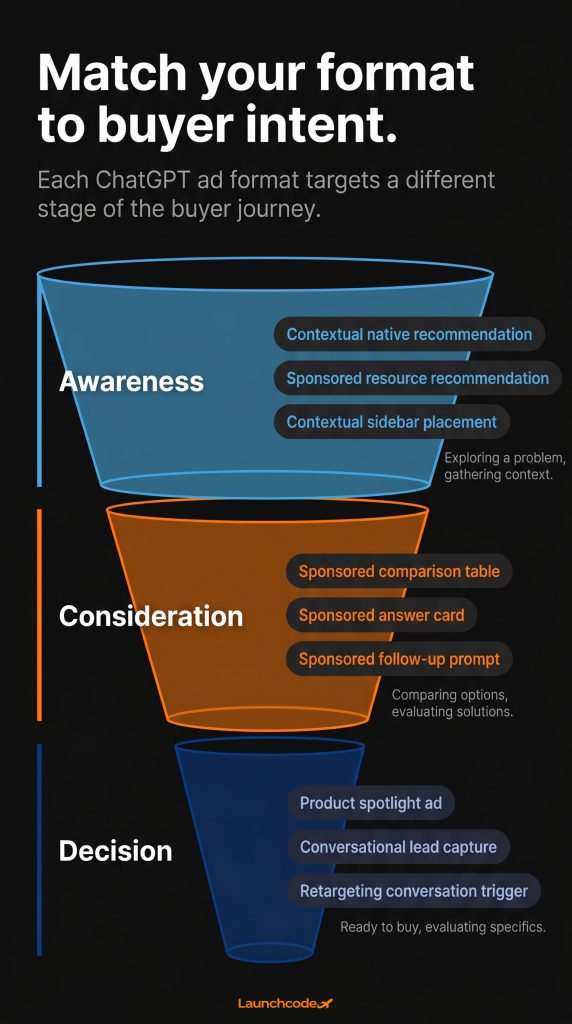
Before choosing a ChatGPT ad format, identify what stage of the buyer journey the user is most likely in when they ask the type of question that triggers your placement. Top-of-funnel queries need formats that add information. Bottom-funnel queries reward direct placements that close the gap between consideration and conversion. The format follows the intent.
The nine formats map across three intent layers:
| Intent layer | User behavior | Best-fit formats |
|---|---|---|
| Awareness | Exploring a problem, gathering context | Contextual native recommendation, sponsored resource recommendation, contextual sidebar placement |
| Consideration | Comparing options, evaluating solutions | Sponsored comparison table, sponsored answer card, sponsored follow-up prompt |
| Decision | Ready to buy, evaluating specifics | Product spotlight ad, conversational lead capture, retargeting conversation trigger |
Use this table before allocating budget. Each of the nine formats below includes its current status, the buyer intent it serves best, and specific creative guidance.
Status: Confirmed live. A sponsored answer card is the flagship ChatGPT ad format. It appears as a clearly labeled, tinted card within or immediately below the AI response to a user query. It addresses the user’s question directly with short, brand-authored copy. No other format currently combines contextual relevance, user intent alignment, and visibility in the same way.
This is the format OpenAI most directly confirmed through its launch framework. It draws on the baseline chat_card spec. The best-performing placements read like a natural continuation of the response. Users who recognize the organic and sponsored separation are more likely to treat the placement as a legitimate recommendation.
One sentence addresses the user’s core concern. One sentence states your specific differentiator. One soft call to action invites the next step. “Built for remote teams of 5 to 50, [Brand] syncs tasks, timelines, and communication in one place. Free for 30 days” reads like a recommendation. “Award-winning collaboration software. Get started today” does not. Specificity earns the placement. Generic copy wastes a high-intent slot.
Status: Confirmed live since March 2026. Sidebar placements appear in a panel adjacent to the conversation, triggered by the topic and intent of the user’s active session. They do not occupy the main response area, which makes them better suited to mid-funnel brand reinforcement than direct response. They behave closer to display advertising but are contextually matched to the conversation.
OpenAI launched three formats simultaneously in March 2026, including the contextual sidebar. According to coverage of the March 2026 platform update, targeting shifted from behavioral profile segments to conversation topic clusters and purchase intent signals with this rollout. Treat the sidebar as a reinforcement layer, not a primary conversion driver.
Headlines should be benefit-led and brief. “Shorten SOC 2 audits by 40%” or “Cut cloud costs without migrating providers” communicate value in under eight words. Supporting copy adds one proof point. Calls to action should invite investigation, not commitment. “See how it works” outperforms “Buy now” when the user is still in research mode.
Status: Confirmed live since March 2026. Product spotlight ads embed product images, pricing, and purchase links directly in the conversational interface when users express explicit shopping intent. A query like “standing desk under $600 that ships within a week” is not research. It is purchase intent with conditions attached. This format competes with Google Shopping for the moment the user is ready to buy.
The commercial intent signals that trigger product spotlight ads are among the strongest in any advertising environment. A placement that matches the user’s stated conditions with an accurate image, correct price, and real availability can compress the entire consideration-to-conversion path into one interaction.
Treat your product feed as a creative asset. Images must be clean and consistent. Pricing must be accurate in real time because a user who discovers a discrepancy loses trust in both the platform and your brand at once. Descriptions should use natural language rather than database-style copy. “Adjustable standing desk, 24-hour delivery, from $499” works. A spec sheet excerpt does not. Product feeds that already power Google Shopping campaigns require minimal rework to serve this format.
Status: Emerging. Contextual native recommendations surface during exploratory conversations rather than in response to direct product queries. They appear when users are gathering information, brainstorming, or asking open-ended questions. The format adds brand presence to conversations that will lead to commercial decisions, before the user has articulated a purchase intent.
Think about the distance between a problem and a product. A user asking ChatGPT to help plan a kitchen renovation has not searched for anything yet. That conversation will lead to purchases across multiple categories. A native recommendation for a design tool or a financing option fits that moment without demanding a response. Eric Siu of Single Grain notes that this format lets brands appear when buyer intent is forming rather than formed, which is a less competitive and often overlooked position.
Restraint matters more here than in any other format. Copy should contribute to the conversation, not redirect it. “For your renovation project, [Brand]’s free design tool lets you visualize layouts before committing to anything” adds value. “Start your renovation with [Brand] today” does not. Calls to action should invite exploration: “Explore your options” or “See how it works.” The user has not asked for a product. Match that posture in the copy.
Status: Emerging. Sponsored comparison tables embed a brand within structured comparison responses. When users ask ChatGPT to compare products, platforms, or services, this format allows a brand to appear as a featured or additional option in the table output. Comparison queries are among the strongest purchase-intent signals in conversational AI because the user has already moved past awareness and is actively evaluating.
A user asking ChatGPT to compare CRM platforms for a 10-person sales team is not gathering information. They are building a shortlist. Appearing in that comparison with an honest, accurate representation puts your brand in the consideration set at exactly the right stage.
Honesty is the strongest creative tool in this format. Include categories where competitors outperform you, because users recognize a comparison table that reads as skewed. Lead with your genuine strengths. An accurate comparison that highlights real advantages is more persuasive than an inflated one, particularly in an environment where the AI’s organic output has set a high standard for accuracy. A rigged table damages brand credibility faster than it builds pipeline.
Status: Forward-looking. Conversational lead capture ads extend the conversation rather than immediately redirecting the user to a landing page. The format asks qualifying questions within the chat interface, collects contact information, and routes the lead to a CRM or sales team. Leads generated this way are structurally higher quality than standard form fills because the user has invested in a multi-turn exchange before submitting any information.
This format is not yet in standard self-serve access. It reflects the direction OpenAI has signaled for the platform, toward interactive ad experiences where users engage with advertised products inside the conversation. As ALM Corp noted in its analysis, the potential is for a user to see an ad and then directly ask questions about the advertised product or service within the same interface, using AI as an interactive layer between the advertisement and the purchase decision. That capability does not exist on Google or Meta today.
Design the conversation flow before writing copy. Map the three to five qualifying questions that give your sales team the most useful context. Keep the tone low-pressure throughout. End the flow with a clear value exchange: “Based on what you’ve shared, a specialist will reach out within one business day with a personalized recommendation.” The user gives information when the payoff is explicit and relevant.
Status: Emerging. Sponsored follow-up prompts appear after the AI delivers its initial response, suggesting a related next step or question. The format guides the user’s next action without occupying the main response area. Because the copy is a suggestion rather than a pitch, the tone can be more casual and exploratory than in other formats.
ChatGPT sessions are often multi-turn. Users refine, follow up, and explore. A sponsored prompt placed at the natural junction between one question and the next can guide the remainder of the session toward brand engagement without requiring the user to leave the interface.
Write in the voice of natural curiosity. The goal is to feel like the next question the user would have asked on their own. Study the follow-up patterns in your category. What do users typically ask after their initial query? Position the sponsored prompt at that junction. If the prompt reads like an ad, it has already failed.
Status: Documented. When users ask ChatGPT for tools, templates, calculators, or guides, this format positions a brand’s free resource as the sponsored recommendation. Brands that provide something genuinely useful before making any ask are more likely to earn continued engagement. Brands with useful free tools have a structural advantage in this format that pure product advertisers do not.
Resource-seeking queries are numerous and varied. They cover business tools, calculators, templates, educational content, and diagnostic assessments. A brand with a well-designed free resource relevant to its category can appear in these moments in a way that feels like help rather than advertising.
The resource is the ad. Build something genuinely useful before placing it. Copy should describe the tool’s utility with specificity. “Free cash flow calculator for small businesses. Enter your revenue and expenses to see your monthly burn rate in 60 seconds” converts because it is specific, low-commitment, and immediately useful. “Download our free guide” does not create the same pull. Pair every resource recommendation with a follow-up nurture sequence, because a user who downloads the resource is in consideration, not conversion.
Status: Forward-looking. Retargeting conversation triggers use signals from previous ChatGPT sessions to serve contextually relevant ads to users who have already expressed intent. In a mature version of this format, a user who researched business software two weeks ago could see a relevant placement during a subsequent conversation on a related topic. This is the highest-ROI format concept on the roadmap and also the furthest from widespread access.
OpenAI’s current documentation confirms that past chat history and past ad interactions already factor into targeting logic, which means the data foundation exists. Full retargeting capability is expected later in 2026. The privacy architecture and cross-session data infrastructure required for reliable execution are still in development.
Clean your data infrastructure before this format reaches self-serve. Work with legal and technical teams to understand what cross-session data OpenAI will make available and under what consent frameworks. Build intent segments based on conversation topic patterns rather than demographic proxies. Brands with clean infrastructure will activate this format faster than those starting from scratch.
Three ChatGPT ad formats are confirmed in self-serve through the OpenAI Ads Manager as of mid-2026: sponsored answer cards, product spotlight ads, and contextual sidebar placements. Conversational lead capture and retargeting triggers are documented but not yet in standard self-serve. Treat emerging formats as planning priorities, not current budget lines.
This distinction matters for campaign planning and for how you set expectations internally. Spend the first phase of testing on confirmed formats, build measurement infrastructure, and prepare creative frameworks for emerging types before they become competitive.
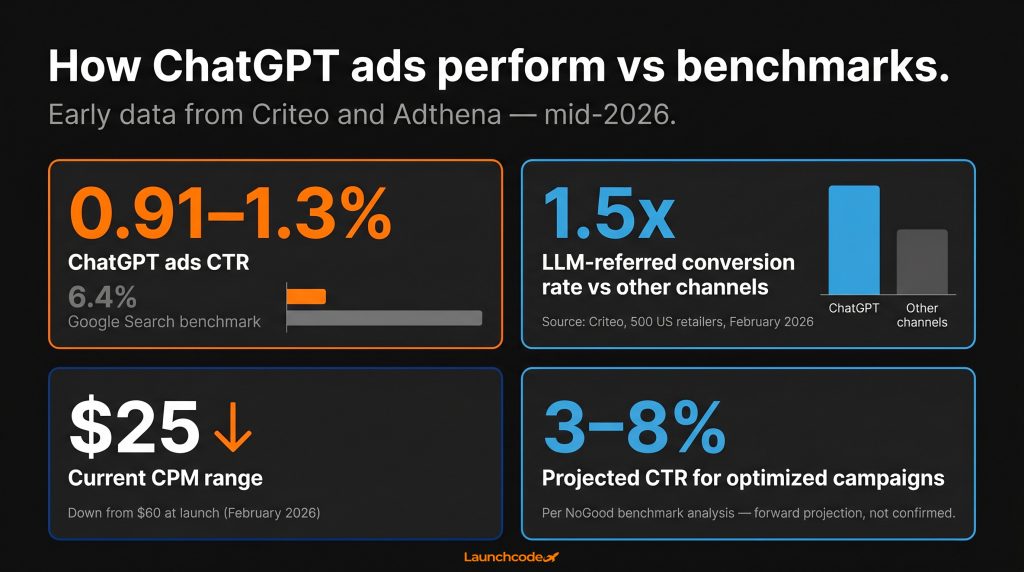
The platform is moving quickly. The OpenAI Ads Manager opened to all US advertisers with no minimum spend on May 5, 2026. CPMs fell from $60 at launch to approximately $25 by mid-April 2026. The minimum spend dropped from $250,000 at launch to zero in three months. Agency holdcos Dentsu, Omnicom, Publicis, and WPP serve brands that prefer managed access. Ad tech partners Criteo, StackAdapt, Kargo, Pacvue, and Adobe connect programmatic buying to the platform. Early confirmed advertisers include Expedia, Qualcomm, Best Buy, Enterprise Mobility, and The Knot Worldwide, which maps the verticals that are already active.
Early CTR data for ChatGPT ads sits at 0.91% to 1.3%, which looks low compared to Google Search’s 6.4% average. That comparison is structurally misleading. ChatGPT ads appear after the AI has already answered the user’s question. The user has what they came for. The ad is a follow-up suggestion. Lower CTR is the expected outcome of a post-answer placement, not a signal of weak creative.
The more meaningful number is conversion quality. According to performance data from Criteo covering over 1,000 active brand campaigns, LLM-referred users convert at roughly 1.5 times the rate of users from other referral channels, with strong results in consumer electronics, lifestyle, and home and garden. These figures come from Criteo’s own client base and have not been independently verified at scale. The directional signal is consistent with what you would expect from a high-intent, mid-task audience.
Robert Webster, founder of AI marketing consultancy TAU, identifies the core gap plainly: Google and Meta own industry measurement, and that is the real moat. The Conversions API and pixel tracking tools OpenAI launched in May 2026 provide the first serious infrastructure for post-click attribution. Independent third-party verification at scale does not yet exist. Per NoGood’s early benchmark analysis, well-optimized campaigns could reach 3% to 8% CTR as the platform matures. Those are projections, not confirmed results.
Brands already running generative engine optimization programs are better positioned for ChatGPT ads than those that are not. The intent signals that determine which conversations trigger organic AI mentions are the same signals that inform paid format selection. An integrated program, where organic content earns AI visibility and paid formats capture commercial moments, consistently outperforms either track in isolation.
GEO focuses on structuring content so AI systems extract and surface it in generated answers. ChatGPT ads target the active conversational context, topic cluster, and purchase intent signals in the user’s query. Both require the same foundational understanding: what your audience is asking, at which stage of the buyer journey, and how your content can answer it.
“ChatGPT ads and GEO are the same strategy on two tracks. Organic AI visibility earns trust. Paid formats capture intent. Brands that run both see the compound benefit because the audience intelligence from one directly informs the other.” Tanner Medina, Co-Founder and Chief Growth Officer, Launchcodex
Brands that succeed at both start by mapping the questions their audiences ask across the full buyer journey, not just at the point of conversion. That map drives both GEO content structure and ChatGPT ad format selection. Our SEO and GEO programs apply this methodology across AI search and traditional search channels.
The nine ChatGPT ad formats in this guide range from confirmed and accessible today to emerging and worth preparing for now. The three confirmed live formats, sponsored answer cards, product spotlight ads, and contextual sidebar placements, are available through the self-serve Ads Manager with no minimum spend for US advertisers.
As eMarketer projects, AI-driven search ad spending is expected to grow from $1.1 billion in 2025 to roughly $26 billion by 2029. OpenAI’s internal targets reach $100 billion annually by 2030. CPMs launched at $60 and have already fallen to $25. They will not keep falling indefinitely.
“Brands that start building on ChatGPT ads now accumulate knowledge that compounds over time. Those who wait for the channel to mature will pay to recover learning that was free today.” Derick Do, Co-Founder and Chief Product Officer, Launchcodex
Start with confirmed formats. Build measurement infrastructure before your first campaign goes live. Map your buyer journey questions to the format taxonomy in this article. Prepare creative frameworks for emerging formats before they become competitive. For an integrated approach across AI search visibility and paid AI placements, our performance media team builds programs across both tracks with full-funnel attribution from first AI touchpoint to conversion.
Three formats are confirmed in self-serve through the OpenAI Ads Manager as of mid-2026: sponsored answer cards, product spotlight ads, and contextual sidebar placements. All are built on the baseline chat_card format: a 50-character title, 100 characters of body copy, one image, and a destination URL.
Ads appear to logged-in adult users on the Free and Go tiers in the United States, Canada, Australia, and New Zealand. Users on Plus, Pro, Team, Business, Enterprise, and Education plans do not see ads. Fewer than 20% of eligible users are shown ads on any given day.
ChatGPT uses contextual intent matching rather than cookies or behavioral profiles. The system reads the topic of the active conversation, past chat history, and previous ad interactions. Advertisers work with intent clusters rather than keyword lists.
It looks low against Google Search benchmarks, but the comparison is misleading. ChatGPT ads appear after the AI has already answered the question. The user already has what they came for. Criteo’s early data shows LLM-referred users convert at roughly 1.5 times the rate of users from other referral channels, which partially offsets the lower click volume.
Confirmed eligible categories include lifestyle and household goods, local services, travel and experiences, digital products, and education. Health, legal, financial services, gambling, and political content are restricted or blocked. Check OpenAI’s ad policies before planning a campaign because the restriction list continues to evolve.
CPMs launched at $60 in February 2026 and fell to approximately $25 by mid-April. CPC bidding is now available with recommended bids of $3 to $5. The self-serve Ads Manager has no minimum spend as of May 2026.
Google Search ads intercept users at the moment of query, before they have an answer. ChatGPT ads appear after the AI has delivered a response. The user is mid-conversation, not scanning a list of links. This requires a different copy tone (conversational rather than declarative), a different CTA approach (invitation rather than urgency), and different measurement expectations focused on conversion quality over click volume.


Real stories from the people we’ve partnered with to modernize and grow their marketing.