
Share:

AI marketing & automation


After years of calling advertising a “last resort,” OpenAI launched ads in ChatGPT on February 9, 2026. Sam Altman had described the combination of ads and AI as “uniquely unsettling” at Harvard in May 2024. The financial reality of running generative AI at global scale changed the timeline. The ad program reached $100 million in annualized revenue in its first six weeks, confirming that advertiser demand had been waiting for access.
For performance marketers, brand managers, and growth leads, this channel operates differently from Google, Meta, and every other platform in your media plan. This article gives you an accurate breakdown of how ChatGPT ads work, who sees them, what they cost, how to measure performance, and how the paid platform connects to the organic AI visibility strategy your brand should already be building.

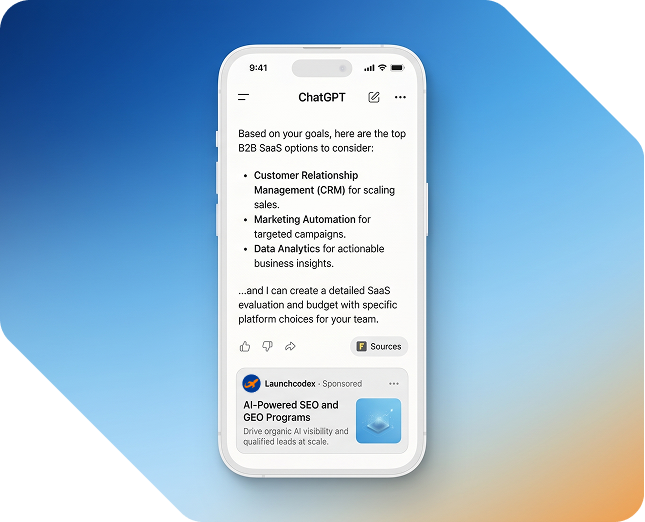
ChatGPT ads are native sponsored placements that appear below AI-generated responses inside ChatGPT conversations. They match the semantic content of the active conversation, not keywords or user profiles. OpenAI describes the product as a way to “help advertisers reach users as they explore, compare, and decide within a single conversational experience.” Each ad is clearly labeled as sponsored and visually separated from the organic answer by a subtly tinted box.
The placement context matters more than any other factor in understanding this channel. A user mid-conversation with ChatGPT is not scrolling a social feed or scanning search results. They are describing a problem in natural language, actively in research or decision mode. When that conversation aligns with an advertiser’s targeting criteria, the sponsored card appears after the AI finishes its response.
The only confirmed ad format at launch is the chat_card. Full specifications:
More formats are on OpenAI’s roadmap. Product spotlight units and contextual sidebar placements have been referenced in platform updates. Every campaign running today uses the chat_card.
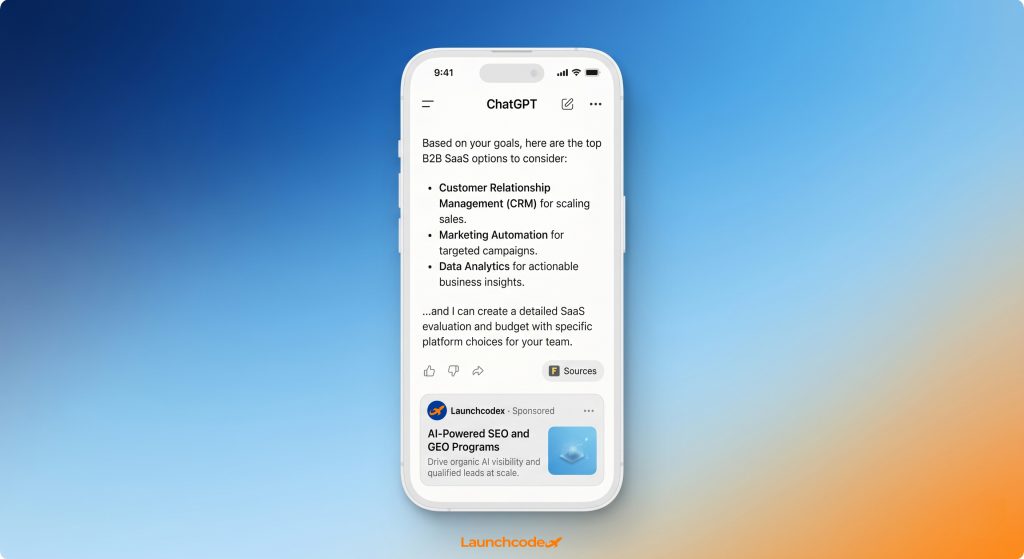
OpenAI’s content policy is explicit on one point: paid placements cannot influence what ChatGPT says in its organic response. The company calls this the Answer Independence principle. What ChatGPT says is determined entirely by accuracy and relevance to the user’s question, not by which brands are spending on the platform.
This has a direct impact on creative strategy. You buy visibility alongside the organic answer. You cannot buy a better position inside it.
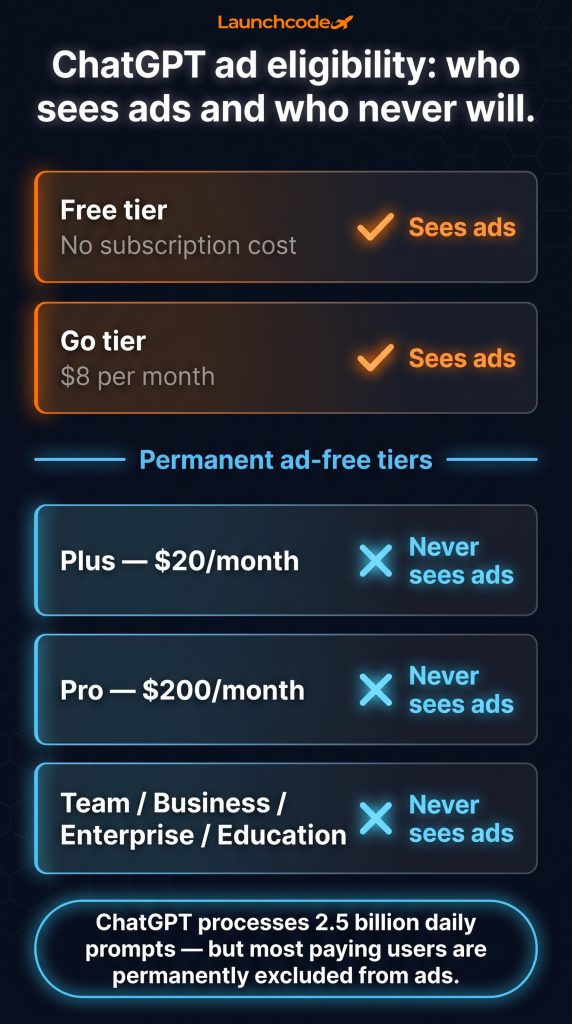
Ads reach users on the Free tier and the Go tier ($8 per month) in the United States. Users on Plus ($20 per month), Pro ($200 per month), Team, Business, Enterprise, and Education accounts do not see ads. OpenAI has permanently positioned ad-free access as a feature of paid tiers. Geographic expansion to Canada, Australia, and New Zealand is underway. EU rollout is delayed due to GDPR consent requirements that have not yet been resolved.
This is the single most important fact for campaign planning. Any reach estimate built from ChatGPT’s total user base will overstate the addressable ad audience. The platform processes 2.5 billion daily prompts, but a significant share of those users are on paid tiers and will never see an ad.
Before building a reach projection, account for all eligibility filters:
Build these filters into your media plan before presenting reach or frequency numbers to any stakeholder.
Go tier users are a distinct segment worth targeting deliberately. At $8 per month, they have demonstrated willingness to pay for AI access, which correlates with higher engagement and more purposeful use than a fully free audience. The segment skews toward entrepreneurs, freelancers, and small business decision-makers with real purchase authority. Early reports from advertisers in the pilot indicate that Go tier campaigns deliver lower cost-per-acquisition despite higher CPMs, because audience quality offsets the impression cost premium.
ChatGPT uses context hints for targeting. The system reads the semantic content and intent of the active conversation, combined with prior chat history, and matches relevant ads from advertiser inventory. There are no keywords, no demographic profiles, and no third-party behavioral data. Advertisers provide context hints describing the conversations where their product is relevant. The platform handles matching.
On Google Ads, you build keyword lists with match types, bids, and negative terms. On Meta, you target demographic segments and behavioral audiences. On ChatGPT, you provide context hints describing the conversation topics where your product is relevant, and the system decides when and where to surface your ad.
| Targeting approach | What you provide | What the system reads | Granularity |
|---|---|---|---|
| Google Search | Keywords, match types, negatives | Query text | High |
| Meta | Demographics, interests, behaviors | User profile data | High |
| ChatGPT Ads | Context hints | Active chat and history | Low to medium |
The reduced granularity is a real tradeoff. Advertisers who rely on precise keyword segmentation will find the abstraction uncomfortable. The upside is access to users who are actively mid-problem, describing their needs in more detail than a search query ever captures.
Current constraints worth flagging before launch:
These are structural privacy architecture decisions, not temporary gaps. OpenAI shares no individual conversation data with advertisers. Reporting is aggregated by design, closer to connected TV measurement than Google Ads in its level of detail. Set expectations internally before launching any campaign.
ChatGPT ads launched at $60 CPM with a $200,000 minimum spend in February 2026. By May 5, 2026, OpenAI had removed the minimum entirely and CPMs had dropped to around $25. CPC bidding with $3 to $5 bid floors by category is now live alongside the CPM model. The full journey from invite-only enterprise pilot to open self-serve took 86 days.
The platform’s pricing history shows a launch CPM that was 6 to 30 times higher than Google Display Network ($2 to $5 CPM) or Meta ($6 to $10 CPM) for comparable audiences. OpenAI positioned ChatGPT as a premium context for a high-intent audience, and the first wave of enterprise advertisers in financial services, B2B software, and premium consumer brands validated the thesis by reaching $100 million in annualized ad revenue in under two months.
The platform moved through three distinct phases:
Comparing CPMs in isolation misses the downstream performance difference. Early data from Criteo shows that referrals from large language model platforms convert at 1.5 times the rate of other digital channels. ChatGPT referral visitors also spend 60 to 80 percent more time on-site than social traffic, with conversion rates comparable to high-intent Google search in tested categories.
The right question is cost per acquisition, not cost per thousand impressions.
| Platform | CPM range | Targeting type | Audience scope | Measurement maturity |
|---|---|---|---|---|
| ChatGPT Ads | $25 to $60 | Context hints | Free + Go tier only | Growing (launched May 2026) |
| Google Search | CPC model | Keyword intent | All search users | Mature |
| Google Display | $2 to $5 | Audience + contextual | Broad, cross-network | Mature |
| Meta | $6 to $10 | Demographic + behavioral | Social audience | Mature |
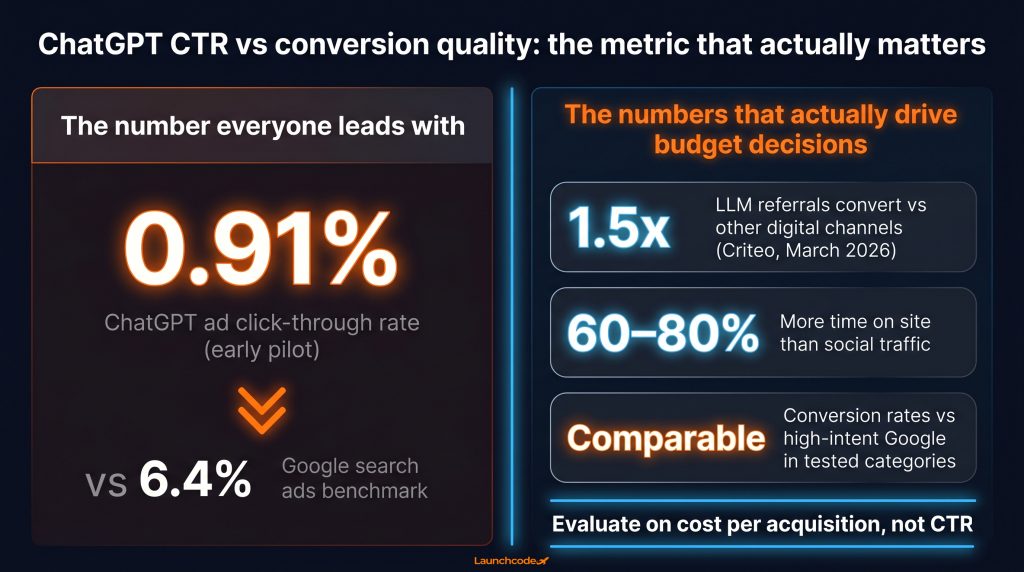
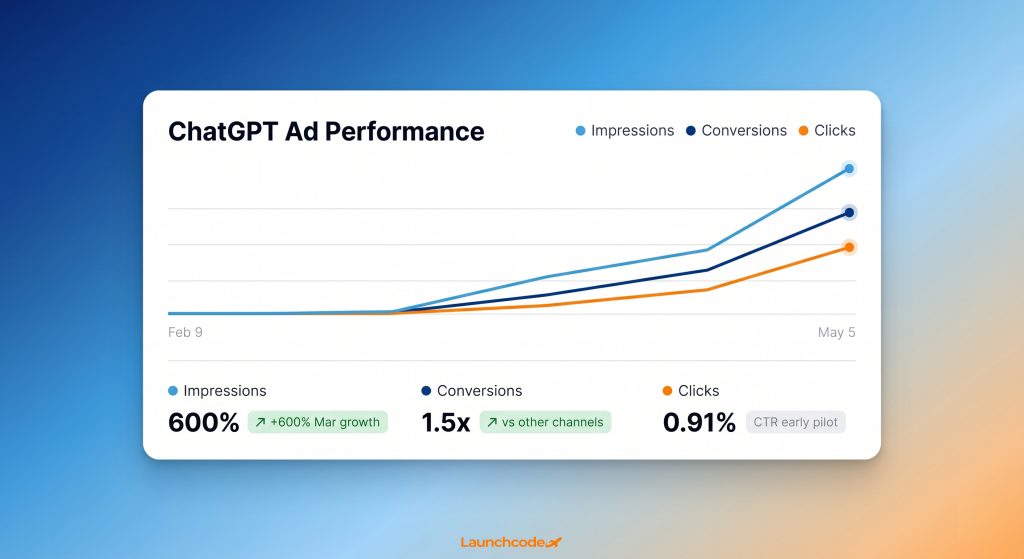
The early ChatGPT ad pilot recorded a 0.91 percent click-through rate, compared to a 6.4 percent benchmark for Google search ads. That gap is real, but CTR is the wrong primary metric for a channel where users continue their conversation after seeing an ad instead of ending the session with a click. Conversion quality and session behavior are more meaningful indicators for most categories.
In search, a click typically ends the interaction. On ChatGPT, the ad appears mid-conversation and the user keeps talking. That session depth changes what performance looks like and how early results should be read. Impressions also jumped approximately 600 percent between early and mid-March 2026, according to Sensor Tower data, reflecting how quickly advertiser volume scaled during the managed pilot phase.
The data points that matter more than CTR for budget decisions:
Evaluate campaigns on cost per qualified lead or cost per acquisition. Early CTR benchmarks will shift as the platform scales and creative quality improves.
The standout early adopter verticals share one trait: users who ask detailed research questions before making a purchase decision.
E-commerce categories with short purchase cycles and lower average order values face a harder equation at current pricing.
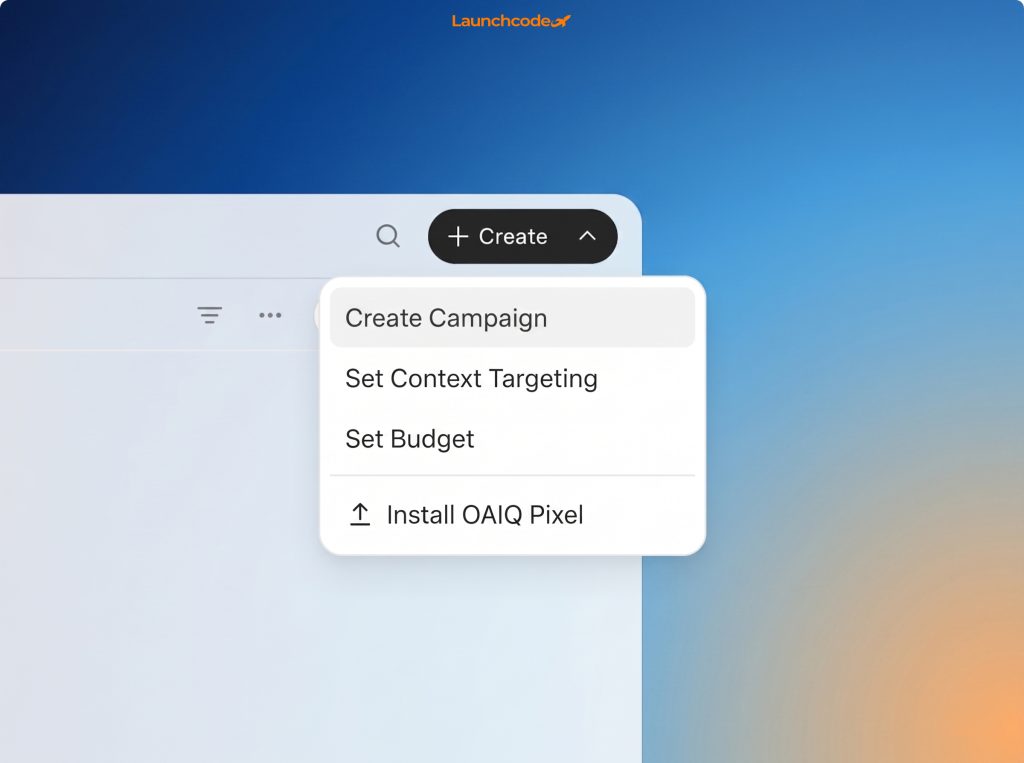
As of May 5, 2026, ChatGPT ads can be tracked with the OAIQ pixel for browser-side events and the OpenAI Conversions API for server-side measurement. Both tools launched on May 5, 2026, closing the measurement gap that had stalled many performance-focused advertisers. Evelyn Mitchell-Wolf, principal analyst at eMarketer, noted earlier this year that “the measurement gap is the biggest barrier for performance-focused marketers.” The OAIQ pixel sets a first-party cookie on the advertiser’s domain, protecting it from browser restrictions that affect third-party cookies.
The default attribution window is 7-day click and 1-day view, configurable per campaign. The Ads Manager shows performance status at every level — campaign, ad group, and ad — with descriptive messages when something is not serving and why. Performance data covering impressions, clicks, spend, CTR, average CPM, and average CPC is available inside the dashboard and exportable as a CSV in either cumulative or daily format.
Even with the full pixel and API in place, reporting stays aggregated. Advertisers do not get access to:
This is a deliberate privacy design, not a temporary product limitation. Build internal reporting expectations around aggregate data and first-party attribution from your own stack, not from what the Ads Manager surfaces alone.
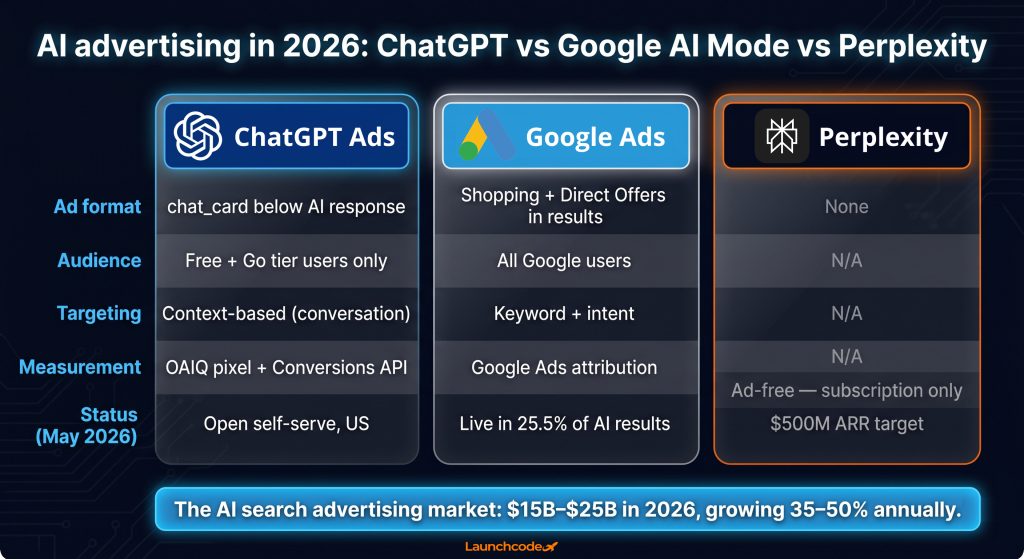
Three AI platforms took fundamentally different approaches to advertising in 2026. ChatGPT launched native placements within conversations. Google extended its existing keyword and shopping infrastructure into AI-generated results. Perplexity pulled all ads in February 2026 and repositioned around subscriptions. Each path reflects different assumptions about how users respond to sponsored content inside AI experiences.
The AI search advertising market is estimated at $15 billion to $25 billion in 2026, growing at 35 to 50 percent annually. A September 2025 Funnel and Ravn Research survey found that 64 percent of worldwide marketers named reduced use of traditional search as the top AI-driven shift they expect in the next few years. Wells Fargo analysts projected that ChatGPT could capture 30 percent of the global search advertising market by 2030.
| Platform | Ad model | Eligible audience | Targeting | Measurement | Status (May 2026) |
|---|---|---|---|---|---|
| ChatGPT | chat_card below AI response | Free + Go tier (US + limited international) | Context hints | OAIQ pixel + Conversions API | Open self-serve (US) |
| Google AI Mode | Shopping + Direct Offers in AI results | All Google users | Keyword + intent | Google Ads attribution | Live (25.5% of AI results) |
| Perplexity | None | N/A | N/A | N/A | Ad-free, subscription-only |
Google is not standing still. It has embedded shopping ads and direct checkout offers into Google AI Mode responses, with ads now appearing alongside 25.5 percent of AI-generated results. Google’s advantage is a more mature attribution system, an unrestricted audience, and two decades of advertiser relationships. Its challenge is that the ad model was adapted from search, not built natively for conversational AI from the start.
Perplexity’s exit from advertising is worth understanding. After testing sponsored follow-up questions through 2024 and 2025, the company concluded that advertising undermines the trust that makes AI search useful. The platform is now targeting $500 million in annualized subscription revenue as an explicitly ad-free alternative. For advertisers, the competitive AI advertising space now has two relevant platforms worth planning around for the foreseeable future.
ChatGPT ads buy a placement below the organic response. They do not affect what ChatGPT says above the ad. Brands that appear organically in that response hold the more trusted position. When paid spend stops, that organic presence either exists independently or it does not. GEO (Generative Engine Optimization) and AEO (Answer Engine Optimization) build the organic layer. Paid ads rent a position below it.
Monitoring data across 500-plus brands on AI platforms shows that brands running ChatGPT ads without an organic AI foundation see their visibility drop to zero within 48 hours of pausing spend. Organic citation rates are independent of paid ad activity. The two systems do not reinforce each other automatically.
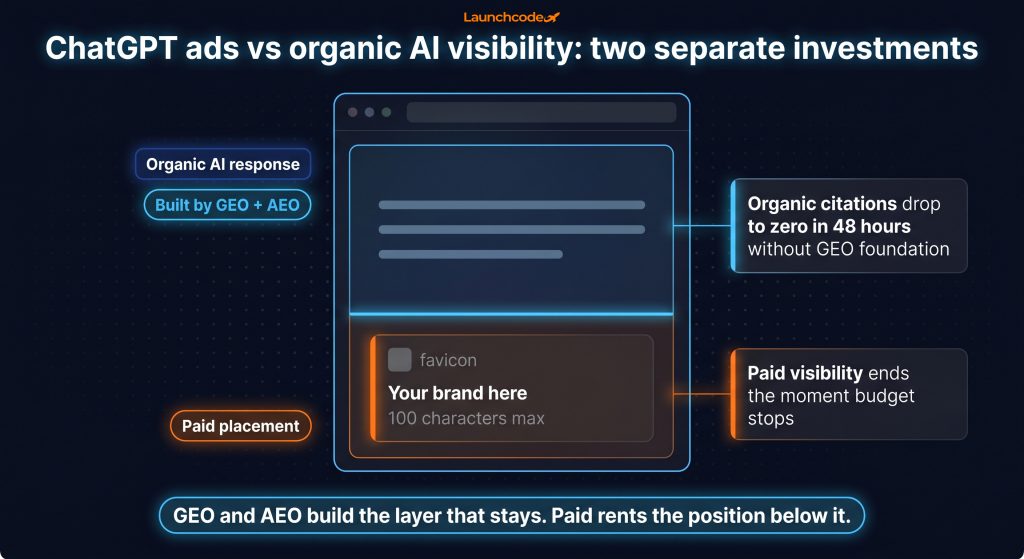
The gap between paid and organic becomes visible the moment a campaign stops:
Brands with strong GEO foundations maintain organic ChatGPT mentions whether ads are running or not. Brands relying only on paid placements disappear from AI responses when the campaign ends. That is not a critical risk at launch, but it becomes one as AI search grows into a primary discovery channel.
Tevfik Mert Azizoglu, SEO and AI Lead at SEO Sherpa, explains the direction clearly: “Traditional SEO for rankings remains important, but Generative Engine Optimization will grow in influence, requiring content to be structured and authoritative so AI systems like ChatGPT and Google’s AI Overviews can find and use it.”
Paid ChatGPT ads work best as a complement to an existing organic AI presence, not a substitute for one. At Launchcodex, our SEO and GEO programs are built to establish the organic citation layer first, then evaluate paid placements as a way to compound existing AI visibility rather than create it from scratch. Research on AI citation overlap also shows that organic AI mentions and traditional search rankings share only about 8 percent overlap on ChatGPT, meaning the brands that appear organically in ChatGPT responses are largely different from those ranking in Google’s top ten. Getting into AI results requires a strategy built specifically for how AI systems retrieve and use content.
Test now if you have a research-heavy category, an existing organic AI presence, a landing page built for high-intent visitors, and attribution infrastructure that can isolate a new channel cleanly. Wait if you have none of those foundations in place, if your audience is primarily European, or if your category is blocked by OpenAI’s content policy.
The self-serve platform is open and the minimum spend is gone. Accessible does not mean ready. The brands seeing the best early results share specific characteristics beyond budget availability.
Test ChatGPT ads now if these conditions apply:
The early-mover case is real. Advertisers who build quality scores and campaign history now will have a structural cost advantage when bidding competition increases in the second half of 2026.
Hold back on ChatGPT ads if:
“ChatGPT ads give marketers access to a new kind of intent signal. The brands that get the most from this channel treat the first 90 days as a learning budget, not a performance budget. The data you collect now is worth more than the conversions you can count.” Derick Do, Co-Founder and Chief Product Officer, Launchcodex
The ChatGPT advertising platform moved from “uniquely unsettling” to fully operational in under two years. OpenAI went from a $200,000 enterprise gate to open self-serve in 86 days, reached $100 million in annualized ad revenue in its first six weeks, and has built the measurement infrastructure that performance marketers need to justify ongoing spend. Major integration partners including Adobe, Criteo, Kargo, Pacvue, and StackAdapt are connected to the platform. The ecosystem is building.
The structural reality has not changed. ChatGPT ads buy a position below the organic answer. The organic answer is shaped by a completely different set of investments: content authority, entity signals, structured information, and the GEO and AEO strategies that determine whether an AI system cites your brand. Brands that win on this channel run both tracks in parallel from the start.
Test with a defined learning budget. Track everything cleanly using the OAIQ pixel, Conversions API, and a dedicated UTM setup. Use the data to understand which conversation contexts your audience uses to find your category in AI. The IAB is still developing formal measurement standards for generative AI ad environments. Brands with campaign history before those standards land will be able to adopt and benchmark immediately. Brands that waited will start from zero.
“The brands that get this right will not think of ChatGPT ads as a paid search replacement. They will use it to understand how their buyers describe their problems inside AI, then use that intelligence to sharpen everything else they are doing across SEO, GEO, and paid.” Tanner Medina, Co-Founder and Chief Growth Officer, Launchcodex
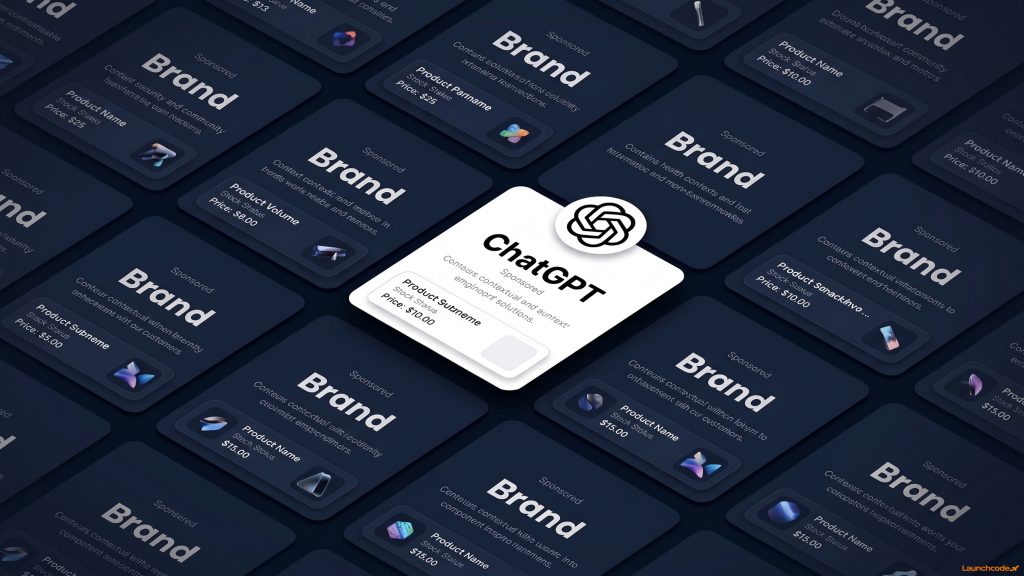
ChatGPT ads are sponsored placements that appear below AI-generated responses inside ChatGPT conversations. They are matched to the active conversation topic, clearly labeled as sponsored, and visually separated from the organic answer. The current format is the chat_card, which includes a short title, body description, image, and destination link. Ads never influence what ChatGPT says in its response.
Only users on the Free tier and Go tier ($8 per month) in the United States currently see ads. Users on Plus ($20), Pro ($200), Team, Business, Enterprise, and Education accounts are permanently excluded. Age restrictions apply, and ads do not appear near health, mental health, or political content.
The platform launched at $60 CPM with a $200,000 minimum in February 2026. By May 5, 2026, the minimum was removed and CPMs had dropped to around $25. CPC bidding is now available at $3 to $5 bid floors by category. Access is through the self-serve Ads Manager at ads.openai.com.
Use the OAIQ pixel for browser-side event tracking and the OpenAI Conversions API for server-side measurement. Both launched on May 5, 2026. A community-built Google Tag Manager template simplifies pixel deployment. The attribution window defaults to 7-day click and 1-day view, configurable per campaign.
No. OpenAI’s Answer Independence principle states that paid placements cannot influence ChatGPT’s organic response. Ads appear below the response in a clearly labeled sponsored box. What ChatGPT says is determined by accuracy and relevance, not by advertiser spend.
Google Ads uses keyword-based targeting with mature attribution and unrestricted audience access. ChatGPT ads use context hints for targeting, with aggregated attribution limited to Free and Go tier users. Early Criteo data shows LLM referrals convert at 1.5 times the rate of other digital channels. Compare on cost per acquisition, not CPM.
Both investments serve different functions and should run in parallel, not in sequence. GEO builds organic AI visibility. ChatGPT ads buy a placement below that organic layer. Brands without organic AI presence will see weaker returns from paid placements because the response above the ad may not validate their product. Build the organic foundation alongside paid testing from the start.


Real stories from the people we’ve partnered with to modernize and grow their marketing.