

Share:

AI marketing & automation


For most of the past decade, getting found meant ranking in the top three Google results. That still matters. But a growing share of patients now skip the results page entirely. They type a question into ChatGPT or ask Perplexity to recommend a specialist, and they act on what comes back. If your practice is not in that answer, you are not in the conversation.
This article explains how patient search behavior has split into two distinct paths, what drives visibility on each one, and what providers and their marketing teams need to do to stay discoverable as AI tools become the default starting point for healthcare decisions.
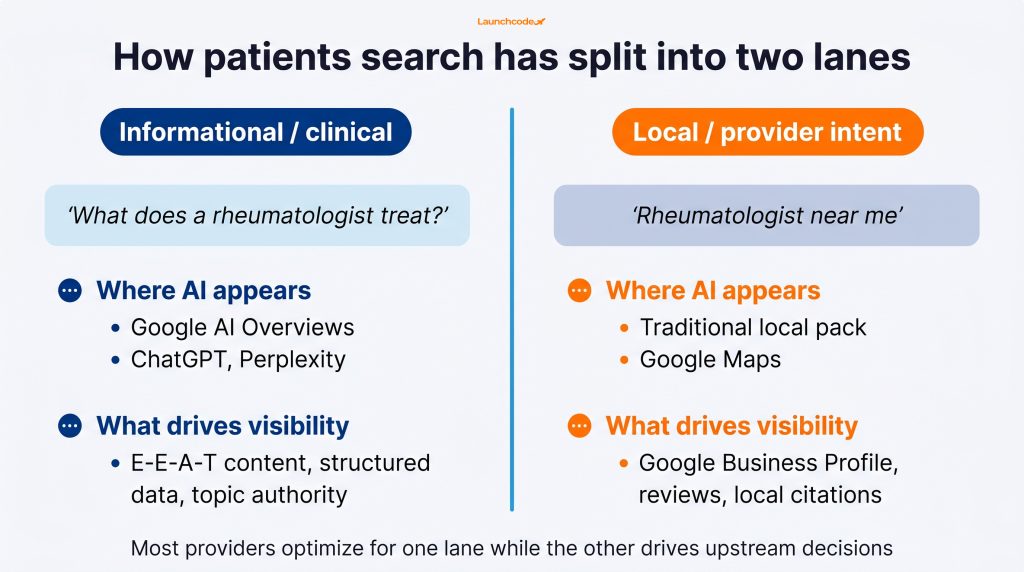
AI and traditional search now serve different moments in the patient journey. Google AI Overviews dominate informational and clinical queries, where patients research symptoms, conditions, and specialties. Traditional local results still handle direct provider searches like “cardiologist near me.” Most providers are optimizing for one lane while the other quietly drives upstream decisions.
Patients used to follow a predictable path. They typed a condition or specialty into Google, scanned the results, checked a few profiles on Healthgrades or Vitals, and called to book. That path still exists, but it now runs alongside a completely different one.
When a patient asks ChatGPT “what kind of doctor treats nerve pain” or queries Google “what causes shortness of breath,” they receive a synthesized answer. That answer names specialists, explains when to seek care, and shapes which providers the patient considers before they ever do a local search. By the time they type “neurologist near me,” their mental shortlist may already be set.
Understanding which lane a query falls into changes how you optimize.
| Query type | Example | Where AI appears | What drives visibility |
|---|---|---|---|
| Informational / clinical | “What does a rheumatologist treat?” | Google AI Overviews, ChatGPT, Perplexity | E-E-A-T content, structured data, topic authority |
| Local / provider intent | “Rheumatologist near me” | Traditional local pack, Google Maps | Google Business Profile, reviews, local citations |
According to BrightEdge data from December 2025, Google removed AI Overviews from local provider-intent queries entirely, dropping coverage to 0%. At the same time, AI Overviews now appear on nearly 100% of treatment and procedure queries. This is one of the most misunderstood dynamics in healthcare digital marketing today. Local SEO is not obsolete. It serves a different lane, and that lane still controls the booking moment.
The informational lane is where patients decide who is worth considering. A patient who asks ChatGPT “do I need a specialist for my lower back pain” and receives an answer naming orthopedic surgeons and physiatrists enters their local search with a specialty in mind, and sometimes a provider already. That upstream moment requires content, authority, and data that AI systems trust enough to cite. A map listing alone cannot win it.
If your organic positions have not changed but your clinical content pages are getting significantly fewer visits, Google AI Overviews are almost certainly the cause. Google now answers health questions at the top of the page before users reach any link. Your rankings still exist. Patients just do not need to visit your site to get the answer.
Healthcare websites saw 20 to 30% year-over-year declines in traffic to clinical content pages in 2025, even as rankings held steady, based on BrightEdge data. The traffic is not going to competitors. Google is absorbing it with AI-generated answers at the top of the page.
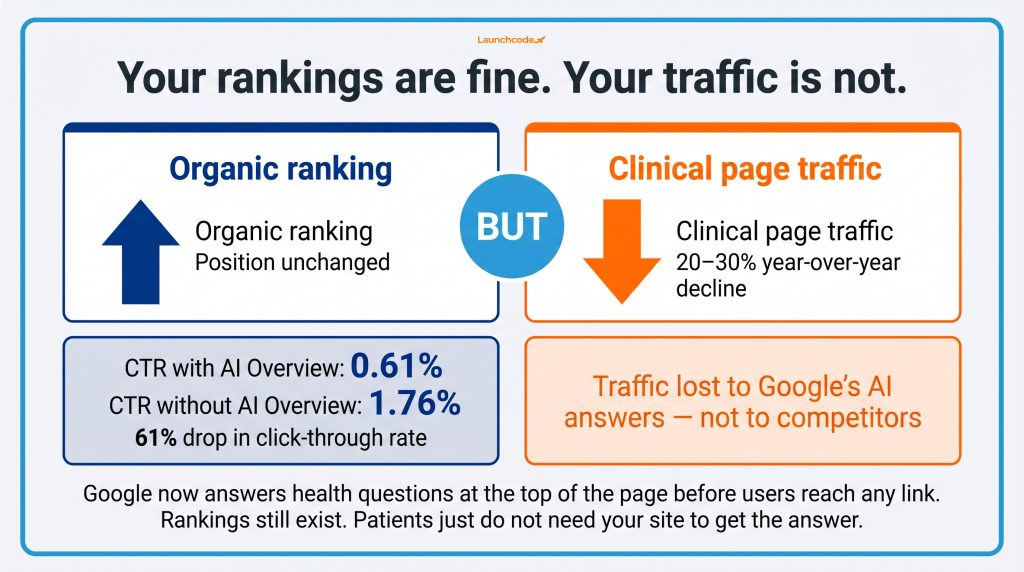
The click data makes this concrete. When Google shows an AI Overview, organic click-through rates fall from 1.76% to 0.61%, a 61% drop, according to Seer Interactive’s analysis of over 25 million organic impressions in September 2025. Matt Eaves, VP of Digital Marketing at University Hospitals in Cleveland, confirmed his team has seen a measurable dip in website visits as AI tools become more embedded in patient search behavior.
Traditional SEO logic says: if traffic falls, improve rankings. But when Google itself is the answer, position one still loses clicks to the AI Overview above it. The goal is to earn a citation inside that Overview, not to chase a higher rank on a page being bypassed.
Practices cited inside AI Overviews gain visibility at the very top of the page, above every organic link. Earning that citation requires content that answers questions completely, signals expertise clearly, and is structured so Google’s system can extract and attribute it. This is the core difference between SEO and generative engine optimization (GEO).
The University Hospitals marketing team now monitors the questions patients ask large language models and uses that data to shape their content calendar. Rather than writing pages to rank for keywords, they write pages to answer questions. The format looks similar. The intent is different, and the outcomes reflect it.
A page written to rank for “knee replacement surgery” optimizes for a keyword. A page written to earn an AI Overview citation answers the full patient question: what is knee replacement surgery, who qualifies, what does recovery involve, and what should a patient ask before agreeing to the procedure. The second page earns the citation. The first gets bypassed by it.
Patients are not only using AI to research conditions. They are asking ChatGPT, Perplexity, and Gemini to recommend specific providers by name and location. This happens entirely outside Google and requires a separate visibility strategy. A practice can rank on page one of Google and be completely absent from AI chatbot recommendations.
Rock Health’s 2025 Consumer Adoption of Digital Health Survey found that 32% of U.S. adults used AI chatbots to find health information in 2025, up from 16% in 2024. The Rock Health team noted that “for many, AI has quickly become a routine part of how they manage their health.” The West Health-Gallup Center added context in April 2026: more than 66 million Americans, roughly one in four adults, have used AI tools for health information or advice. And 70% of patients say they are open to using AI tools to research physicians, with one-third trusting AI results as much as traditional search.
Traditional search queries are short and keyword-driven: “cardiologist Denver.” AI queries are conversational and specific: “Who is the best cardiologist in Denver for someone with a valve issue who also accepts Blue Cross?” That specificity changes what a system needs to respond confidently.
AI tools build their recommendation from whatever exists about a practice, including aggregated reviews, listed specialties, accepted insurance, and physician credentials pulled from directories like Healthgrades and Vitals. A practice with incomplete or outdated profile data is less likely to be recommended, not because the AI is biased, but because it cannot assemble a confident, complete answer.
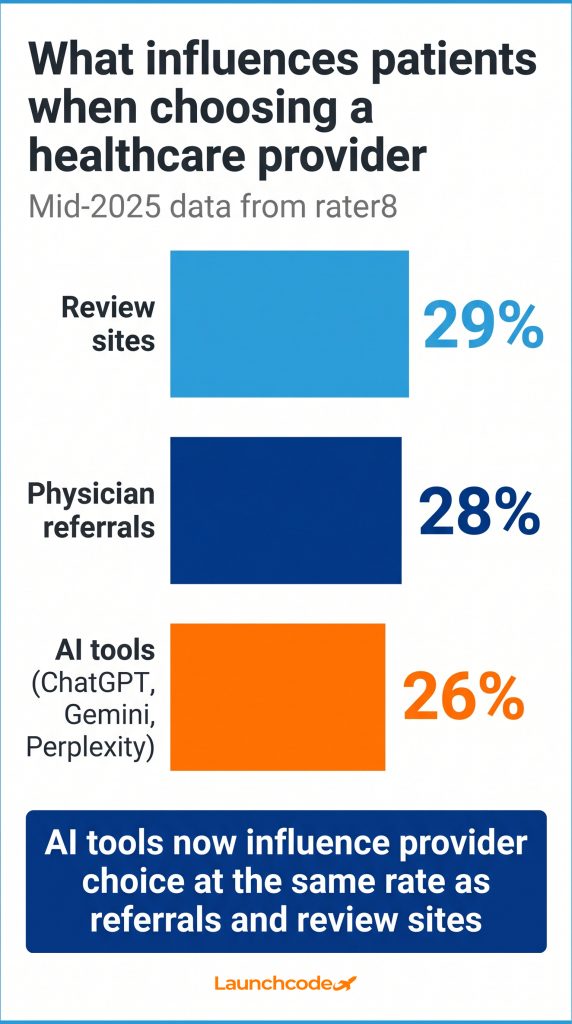
A 2025 patient choice study from rater8 found that by mid-2025, 26% of patients said AI tools had directly influenced which healthcare provider they chose. That places AI on par with primary care referrals at 28% and review sites at 29%. ChatGPT ranked first among AI tools for perceived helpfulness and accuracy in provider research. Gemini and Perplexity are close behind, and both are growing.
SocialClimb, a healthcare marketing platform, described this as “the most significant change in patient discovery behavior since the rise of online reviews.” Most healthcare organizations have not updated their strategy to match.
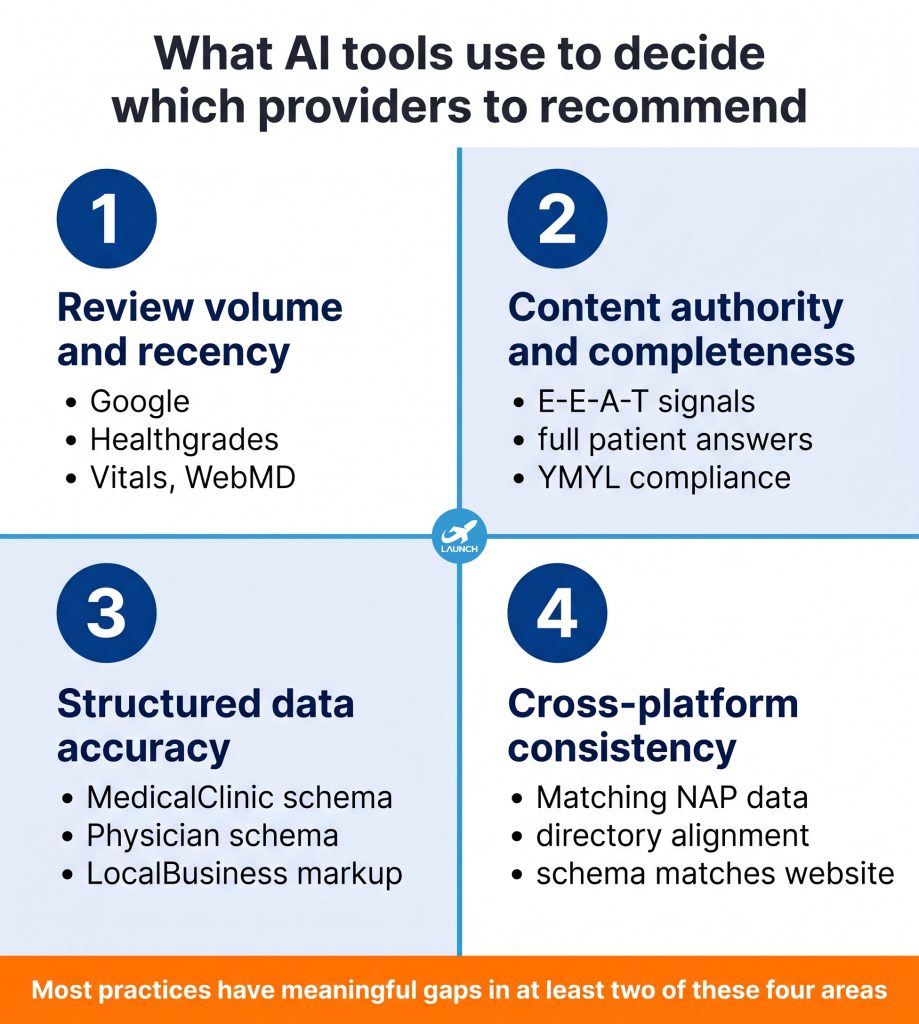
AI tools recommend providers based on four core inputs: review volume and recency, content authority and completeness, structured data accuracy, and cross-platform consistency. Providers who perform well across all four are far more likely to appear in AI-generated answers. Most practices have meaningful gaps in at least two of these areas.
According to a 2026 survey covered by Medical Economics, 40% of patients say verified patient reviews are the most important element in an AI-generated provider recommendation, ranking above physician credentials and insurance acceptance. AI tools pull review data from Google, Healthgrades, Vitals, and WebMD. A thin presence on any of these platforms weakens the overall recommendation signal.
Review response behavior matters too. RepuGen research shows that 59.48% of patients trust providers more when they see responses to reviews, including negative ones. Providers who respond consistently demonstrate accountability and relevance, two qualities AI systems weigh heavily.
One important note: when responding to reviews, providers must follow HIPAA guidelines carefully. Never confirm a patient relationship or reference any protected health information in a public response. A well-crafted, HIPAA-compliant response still carries full reputational value and contributes to AI visibility signals.
Google and other AI systems evaluate health content using E-E-A-T, the framework covering Experience, Expertise, Authoritativeness, and Trustworthiness. Healthcare content falls under Google’s Your Money or Your Life (YMYL) category, which receives stricter evaluation than most other topics.
For a provider page to earn an AI Overview citation or appear in a ChatGPT recommendation, it needs to answer patient questions completely. Google favors content that can stand alone as a full answer. A physician profile that explains what the doctor treats, what symptoms prompt a visit, what to expect during a consultation, and what credentials the physician holds is far more likely to be cited than a page listing a specialty and a phone number.
“The practices earning AI citations consistently are doing something simple: they answer the next three questions a patient would have before those patients even ask them. Complete, structured answers win.” Tanner Medina, Co-Founder and Chief Growth Officer, Launchcodex
AI systems use structured data to confirm who a provider is, what they do, and where they operate. At minimum, a healthcare provider website should implement:
Both Google and Microsoft reaffirmed in 2025 that schema markup improves AI system efficiency in reading and citing content. The practical starting point for most practices is accurate MedicalClinic and Physician schema, combined with consistent LocalBusiness data across every page and location.
AI tools pull provider information from multiple sources and cross-reference them to build a complete picture. If a practice has a slightly different address on Google Business Profile than on Healthgrades or its own website, AI systems register the inconsistency and reduce confidence in the data. A consistent name, address, and phone number across all directories is foundational, and it remains one of the most commonly neglected elements in provider digital presence.
AI tools can surface wrong information about healthcare providers, including outdated addresses, incorrect insurance panels, and inaccurate specialties. Providers who skip an AI footprint audit before starting a GEO strategy are optimizing on top of bad data. Getting AI to recommend a practice with wrong details is worse than not being recommended at all.
The risk is concrete. A patient asks ChatGPT for a cardiologist who accepts a specific insurance plan in their city. The AI recommends a practice but displays an insurance panel that was updated two years ago. The patient calls. The plan is no longer accepted. That patient does not blame the AI. They blame the practice, and they move on to the next recommendation.
“We see it regularly. A practice spends weeks building out GEO content, then discovers AI tools have been recommending their old address for months. The audit has to come first, every time.” Brittany Charles, SVP Client Services, Launchcodex
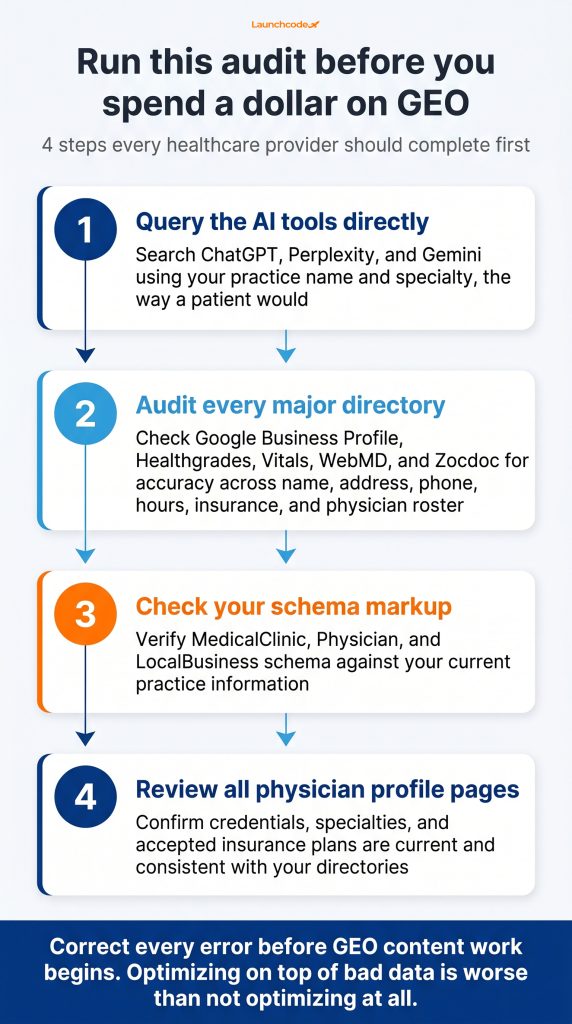
Providers should complete a basic AI footprint audit before investing in any optimization work. The audit covers:
Correct every error before GEO content work begins.
AI search tools are powerful aggregators but they are not infallible. A practice that relocated may still appear at the old address in AI results. A physician who left a group may still be listed there. These errors persist because AI systems rely on indexed data, and that data can lag weeks or months behind real-world changes.
Directory hygiene and schema accuracy are not one-time setup tasks. They are ongoing operational requirements for any practice that wants clean, reliable visibility in AI-generated search.
The providers who will lead patient discovery over the next two to three years are building two systems at once: a local SEO foundation that wins direct provider searches and a GEO content strategy that earns citations in AI-generated informational answers. Neither replaces the other. Both are required.
Local search still handles the moment a patient is ready to book. Google AI Overviews have been removed from queries like “pediatrician near me” and “dermatologist near me,” which means traditional local ranking factors apply in full here. A strong local SEO foundation for a healthcare provider includes:
GEO targets the informational lane, where AI Overviews now appear on nearly every clinical and treatment query. The goal is to become the source AI systems cite when a patient researches a condition, treatment, or specialty. Over 65% of consumers have used Google to find a new provider, and that research phase now largely happens inside AI-generated answers rather than on practice websites.
Effective GEO content for healthcare providers includes:
Social media has become a secondary trust signal in provider recommendations. The same rater8 research that tracked AI influence found that 35% of patients have chosen a physician based on social media presence, and nearly a quarter listed social platforms among their top influences in provider choice. AI tools increasingly factor social engagement and online presence breadth into their confidence scoring when making recommendations.
A consistent, active social presence does not need to be large to contribute. Regular educational content, physician commentary, and patient-focused posts all build the digital footprint that AI systems pull from across the open web.
The patient discovery process has changed faster than most healthcare marketing teams have adapted. AI tools now influence provider selection at roughly the same rate as physician referrals, and the rate is growing. RepuGen found that 39.7% of patients now use AI exclusively or alongside traditional search to research healthcare providers. Three years ago, that number was effectively zero.
The shift is not a reason to abandon what works. Local SEO, review management, and a strong Google Business Profile still drive direct patient acquisition. The new requirement is a GEO layer on top of that foundation so your practice earns citations in the AI-generated answers that shape patient decisions before they ever reach a local search query.
For practices and health systems acting now, the priorities are:
At Launchcodex, we build integrated SEO and GEO strategies that address both lanes as part of the same engagement. If your practice is losing ground in AI-generated answers or you are unsure what AI tools currently say about you, the audit is the right starting point.
SEO focuses on ranking in traditional search results, including Google’s organic links and local pack. GEO, or generative engine optimization, focuses on getting your practice cited in AI-generated answers from tools like Google AI Overviews, ChatGPT, and Perplexity. Both matter, but they target different moments in the patient journey and require different content and technical approaches.
Not entirely. Google AI Overviews now dominate informational and clinical queries, but Google has removed AI summaries from direct provider searches like “cardiologist near me.” Local results still handle booking-intent queries. Tools like ChatGPT and Perplexity are growing as a separate discovery channel alongside Google, not replacing it.
Query ChatGPT, Perplexity, and Gemini directly using your specialty and city, the way a patient would. Check whether your practice appears, what information is shown, and whether that information is current and accurate. This is the starting point of an AI footprint audit.
Yes. Review volume, recency, and response behavior all influence how AI tools evaluate and recommend providers. Forty percent of patients say verified reviews are the most important element in an AI-generated provider recommendation. Reviews on Google, Healthgrades, Vitals, and WebMD all feed into AI aggregation.
At minimum: MedicalClinic or Physician schema at the practice and provider level, LocalBusiness schema with accurate contact and location data, and Article markup on content pages. Schema helps AI systems confirm who a provider is and what they treat, making the practice more likely to appear in structured AI-generated responses.
Yes. AI tools pull from indexed data that can lag real-world changes. Relocated practices, updated insurance panels, and physicians who have left a group may all still appear with outdated details in AI answers. Providers should audit their AI footprint and correct directory and schema data before running any GEO optimization.


Real stories from the people we’ve partnered with to modernize and grow their marketing.