

What is performance creative and how it transforms your digital marketing results
Performance creative is the data-driven approach to building ads that convert. Learn what it is, which metrics matter, and h...





OpenAI has outlined how it plans to introduce advertising inside ChatGPT and which guardrails it says will protect user trust.
This guide explains what is known today, what is still unknown, and how you can design early tests that protect brand safety while proving real business impact.
OpenAI says ads are not live yet, but it plans to start testing in the coming weeks for logged-in adults in the U.S. on ChatGPT Free and Go. Ads are expected to appear at the bottom of answers, clearly labeled and separated from the organic response. Higher tiers like Pro, Business, and Enterprise are expected to remain ad-free during this phase.
Ready to grow your organic traffic?
Get a free SEO audit from the Launchcodex team.
Scope is the key constraint. A limited test means limited inventory, fewer learnings, and restricted advertiser access early on.
OpenAI’s Help Center says there are currently no ads in ChatGPT and describes internal testing before broad availability, along with early tier rules, see the official FAQ on Ads in ChatGPT.
For planning, treat this like a new channel in prelaunch:
OpenAI frames ads as a way to expand access while maintaining an ad-free paid option and user controls, described in OpenAI’s approach to advertising and expanding access.
This is entering a huge market. IAB reports U.S. internet advertising revenue reached $258.6 billion in 2024, up 14.9 percent year over year, per IAB’s digital ad revenue announcement. New inventory that sits close to purchase intent attracts budget fast.
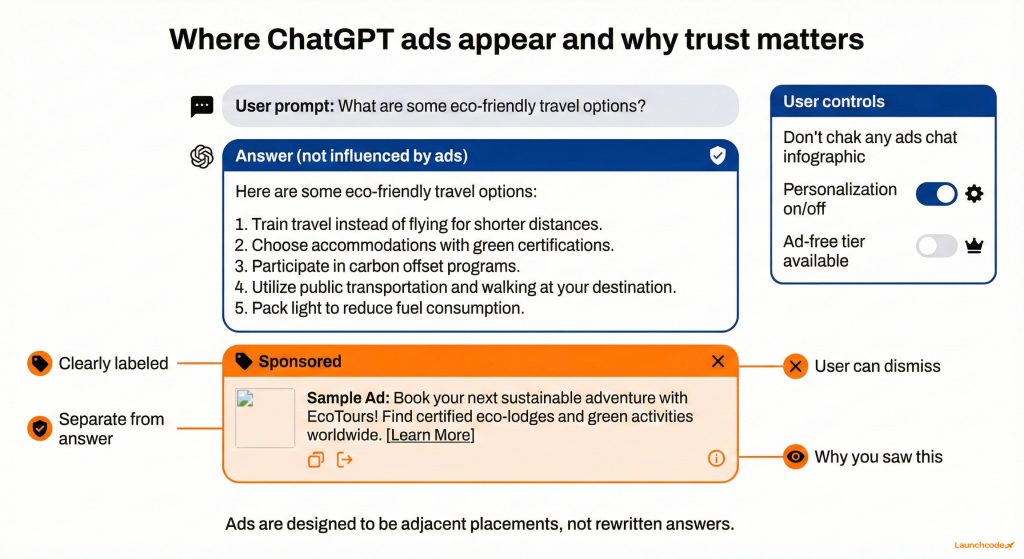
OpenAI’s stated design is that ads show as sponsored units, clearly labeled, and placed below the answer when a product or service is relevant to the conversation. OpenAI also states ads do not influence the answer itself, so the paid unit should function as an adjacent placement, not a rewritten response.
If OpenAI enforces this separation in production, user trust becomes the main variable you need to protect.
OpenAI describes testing ads at the bottom of answers and emphasizes labeling and separation. That matters because it reduces confusion about what is paid and what is the model response.
Plan for the creative and the landing page to carry the load:
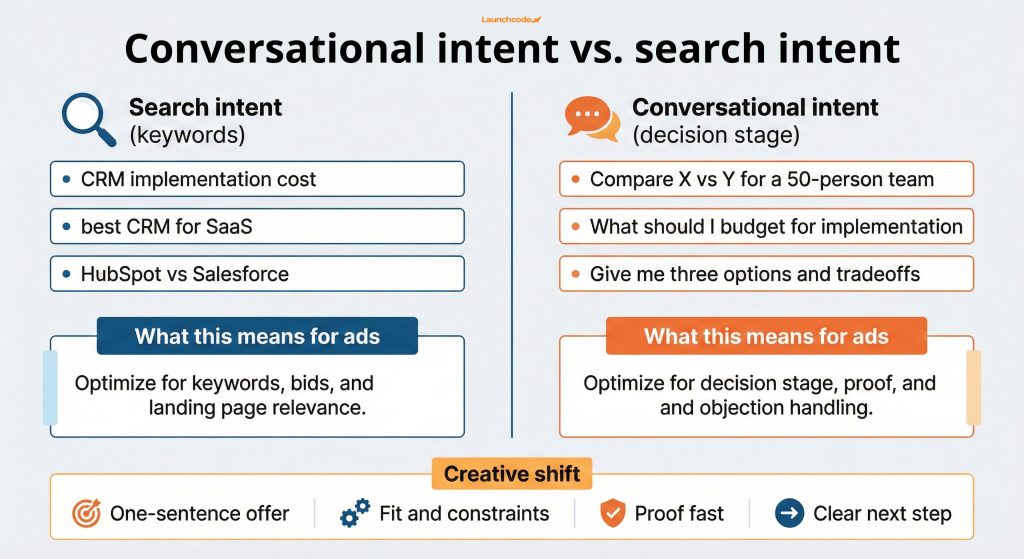
Conversational intent often shows up after the user has refined constraints. The user may already know what they want, and they want tradeoffs, costs, and fit.
Examples of high-intent conversation states:
A simple rule: write ads that align to a decision stage. Do not write ads that assume the user is starting from scratch.
| Option | Who it fits | Key strength | Watch out for |
|---|---|---|---|
| ChatGPT sponsored unit | Teams testing new high-intent surfaces | Strong alignment to evaluation moments | Limited inventory and limited reporting early |
| Google search ads | Teams with proven keyword intent | Mature bidding, high control, strong reporting | Rising CPCs and crowded SERPs |
| Meta ads | Teams scaling awareness and demand capture | Scale and creative testing | Lower intent and more attribution noise |
OpenAI says it will not share your ChatGPT conversations with advertisers and that ads will not influence answers. It also says users can dismiss ads, learn why they saw them, and turn off personalization. OpenAI also states it will not show ads to users it believes are under 18 and will exclude sensitive categories like health, mental health, and politics.
Those constraints will shape performance. You should expect lower scale and more performance variance than mature ad platforms.
OpenAI’s public materials draw a hard line: private conversation content is not shared with advertisers. If OpenAI keeps reporting aggregate, you will need to validate performance through your own systems.
Reuters also reports OpenAI will test ads in Free and Go tiers and that ads will not affect outputs or share user data with advertisers, as covered in Reuters reporting on the ChatGPT ads test.
OpenAI describes user controls for personalization, including opt-out paths. That implies a mix of:
If a meaningful share of users opts out, performance will depend on fundamentals:
“Treat the first test like a product experiment, not a scale channel. Your goal is clean signal on lead quality and pipeline.”
Tanner Medina, Co-Founder and Chief Growth Officer
Early ChatGPT ads will likely ship with limited reporting compared to Google Ads or Meta. You should plan for a tighter set of metrics, prioritize lead quality over volume, and use an incrementality test to reduce attribution guesswork. If you cannot show lift, you will not defend budget once this inventory gets competitive.
You can still run high-quality tests with limited platform reporting if your measurement stack is ready.
Start with what you control:
Use named tools so your team can execute:
If you already run a CRM and automation layer, map every step from click to booked meeting and closed-won. That is also a good time to tighten response-time automations. Launchcodex often sees lead quality improve when the first response happens in minutes, not hours, because evaluation intent decays fast.
Run a simple experiment:
If you cannot keep other variables stable, document what changed and treat results as directional.
ChatGPT is an evaluation surface. Users may click later through branded search, direct, or email.
In reporting, separate:
OpenAI says it will restrict ads from sensitive topics like health, mental health, and politics, and it will not show ads to users it believes are under 18. That helps, but you still need your own review process because conversational context can change quickly and misalignment can happen even with strong platform rules.
Treat this like a high-trust publisher environment. Your standards should be higher than broad social targeting.
Use this before you spend:
Even with clear ad labels, users will scrutinize anything that looks like it influenced the answer.
Build for trust with specifics:
For disclosure standards and avoiding deceptive claims, align internal review to the FTC’s advertising and marketing guidance.
“Your safest approach is to approve messages the same way you would for a premium publisher: clear claims, clear proof, and clear exclusions.”
Brittany Charles, SVP, Client Services
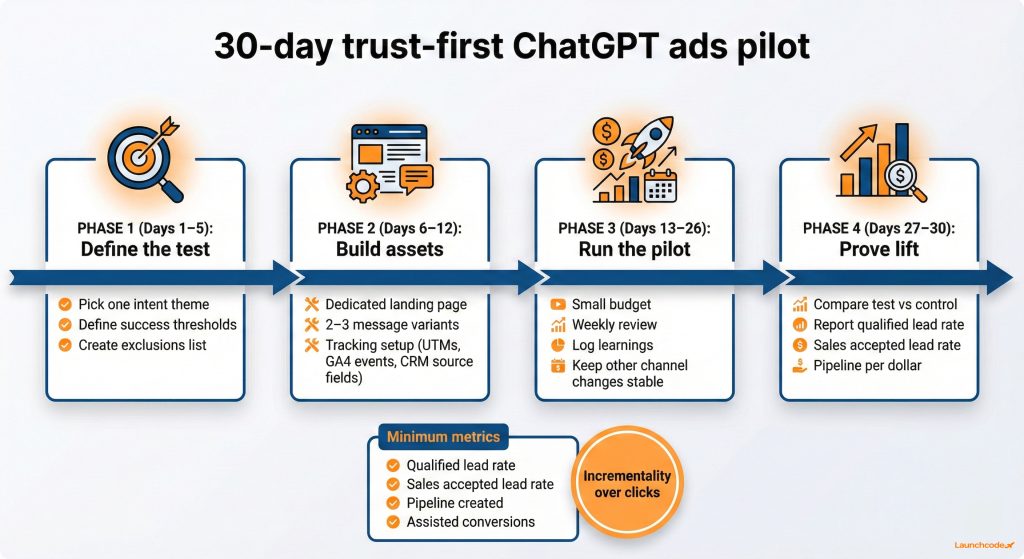
The best early strategy is to test one narrow use case with tight creative, an intent-matched landing page, and a measurement plan tied to pipeline. Treat it like a controlled pilot, not a scaled acquisition channel. The goal is learning: which conversation states convert, and what messaging earns trust.
Most teams waste money by copying search ad copy and sending it to generic pages.
OpenAI is drawing a line between sponsored units and the answer itself, but paid placement will still influence discovery because it sits next to decision-making. The strongest approach is to combine paid tests with GEO fundamentals so you show up both as a sponsor and as a trusted source that AI systems cite.
This is a new paid layer on top of evaluation behavior. It does not remove the need for organic credibility.
Build both tracks around the same intent themes:
For the organic side, prioritize:
If you track where your brand appears in AI answers, use that data to pick intent themes that correlate to pipeline. If you do not track it yet, start with a prompt set tied to your funnel and measure visibility and citations over time.
Conversational ads are not guaranteed to scale. Several AI answer products have had to rethink how ads fit without damaging trust. Treat this as a channel where user experience limits inventory more than technology does.
Move now, but move carefully. Build readiness, then test with discipline.
If you want a practical operating model, run a 30-day “AI channel readiness” sprint: one intent theme, one landing page, one measurement plan, one weekly learning loop.
OpenAI says ads are not live yet. It says it plans to begin testing for logged-in adults in the U.S. on Free and Go tiers, with higher tiers expected to remain ad-free during the early phase.
OpenAI states ads do not influence the answers ChatGPT provides and that sponsored placements are separated and clearly labeled.
OpenAI’s public policy statements say it does not share your conversations with advertisers. If you choose to interact with an advertiser through an ad, that direct interaction may be visible to the advertiser.
Prioritize qualified lead rate, sales accepted lead rate, pipeline created per dollar, and close rate where possible. Use an incrementality test design to estimate lift.
Match the decision stage, answer objections fast, show proof early, and keep the path to conversion simple. Use dedicated pages per intent theme rather than generic homepages.




Performance creative is the data-driven approach to building ads that convert. Learn what it is, which metrics matter, and h...
Find out exactly where Google Display Network ads appear, which campaign types auto-enroll in GDN, how to audit your placeme...
Learn a 4-step workflow for using ChatGPT to write responsive search ad copy that meets Google Ads character limits, support...