
Share:

AI marketing & automation


Most teams still treat digital PR as a link-building tactic with better branding. That mindset made sense before AI answer engines started citing brands whether or not those brands earned a hyperlink. It no longer holds up. A single piece of earned coverage today can move a keyword ranking and shape whether ChatGPT or Google AI Overviews mention a brand by name.
This article breaks down what digital PR actually does for search engines and AI systems in 2026, which outreach platforms replaced HARO, which campaign formats still earn coverage, and how to plan, run, and measure a campaign that earns both outcomes at once. You get a specific, usable framework for planning, pitching, and measuring a campaign this way.
Digital PR is the practice of earning third-party media coverage that produces a backlink, a brand mention, or both, through stories a journalist chooses to cover rather than content a brand pays to place. It sits inside earned media, separate from owned channels like a company blog and paid channels like display ads. That separation matters more now than it did five years ago, because earned coverage feeds two different systems at once.
Traditional SEO advice treats these three media types as separate budget lines. GEO collapses that separation. Google’s AI Overviews and tools like ChatGPT draw heavily on earned coverage because it carries independent, third-party judgment that owned content cannot fake. A blog post a brand writes about itself signals far less than a Forbes article that chose to feature it on its own merit.
Older digital PR guides, including well-known ones from major SEO vendors, still frame the goal almost entirely around Domain Rating and backlink counts. That framing predates AI Overviews becoming a mainstream search surface. The mechanics of earning coverage have not changed much. What changed is what that coverage now does downstream, for a second system that does not read anchor text at all.
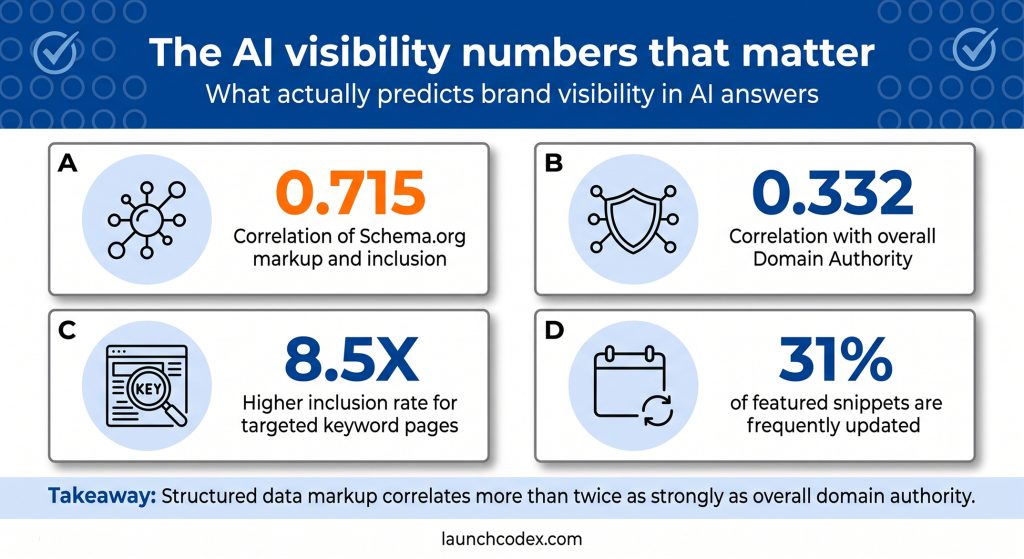
Branded web mentions correlate with AI Overview brand visibility at 0.664, compared to just 0.218 for backlinks, based on a study of 75,000 brands. That is roughly a three-to-one gap in favor of mentions. Ahrefs analyzed AI Overview brand visibility factors across domain and keyword-level signals and found the strongest predictors were all off-site, brand-shaped factors rather than link metrics.
The same study found brands in the top quartile for web mentions averaged 169 AI Overview mentions, over ten times more than the next quartile down, which averaged just 14. Roughly 26 percent of the brands studied had zero AI Overview mentions at all. Visibility compounds. Brands that already get talked about keep getting talked about, and brands that do not stay invisible to AI systems.
Ryan Law, Ahrefs’ Director of Content Marketing, explains the mechanism directly. Unlinked mentions have very little impact on SEO, he notes, but a much bigger impact on GEO, because large language models derive their understanding of a brand’s authority from words on the page, from the prevalence of particular words, and from the context in which those words appear. Independent growth advisor Kevin Indig found a related pattern in his own research, that brand search volume is the biggest predictor of visibility in ChatGPT, with a correlation of 0.334 between chatbot mentions and branded search volume.
“Clients still ask us for the link count first. We show them the mention count next to it, because that is the number that shows up when we check what ChatGPT says about them six months later.” Tanner Medina, Co-Founder and Chief Growth Officer
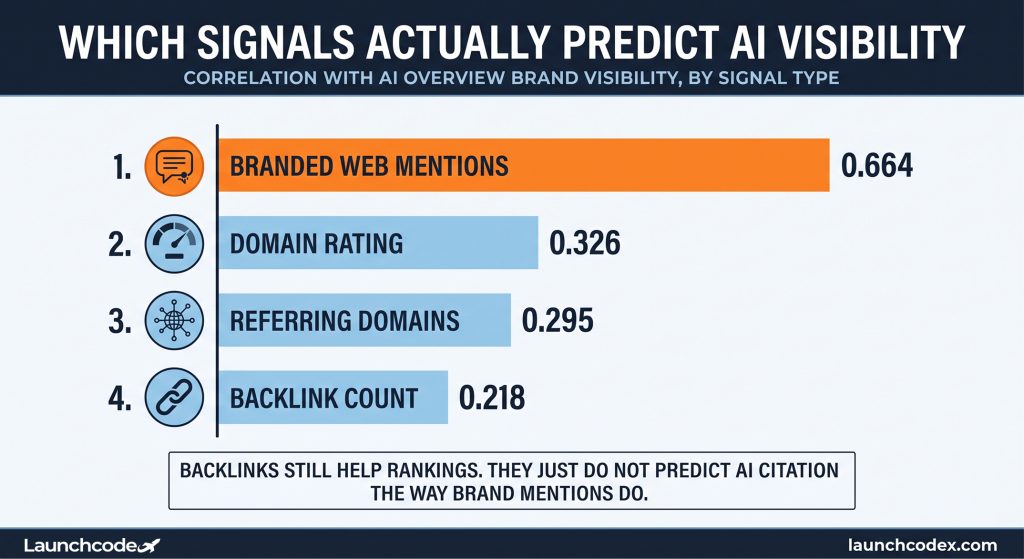
Backlinks remain a real ranking factor, and digital PR is still one of the cleanest ways to earn them, but treating links as the only goal misses half the return. Google’s own John Mueller has said as much. On a widely cited post on X, Mueller called digital PR just as critical as technical SEO, probably more so in many cases, and added that it is a shame the tactic gets bucketed with spammy link building.
Link volume still correlates with rankings in a direct way. Search Engine Land’s guide to digital PR for SEO cites research showing 96.3 percent of websites ranking in Google’s top ten positions have more than 1,000 linking domains. That correlation has not disappeared. It has simply stopped being the whole story.
| Signal | Correlation with AI Overview visibility | What it still does well |
|---|---|---|
| Branded web mentions | 0.664 | Predicts AI citation and builds topical authority |
| Domain Rating | 0.326 | Signals overall site trust to Google |
| Referring domains | 0.295 | Diversifies link profile strength |
| Backlink count | 0.218 | Supports traditional keyword rankings |
Do not drop link building to chase mentions instead. The two goals reinforce each other. A journalist who quotes a brand and links to it in the same sentence delivers both outcomes in one placement, which is the actual target.
HARO no longer exists in the form most digital PR guides still describe. Cision folded the brand into Connectively and shut that platform down in December 2024. Qwoted’s account of the shutdown explains why, Cision pivoted its resources toward the CisionOne platform instead. Featured.com later acquired the original HARO name and relaunched it in April 2025. Anyone following an outreach guide written before that shift is citing platforms that no longer work the way the guide describes.
Muck Rack’s 2026 State of Journalism report, based on nearly 900 journalists, found 86 percent say at least some of their stories start from a PR pitch, but 88 percent immediately discard pitches that miss their beat. A pitch feels genuinely relevant to 78 percent of journalists when it directly affects the community their audience belongs to. The same report found AI adoption among journalists has reached 82 percent, with ChatGPT usage at 47 percent. Journalists now research stories through the same AI tools that cite earned coverage, so journalist research and AI citation increasingly reinforce each other.
Sending the same generic pitch across every platform on this list wastes the fit each one offers. Qwoted rewards a complete, verified expert profile. Featured rewards a tightly structured, ready-to-publish answer. Treat them as different channels, not one mailing list.
“We treat Qwoted and Featured as two separate systems, not one contact list. The profile that gets a response on one rarely works copied straight onto the other.” Derick Do, Co-Founder and Chief Product Officer
Four campaign formats consistently earn journalist attention, original data studies, reactive expert commentary, newsjacking, and creative stunts, and each fits a different resource level and timeline. Picking the wrong format for a team’s size and speed is the most common reason a first campaign underperforms.
Journalists want numbers they cannot get anywhere else. A brand with any kind of usage data, customer survey capacity, or public dataset access can build a study around a specific, surprising finding and pitch it with a visual asset attached. This format takes the most lead time but earns the most durable coverage.
This is the tactic HARO originally served. A brand expert answers a live journalist request through Qwoted, Featured, or Source of Sources. It requires almost no production time, only a fast, specific, quotable answer, and it works well for teams without a dedicated PR function.
Attaching expert commentary to a breaking story works only when the brand can move within hours, not days. Google Alerts set up around relevant keywords gives a lean team enough warning to respond before the news cycle moves past the story.
Bold or unexpected campaigns can earn wider pickup than a data study, but they carry more execution risk. This format suits brands with design resources and tolerance for a campaign that might not land.
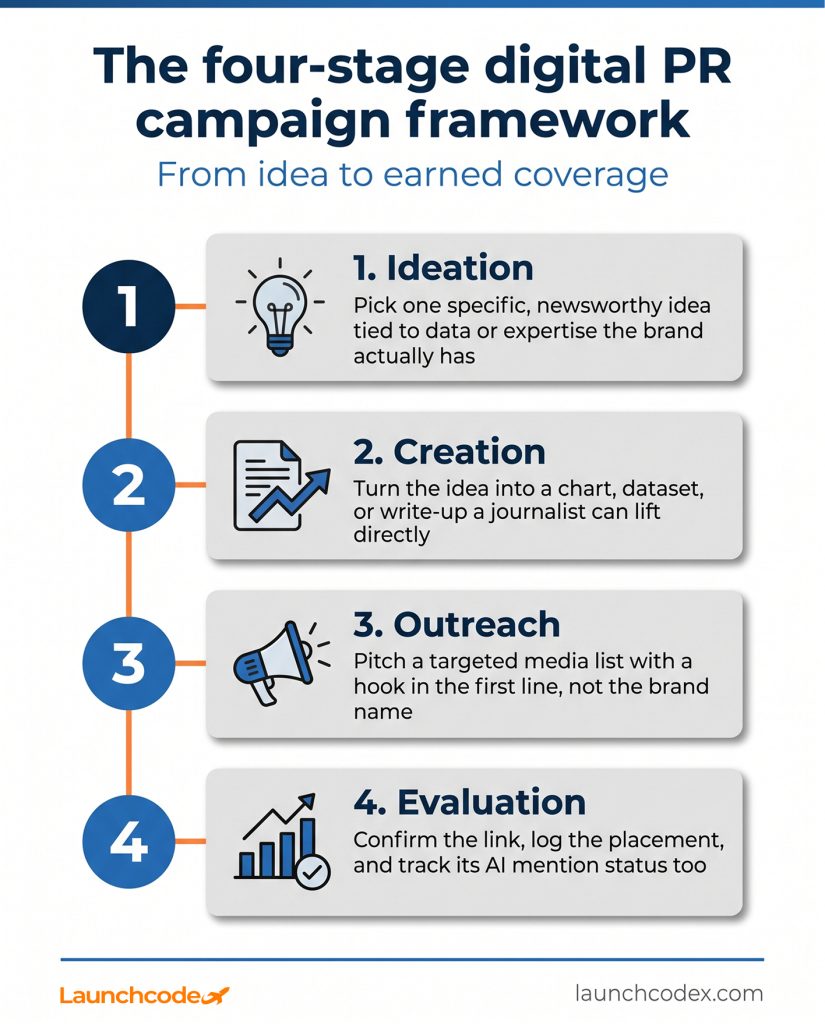
A digital PR campaign moves through four stages, ideation, creation, outreach, and evaluation, and skipping straight to outreach without a genuinely newsworthy idea is the single most common reason campaigns fail to earn coverage.
A team without a dedicated PR function should start with reactive commentary, not a data study. It costs almost nothing beyond a well-written profile and a fast response habit, and it builds journalist relationships that make the next, bigger campaign easier to place.
“We log every pitch in one sheet, flagged for platform, link status, and AI mention status. It is not complicated, but almost nobody keeps that second column, and that is the one that tells you if a placement is working for GEO.” Derick Do, Co-Founder and Chief Product Officer
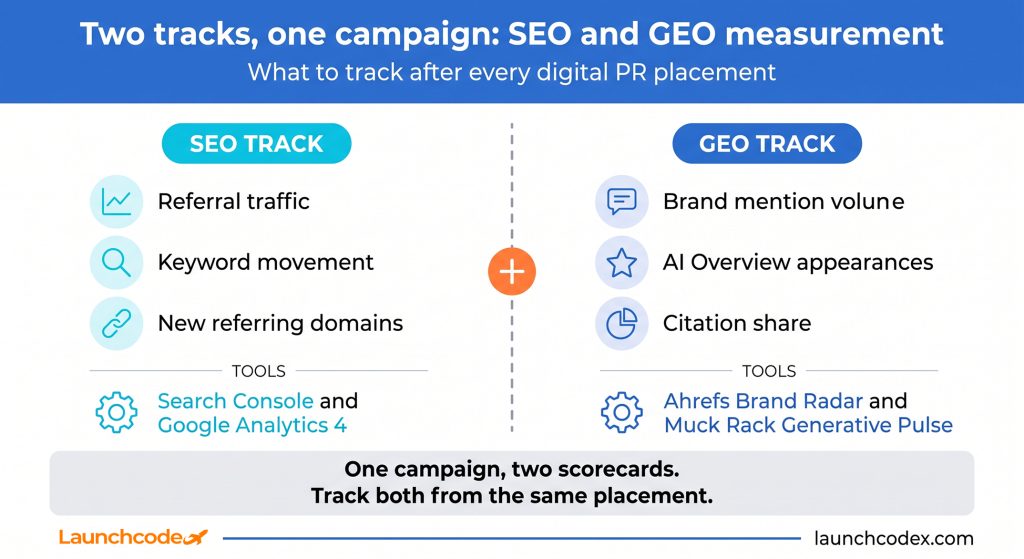
Digital PR results split into two measurement tracks, traditional SEO metrics tracked through Search Console and Google Analytics, and GEO metrics tracked through brand mention and AI citation monitoring, and most teams only build the first track. PRSA’s coverage of Muck Rack’s 2026 State of PR report found 39 percent of PR professionals are not measuring GEO at all, even though 45 percent list media measurement as a major part of their job. Among those who do track it, only 25 percent monitor brand mentions inside AI-generated responses.
Muck Rack cofounder and CEO Greg Galant put the gap plainly. Most PR professionals recognize that AI visibility matters, he says, but many companies still have not decided who owns it or how to measure it. That ownership gap is where a structured measurement approach earns its value.
| Track | What to measure | Tool |
|---|---|---|
| SEO | Referral traffic, keyword movement, new referring domains | Google Search Console, Google Analytics 4 |
| GEO | Brand mention volume, AI Overview appearances, citation share | Ahrefs Brand Radar, Muck Rack Generative Pulse |
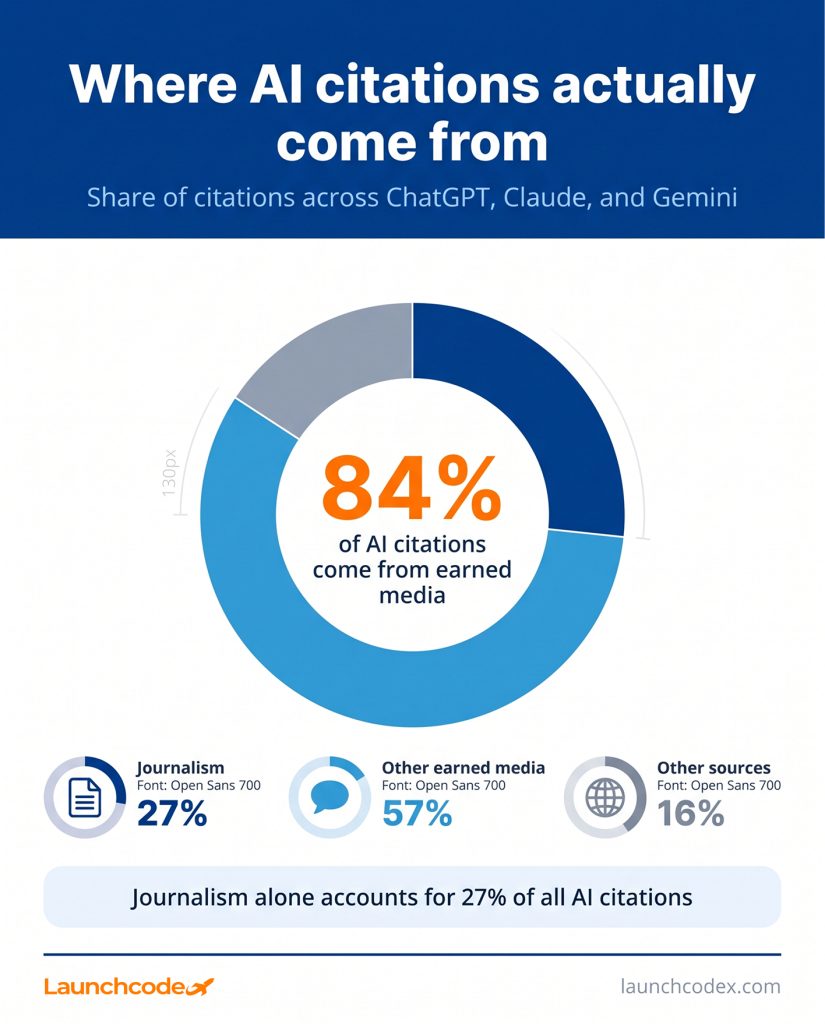
Earned media’s role in this second track is substantial. Muck Rack’s Generative Pulse analysis of more than 25 million links across 17 industries found earned media accounts for 84 percent of all AI citations across ChatGPT, Claude, and Gemini, with journalism alone making up 27 percent of cited sources. Every placement logged for its backlink should also be logged for whether it shows up later inside an AI answer.
“A digital PR report that only shows referring domains is half a report. We tie every placement back to branded search lift and AI mention share before we call a campaign a win.” Tanner Medina, Co-Founder and Chief Growth Officer
A single earned link from a genuine digital PR campaign typically costs 1,000 dollars or more once time, data, and outreach effort are factored in, which is a realistic number to bring into a budget conversation rather than a discouraging one. BuzzStream’s 2026 digital PR benchmarks put average cost per earned link at that figure for authoritative placements, well below what a comparable amount of paid media would cost for similar reach.
Ask two questions before spending the budget. Would a journalist genuinely want to cover this without being paid to? And does the plan include a way to measure both the link and the mention? If either answer is no, the campaign needs more work before outreach starts.
Digital PR in 2026 is not a choice between chasing links and chasing AI visibility. The same well-placed story does both, provided the campaign is planned, pitched, and measured with both outcomes in mind from the start. Launchcodex’s SEO and GEO work treats every placement this way, tracking a keyword’s movement and a brand’s AI citation share from the same piece of coverage rather than treating GEO as an afterthought.
The next step is direct. Pick one data point or one expert perspective a brand can genuinely back up, pitch it through a current outreach platform, and track it on both the SEO and GEO side once it lands. That single habit closes most of the gap this article has outlined.
No. Link building focuses only on acquiring backlinks. Digital PR earns media coverage that may include a backlink, a brand mention, or both, and it works even when a journalist chooses not to add a hyperlink.
Yes. The original HARO platform closed under Connectively in December 2024 and later relaunched under Featured.com, but the underlying tactic, reactive expert commentary, still works through Qwoted, Featured, and Source of Sources.
They help GEO more directly than SEO. Ahrefs found branded web mentions correlate with AI Overview visibility at 0.664, well above backlinks at 0.218, which means an unlinked mention still carries real weight for AI citation even without an SEO backlink attached.
Expect to budget around 1,000 dollars or more per earned link once outreach time and asset creation are included, based on 2026 industry benchmarks from BuzzStream.
Individual placements can land within a few weeks of a strong pitch. Measurable ranking movement and AI citation growth typically take longer, often several months, since both systems need repeated mentions to register a brand as consistently authoritative.


Real stories from the people we’ve partnered with to modernize and grow their marketing.