

Share:

AI marketing & automation


Google can now rewrite your page title in search results using AI. Not just shorten it or swap in your H1. The system generates entirely new phrasing, sometimes changing the tone, stripping context, or altering what your page appears to promise. There is no notification when it happens. There is no opt-out.
This article breaks down what the AI headline rewrite test actually does, how it connects to a pattern Google already made permanent in Discover, and what you can do right now to reduce rewrite risk on your own pages. You will get specific data on which titles survive unchanged, a step-by-step monitoring process, and a framework for building pages that give Google less reason to step in.
Google confirmed to The Verge in March 2026 that it is running a live experiment where AI rewrites the headlines shown for web pages in standard search results. The test applies to news sites and other types of websites. Google described it as “small and narrow,” but the changes are real. The AI generates new title text rather than pulling from existing on-page elements like H1 tags or anchor text. In at least one documented case, the rewritten headline used phrasing that never appeared anywhere on the original page.
This is different from the algorithmic title rewrites Google has used since 2021. That older system selects alternative text from content the publisher already wrote, such as subheadings, body copy, or Open Graph tags. The AI test creates novel text. That distinction matters because it means a reader could see a headline attributed to your brand that you never approved, reviewed, or wrote.
The Verge documented several cases where its own headlines were altered. One article titled “I used the ‘cheat on everything’ AI tool and it didn’t help me cheat on anything” appeared in Google as “‘Cheat on everything’ AI tool.” The original was a critical review. The rewrite made it sound like a product endorsement. A second article about Microsoft rebranding Copilot was rewritten to “Copilot Changes: Marketing Teams at it Again,” language the article never used.
These are not edge cases. They show how AI rewrites can strip editorial framing, change meaning, and misrepresent the content behind the link. As Louisa Frahm, SEO Director at ESPN, wrote on LinkedIn: “A headline is the most prominent element for attracting readers in timely windows. If that vision gets altered and facts are misrepresented, long-term audience trust will be compromised.”
Google told The Verge the test aims to “identify content on a page that would be a useful and relevant title to a user’s query.” The company said that any future permanent version might not use generative AI, but did not explain what the alternative would look like. Google does not disclose when a headline has been rewritten. No label or indicator appears next to the altered title. The reader has no way to know the headline was changed unless they visit the page and compare.
There is currently no opt-out mechanism. The News Media Alliance, which represents more than 2,000 US news outlets, has called for transparency and opt-out tools. Google has not responded publicly to those requests.
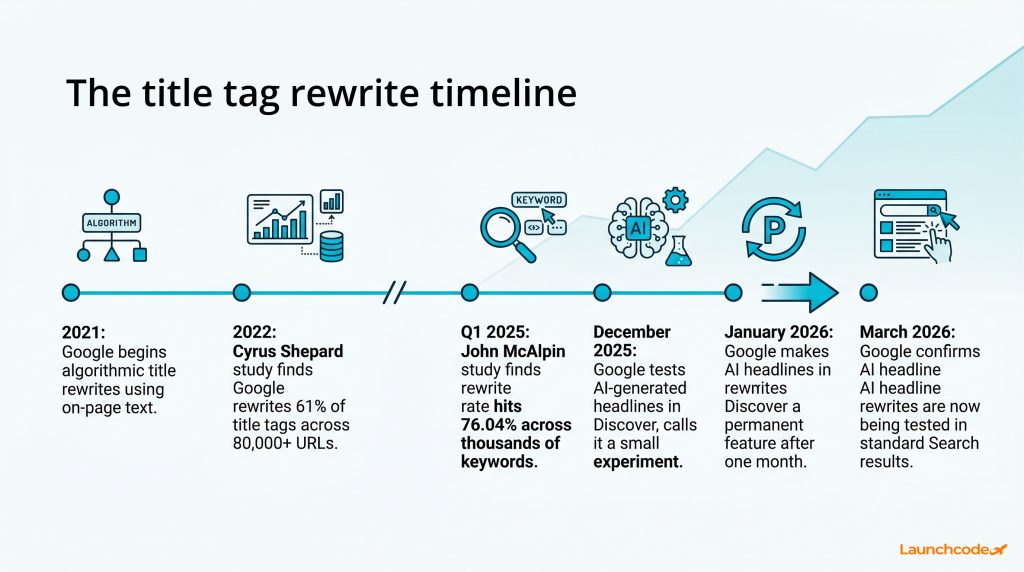
Google tested AI-generated headlines in Discover in December 2025, calling it “a small UI experiment for a subset of Discover users.” By January 2026, Google reclassified it as a permanent feature, citing that it “performs well for user satisfaction.” That transition took roughly one month. The same language Google used for Discover is now being applied to the Search test, which makes the Discover timeline the most useful signal for what comes next.
As Sean Hollister, Senior Editor at The Verge, noted: “You shouldn’t assume that means the company won’t roll it out more widely, because Google originally told us its AI headlines in Google Discover were an experiment too.”
The Discover version of AI headlines had well-documented accuracy issues before it became permanent. Headlines sometimes stated the opposite of what articles reported. Summaries routinely misrepresented information. Nieman Journalism Lab covered the reclassification and noted that the “Generated with AI, which can make mistakes” disclaimer was buried under a “See more” button, not displayed prominently.
Despite those problems, Google still promoted it to a permanent feature. That decision tells you something important: Google is prioritizing engagement metrics over editorial accuracy in its headline display decisions. For business owners and marketers, this means you cannot rely on Google to preserve the intent of your title, even when the content behind it is strong.
An analysis of over 400 publishers found that Discover’s share of Google-sourced traffic climbed from 37% to roughly 68%. For publishers already dealing with AI headlines in Discover, having the same system roll into traditional Search would mean losing headline control across both of their primary Google traffic sources.
Before the AI headline experiment, Google’s algorithmic title rewrite system was already changing most titles in search results. SEO consultant John McAlpin analyzed thousands of keywords across YMYL and non-YMYL websites in Q1 2025 and found that Google rewrote 76.04% of all title tags. That is up from 61% in a 2023 study by Cyrus Shepard at Zyppy, which analyzed more than 80,000 title tags.
The trend is accelerating. Only 24% of title tags survived unchanged in the McAlpin study. When Google does modify a title, it removes an average of 2.71 words and retains only 35.02% of the original content. The AI headline experiment layers on top of this already aggressive rewrite system.
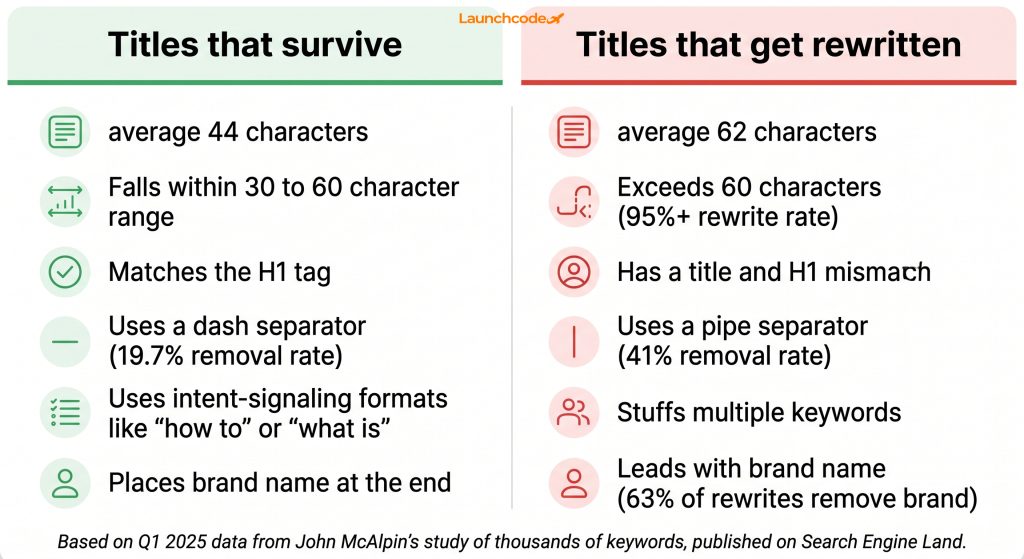
McAlpin’s research identified clear patterns in which titles Google changes and which ones it leaves alone.
The most common change is removing brand names, which happened in 63% of all modified titles. Google tends to strip brand mentions when the query is not brand-specific, especially in health, finance, and legal content. About 30% of title changes aimed to improve readability by converting vague statements into questions or making value propositions more direct.
High-volume keywords trigger more rewrites than low-volume ones. For keywords with over 100,000 monthly searches, Google changed 79.23% of titles. For low-volume keywords (0 to 100 searches), the rate was 75.69%. The difference is small but consistent. Google applies more scrutiny to titles that more people will see.
Titles that Google left unchanged shared several traits:
These patterns give you a clear blueprint for writing titles that have the best chance of appearing as written.
Google uses the original HTML title tag for ranking purposes regardless of what it displays in search results. According to ranking factor analysis from Rankability, the separation between ranking assessment and display means that optimized title tags retain their SEO value even when Google chooses different display text. Pages ranking on Google’s first page include their target keywords in the title tag 65% to 85% of the time.
This is a critical point that most coverage of the AI headline rewrite test misses. The title tag you write still affects where your page ranks. What changed is that the title searchers see may not be the one you wrote. That creates a split between ranking performance and click-through performance that requires a different optimization approach.
Google processes the full content of title tags for ranking, even when displaying shortened or rewritten versions. Longer, keyword-rich titles can contribute to rankings even if they get truncated in the display. You should still include your primary keyword in the title tag, ideally near the beginning.
Think of the title tag as serving two audiences now. The ranking algorithm reads the full HTML title. The display system may rewrite what users see. Your optimization needs to account for both.
“We treat title tags as two jobs in one. The first job is telling Google what the page is about for ranking. The second job is earning the click. When those two goals conflict, most teams optimize for one and lose the other.” , Tanner Medina, Co-Founder and Chief Growth Officer at Launchcodex
Click-through rate is where the real impact of AI rewrites shows up. If Google rewrites your title to something less compelling, less accurate, or less aligned with your brand, your CTR drops. That affects your traffic directly and can create a negative feedback loop where lower engagement signals lead to lower rankings over time.
This risk compounds with the broader AI search shift. A Seer Interactive study analyzing 3,119 queries found that organic CTR dropped 61% for queries where AI Overviews appeared. When clicks are already scarcer, controlling the few remaining decision points matters more. Losing your headline to an AI rewrite during a period of shrinking click volumes is a compounding problem.
The data from the McAlpin study and Zyppy’s research provides a specific framework for writing titles that Google is less likely to change. This is not about gaming the system. It is about giving Google less reason to step in by writing clear, well-structured titles that already match what the algorithm wants to show.
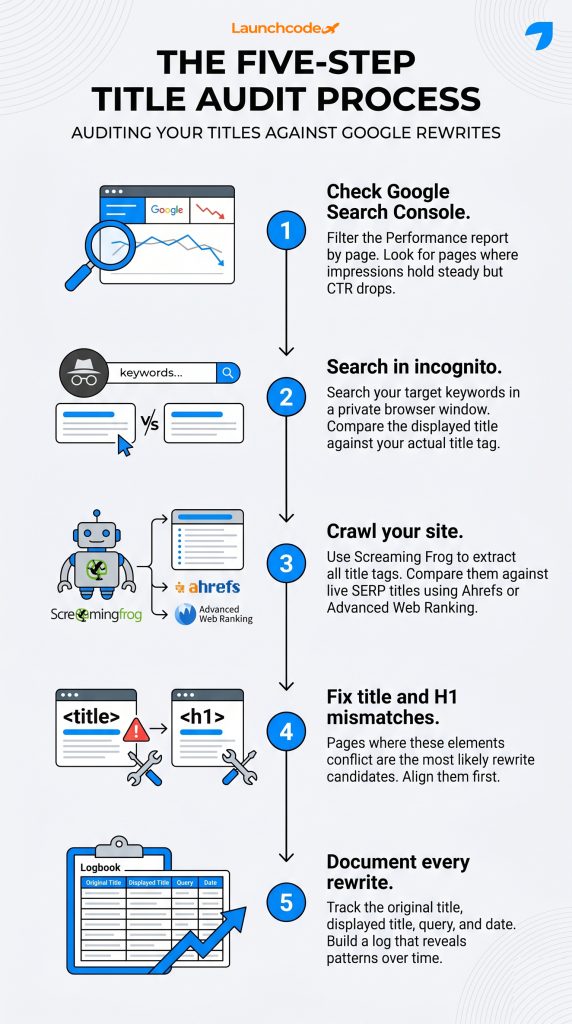
Google does not notify you when it rewrites your titles. You will not find a flag in Google Search Console or an alert in your analytics. Detecting rewrites requires a proactive monitoring process that compares what you published against what Google actually displays.
| Tool | What it does | Best for |
|---|---|---|
| Google Search Console | Shows impressions, clicks, and CTR by page and query | Detecting CTR drops that may signal rewrites |
| Screaming Frog | Crawls your site and extracts all title tags | Baseline comparison against live SERPs |
| Ahrefs | Tracks SERP features and displayed titles for target keywords | Monitoring at scale across many keywords |
| Advanced Web Ranking | Tracks title display changes in SERPs over time | Historical tracking of title changes |
| Zyppy Title Tag Analyzer | Analyzes title tag patterns and rewrite risk | Auditing title structure before publishing |
“The fastest way to catch a title rewrite is to watch for pages where impressions hold steady but CTR drops. That gap is your signal. We build automated alerts around that ratio so nothing slips through.” , Derick Do, Co-Founder and Chief Product Officer at Launchcodex
The AI headline rewrite test does not exist in isolation. It sits inside a broader transformation where Google increasingly controls how content appears to users. AI Overviews, AI Mode, zero-click searches, and now AI-generated headlines all reduce the direct connection between what you publish and what users see.
BrightEdge data tracked from February 2025 to February 2026 shows that AI Overviews now trigger on approximately 48% of all tracked US queries, a 58% increase year over year. Education queries trigger AI Overviews 83% of the time. B2B tech queries hit 82%. Healthcare reaches 88%.
When AI Overviews appear, users are far less likely to click through to any website. The Seer Interactive study found organic CTR dropped from 1.76% to 0.61% when AI Overviews were present. AI headline rewrites compound this by changing the one remaining element that gives you some control over how your content appears in traditional results.
The pushback goes beyond opinion. Penske Media, parent company of Rolling Stone, Billboard, and Variety, filed an antitrust lawsuit against Google in September 2025. The suit named traffic loss and editorial control as core concerns. PMC reported that its affiliate revenue had declined by more than a third by end of 2024.
On the regulatory side, the UK Competition and Markets Authority proposed that Google must let publishers opt out of AI Overviews without facing ranking penalties. Google committed to exploring opt-out but proposed a six-month implementation window with no binding timeline. These moves have not yet extended to AI headline rewrites specifically, but the regulatory framework is expanding.
The strategic response goes beyond title tags. When Google’s AI can rewrite your headline, the entire page needs to communicate your message clearly enough that any extracted text still represents your content accurately.
This means investing in:
The infrastructure that protects your headlines from AI rewriting is the same infrastructure that gets you cited in AI Overviews and referenced by AI search systems. Clarity, accuracy, structure, and freshness work for both goals.
Google’s AI headline rewrite test may still be labeled “small and narrow.” But the Discover precedent shows that label can change within weeks. The 76% title rewrite rate from Q1 2025 shows that Google was already overriding most titles before AI entered the equation. These two forces are converging.
The practical response is a three-layer approach. First, audit your existing titles against the survival benchmarks: 30 to 60 characters, H1 alignment, dash separators, intent-signaling formats. Second, align your full page structure so that every element reinforces the same message your title promises. Third, build a monitoring workflow that catches rewrites early, before CTR erosion becomes a traffic problem.
Title tags still affect rankings. They still influence clicks. They still carry your brand voice into search results. What has changed is that you now need to earn the right to keep that voice visible by writing titles so clear and well-matched to your content that Google’s AI has nothing to improve.
Google confirmed the test is not limited to news sites. It applies to all types of websites. News publishers have provided the most documented examples so far because their headlines tend to carry editorial framing that AI rewrites flatten.
No. There is currently no opt-out mechanism for AI headline rewrites. Google’s publisher controls documentation covers opt-outs for some AI features broadly but does not address headline rewrites specifically. The News Media Alliance has called for transparency and opt-out tools. Google has not responded publicly.
Yes. Google uses the original HTML title tag for ranking purposes regardless of what it displays in search results. The ranking signal and the display are separate systems. Optimized title tags retain their SEO value even when Google rewrites the displayed version.
Google does not notify publishers when it rewrites titles. You need to manually compare your title tags against what Google displays by searching for your target keywords in an incognito window or using tools like Screaming Frog and Ahrefs to compare source code titles against live SERP titles.
Research from Q1 2025 found that 84.87% of unchanged titles fell within the 30 to 60 character range. Unchanged titles averaged 44.47 characters. Titles over 60 characters were rewritten at rates above 95%.
Google has not confirmed a timeline. The Discover precedent is the strongest signal. Google described AI headlines in Discover as a “small experiment” in December 2025 and reclassified them as a permanent feature by January 2026. The same language is now being used for the Search test.


Real stories from the people we’ve partnered with to modernize and grow their marketing.