Share:

AI marketing & automation


Half of all prospective students now use AI tools at least weekly during their college search, according to research from UPCEA and Search Influence. They are asking ChatGPT which nursing programs have the best NCLEX pass rates. They are asking Perplexity which business schools offer evening MBAs near Dallas. They are forming shortlists before they ever visit a university website. Most institutions are not showing up in those answers.
This article explains how enrollment marketing teams can use GEO to change that. You will learn how students use AI to research schools, how to structure and optimize content for AI citation, which schema types drive the most visibility, and how to track the leads that result. Every section is built around tactics you can act on now.
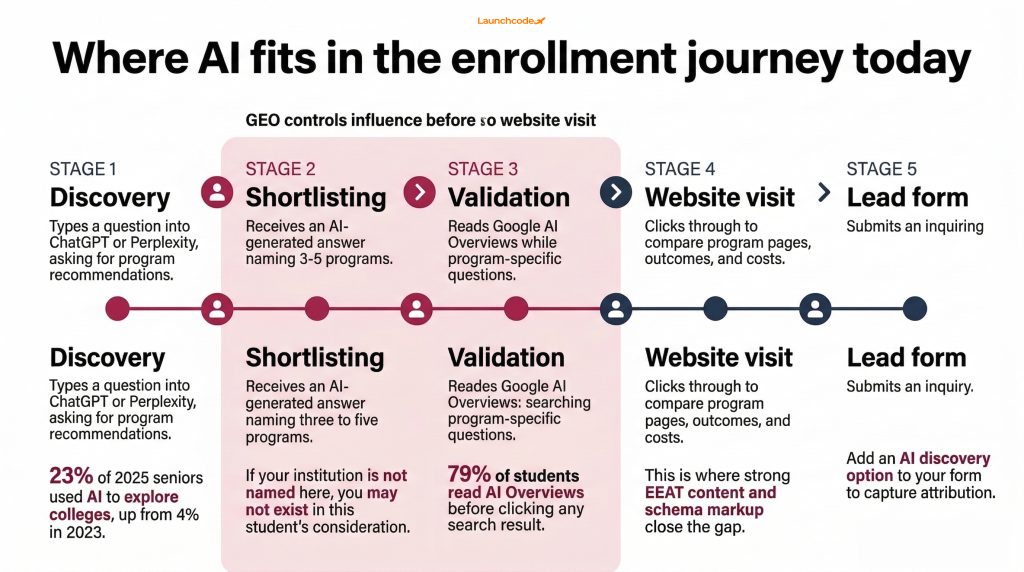
Prospective students are using generative AI tools to research, compare, and shortlist colleges long before they fill out a lead form. This is not a fringe behavior. The data shows it is becoming the default starting point for how students gather context and form opinions about which programs are worth pursuing.
In 2023, just 4% of graduating seniors used AI tools to explore colleges. By 2025, Carnegie Higher Education reports that figure has jumped to 23%. That is nearly a sixfold increase in two years. Meanwhile, 79% of prospective students now read Google AI Overviews before clicking any organic search result. The decision about which programs seem credible is often made inside that AI summary, not on your website.
This matters because it rewrites where enrollment influence actually happens. If an AI tool does not reference your programs when a student asks a relevant question, your institution does not exist in that moment of consideration.
Losing a Google ranking hurts traffic. Losing AI visibility is different. It means your institution is absent from the conversation students are having before they search at all. A student who asks ChatGPT for the top data science master’s programs in the Southeast and does not see your school named will often stop there. They will not search further.
EducationDynamics’ 2025 research found that 37% of modern learners specifically use AI chatbots to gather information about colleges and universities. These are not casual users. They are students actively building their shortlists.
Only 30% of higher education institutions have a formal AI search strategy in place. Another 60% are still in early exploration, and 10% have not started at all. That data comes from a UPCEA snap poll conducted in 2025. The institutions that move now have a clear window to build citation share before competitors close the gap.
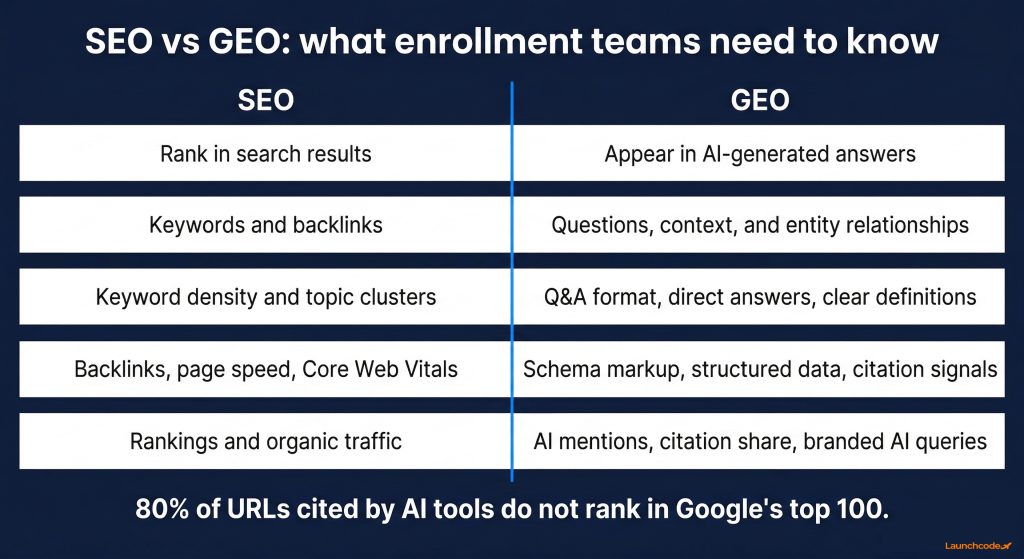
GEO is the practice of optimizing content so AI systems cite it in generated answers. It is distinct from traditional SEO, which optimizes for ranking positions in search engine results. Both matter. But they operate on different signals, reward different content structures, and require different technical implementations.
The clearest evidence of this distinction: StoryChief research shows that 80% of URLs cited by ChatGPT, Perplexity, and Microsoft Copilot do not rank in Google’s top 100 results for the same query. Strong SEO performance does not transfer automatically to AI citation. The two systems operate independently.
| Dimension | SEO | GEO |
|---|---|---|
| Goal | Rank in search results | Appear in AI-generated answers |
| Optimization target | Keywords and backlinks | Questions, context, and entity relationships |
| Content structure | Keyword density and topic clusters | Q&A format, direct answers, clear definitions |
| Technical signals | Backlinks, page speed, Core Web Vitals | Schema markup, structured data, citation signals |
| Measurement | Rankings, organic traffic | AI mentions, citation share, branded AI queries |
| Timeline | Months to years | Weeks to months for early gains |
Gartner projects that by 2028, up to 25% of all searches will shift to generative engines. Institutions that treat GEO as a future priority rather than a current one will face a compounding visibility gap that grows harder to close each quarter.
“Most enrollment teams we work with have solid SEO foundations but no GEO strategy. That gap is where lead volume is being lost right now, and most institutions do not realize it yet.”
Tanner Medina, Co-Founder and Chief Growth Officer, Launchcodex
Higher education institutions have structural advantages that most commercial websites lack. The .edu domain carries genuine trust weight with AI systems. Accreditation credentials such as AACSB, ABET, CCNE, and HLC are recognizable signals of authority that generative engines are trained to respect. Faculty expertise, published research, and documented outcomes are exactly the kind of evidence-backed content AI systems prefer to cite.
The problem is not that university content lacks credibility. The problem is that most of it is not structured in a way that AI systems can extract and use.
AI systems cite content that answers specific questions clearly, uses plain language, and provides verifiable context. The most effective content structure for GEO combines direct answer paragraphs, Q&A formatting, and entity-rich supporting detail. Program pages and blog content that follow this structure get cited more often than pages written for traditional SEO alone.
The foundational GEO research from Pranjal Aggarwal and the Princeton NLP Lab published at KDD 2024, identified several content signals that consistently improve AI citation rates. These include statistical evidence, authoritative source citations, quotations from named experts, and fluent, readable prose. Higher education content teams can apply every one of these signals without significant budget.
Apply this structure to every graduate program, certificate, and major program page.
AI systems extract passages that answer questions directly. Every paragraph on a program page should be able to stand alone as a useful answer. If a paragraph cannot answer a specific question on its own, it is probably too abstract or too general.
Avoid promotional language that states no evidence. “Our program is world class” gives AI nothing to cite. “Our nursing program holds CCNE accreditation and reported a 94% NCLEX first-time pass rate in 2024” gives AI a specific, citable fact.
Schema markup is structured data embedded in a page’s code that tells AI systems and search engines exactly what type of content they are reading. Pages with FAQPage schema are 3.2 times more likely to appear in Google AI Overviews. Yet only 12.4% of websites globally use any form of structured data. For enrollment teams willing to implement schema, this is one of the highest leverage technical moves available.
That citation lift figure comes from Frase.io research published in 2025. A separate study by Relixir across 50 domains found that FAQ schema delivers a 28% median citation lift in AI search results. These are not marginal gains.
| Schema type | What it does | Where to use it |
|---|---|---|
| FAQPage | Marks up Q&A content for AI extraction | Program pages, admissions pages, cost pages |
| Course | Describes a specific course or program with credits, provider, and description | All course and program catalog pages |
| Organization | Establishes institutional identity, location, and contact details | Homepage and about page |
| Person | Marks up faculty profiles with name, title, affiliation, and expertise | Faculty directory and bio pages |
The Course schema type is particularly underused in higher education. When a prospective student asks ChatGPT which schools offer an accredited online MBA with AACSB accreditation in Texas, generative engines parse Course schema to match programs to that query. Institutions without it rely entirely on unstructured page text, which is far less reliable.
For teams without dedicated web development resources, these steps reduce the barrier to implementation.
Schema App is a dedicated structured data tool worth evaluating for institutions managing large course catalogs, as it supports bulk schema generation and ongoing management.
Higher education institutions carry more inherent EEAT authority than almost any other content publisher. Accreditation, faculty credentials, published research, and institutional track records are exactly what AI systems are trained to recognize as credible. The problem is that most universities bury these signals inside content structures that AI cannot parse effectively.
EEAT stands for Experience, Expertise, Authoritativeness, and Trustworthiness. It is Google’s quality framework, now deeply embedded in how generative engines assess whether content is worth citing. Brent Ramdin, CEO of EducationDynamics, put the underlying student demand clearly in the company’s 2025 higher education marketing trends report: students expect transparency about costs, programs, and career prospects, and institutions that deliver it will drive enrollment.
Most university websites have strong institutional authority but weak page-level authority. That means the domain is trusted but individual program pages do not carry the content signals that earn AI citations.
Specific gaps include:
Apply these actions to your highest-traffic program and admissions pages first.
“The institutions that win at GEO are not necessarily the biggest names. They are the ones that surface their outcomes, their faculty credentials, and their accreditations on the pages where students are actually looking.”
Brittany Charles, SVP Client Services, Launchcodex
Kansas City University applied this kind of structured GEO approach and now consistently appears in ChatGPT and Perplexity results when prospects search for top osteopathic schools in the Midwest. The Elliance case study notes that the visibility gains came from a combination of clear program descriptions, credentialed faculty attribution, and content that directly answered the questions prospective DO students ask.
GEO performance requires a different measurement approach than SEO. AI-driven leads often arrive through direct website visits or branded searches rather than trackable referral clicks. Enrollment teams that build a dedicated measurement framework for AI-sourced leads will be able to show ROI on GEO investment and make smarter decisions about where to optimize next.
AI-referred web sessions grew 527% in the first half of 2025, which means even institutions with basic attribution in place are already missing a growing share of their lead volume. Setting up proper measurement now prevents a gap that compounds as AI traffic grows.
AI tools typically do not pass referral parameters the way paid ads or email campaigns do. Leads from AI-influenced searches often arrive as direct traffic or branded organic. To capture them:
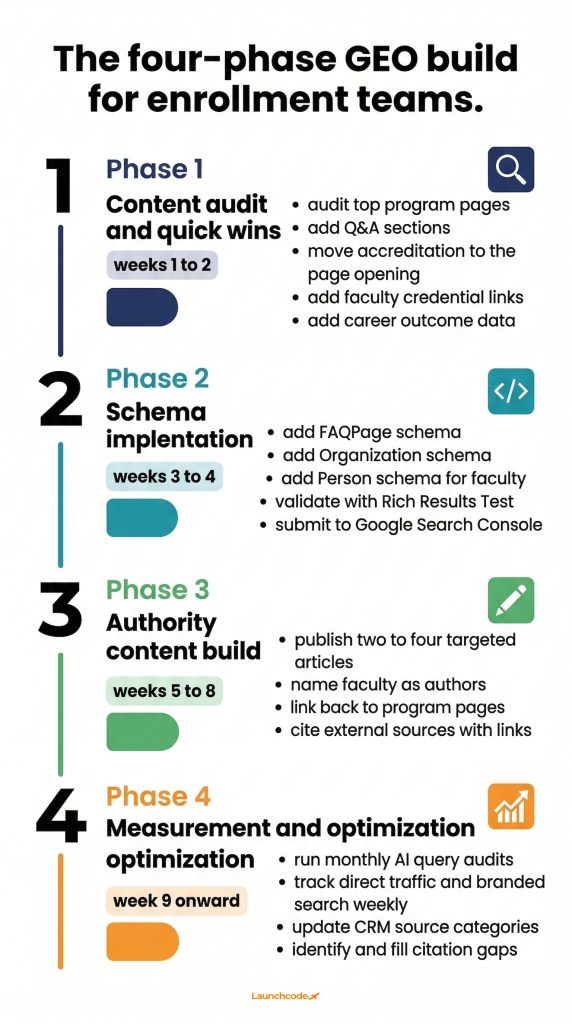
Most enrollment marketing teams do not have unlimited technical resources. The right approach is to sequence GEO investments by impact and complexity, starting with content changes that require no developer involvement, then moving to technical implementation. Done in order, this sequence produces visible results within 60 to 90 days.
65% of higher education marketing teams are now actively using AI technologies in their enrollment efforts, according to the UPCEA and EducationDynamics AI Readiness Report 2025. Over one-third still have no structured plan. Having a sequenced plan is what separates teams that see results from teams that stay in exploration mode.
Higher education institutions are sitting on structural advantages that most commercial publishers will never have: .edu domain authority, accreditation credentials, faculty expertise, and documented program outcomes. These are exactly the signals AI systems are designed to cite. The gap is not credibility. It is structure and execution.
Students are already asking AI tools which programs to consider. They are forming shortlists, comparing programs, and deciding which schools are credible before they ever visit a website. Institutions that appear in those answers will generate lead volume that competitors are not capturing and may not even know they are missing.
The steps in this article are sequenced by impact. Start with content updates to your highest-traffic program pages. Add schema. Build authority articles. Measure and refine. None of these steps require a complete website overhaul or a large technology investment. They require a clear process and consistent execution.
If you want to see how a GEO program fits into your broader enrollment marketing strategy, the Launchcodex GEO team builds and runs these programs alongside the technical SEO, content, and automation infrastructure they depend on.
GEO stands for Generative Engine Optimization. It is the practice of structuring and optimizing content so that AI tools like ChatGPT, Perplexity, and Google AI Overviews cite your institution when prospective students ask questions about programs, admissions, or career outcomes.
No. GEO and SEO are complementary. SEO optimizes for search engine rankings. GEO optimizes for AI-generated answers. Strong SEO foundations such as domain authority, page speed, and quality backlinks support GEO, but ranking well on Google does not automatically produce AI citations. Both strategies are necessary.
Start with Google AI Overviews, ChatGPT, and Perplexity. These are the three platforms most commonly used by prospective students during college research. Google AI Overviews is highest priority because it appears directly inside the Google search experience that students already use.
The four highest-priority schema types for higher education are FAQPage for Q&A content, Course for program and course catalog pages, Organization for institutional identity on the homepage, and Person for faculty profiles. FAQPage schema has the strongest documented impact on AI Overview appearances, making pages 3.2 times more likely to appear.
Run monthly branded queries in ChatGPT, Perplexity, and Google AI Overviews using questions your prospective students would ask. Track which queries return citations to your institution. Also monitor direct traffic to updated program pages, branded search volume in Google Search Console, and AI as a self-reported discovery source on your lead forms.
Content and schema changes to existing high-authority pages can produce AI citation gains within four to eight weeks. New authority content typically takes longer as AI systems build trust in the source. Plan for 60 to 90 days to see measurable movement, and treat GEO as an ongoing program rather than a one-time project.



Real stories from the people we’ve partnered with to modernize and grow their marketing.