
Share:

AI marketing & automation


Your competitor just showed up in a ChatGPT response for a buying query in your category. You did not. That is not a coincidence. AI systems select brands based on a specific set of signals, and right now, your competitor has built more of those signals than you have.
This article breaks down exactly how ChatGPT decides which brands to surface, what winning brands are doing that most others ignore, and the specific steps you can take to close the gap. You will also find a practical audit you can run in under 30 minutes to see where you stand today.
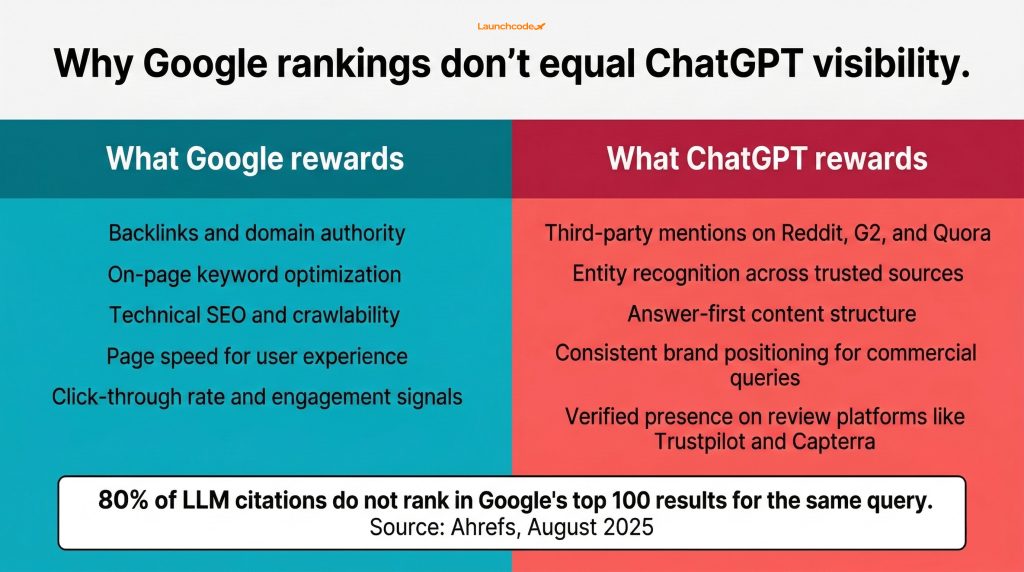
If you are waiting for your Google SEO investment to translate into ChatGPT visibility, the data says it will not. Ahrefs research from August 2025 found that 80% of LLM citations do not rank in Google’s top 100 results for the same query. The signals that drive Google rankings and the signals that drive AI mentions operate on entirely separate logic.
Google rewards links, on-page optimization, and technical performance. AI systems reward verifiable entity authority. ChatGPT is not crawling your site and checking your H1 tags. It is drawing on everything it knows about your brand across the entire web. That includes third-party platforms, community forums, review sites, industry publications, and every place your brand does or does not appear.
AI systems build a picture of your brand as an entity, similar to a profile in a knowledge graph. The more consistent, specific, and widely verified that profile is across trusted sources, the more confidently an AI system will surface your brand in relevant responses.
If your brand exists primarily on your own website with limited presence elsewhere, that profile is thin. A competitor with identical products but active presence on G2, Reddit, Wikipedia, and industry review platforms will appear far more credible to an AI system, even if your Google rankings are stronger.
Not all queries carry equal weight for brand visibility. BrightEdge research from 2025 found that commercial intent language drives 4 to 8 times higher brand mentions in ChatGPT than informational queries. Buyers asking “what is the best CRM for a 50-person B2B team” trigger brand mentions at a far higher rate than someone searching for a definition or how-to answer.
If your content and positioning do not map clearly to commercial buying questions in your category, you are invisible exactly when buyers are ready to act.
ChatGPT does not rank brands. It surfaces the brands its model associates most strongly with a given topic, problem, or category. That association is built from training data and live web signals. Brands that appear frequently, consistently, and in credible third-party sources get reinforced. Brands that appear only on their own site do not.
The mechanism is not algorithmic in the way Google’s ranking system is. It is closer to reputation. The AI is asking, in effect: which brand does the credible internet think is relevant here?
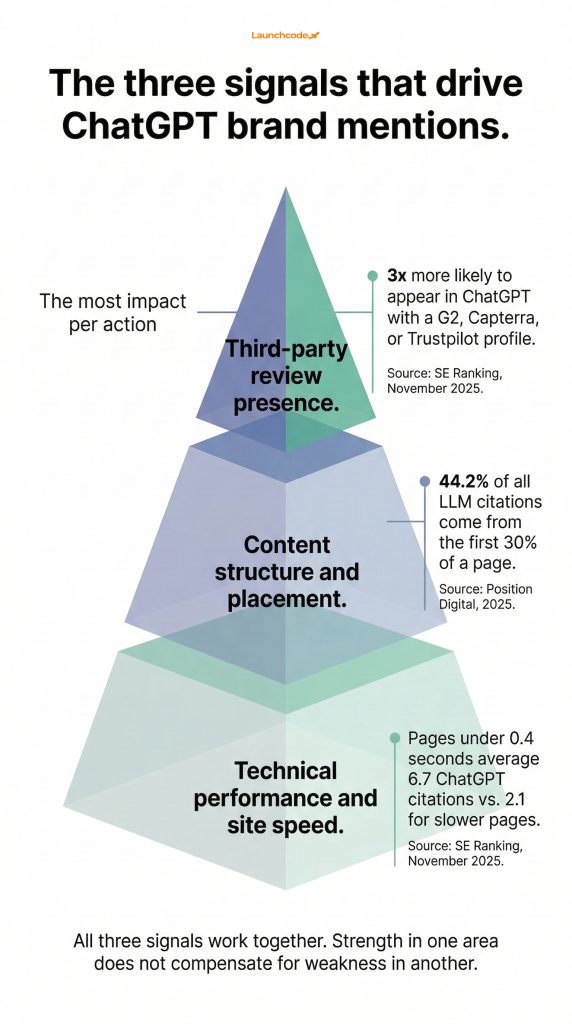
Research from SE Ranking and BrightEdge identifies three primary signal types that consistently correlate with AI mentions.
Rand Fishkin and Patrick O’Donnell at SparkToro published research in January 2026 showing there is less than a 1 in 100 chance that ChatGPT will produce the same list of brand recommendations if asked the same query 100 times. There is no fixed position to hold.
The goal is not to rank. The goal is to appear consistently across a wide range of relevant queries. Fishkin describes this as “visibility percentage,” the share of times a brand appears across many runs of a given prompt type. Brands that build broad entity authority appear more often. Brands that optimize for a single keyword-style query appear rarely and unpredictably.
“Most teams we work with assume their Google rankings are doing work in AI search. They are usually surprised to find they have near zero visibility in ChatGPT for their core buying queries. The two systems are genuinely separate problems.”
Tanner Medina, Co-Founder and Chief Growth Officer, LaunchCodex
The brands consistently appearing in ChatGPT responses are not getting lucky. They have built wider digital footprints. They appear in the sources AI systems treat as evidence. Competitors winning in AI search have content, or are being mentioned in content, that AI models use as evidence. That content lives off your website.
Most brands focus almost entirely on their own website. They write blog posts, optimize landing pages, and build backlinks. All of that has SEO value. None of it directly builds AI visibility.
The sources AI systems weight most heavily include community platforms like Reddit and Quora, professional review platforms like G2 and Capterra, trusted publications and industry media, and reference sources like Wikipedia. If your brand is not named, discussed, and evaluated in those places, AI systems have limited evidence to draw on.
A competitor with 50 Reddit threads mentioning their product, a complete G2 profile with 40 reviews, and coverage in three industry publications has a dramatically stronger entity profile than a brand with a technically sound website and zero external presence.
Forrester data from 2025 found that 89% of B2B buyers now use generative AI as a primary source of self-guided information throughout their purchasing journey. That means your buyers are researching in ChatGPT before they visit your website, before they fill out a contact form, and before they talk to your sales team.
If ChatGPT does not know your brand well enough to surface it during that research phase, you are losing deals before the conversation starts. Semrush data confirms the conversion opportunity: AI search visitors convert at 4.4 times the rate of standard organic visitors. The buyers arriving from ChatGPT are further along in their decision. Not being there is not a neutral outcome.
The competitive gap in AI visibility is already widening. After ChatGPT’s October 2025 entity update, Profound data showed average brand visibility scores fell by 31%, with more than 85% of brands seeing decreases. The number of brand mentions per response also dropped from 6 to 7 down to 3 to 4. Fewer slots and more competition means brands that wait are entering a harder position.
The brands investing in AI visibility now are compounding that advantage. Their entity profiles are reinforced with each model update, each new review, and each community mention. That effect takes time to build, which is exactly why timing matters.
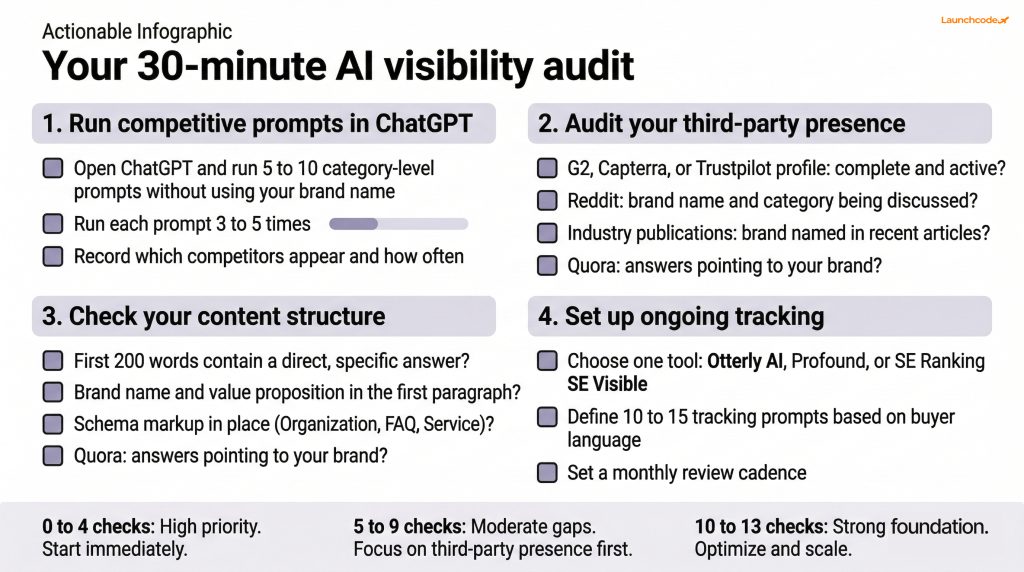
Before you build a strategy, you need a baseline. Most brands discover they have far less AI visibility than they assumed. A basic audit takes under 30 minutes and will show you exactly where your gaps are relative to competitors. No specialist tools required for the first pass.
Open ChatGPT and run five to ten prompts that reflect how your buyers describe their problems. Do not use your brand name. Use category and use-case language.
Examples:
Record which brands appear and which do not. Note whether your brand surfaces at all, how often, and in what context. Run each prompt three to five times. Due to ChatGPT’s inherent variability, a single run is not representative.
Check your current presence on the platforms AI systems weight most heavily.
For each platform, rate your presence as strong, weak, or absent.
Pick your five most important service or category pages. For each one, ask:
For structured tracking beyond the manual audit, tools like Otterly AI, Profound, and SE Ranking’s SE Visible let you monitor brand mention frequency across ChatGPT, Perplexity, and Google AI Overviews over time. These platforms track visibility scores across a set of prompts so you can measure progress as you act.
There is no single tactic that unlocks AI visibility. It is built through a combination of entity authority, off-site presence, and structured content. The brands gaining ground fastest are executing across all three areas at once. Each action below is tied to a specific signal that influences AI mention frequency.
Claim and complete your profiles on G2, Capterra, and Trustpilot. Actively request reviews from customers. SE Ranking data is clear: profiles on those platforms make you 3 times more likely to appear as a ChatGPT source. This is one of the highest-leverage actions available and most brands have not completed it.
Contribute genuine, helpful answers on Reddit and Quora in threads relevant to your category. Pitch bylined articles to industry publications. Engage with communities where your buyers already ask questions. The goal is legitimate mentions in credible third-party contexts.
A practical starting point: identify the five to ten most active Reddit communities in your category. Spend 30 minutes per week contributing useful answers. Do not pitch your brand directly. Provide real value. Brand mentions follow naturally when you are genuinely helpful.
Rewrite the opening of your key pages. Put the direct answer to the main question in the first two paragraphs. BrightEdge data shows that 44.2% of all LLM citations come from the first 30% of a page. Long setup paragraphs and buried value propositions directly reduce your citation probability.
Each page should open with: what this is, who it is for, and what outcome it delivers. Specific, short, and factual.
Add JSON-LD schema to your key pages. Start with Organization schema on your homepage, FAQ schema on content pages, and Service schema on your service pages. Structured data helps AI systems understand what your brand is, what it does, and who it serves. It is one of the clearest direct signals available.
“The brands that show up fast in AI search are almost always the ones who treated structured data as infrastructure from day one, not as a box to check later. Schema is how you tell AI systems exactly what your business does.”
Derick Do, Co-Founder and Chief Product Officer, LaunchCodex
Map your content to the specific commercial questions buyers ask at the evaluation stage. BrightEdge found commercial intent queries trigger 4 to 8 times more brand mentions than informational queries. If your content is primarily educational but not aligned to purchase-stage questions, you are missing the highest-value visibility window.
Build dedicated pages or content that directly answers queries like “best [category] for [use case]” and “how to choose a [your type of service] provider.”
AI visibility is not a technical SEO project with a clean finish line. It is a brand authority project with technical components. The brands that appear consistently in ChatGPT responses have invested in being verifiable, useful, and present across the places buyers actually look.
Neil Patel framed it clearly at MartechNEXT 2025: “Build a brand. That’s the only real moat left. Products can be copied. Campaigns can be cloned. Tech stacks are accessible. But your brand? That’s yours.”
That principle applies directly to AI visibility. A widely-cited brand is harder to displace in AI responses than any single optimized page. The work compounds over time.
AI search traffic across tracked properties grew 527% year-over-year in the first five months of 2025. ChatGPT sent 243.8 million visits to websites in April 2025 alone, a 98% increase from January of the same year. Brands building entity authority now will own a larger share of that traffic as it continues to scale.
The audit framework in this article gives you a starting point. The five actions give you a clear direction. If you want a structured approach to identifying and closing your specific visibility gap, the LaunchCodex SEO and GEO team builds and executes these strategies end-to-end for brands that cannot afford to keep losing ground.
Not directly. Ahrefs found that 80% of LLM citations do not rank in Google’s top 100 results for the same query. Google rankings and AI visibility are driven by different signals. You need to build for both separately.
As of late 2025, ChatGPT surfaces 3 to 4 brand mentions per response on average, down from 6 to 7 before the October 2025 entity update. Competition for those slots is increasing.
Start with G2, Capterra, or Trustpilot depending on your category, then Reddit and Quora. SE Ranking data shows review platform profiles make you 3 times more likely to appear as a ChatGPT source. Reddit and Quora mention volume correlates with a 4 times higher citation chance.
Run manual prompts in ChatGPT using category and use-case language, not your brand name. For structured ongoing tracking, tools like Otterly AI, Profound, and SE Ranking’s SE Visible monitor brand mention frequency across multiple AI platforms with historical data.
Brands that start with strong entity infrastructure, active review platforms, and well-structured content can see early visibility improvements within 90 days. Full compounding effect from community presence and third-party citations builds over 6 to 12 months.
No. GEO, or generative engine optimization, targets AI-generated answers across platforms like ChatGPT, Perplexity, and Google AI Overviews. SEO targets traditional search engine rankings. The underlying signals, content structures, and distribution channels are meaningfully different, though some technical foundations overlap.


Real stories from the people we’ve partnered with to modernize and grow their marketing.