
Share:

AI marketing & automation


Most marketing budgets still depend on rented reach, whether that means Meta, Google, or another platform charging for every impression. You pay for access to an audience, and the moment you stop paying, that audience disappears. Ad costs keep rising, targeting keeps getting less precise, and every algorithm change can undo months of work. A first-party data strategy fixes this by keeping the relationship, and the data behind it, with you instead of a platform.
This guide covers what actually changed with third-party cookies in 2026, why first-party data matters even more now, and how to build a strategy sized for a small or mid-market team instead of an enterprise budget. By the end, you will have a clear starting point, whether that is your email list, your website, or your CRM.
Third-party cookies did not disappear in 2026. Google reversed its removal plan on April 22, 2025, kept cookies on by default in Chrome, then shut down most of its Privacy Sandbox replacement technology on October 17, 2025. Safari, Firefox, and Brave still block third-party cookies by default though, which means roughly 17 to 20 percent of global web traffic was already cookieless before Chrome made any decision at all.
Most first-party data guides published before 2025 still open with the same warning, that third-party cookies are about to disappear. That framing is out of date now, and repeating it signals a source has not kept up with what actually happened.
Here is where the major browsers stand today:
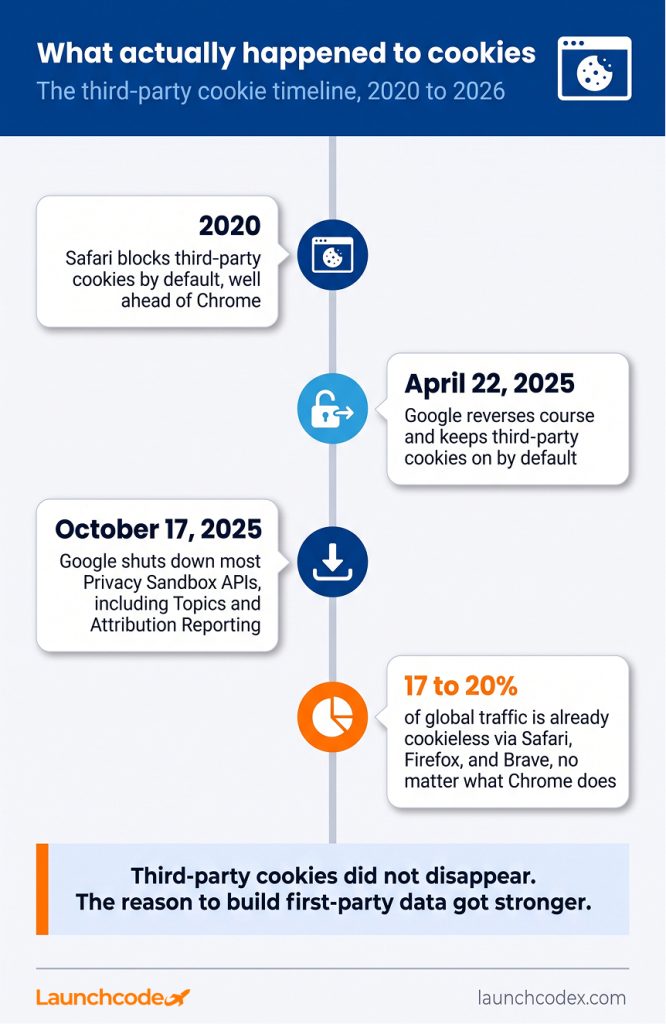
According to a detailed breakdown of the 2026 cookie landscape, only a few Privacy Sandbox pieces, CHIPS, FedCM, and Private State Tokens, survived the wind-down. Consent requirements under GDPR and CCPA still apply no matter what any single browser decides.
The real driver behind signal loss in 2026 is not Chrome. It is default blocking in Safari and Firefox, AI-powered search reducing referral data, and privacy regulation that keeps tightening regardless of browser policy. A first-party data strategy built on the correct 2026 facts holds up. One built on a myth does not.
“I still see teams open pitch decks with a cookie deprecation slide from 2019. It costs them credibility the moment a marketing lead in the room already knows Chrome backed off that plan.” Tanner Medina, Co-Founder and Chief Growth Officer
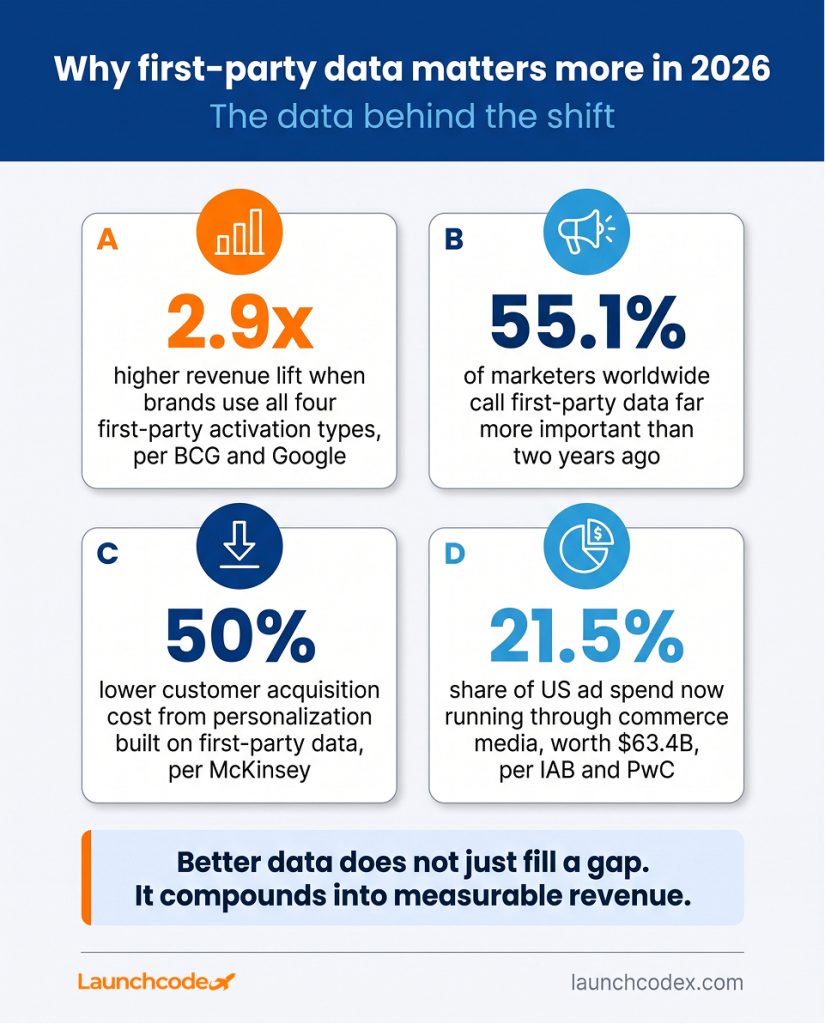
First-party data matters more in 2026 because AI systems, rising acquisition costs, and default cookie blocking in Safari and Firefox all reward brands with direct customer signal. Fifty five percent of marketers worldwide now call first-party data far more important than two years ago, and personalization built on it can cut customer acquisition costs by up to fifty percent.
EMarketer’s most recent survey data puts that figure at 55.1 percent, and a related EMarketer benchmark shows 70 percent of B2B marketers are increasing their investment in it.
LiveRamp CEO Scott Howe told an audience at RampUp 2026 that “data is power and those that control the data will win”. His point was that public AI models increasingly train on the same shared web data, so any edge that data alone provides keeps shrinking. Lauren Griewski, who leads Chase Media Solutions at JPMorganChase, made a related point at the same event. She argued that AI decisions are only as reliable as the signals behind them, and that a verified transaction beats a click or a modeled guess every time.
“Clean, first-party data is what separates an AI system that actually understands your customers from one that is guessing with borrowed information.” Derick Do, Co-Founder and Chief Product Officer
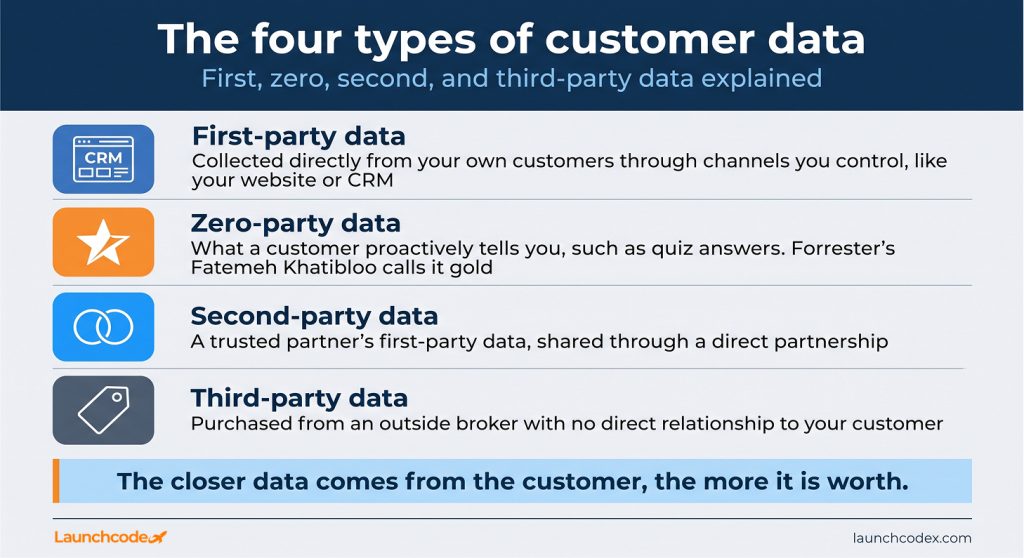
First-party data is anything you collect directly from your own customers through channels you control, like your website, app, or CRM. Zero-party data is what a customer proactively tells you, such as quiz answers or stated preferences. Second-party data comes from a trusted partner’s first-party data. Third-party data is purchased from a broker with no direct relationship to your customer at all.
| Data type | Who collects it | How it is obtained | Best use |
|---|---|---|---|
| First-party | Your business | Direct interactions on owned channels | Personalizing and retargeting your own customers |
| Zero-party | Your business | Customer states it proactively | High-accuracy segmentation |
| Second-party | A trusted partner | Shared through a direct partnership | Filling gaps without buying broad data |
| Third-party | An outside broker | Aggregated from unrelated sources | Reach and scale, lowest accuracy |
Forrester coined the term zero-party data in 2018, according to TechTarget’s explainer on the term’s origin. Fatemeh Khatibloo, Forrester’s VP principal analyst, called it “gold” in comments reported by theCustomer, because a brand does not have to guess at intent a customer already stated outright.
Building a first-party data strategy starts with auditing what you already collect, not buying new software. Unify your CRM, website, and email data into one view first, add a clear consent process, then decide whether a lightweight customer data platform or a full enterprise CDP actually fits your team’s size and budget.
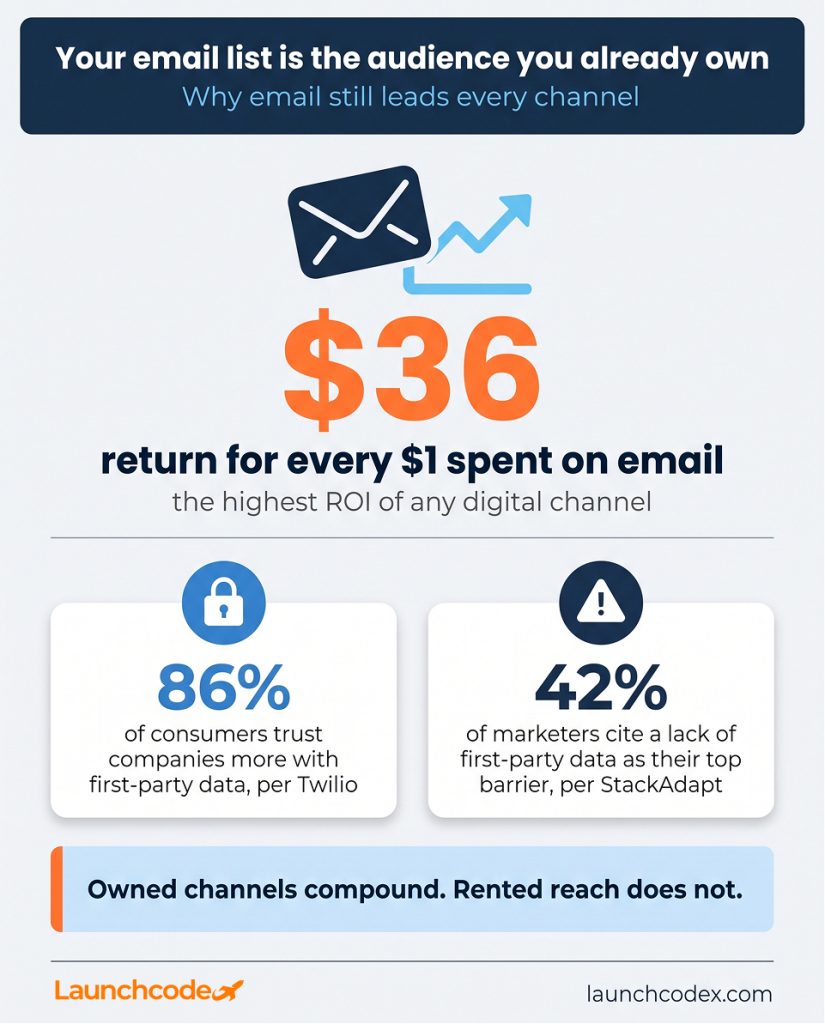
Salesforce’s State of Marketing report found only 31 percent of marketers feel fully satisfied with their data unification, which is usually a process problem, not a tooling problem. Separately, research StackAdapt ran with Ad Age found 42 percent of marketers say a lack of first-party data is the top reason they are not using it, often because step one, the audit, never happened.
“Most of the stalled projects I review are not tooling problems. A team collects data with no plan for where it flows next, then wonders why nothing changed.” Tanner Medina, Co-Founder and Chief Growth Officer
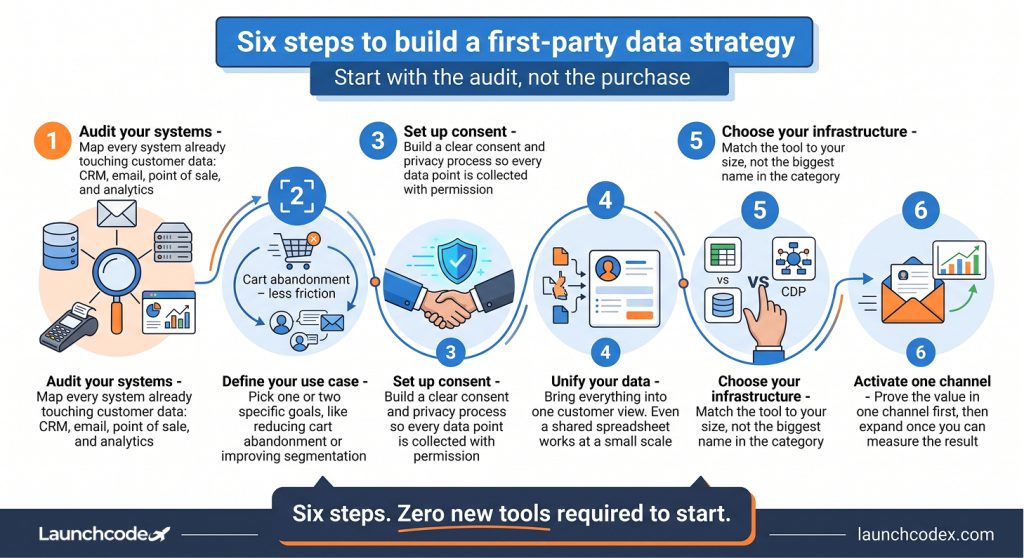
| Option | Who it fits | Key strength | Watch out for |
|---|---|---|---|
| CRM plus spreadsheets | Small teams, under 10,000 contacts | Fast to set up, no new cost | Manual upkeep, breaks at scale |
| Lightweight CDP | Growing mid-market teams | Automates unification across tools | Still needs clean source data going in |
| Enterprise CDP | Large, multi-brand organizations | Deepest identity resolution and governance | Longest implementation, highest cost |
We see this exact pattern during client onboarding. Spreadsheets full of duplicate and outdated records need cleanup before any new platform makes sense.
Your email list is the clearest example of an audience you own. Email marketing returns roughly 36 dollars for every 1 dollar spent, the highest return of any digital channel, and it is one of the only channels not controlled by a platform algorithm. Growing that list with real permission, not purchased contacts, is the fastest way to build a durable, first-party audience.
Recent email benchmark data puts the average return at 36 dollars for every dollar spent, well ahead of paid social or paid search.
Ask for a little information at a time instead of demanding everything upfront. A short preference question at checkout, instead of a long signup form, can grow your zero-party data set without adding friction to the purchase. Each small answer adds to a richer profile over time, without a single high-friction moment that scares off a new subscriber.
A loyalty program only produces useful data if it rewards more than price sensitivity. Programs built around early access, recognition, or community membership tend to attract more engaged, higher-value customers than programs built purely on discounts.
Most first-party data strategies fail at the infrastructure layer, not the strategy layer. Without server-side tracking and a proper consent setup, data collection breaks silently every time a browser update, ad blocker, or cookie restriction hits your site, and you will not see the gap until your numbers stop making sense.
At Launchcodex, we rebuilt a nonprofit client’s donation tracking using a server-side pipeline that forwards payment events directly from Stripe to GA4 through the Measurement Protocol, instead of relying on browser-based pixels that ad blockers and cookie restrictions routinely strip out. That kind of first-party, server-side capture is what keeps data reliable even as browser rules keep shifting.
“We only found the gap because the donation numbers stopped adding up. Once we moved that data server side, the reporting matched reality again.” Derick Do, Co-Founder and Chief Product Officer
Build your consent process around GDPR, CCPA, and CPRA requirements from the start, not as an afterthought once a regulator asks. Twilio’s consumer trust research found 86 percent of consumers trust companies more when they rely mainly on first-party data instead of third-party sources. A clear, well-explained consent process builds that trust, on top of meeting the legal requirement.
This is the same consent-first approach we build into every tracking setup we deliver for clients.
Start with the audit, not the purchase. In the first 30 days, map every system already touching customer data and fix your consent setup. In the next 30, unify what you have into one usable view, even a well-organized spreadsheet counts at a small scale. In the final 30, pick one channel, most often email, and prove the value with a real activation before you expand further.
The brands that come out ahead in 2026 are not the ones with the biggest ad budgets. They are the ones that built an audience they own before they needed it. The facts about third-party cookies changed. The reason to build a first-party data strategy did not go away, it got stronger.
Yes. Safari, Firefox, and Brave already block them by default, and AI systems and rising ad costs reward brands with direct customer signal regardless of what Chrome decided.
First-party data comes from observing customer behavior on channels you own. Zero-party data is information the customer tells you directly, like a stated preference or a quiz answer.
No. Start by unifying what you already have in your CRM and email platform. A CDP becomes worth it once manual unification stops scaling.
Your email list. It is usually your largest existing owned audience, and growing it with real permission pays off through the highest ROI of any digital channel.
Most teams see early wins in email segmentation or on-site personalization within a few months. Compounding value, like cleaner signal for AI systems, builds over a longer stretch.


Real stories from the people we’ve partnered with to modernize and grow their marketing.